Bathroom and Laundry Organization Guide for São Paulo
The two rooms where damp decides what can be stored. What belongs in each, what has to leave on an expiry date, and how laundry circulates through the home. By Silvana Santanna, certified personal organizer.
Neste guia você verá:
- 01Why these two rooms follow their own rules
- 02What belongs in each one
- 03The medicine cabinet does not belong in the bathroom
- 04Expiry and disposal: how these rooms empty
- 05Damp and mould in a São Paulo apartment
- 06The laundry flow
- 07How the professional process works
- 08When hiring is worth it
- 09Posts by topic
- 10Frequently asked questions
The bathroom and the laundry are the two wet rooms of the home, and that makes them the only ones where damp, not floor area, decides what can be stored. In every other room a misplaced item just gets in the way. Here it spoils.
This guide treats them together because they share the same three rules: what damp allows you to keep, what has to leave on an expiry date, and the path dirty laundry takes between them. It covers what belongs in each room, what migrated into the wrong one, mould control in a São Paulo apartment, and the routine that keeps both working afterwards.
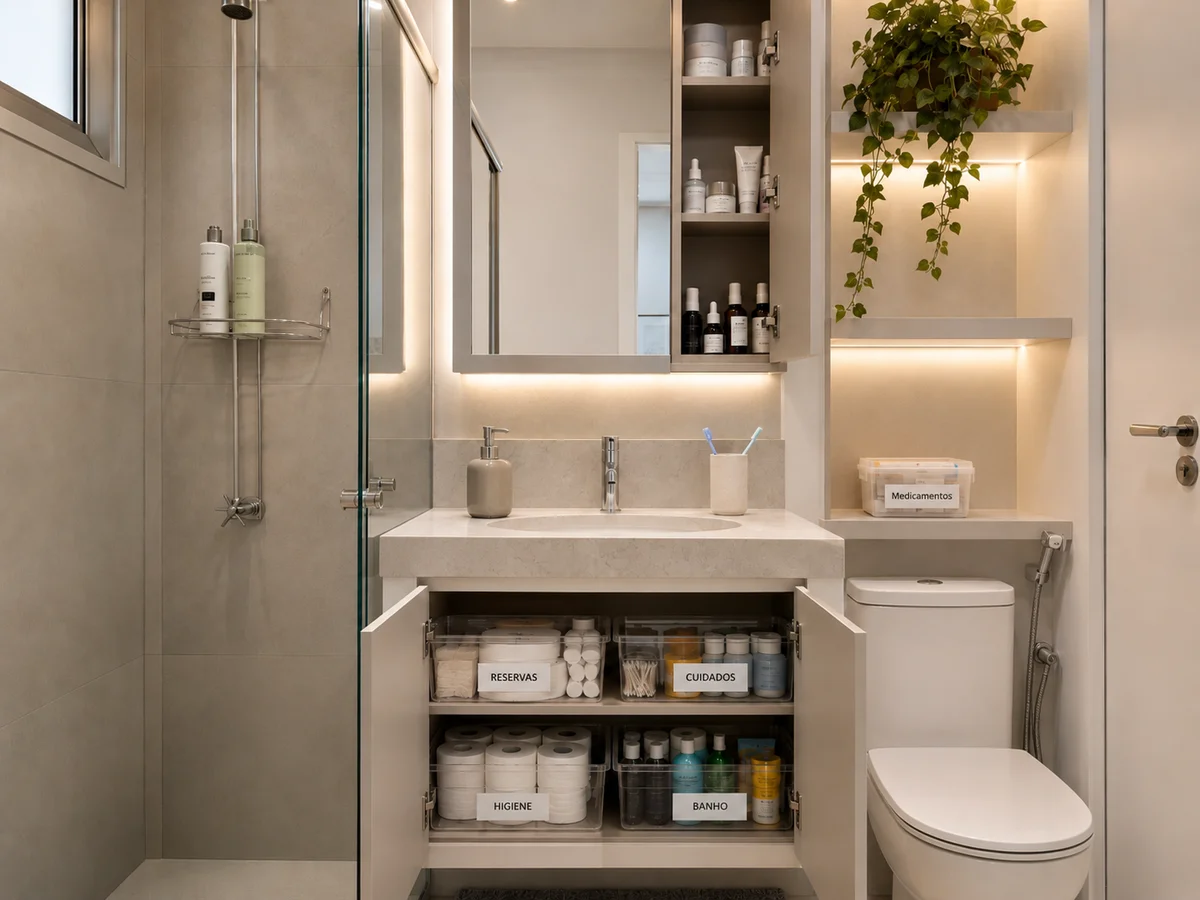
Why do the bathroom and laundry follow their own rules?
Because damp imposes a filter the other rooms do not have: paper, cardboard, spare fabric and medicine do not survive well there. And because they are the only two rooms that hold consumable stock, from soap to fabric softener, so the volume grows on its own without anyone deciding to buy a thing.
The cycle repeats on projects. The bathroom drawer takes in the hotel sample, the pharmacy freebie and the cosmetic bought on offer. The laundry shelf takes in the refill that happened to be cheap. None of those items was chosen at home, and none has a defined leaving date. A year later the space is gone and nobody can name what came in.
The two problems that exist only here
- Deterioration by environment: labels that peel, cardboard that warps, fabric stored still damp that goes mouldy, tablets that lose potency before the printed date
- Stock with no ceiling: both rooms take consumable restocking, and without a physical limit per category the next purchase happens before the previous item runs out
The floor area of a São Paulo apartment makes both worse. A bathroom of three or four square metres holds no stock, and a laundry tucked into a hallway or balcony holds nothing beyond what serves washing. When the stock has no other address in the home, it occupies the only available cabinet, which happens to be the worst place to keep it.
What belongs in each of the two rooms?
The bathroom holds this week's consumption only: daily hygiene, what is in use, and the towel in rotation. The laundry holds what serves washing, drying and ironing, plus the cleaning products used every week. Everything else, including restocking, paper, medicine and bed linen, lives outside both, in a dry room.
The question that settles most doubts: what happens to this item after six months in here? Spare toilet paper copes. An appliance box does not. Manuals and invoices, shelved in the laundry because there was room, come out yellowed and sometimes unreadable.
- Bathroom: daily hygiene in use, one towel per person in rotation, immediate toilet paper backup and a fast-access first aid kit
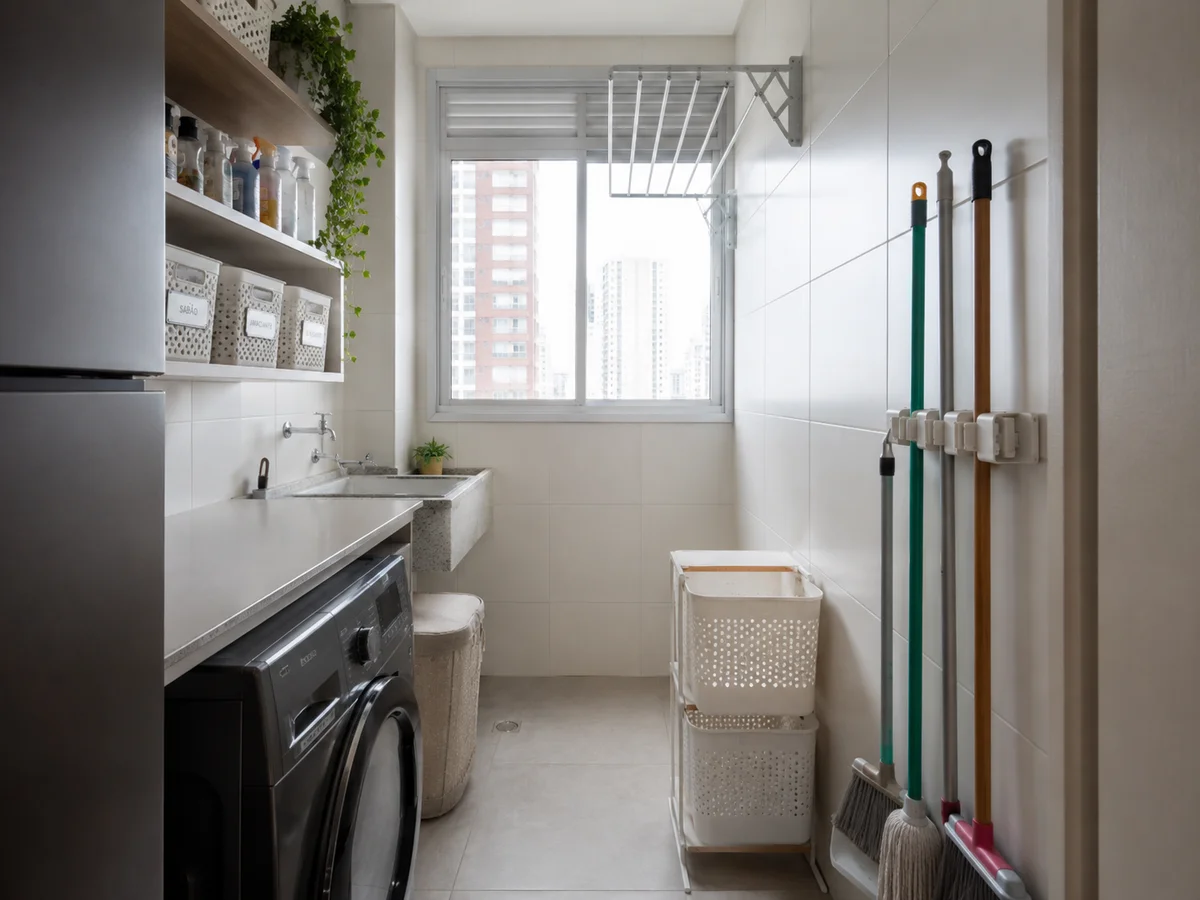
- Laundry: detergent, softener, bleach, iron and board, sorting basket, and the cleaning products used every week
- Outside both: restocking, long-term medication, spare bed and bath linen, paper, documents, manuals and tools
- Never in either: appliance cardboard boxes, which warp, draw damp and shelter insects
The zone-by-zone breakdown of each room sits in the posts this guide gathers: the complete five-zone bathroom system and the four zones of a small laundry room, with organizers and vertical space.
Why does the medicine cabinet not belong in the bathroom?
Because heat and steam degrade active ingredients. The bathroom concentrates both conditions several times a day, and the medicine loses effectiveness before the date printed on the box. The right place is dry, cool and out of children's reach: a high bedroom shelf, a chest of drawers, or a kitchen cupboard away from the stove.
This is the hardest habit to change on projects, because the mirror cabinet exists for that purpose in almost everyone's mind. The name of the furniture carries the custom, and the custom crossed generations without ever being checked.
The system that works sorts by frequency, not by ailment. Long-term medication stays together and visible, because it has to be taken every day. Occasional medication sits behind it. A finished prescription leaves the house. The sorting criteria, the expiry check and the kit itself are detailed in the post on how to organize the medicine cabinet.
Expiry and disposal: how do these rooms empty?
The bathroom and laundry are the only rooms where sorting has an objective criterion: the expiry date decides on its own. Expired medicine goes to a pharmacy collection point, not the household bin. An opened cosmetic has its own clock, counted from the day it was opened. Expired cleaning product loses its action and holds a shelf without doing a job.
The two rooms part company with every other one in the house at this point. In a closet, deciding what leaves is an emotional decision and it takes time. In the bathroom, the label answers. That is why sorting these two is usually the fastest part of a whole project, and also the part that frees the most space in the first hour.
The three dates nobody checks
- Opened cosmetics: the clock starts at opening, and the open-jar symbol on the label states how many months the product holds from then on
- Sunscreen and treatment products: they lose effectiveness with heat and time, and a bottle kept in the bathroom crosses a temperature swing twice a day
- Cleaning products: bleach and disinfectant lose their action over time, so stock bought in bulk delivers less than the saving suggested
That point shows up in the laundry more than anywhere else. Buying in volume looks like a saving and turns into waste when the product expires on the shelf. The post on organizing cleaning products details how to set the ceiling per category and the restocking point.
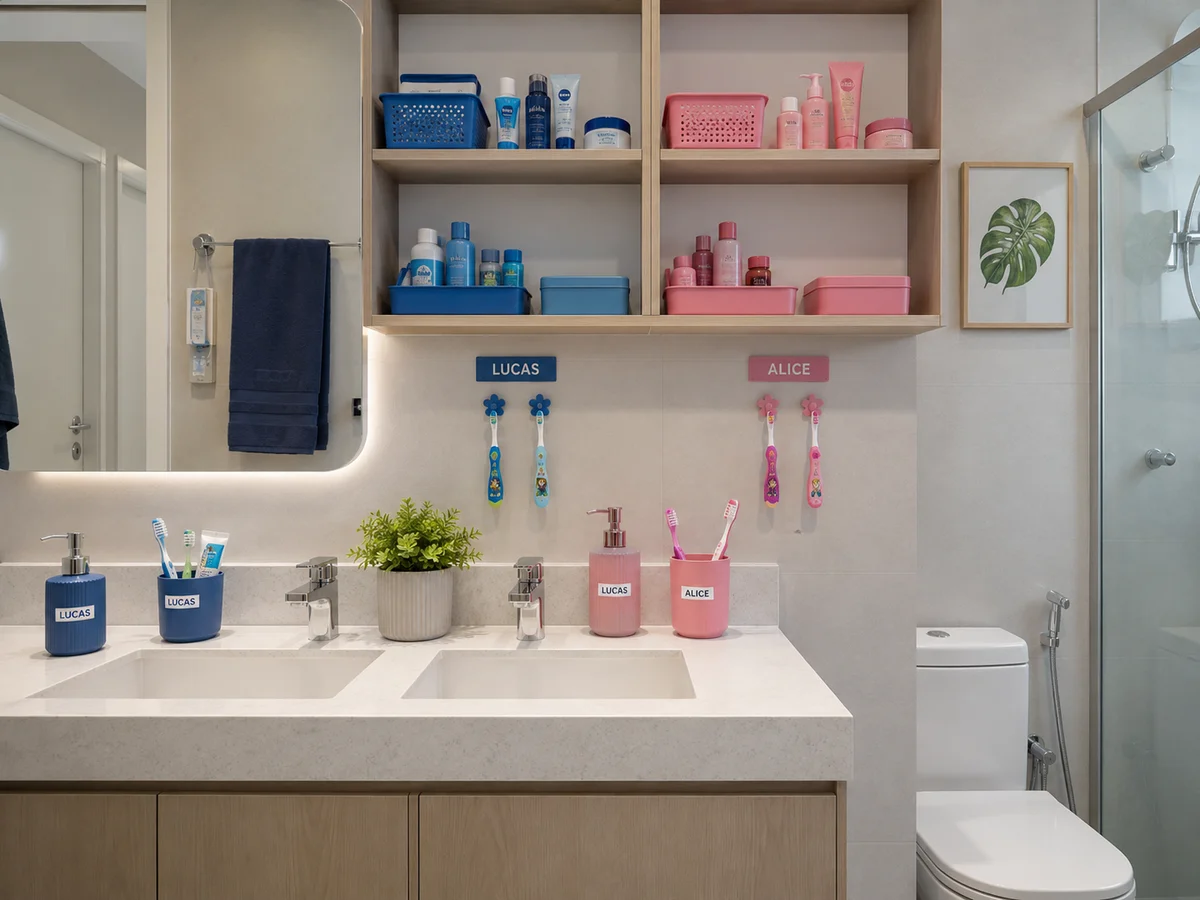
A bathroom and laundry with no room for daily use: the on-site assessment maps the real stock before any decision about organizers.
Request an assessment →How do you control damp and mould in a São Paulo apartment?
Keep relative humidity below 60% and dry any wet area within 48 hours. In apartment practice: run the extractor during the shower and for another 20 to 30 minutes afterwards, leave the door open outside usage hours, and keep no closed cabinet against the shower wall. A damp towel hanging inside a closed bathroom sustains the problem all day.
Damp is the factor that separates organizing these two rooms from organizing any other. A handsome system built on a mouldy wall lasts a few weeks: the problem returns and passes to whatever is stored there. Treating the wall comes before installing any shelf.
What changes inside the cabinet
- Open or ventilated containers instead of sealed boxes, so air moves between the stored items
- No fabric put away still damp, which is the most common source of the smell nobody can trace
- High shelves for what fears damp and low ones for what resists it, because steam rises and gathers at the top of the room
- A seasonal review at the turn of the São Paulo summer, when rain and heat together push humidity up inside the cabinets
How do you organize the laundry flow?
The basket goes where clothes come off the body, usually the bedroom or the bathroom, not the laundry room. A basket far from the changing point produces the pile on the bedroom chair. Sorting by wash type happens at the laundry entrance, and clean clothes return folded in a single trip, with no intermediate stop on the sofa.
Laundry is the only flow that crosses three rooms in sequence, which is why it breaks in three different places. It leaves the bedroom, passes through the bathroom, reaches the laundry and makes the trip back. When one of those points has no defined address, the pile forms in the same spot every time.
The three points that stall
- Exit: the basket sits far from where clothes come off. The pile on the bedroom chair is a symptom of distance, not of carelessness
- Sorting: one basket for everything pushes the separation to wash time, which is exactly when time is short. Two compartments fix it, one light and one dark
- Return: clean laundry stops in the living room and reaches the bedroom over several trips. The rule is fold in the laundry and carry once
A basket in the bathroom has to be ventilated, never lidded. Damp towels and gym clothes inside a closed container, in a room that is already damp, is the combination that produces a smell within hours. The storage system for clean linen, with folding and rotation, is in the post on bed, bath and table linens.
How does the professional process work in these two rooms?
The process runs the same four stages as any other room: assessment, sorting, implementation and upkeep. The difference is speed. Sorting has an objective criterion, so the volume leaves fast, and much of the project time goes into deciding where the stock will live outside both rooms.
- Assessment: mapping the damp points, the stock scattered across the home, and how many people share each bathroom
- Sorting: checking expiry item by item, with a destination defined for expired medicine, out-of-date opened cosmetics and cleaning products past their action
- Implementation: zones by frequency of use, containers that let air move, legible labelling, and relocating the stock to a dry room
- Upkeep: a ceiling per category for restocking, an expiry review at a defined interval, and the short end-of-day routine that keeps the counter clear
What leaves these two rooms impresses more by how much of it has expired than by how large it is. Hotel samples kept for years, sunscreen from two summers ago, medication from a finished course and refills bought twice fill most of the cabinet on the majority of projects.
How long it takes
Bathroom and laundry together are usually finished in one day. Three or more bathrooms, or stock scattered across several rooms, take the work to two days. In a compact apartment the stage that sets the schedule is not the organizing itself: it is finding the new address for the stock that has to leave. The assessment sets the schedule before the work starts.
When is hiring worth it, and when can you do it yourself?
These two rooms are the ones people most often solve alone, because sorting by expiry does not stall on emotional decisions. An afternoon and a disposal bag usually cover it. What does not get solved alone is whatever depends on another room of the house.
You can probably handle it yourself when
- The irritation is a build-up of expired items and label-by-label sorting covers it in one afternoon
- There is dry space available elsewhere in the home to take the stock leaving these two rooms
- There is no mould on the walls and no persistent smell returning after cleaning
It is worth calling a professional when
- The stock has nowhere to go, because the whole home is already at its limit and the problem stopped being the bathroom
- Mould returns within weeks of every cleaning, a sign that ventilation and storage need redesigning together
- Three or more people share one bathroom and no shelf arrangement sustains the division
- The laundry became the dumping ground for everything without an address, including paper, tools and empty boxes
- The dirty pile and the clean pile share the same spot and the washing routine never closes within the week
- The apartment is compact and the laundry shares a function with the balcony or kitchen, with no defined separation between them
None of these signals points to carelessness about the home. They point to the two smallest rooms absorbing the overflow from the larger ones. Once the stock finds an address of its own in a dry room, the bathroom and laundry go back to fitting what they do, which is daily hygiene and the laundry cycle.
Posts by bathroom and laundry topic
Each post goes deeper into one topic from this guide, with method, real examples from projects in São Paulo and practical guidance.
Frequently asked questions about an organized bathroom and laundry
Why do the bathroom and laundry fall out of order differently from the rest of the home?
Because in both rooms damp, not available space, decides what can be stored. In other rooms a misplaced item is simply in the wrong place. In the bathroom and the laundry it spoils: labels peel, cardboard warps, medicine loses potency, fabric put away still damp goes mouldy. They are also the only two rooms that hold consumable stock, so the volume grows even when nobody buys anything on impulse.
Can you keep medicine in the bathroom cabinet?
It is not the right place. The FDA notes that improper storage, such as a damp bathroom cabinet, contributes to reduced effectiveness in medicines that have not even reached their printed expiration date. A bathroom concentrates heat and steam several times a day, exactly the two conditions that degrade active ingredients. The right spot is dry, cool and out of children's reach: a high bedroom shelf, a chest of drawers, or a kitchen cupboard away from the stove.
How do you control damp and mould in a bathroom with no window?
The EPA recommends keeping relative humidity below 60%, ideally between 30% and 50%, and drying any wet area within 24 to 48 hours, because within that window mould generally does not take hold. In a windowless bathroom that means running the extractor during the shower and for another 20 to 30 minutes afterwards, leaving the door open outside usage hours, and avoiding a closed cabinet against the shower wall. A damp towel hanging inside a closed bathroom sustains the problem all day.
What do you do with expired medicine in Brazil?
Take it to a collection point at a pharmacy. Decree 10.388/2020 established the reverse logistics system for expired or unused household medicines, and pharmacies and drugstores are the ones that install and maintain those collection points until the waste is picked up. Household bins and the toilet are both out: each sends active ingredients into soil and water. The packaging goes in with the disposal.
What should never be stored in the laundry room?
Nothing made of paper or cardboard, and no spare linen. The laundry holds what serves washing, drying and ironing, plus the cleaning products used every week. Cardboard boxes warp, documents and manuals yellow, and bed linen stored there takes on the smell of the room. The most common mistake in a compact apartment is letting the laundry become the dumping ground for everything without an address, because it is the only room guests never see.
Where should the laundry basket go in a small apartment?
Where clothes come off the body, which in most apartments is the bedroom or the bathroom, not the laundry room. A basket far from the changing point produces the pile on the bedroom chair. If the basket lives in the bathroom it has to be ventilated and never lidded, because damp clothing in a closed container inside a damp room is the most common source of the smell nobody can trace.
How long does professional bathroom and laundry organization take?
Both rooms together are usually finished in one day, because the volume is smaller than a closet or kitchen and the sorting is fast: an expiry date decides on its own. With three or more bathrooms, or with product and cosmetic stock scattered across several rooms, the work runs to two days. The on-site assessment sets the schedule before the work starts.

About the author
Silvana Santanna →Personal Organizer in São Paulo, specialized in residential move organization and functional organizing projects for homes, closets, kitchens, trousseaux and home offices. Creator of the Casa Pronta™ Method, with more than 100 projects completed across São Paulo and the greater metro area.
The two smallest rooms
back to doing their job.
An on-site assessment to map the damp points and the real stock before any decision.