Organization for the mind: why clutter tires the brain
A disorganized home weighs on your head before it weighs on your schedule. Before the aesthetic result, organizing works on the mental load of daily life. That is the focus of the Silvana Organizer method.
Neste guia você verá:
You open your front door after a long day and feel an extra tiredness before you even take off your shoes. It is not in your head. The brain reads clutter as unfinished work, and unfinished work does not let anyone rest.
Most people treat organizing as a matter of aesthetics: making the home look nice. In practice, what changes first is not the photo of the room. It is how much your mind works just to manage what is out of place. That is what this page is about.
What clutter does to the mind
The relationship between environment and mental state is not poetic, it is measured. Three lines of research explain why clutter weighs, gathered in the article on what science says about disorganization and the brain.
Clutter steals attention
A 2011 study from the Princeton Neuroscience Institute showed that visual clutter competes for attention within the cortex. The more stimuli compete for your field of view, the less capacity is left for the task you actually want to do. The brain spends energy processing what does not matter. A desk covered in things is not just unsightly: it splits your attention all the time.
Clutter and stress go together
Researchers at the University of California (UCLA) followed families at home and found a link between describing your own home as disorganized and worse cortisol patterns, the stress hormone, throughout the day, plus a heavier mood in the late afternoon. A home that feels like a to-do list does not switch off when you do.
Clutter affects satisfaction with home
Environmental psychology studies, such as those by Catherine Roster (2016) and Joseph Ferrari, link clutter to a lower sense of wellbeing and belonging at home, and to lower life satisfaction. The more things without a place, the less your home works as the place where you recharge.
Why organizing your home is not just aesthetics
Traditional organizing stops at the delivery photo: the room looks beautiful on the day and returns to chaos within a few weeks. The problem is that aesthetics does not reduce mental load on its own. A beautiful closet with no use logic still makes you decide and search every day.
Organization for the mind flips the order of priorities. The beautiful result still exists, but it is a consequence, not the goal. The goal is to reduce the invisible effort: how many decisions your home demands per day, how many stimuli compete for your attention, how much time you lose looking for what should be within reach.
An honest note: organizing is not health treatment. For anxiety or mental health concerns, the support of a health professional is irreplaceable. What organizing the environment does is remove a concrete, daily source of overload. Within what the environment can reach, the relief is real.
How the method works on mental load
Reducing mental load is not an abstract promise. These are concrete organizing decisions, applied room by room.
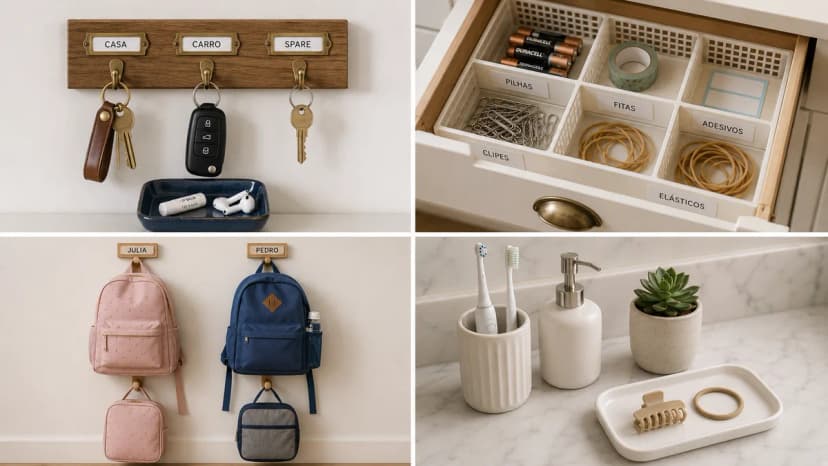
- Fewer decisions per day: every item gets a place defined by use logic. You stop deciding where to store and where to look each time.
- Return in seconds: what you use every day stays within immediate reach. What you barely use moves out of the way. The home stops demanding attention with every gesture.
- Fewer visual stimuli: clear surfaces and clear categories reduce the noise competing for your attention at home.
- A system the family maintains: the logic is simple enough for anyone to restock without thinking. Organization does not depend on the most organized person in the house.
It all starts with a diagnosis of your routine, not a ready-made standard. How each person uses each room is what defines where each thing goes. That is why the result rests the mind of those who live there, and not only impresses those who visit.
The method is the same in any space: fewer stimuli, fewer decisions, more clarity. The assessment maps where your home weighs most today.
Request an Assessment →Who feels it most
The mental load of clutter affects everyone, but it weighs more in some routines.
- High-performance routines: those who decide all day at work have no energy left to also decide at home. Home has to be the place that rests you, not another queue of pending tasks.
- Living with anxiety or burnout: a predictable environment with fewer stimuli is concrete daily support, within what the environment can reach and without replacing health care.
- Full house, full schedule: families with children and little free time feel the difference when the home stops demanding attention every hour.
- Those who already organized and the mess came back: a sign that a system was missing, not discipline. That is exactly what the method solves.
Frequently asked questions
Does a disorganized home affect mental health?
Research in neuroscience and environmental psychology links disorganized spaces to more stimuli competing for attention, worse cortisol patterns through the day, and lower satisfaction with your own home. Clutter does not cause a diagnosis, but it increases the mental load of daily life. Organizing the environment does not replace health care: it eases part of the effort the brain makes to manage visual chaos.
Why does clutter tire the brain?
Every object out of place is one more stimulus for the brain to process. A 2011 study from the Princeton Neuroscience Institute showed that visual clutter competes for attention in the cortex and reduces focus, because the brain has to process information irrelevant to the task at hand. Fewer stimuli competing means more attention available for what matters.
What is organization for the mind?
It is Silvana Organizer’s approach that treats organizing the home as reducing mental load, not just as an aesthetic result. Each system is designed so you decide less day to day: every item with a defined place, return in seconds, fewer visual stimuli. The goal is not a home that looks good in a photo, it is a home that rests the people who live in it.
Does organizing solve anxiety?
No. Organizing is not health treatment and does not replace professional support. What organizing the environment does is reduce a concrete source of daily mental load: the amount of decisions and stimuli a disorganized home demands at every moment. For those living with anxiety or a high-pressure routine, that can be real relief, within what the environment can reach.
Why does organizing on your own usually not last?
Tidying without a method moves objects but does not create a system. Without a system, clutter returns, and with it the mental load. Professional organizing starts with a diagnosis of your routine and creates a use logic the whole house can maintain. It is the difference between a home that looks good for two weeks and a home that stays light afterward.

About the author
Silvana Santanna →Personal Organizer in São Paulo, specialized in residential move organization and functional organizing projects for homes, closets, kitchens, trousseaux and home offices. Creator of the Casa Pronta™ Method, with more than 100 projects completed across São Paulo and the greater metro area.
Related posts
How to Keep Your Home Organized When You Work Full Time
14 min · Read article →

How to Let Go of Belongings Without Guilt: 5 Practical Questions to Decide
12 min · Read article →

Personal Organizer for ADHD in São Paulo: Systems That Last
10 min · Read article →
A home that rests
your mind.
An assessment to understand where your home weighs most today and how the method can ease it.