Residential Organization Guide for São Paulo: Room by Room and by Profile
What professional residential organization includes, how the process works room by room, who it is for, and when it makes sense to hire. By Silvana Santanna, certified personal organizer in São Paulo.
Neste guia você verá:
A study from the University of California found that women who live in disorganized homes have elevated cortisol levels throughout the day. The brain reads clutter as unfinished work. And unfinished work never lets anyone rest.
The most recurring pattern in the São Paulo apartments I work in: enough space, sometimes brand-new cabinetry, no criteria at all about where each item goes when it comes back home. Renovations create structure. The usage system is left for later. That "later" never arrives on its own.
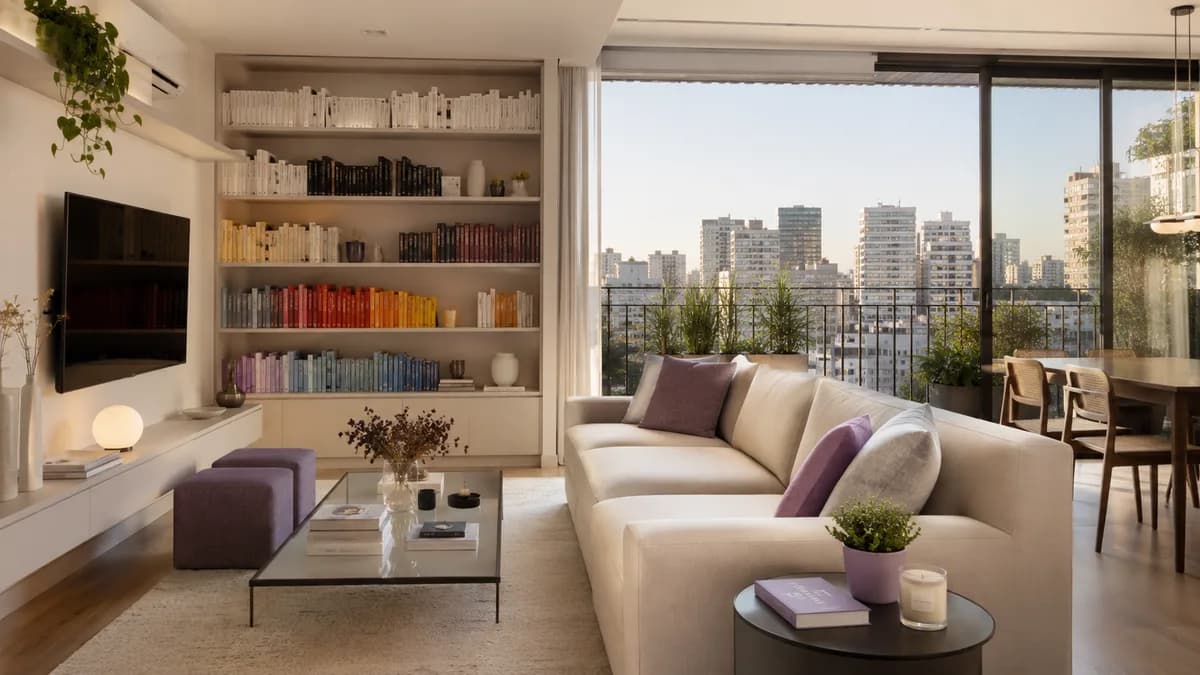
Why does organizing an apartment in São Paulo have specific challenges?
Three factors make São Paulo apartments harder to organize than average: rooms with multiple functions (office in the bedroom, laundry in the hallway), high resident turnover carrying accumulation from address to address, and cabinetry delivered without a defined usage system. In 2024, more than 81% of properties launched in São Paulo were compact, according to SECOVI, which compresses those three problems into a smaller space.
Between January and July 2023, 81.6% of the properties launched in São Paulo measured up to 45 square meters, according to data from Secovi-SP. Compact studios and apartments have become the market standard. That creates three situations generic organization guides do not cover.
Rooms with multiple functions
In apartments of 45 to 70 square meters, the office is in the bedroom. The laundry occupies the hallway. The workout station shares the living room with the sofa. Each room accumulated functions it was never planned for, with no reorganization of the physical space.
According to IBGE, nearly 6.6 million Brazilians worked from home in 2024. Many keep a permanent office inside the apartment. Most clients I work with have a home office integrated into the bedroom or living room, and both spaces stall because neither was organized for that reality.
High resident turnover
Families renting in São Paulo move frequently, and each move carries the accumulation of the previous address. After two or three moves with no real decluttering, the volume of items exceeds any new apartment. A move does not filter, it only redistributes.
Cabinetry delivered without a system
Renovations with built-in furniture create storage structure. What cabinetry does not define is the usage system: what goes where, in what order, who uses what. A planned closet with 30 hangers and no usage criteria falls apart within weeks. Structure only works when there is a system behind it.
What professional residential organization includes, room by room
Each space has specific dysfunctions. Professional organization works room by room, with a method calibrated to the volume of items, the routine of the people using the space, and the available structure.
Closet and wardrobe
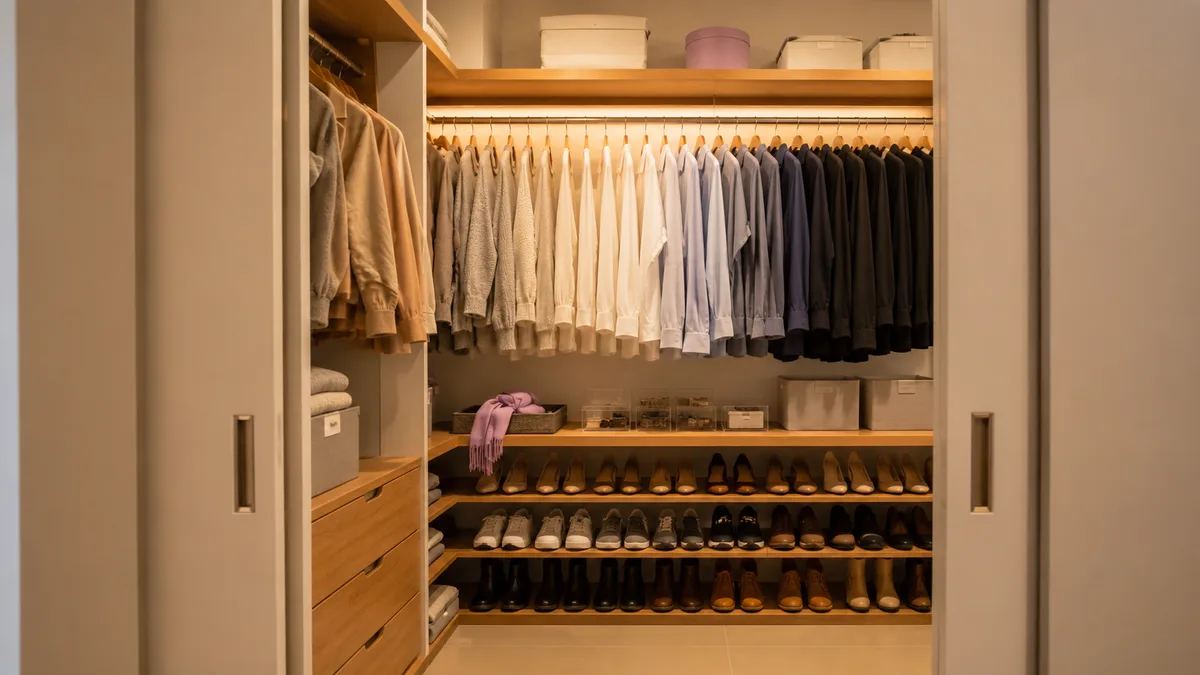
Closets of 3 to 8 square meters in São Paulo tend to accumulate clothes from two to four seasons mixed together, shoes grouped by chance rather than by frequency of use, accessories with no defined exit point, and items migrated from other rooms for lack of a destination.
Professional organization covers sorting by category and frequency, creating sections by garment type (everyday, formal, athletic, off-season), a shoe system by access, and a fixed spot for accessories. You end up knowing exactly what you own, and any piece turns up in under 30 seconds.
Kitchen and pantry
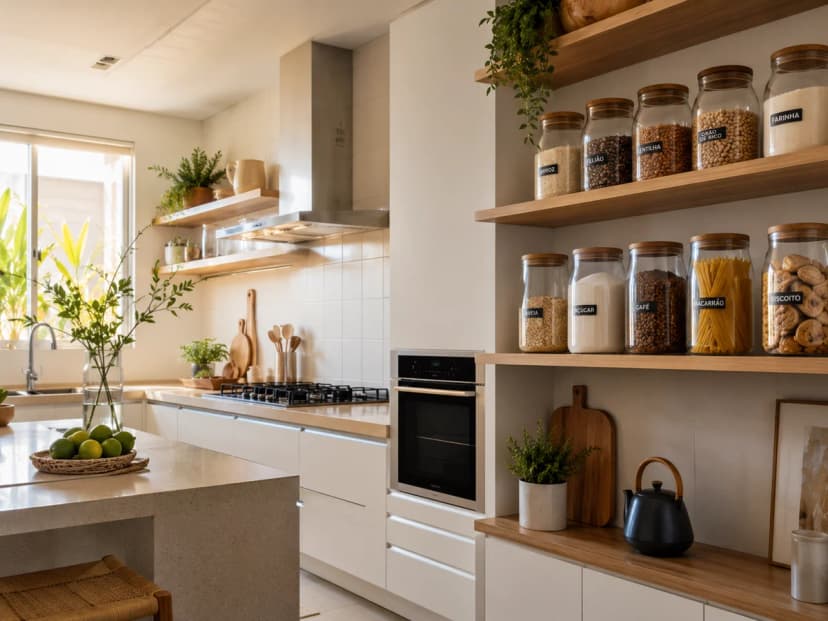
The kitchen works by zones: prep (cutting boards, knives, seasonings), cooking (pots, stovetop utensils), serving (plates, glasses, cutlery), and dry and cold storage. In São Paulo's compact kitchens, these zones overlap. Items were placed where there was space, not where they make sense for the person who cooks.
The pantry accumulates duplicates because no one knows what is there. Organizing by categories with front-facing visibility, product always at the front and never stacked behind another, solves double buying and loss to expiration.
Integrated home office
The space that grew most in complexity since 2020. In São Paulo, an office integrated into the bedroom or living room is the most common case in apartments of up to 70 square meters. Mentally separating two spaces that share the same physical area requires criteria that cabinetry does not create.
Home office organization works with visual zone delineation, filing systems that close when the workday ends, and cable management that does not contaminate the rest space. The goal is to create visual signals the brain distinguishes as work and as rest, without needing walls. The whole room, from choosing the spot in the floor plan to closing the working day, is detailed in the home office organization guide.
Main bedroom
Everything with no place in the rest of the apartment ends up in the main bedroom. A headboard with a landscape of cables. A nightstand as a secondary storage unit. Under the bed as the first storage unit. An improvised desk that never left.
Organizing the bedroom starts by identifying what should not be there, defining the real purpose of each surface, and creating quick-return systems for the items that come and go every day: chargers, books, frequently used medications. Books stacked on the nightstand and on the floor are already a category of their own, and there is a method for it: how to organize books at home.
When two people share the bedroom, the problem stops being volume and becomes boundary. Each side needs its own zone and its own return rule. Without that, one of the two carries the system alone and drops it within weeks. The step by step is in how to organize a couple's bedroom.
Laundry
No space surprises clients more than the laundry area. In São Paulo apartments, laundry rooms of 2 to 4 square meters accumulate cleaning products from the whole home, leftover renovation items, clothes that need special attention, and sometimes objects with no destination from other rooms. The laundry and the bathroom follow the same damp rule and are covered together in the bathroom and laundry guide.
With clear categories (household cleaning, laundry, utensils, maintenance), use of vertical height, and immediate access for the most-used items, a compact laundry works better than a large one with no system.
Other spaces
Bathroom: products organized by frequency of use and by user, not by generic cosmetic category. Entryway: when the arrival point has a system, the mess stays contained there instead of spreading through the home. Kids' area: systems at a height and with categories the child can access and put away without depending on an adult.
Each space has a different sticking point. The in-person diagnostic maps yours before any reorganization.
Request an assessment →How does the professional residential organization process work?
The process follows four steps in a fixed order: an in-person diagnostic of 1 to 2 hours to map spaces and routine, sorting room by room with four possible destinations for each item, implementation of usage zones and storage systems, and maintenance training. Starting with implementation without a diagnostic redistributes the accumulation more elegantly without solving the volume problem.
The four steps build on each other. Skip the diagnostic and jump straight to implementation, and you spread the same clutter around more neatly. Three weeks later the apartment is back where it started, because the volume never moved.
- Diagnostic: an in-person visit of 1 to 2 hours, mapping spaces and routine, defining scope and work sequence
- Sorting: room by room, four categories (keep with a defined destination / donate / sell / discard), decisions made with the client
- Implementation: creating usage zones, reorganizing by frequency and category, storage systems, labeling
- Training and maintenance: practical guidance per space, how to recover when things get off track, adapting as the routine changes

Why the diagnostic is the most important step
No project starts without an in-person visit. The diagnostic defines the real scope: which spaces are a priority, how much volume to work through, where the biggest points of dysfunction are in the client's routine. With a diagnostic, the project is calibrated to that specific apartment and to how that family actually uses each space. Without it, it is generic organization.
Why organizing without sorting does not work
Organize without sorting first and you just rearrange the same pile. On average, clients let go of 20 to 40 percent of their volume once they start deciding. That freed-up room is what a system needs to hold for good. Without it, the tidy version lasts a couple of weeks.
Who is professional residential organization for?
Professional residential organization serves those who have lived in the apartment for more than six months and still have spaces that do not work: accumulation that came back after cleanings, a renovation delivered with no usage system, a move made recently with rooms still without a destination, a new baby or child reorganizing the volume of items, or a home office installed in a space not organized for it.
Six profiles show up most often in residential projects in São Paulo. The common thread: spaces that do not work as they should, no matter how much effort the person puts into maintaining them.
- Accumulated routine, no recent move: has lived in the apartment for three or more years and cannot keep it organized even on cleaning days. It is a lack of system, not effort or time.
- New renovation or cabinetry delivered: just renovated and realized the new space needs a system to work. Cabinetry delivered without organization distributes the same chaos across more drawers.
- Recent move without full organization: arrived at the new home, life restarted immediately, and two months later there are still spaces with no defined destination.
- New baby or child in the space: the routine changed, the volume of items grew, and the apartment was not reorganized for that new reality. Nursery, diaper station, scattered toys, multiplied hygiene products.
- Permanent home office: started working from home and the apartment was never organized for it. Without visual separation between work and rest, the two spaces contaminate each other.
- Caregiver for an elderly person or someone with reduced mobility: the apartment needs to work for someone with limits of reach, vision, or mobility. In that case, functional organization is also practical accessibility. In a trial with 310 older adults published in Innovation in Aging, participants who went through a home hazard removal program recorded 1.4 falls over twelve months, against 2.2 in the control group.
If you do not fit any of these profiles but have spaces that do not work as they should, a diagnostic consultation identifies what is causing the dysfunction and whether a full project or targeted fixes make sense.
Silvana Organizer serves apartments and homes across the city of São Paulo, with a focus on the main residential neighborhoods. See the full residential organization service in São Paulo.
Frequently asked questions about residential organization in São Paulo
What does professional residential organization include?
It depends on the scope. At a minimum: a diagnostic of the spaces, sorting of items, implementation of storage systems with defined usage zones, and maintenance guidance. Broader projects include cabinetry consultation, document organization, and post-service follow-up. The scope is defined at the diagnostic visit, not before.
Which space is the hardest to organize in a São Paulo apartment?
The closet, because of the emotional weight of sorting decisions, and the laundry area, because of the volume accumulated in little space. In apartments with an integrated home office, the office in the bedroom is what resists most because it was never designed for that function. The difficulty is rarely the space: it is the absence of a system.
In what order should you organize the rooms of an apartment?
Start with the space that most affects the daily routine. For most clients in São Paulo, that is the kitchen or the closet. Those two solve everyday life. Then: the main bedroom, bathroom, home office, laundry. Living room and social areas last, because they are the spaces that adapt most to whatever is left over from the others.
How long does it take to organize an apartment in São Paulo?
A specific space such as a closet or kitchen takes an average of 1 to 2 days, depending on volume and scope. A full two-bedroom apartment takes 3 to 5 execution days. The actual time depends mainly on the sorting: when the client decides quickly and discards with criteria, the process is shorter. The exact timeline is estimated at the project assessment.
How do you keep the apartment organized after the service?
The system needs a low maintenance cost: every item with a defined place and a 30-second return. What breaks maintenance is not a lack of discipline, it is a poorly designed system that takes effort to keep up. Two practical habits: a 10-minute daily reset before bed and a monthly review of one space at a time.
Do I need to buy organizers before hiring a personal organizer?
No. Buying organizers before sorting is one of the most common mistakes. You do not know what will stay until sorting is done. Most clients discard 20 to 40 percent of their volume during sorting: organizers bought beforehand end up unused or the wrong size. The professional recommends what to buy after the diagnostic.
What is the difference between a personal organizer and a cleaner?
A cleaner does surface cleaning and tidying: they put back what was already in place and clean surfaces. A personal organizer rebuilds the storage system and creates functional usage zones. The two complement each other: with a well-organized system, the cleaner keeps the apartment in order in less time because every item has a defined place.
Does residential organization work in very small apartments?
Especially for them. In studios and compact units of 30 to 50 square meters, the organizational system is what determines whether the space is livable or suffocating. The difference between a functional studio and a chaotic one is rarely the square footage. It comes down to where each item sits and whether every surface has a job. Small apartments have less margin for error than large ones.
When is it worth hiring for residential organization rather than a move?
Residential organization is for those already living in the apartment who want it to work better. Move organization is for those arriving or leaving. If you moved less than 6 months ago and still have spaces with no defined purpose, the moving service still makes sense. If the problems are about accumulation and system in an apartment that is already your routine, residential is the right fit.

About the author
Silvana Santanna →Personal Organizer in São Paulo, specialized in residential move organization and functional organizing projects for homes, closets, kitchens, trousseaux and home offices. Creator of the Casa Pronta™ Method, with more than 100 projects completed across São Paulo and the greater metro area.
Related posts

How to Prepare Your Home for a Personal Organizer: 5 Essential Steps
10 min · Read article →
How to Organize a Kitchen by Zones: A System That Works in Any Size
11 min · Read article →
What Does a Personal Organizer Do in São Paulo? Services and Process
10 min · Read article →
Your apartment needs a system,
not more space.
A diagnostic visit to understand what is not working.