Moving Organization Guide for São Paulo: From Planning to the New Home
The complete moving organization process: a week-by-week timeline, how to declutter before packing, packing room by room, the moving-day protocol, and the first 7 days in the new home. By Silvana Santanna, personal organizer specialized in residential moves in São Paulo.
Neste guia você verá:
Three weeks after the move, a client sent me a photo of her closet. It was not messy: it was still packed. The clothing boxes had ended up in the living room, the kitchen ran at half capacity, and the office was still a pile of cardboard. The truck had arrived on the right day. The move had not.
Moving is on the Holmes and Rahe scale as one of the biggest life stressors, alongside divorce and grief. Not because people are fragile, but because a poorly organized move creates months of real dysfunction: you cannot cook properly, you cannot find your clothes, you work in a chaotic space. In São Paulo, with rented households growing more than 50% since 2016 (IBGE, 2025), more people are moving more often and facing this repeated problem.
This guide covers the process from start to finish, in sequence. Read it in order and come back to the sections when you need them during the process.
Why do most moves in São Paulo go wrong before they even start?
What turns a move into months of dysfunction is starting to pack before decluttering, mixing rooms in the boxes, and having no sequence for the day the boxes arrive at the new home. The truck and the mover are the smallest problems. The three mistakes below almost always show up together.
The first mistake is the most expensive: packing without decluttering. Every item that goes in a box goes into a cabinet in the new home. Clothes that do not fit the current closet will take up space in the new one. Duplicate kitchen utensils will stay duplicated. A move does not solve accumulation, it transports it.
- Packing without decluttering: you transport the problem from one address into the new cabinet.
- Mixing rooms in the boxes: a box of "miscellaneous stuff" becomes a treasure hunt in the new home.
- No system for arrival day: movers put everything in any room because no one directed them.
- Leaving organization for "after the move": after never arrives, because life restarts immediately.
The second mistake is technical: mixing rooms. A box with a frying pan, three books, a charger cable, and a loose cushion has no defined destination. It goes wherever there is space and stays there until someone decides what to do with it. With a good packing system, every box has a single destination and whoever is unloading knows where to put it without asking.
The third mistake is about planning: having no system for arrival day. Without instruction, movers put boxes wherever there is space. Without a room map, furniture goes to the wrong place and you drag the sofa at 10 p.m. Most moving-day chaos is preventable with 30 minutes of preparation the week before.
How far in advance should you organize a move?
For two-bedroom apartments, 45 days is the comfortable minimum. For three-bedroom homes or larger with years of accumulation, 60 days. Starting with 15 days means doing it under pressure: no time to declutter, no time to sell what has value, no margin for logistics errors.

Week-by-week timeline
The timeline below works for two- to three-bedroom apartments. Adjust up or down according to the volume of your home.
- 60 days before: inventory of every room, research movers, book the moving date, visit the new home to measure spaces
- 45 days before: start sorting and decluttering, room by room, beginning with closet and kitchen
- 30 days before: pack non-essential items (books, décor, off-season clothes, storage items)
- 15 days before: pack everything except what you use daily
- 7 days before: assemble the essentials box, confirm the time with the mover, make a room map of the new home
- 1 day before: check fragile items, set aside personal documents to carry by hand
- Moving day: supervise, do not organize
A move with many rooms and little room for error. A scope diagnostic shows what you can do on your own and where professional help changes the result.
Request an assessment →A note on timing: the 60-day timeline looks long until you reach decluttering week and realize the closet alone takes a full weekend. Those who underestimate the volume have two options: cut the decluttering (and transport everything) or pack in a rush and mix rooms. Both options charge their price later.
How do you declutter before packing a move?
Before packing, declutter room by room: closet first, then kitchen, then storage. Use four fixed categories for each item: keep (with a defined destination in the new home), donate, sell, and discard. Items with no destination do not go in the box. The fifth category, "decide later," is only valid with a 30-day deadline.
Decluttering before the move is not optional. Every item that goes in a box goes into a cabinet in the new home. The moment to decide is before packing, not after arriving. After arriving, you are tired, life has already restarted, and the boxes sit in the corner until they become routine.
The four-category sorting method
Do not use "stays" and "goes." Stays where? Goes where? The four categories below force a destination decision for each item:
- Keep: goes along, with a defined place in the new home. If there is nowhere to put it, it goes back to sorting.
- Donate: charities, community thrift shops, neighborhood WhatsApp groups, family, resale apps (to get something in return).
- Sell: resale marketplaces and neighborhood groups. Set a deadline: an item with no buyer in 30 days becomes a donation.
- Discard: regular waste, electronics drop-off points, the São Paulo collection service for large furniture.
The fifth category, "decide later," exists only with an expiration date. If the decision is not made within 30 days, the item goes to discard. "Decide later" boxes with no deadline become a storage unit for objects with no function.
The rooms with the most accumulation
Closet and kitchen are the ones that surprise most. Clothes kept "for when I lose weight" take up space you will need in the new home. Duplicate kitchen utensils, unused appliances, and lidless containers add volume that is not worth transporting. The service area and storage tend to be the graveyards of the home's function-less objects: everything with nowhere to go ended up there.
Declutter room by room, never all at once. Decluttering decisions are cognitively tiring. One afternoon for the closet is enough. Try to tackle the kitchen the same day and the quality of decisions drops in the second half. Reserve specific weekends for each room in your timeline.
How do you pack moving boxes room by room?
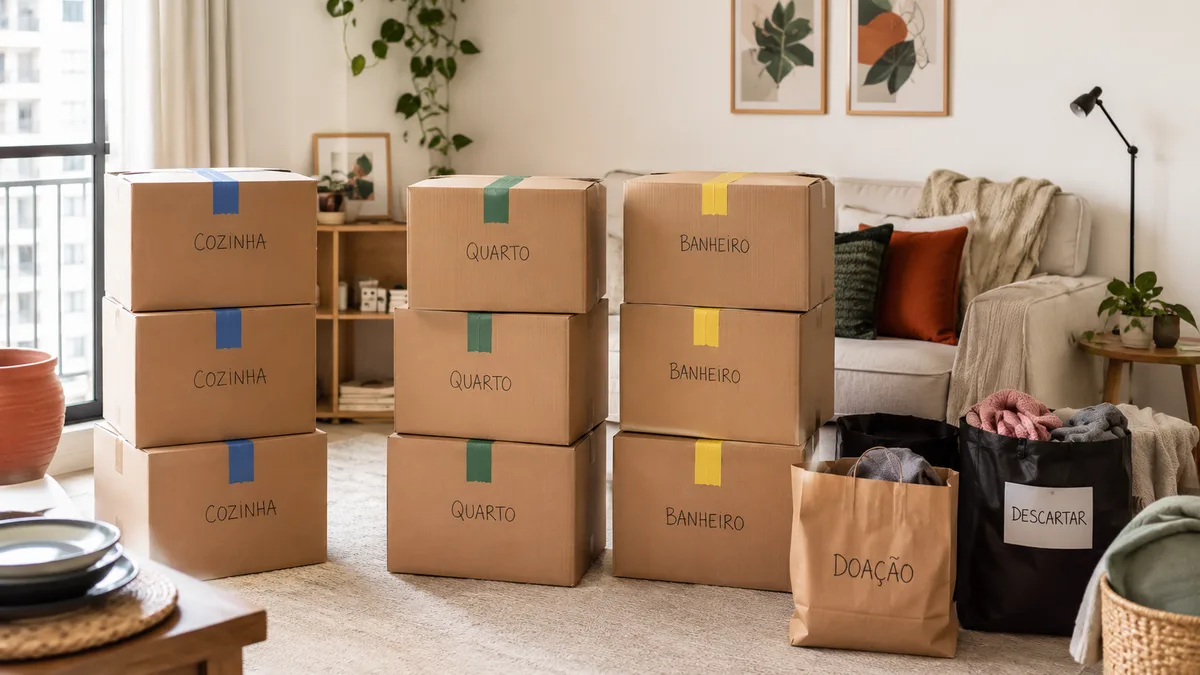
The core rule is one box per room, with a label on the side indicating the destination room and the main contents. Plates go vertically, with cardboard between each one. Clothes come off the hanger straight into a bag. Documents never go in the truck. Use colored tape by room so movers know where to place each box without asking.
The core rule is simple: one box, one room. A label on the side of the box, not on top, with the destination room and main contents. Boxes labeled only on top become illegible when stacked in the truck.
General packing rules
- Heavy boxes: small, dense items (books, tools, dishware). A full book box should not exceed 15 kg.
- Light boxes: bulky, soft items (clothes, pillows, blankets, cushions).
- Never mix rooms, even if there is space left in the box.
- Padding on the sides and top of each box: crumpled paper, fabric, old clothes.
- Boxes that do not fully close are dangerous to stack.
By room
Kitchen: plates packed vertically (like vinyl records), with cardboard between each one. Packed flat, the weight of the stack breaks the bottom ones even with protection. Pots and bowls nest with tissue paper or cloth between them. Knives: individually wrapped in paper and taped, or inside the knife block, never loose. Small appliances: in their original boxes when possible, or wrapped in bubble wrap with the cord coiled and secured.
Closet: hanging clothes go straight into a garment bag or a specific box, without folding. Shoes in pairs, each pair in a separate plastic bag. Accessories in a smaller box inside the larger one. Fine costume jewelry and jewelry: do not go in the truck, they travel with you.
Documents: never go in the truck. An accordion folder with categories (personal, property, vehicle, financial, health). Photos and albums: tissue paper between each photo, wrapped, a separate box labeled "FRAGILE: PERSONAL."
Electronics: in their original boxes when available. Without the original box: bubble wrap, cables labeled with tape (a small piece of tape reading "living room TV," "router"), a photo of the back panel of the TV before disconnecting so you know how to reconnect later.
Fragile objects: tissue paper before bubble wrap. A smaller box inside a larger one with padding on the sides. Never place something heavy on top of something fragile, even if the fragile item is wrapped.
Labeling system
Use two levels. First: colored tape by room, one color per room. It defines things visually during loading and unloading. Second: a written label on the side with the room, main contents, and a sequential number. Example: KITCHEN #3, Pots + Cutting boards. With this system, the mover knows where each box goes and you locate an item without opening every box in the room.
What to do on moving day
Moving day is operational, not organizational. If you got here prepared, the day's work is to supervise. Without preparation, moving day becomes expensive improvisation: unguided movers, furniture in the wrong place, and boxes opened in the middle of the chaos to "find something."
The essentials box
This box is the first one you open in the new home, before any other. It does not go in the truck, it stays with you in the car or personal transport.
- Toilet paper, liquid soap, a towel
- Coffee, a mug, a spoon (or a quick-meal kit)
- Daily medications
- Phone charger
- Spare key to the new property
- A blanket or sheet for the first night
- Personal ID, lease contract or deed
- Flashlight (in case of a power outage during unloading)
Arrival protocol at the new home
With the room map prepared the week before (a photo or sketch of each room with space for each piece of furniture), position someone at the entrance of the new home to direct the movers. That role can be yours, a family member's, or a service provider's. The instruction is simple: "blue box goes in the kitchen, green box in the main bedroom, large furniture against the south wall of the living room."
- Before signing the mover's delivery note: check fragile items. Damage not recorded at delivery becomes a legal dispute later.
- Do not open boxes on moving day: opening a box creates localized mess that will contaminate the rest of the process.
- Large furniture first, boxes after: sofa, bed, and large cabinets need room to maneuver. With boxes already scattered, moving a sofa becomes a circus.
- Do not assemble furniture on moving day if you can avoid it: energy runs out, the day is long, and assembling a bed at 11 p.m. with an Allen key is a recipe for error.
How do you organize the new home in the first days after the move?
The correct sequence starts with function: day 1, a functional kitchen and the bed set up in the main bedroom. Days 2 and 3, bathrooms and a basic closet. Days 4 and 5, living room and home office. Second week, décor and artwork. Those who start with aesthetics end up redoing everything when they realize the furniture layout does not work in real routine.
The right order starts with function, not aesthetics. Day 1: a functional kitchen and the bed set up. Days 2 and 3: bathrooms and a basic closet. Days 4 and 5: living room and home office. Second week: décor, artwork, and personalized items. Those who start with décor redo everything when they realize the furniture layout does not work in daily life.

A client of mine spent her first weekend in the new home hanging pictures. In the second week, she discovered the sofa needed to move to another wall because of natural light. She took down two pictures, moved the sofa, hung them again. Décor without the functional defined first is guaranteed rework.
What "functional kitchen" means in practice
That does not mean a tidy kitchen. It means a kitchen where you can cook a simple meal and make coffee. Stove on, fridge working, basic utensils within reach, one pot and one cutting board out of the box. Everything else can wait.
Want to hand the whole process to someone else? The post-move service handles the unpacking, the usage zones, and the maintenance systems in the new home.
The first days in the new home have a protocol. See how the post-move organization service sets up each room in the right order.
See post-move organization →When it is worth hiring a personal organizer for the move
It is worth it when you have more than 3 bedrooms, work full-time during the moving period, or are renovating in parallel. In those scenarios, the cost of a personal organizer is lower than the cost of weeks of chaos, poorly made decluttering decisions, and spaces that never quite work. To understand what defines that value, see the certified personal organizer credentials behind each project.
Situations that justify hiring
- Large home with high volume: more than 3 bedrooms, a full storage room, years of accumulation.
- Short timeline: a move in under 30 days with no possibility of taking time off work.
- Simultaneous renovation: boxes arrive when not every room has a defined destination.
- Family with a small child: impossible to give attention to both the move and the child at the same time.
- History of procrastination: if the person knows they will stop halfway through decluttering and never resume, having someone to lead the process changes the result.
The professional can be hired for the pre-move phase (planning, decluttering, packing), for the post-move (unpacking, organizing, creating maintenance systems), or for both. It does not have to be all or nothing: a 2-hour planning consultation before starting already prevents the most expensive mistakes.
Worth hiring or can you handle it yourself? See how the Casa Pronta™ Method turns a move into a home that works from day one.
See the Casa Pronta™ Method →Frequently asked questions about moving organization in São Paulo
How far in advance should I start organizing a move in São Paulo?
For two-bedroom apartments, 45 days is the comfortable minimum. For three-bedroom homes or larger with years of accumulation, 60 days is ideal. Starting with 15 days means doing it under pressure: no time for decluttering, no time for careful packing, and a high chance of mixing rooms in the boxes. Early planning is what separates a smooth move from weeks of chaos in the new home.
What is the moving essentials box and what should it contain?
The essentials box is the first one you open in the new home, before any other. It should contain first-need items for the first 24 hours: toilet paper, soap, a towel, coffee and basic utensils to prepare a simple meal, daily medications, a phone charger, the spare key to the property, and a sheet or blanket for the first night. Personal documents and lease contracts should also go in it, not in the truck.
In what order should I organize the rooms in the new home after the move?
The right order starts with function, not aesthetics. Day 1: a functional kitchen and the bed set up in the main bedroom. Days 2 and 3: bathrooms and a basic closet. Days 4 and 5: living room and home office. Second week: décor, artwork, and personalized items. Those who start with décor usually redo everything when they realize the furniture layout does not work in daily life. Setting up the functional first avoids that rework.
How do you pack plates and dishes correctly for a move?
Plates should be packed vertically, like vinyl records, with cardboard between each one. Packed flat, the weight of the stack breaks the ones at the bottom even with protection. Bowls nest with tissue paper between them. Wine glasses and cups: tissue paper before bubble wrap, without squeezing too tight. The dish box should have padding on the sides and bottom to prevent internal movement, and be labeled FRAGILE on the side, not on top, so it can be read when stacked.
Can documents go in the moving truck?
Never. Personal documents, certificates, contracts, deeds, passports, insurance policies, and any paper with legal or financial value should go with you, in hand or in a carry bag. The risk is not just loss: a box of documents can be opened by mistake, get wet, or be damaged during loading. The rule is simple: if losing it would cause harm or work to replace, it does not go in the truck.
How do you declutter before a move without feeling paralyzed?
Do it room by room, never all at once. Decluttering decisions are cognitively tiring. One afternoon for the closet, another day for the kitchen. Use four categories: keep (goes along with a defined destination), donate, sell, and discard. The fifth category, decide later, only exists with a deadline: if you have not decided in 30 days, the answer is discard. Items with no defined destination in the new home should not go in the box.
What is the difference between pre-move and post-move organization?
Pre-move organization happens at your current home and covers inventory, decluttering, packing by room, and moving-day logistics. The goal is to reach moving day with everything labeled, categorized, and ready for the truck. Post-move organization happens at the new home and covers unpacking, defining usage zones by room, building storage systems, and creating maintenance routines. The two stages complement each other. Hiring only the post-move without a good pre-move means organizing chaos instead of organizing a clean space.
How do you organize a move with a small child without losing control?
With children up to age 5, the ideal is for their room to be the first space fully set up and organized in the new home, before anything else. A small child needs a spatial reference to feel safe in the new environment. Practically, that means separating the child's room boxes with a different color, setting it up on day 1 along with the parents' room, and keeping the sleep routine unchanged even during the rest of the home's disorder.
What cannot go inside moving boxes?
Besides important documents, these should not go in boxes: flammable materials such as alcohol and solvents, loose batteries, plants (enclosed transport damages them), perishable food, high-value items like jewelry and watches, and anything that needs temperature control. Sensitive electronics such as external hard drives and laptops travel better in a backpack than in the truck, because of the risk of vibration and impact during transport.
How do you set up an efficient labeling system for moving boxes?
Use two levels of identification. First: colored tape by room, one color per room (blue for kitchen, green for main bedroom, yellow for living room). Second: a label written on the side of the box, never on top, with the destination room, main contents, and a sequential number within that room. Example: KITCHEN #3, Pots + Boards. With this system, whoever is unloading knows where each box goes without asking, and you locate a specific item without opening every box.
How long does it take to organize a new home after a move?
With proper preparation and packing by room, the functional spaces are ready in 7 days for a two-bedroom apartment. Larger homes take 10 to 14 days. Without preparation, the real average I see in projects where I am called in to fix post-move chaos is 3 to 6 weeks to reach basic functionality. The time difference between having prepared and not having prepared is exactly that: weeks versus days.
Is it worth hiring a personal organizer just for the post-move?
Yes, especially if the pre-move phase was already done carefully: every box labeled, rooms separated, no mixed items. In that scenario, the professional arrives at a home with organizational potential and only needs to unpack, define zones, and create maintenance systems. If the pre-move was done under pressure, mixed and unlabeled, the post-move work triples. In some cases, it is worth hiring for both stages or at least doing a planning consultation before starting to pack.
How do you organize a move without taking time off work?
With 60 days' notice, it is possible to do everything in blocks of 2 to 3 hours on weekends. The key is to start decluttering early, while there is still time to sell and donate without pressure. Weeks 1 to 3: declutter one room per weekend. Weeks 4 to 6: gradual packing of non-essential items. Weeks 7 and 8: pack the rest. Those who hire a personal organizer to coordinate cut that time in half because they do not stall in the middle of decluttering decisions.
What do you do with furniture that does not fit in the new home?
Decide before moving day, not after. Furniture that goes to the new home with no defined place becomes an obstacle. The options are: sell before the move, donate to family or an institution, temporary storage if the decision is not yet clear (with a defined exit date, not for now), or disposal through the city collection service. Taking it to decide later is the most expensive decision: you pay freight for an item you will discard in 6 months.
How do you keep the home organized after a move?
A move creates a rare opportunity: the new home starts from zero. The maintenance system needs to be defined while everything is still in the right place, not after old habits return. Two habits that make a difference: a 10-minute daily reset (every item back in place before bed) and a monthly accumulation review by room. For families, defining who is responsible for which room works better than general rules. The problem is not keeping it organized, it is recovering when it gets off track.

About the author
Silvana Santanna →Personal Organizer in São Paulo, specialized in residential move organization and functional organizing projects for homes, closets, kitchens, trousseaux and home offices. Creator of the Casa Pronta™ Method, with more than 100 projects completed across São Paulo and the greater metro area.

Would you rather have someone
handle it all for you?
A project assessment visit.