Closet and Clothing Organization Guide for São Paulo
By type of space, by item category, and by professional process. Everything that involves closets, wardrobes, shoes, bags, and linens in São Paulo apartments. By Silvana Santanna, certified personal organizer.
Neste guia você verá:
The closet is the space that receives the most organization attempts and the one that returns to its previous state fastest, within weeks. It is rarely a space problem. It is almost always an excess of items with no real sorting and the absence of a system calibrated to the routine of whoever uses that space every day.
This guide brings together everything that involves closet and clothing organization in São Paulo apartments: by type of space, by item category, and the professional process from end to end.

Why is the closet the space that resists organization the most?
The closet resists because it concentrates two problems at once: an excessive volume of items accumulated with no exit process, and a high emotional cost in every sorting decision. Clothes with history, expensive pieces never worn, items that "will fit again" stall any solo attempt. According to Agência Brasil, each Brazilian household discarded an average of 44 kg of clothing in 2024, which gives an idea of the volume that comes in with no defined criteria for going out.
The closet concentrates emotional decisions in high volume within a compressed space. The resistance comes from the emotional cost of each sorting decision, added to the absence of a clear system for what stays. Clothes with history, pieces that will fit again, expensive items never worn, gifts hard to discard. Each piece requires a decision. Hundreds of decisions in a day exhaust anyone.
There is also a problem of scale. According to Agência Brasil, each Brazilian household discarded an average of 44 kilos of clothing and footwear in 2024. We buy often, wear a fraction of what we buy, and accumulate with no structured exit process. The wardrobe absorbs that excess until it can no longer hold any system.
The mistake of buying organizers before sorting
The natural impulse is to buy boxes, dividers, and extra rails. The result is almost invariably product the wrong size, for a volume that no longer exists after decluttering. Most clients discard between 20 and 40 percent of their pieces during sorting. The organizers bought beforehand end up unused or the wrong dimension.
The mistake of new cabinetry as the solution
A built-in closet with shelves, rails, and drawers creates storage structure, not a usage system. The system defines where each category goes, which height suits each garment type, where the everyday shoes go versus the occasion ones. Without a system calibrated to the real routine of whoever uses it, the built-in closet becomes messy in six weeks.
How does closet organization change by type of space?
The sorting process is the same for any type of space. What changes is the implementation: in a built-in closet, the work is calibrating the system to the existing cabinetry, adjusting heights and zones to the real usage profile. In a small wardrobe, the strategy is smart compression with vertical folding, a second rail, and seasonal rotation. In a couple's wardrobe, the focus is creating individual zones with clear physical boundaries so two different systems coexist.
Built-in closets, sliding-door wardrobes, and small wardrobes have distinct challenges. The sorting process is the same in all three. What changes is the implementation strategy after decluttering is done and the real volume becomes clear.
Built-in closet (3 to 8 square meters)
The built-in closet has more structure and more room for error. A wardrobe delivered with drawers at the wrong height, short rails where they should be long, open shelves where there should be doors. The first step before any organization is to assess whether the cabinetry is calibrated to the person's real usage profile, not to the design approved two years earlier.
The most frequent failure in São Paulo closets is the double rail installed where only one makes sense, and the single drawer instead of four or five smaller ones. Too many drawers tend toward a confusing drawer. Too many open shelves tend toward a shelf full of items stacked without criteria.
Small wardrobe (standard two-door)
A small wardrobe requires smart compression. Three strategies work: KonMari vertical folding in the drawers, which multiplies capacity without increasing volume; a second rail installed on the bar to double the space for short garments like t-shirts and blazers; and seasonal rotation with under-bed boxes for off-season clothes. Organizing without decluttering first does not work. With high volume in a small space, any system collapses in days.
Couple's wardrobe in the main bedroom
Two systems inside the same piece of furniture. Each person needs their own zone, their own drawers, and their own internal usage criteria. What sticks is rarely the difference in style. It is the lack of physical boundaries. Without defined sides, items migrate between the spaces and neither person can maintain what was organized. The wardrobe solves one part. The rest of the room follows the same boundary logic, and has a method of its own: how to organize a couple's bedroom.

How do you organize each item category in the closet?
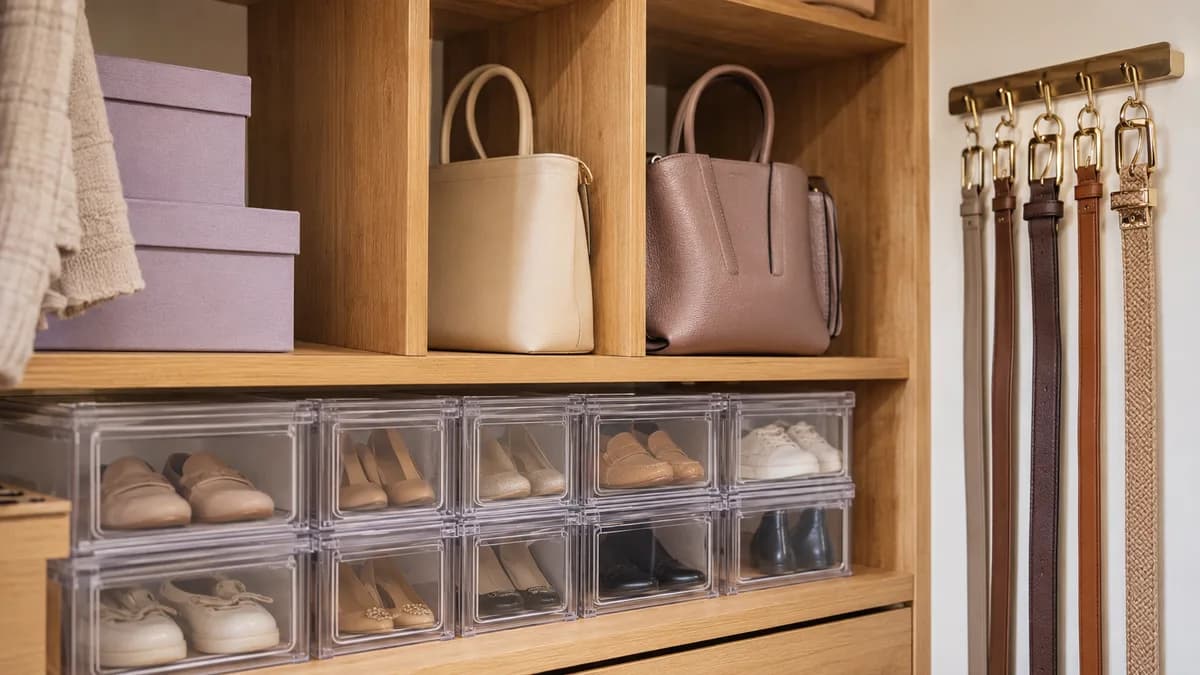
Each category has its own criterion: clothes go grouped by garment type, with the most-used at eye level. Up to 15 pairs of shoes fit on a door rack; above 30, clear boxes with a photo on the lid. Bags stay upright, never lying down, to preserve their structure. Everyday accessories need a visible, fixed exit point, outside the drawers, so they do not disappear from daily use.
Clothes, shoes, bags, and accessories have distinct storage rules. Storing by instinct results in mixed categories, items hidden behind others, and pieces that vanish into a corner of a shelf. Each category calls for its own usage criterion so the system holds.
Clothes
Dividing by garment type comes before anything else. All the tops together, all the trousers together, all the dresses together. Within each category, organize by frequency of use: the most-used pieces occupy eye level and easy access. Occasion pieces go in secondary-access positions.
On the rail, organizing by color within each category is optional. Those who put together outfits often benefit. Those who pick piece by piece without thinking about combinations can skip that step with no loss of function.
Shoes
The volume of pairs determines the system. Up to 15 pairs: a door rack. Between 15 and 30 pairs: open shelves with each pair facing forward. Above 30 pairs: clear stacked boxes with a photo on the lid. A shoe inside an opaque box with no label disappears from the person's mental wardrobe. Everyday shoes go in the first access spots. Occasion shoes go higher or further back.
Bags and accessories
A bag needs to stand upright to preserve its structure. A bag lying down deforms. The practical options: an open shelf with a support between pieces, hooks on the side of the closet for smaller bags, or a hanging bag organizer for those with available vertical space. A bag stored inside a cover with no visibility disappears from daily use.
Everyday accessories, like belts, scarves, and glasses, need a visible, fixed exit point. What stays hidden in a drawer is forgotten.
Bed, table, and bath linens
Often outside the closet's scope, but part of the same space problem. A bedding set stored with the sheet inside the pillowcase takes up less volume and comes out as a complete kit, with no search for separate pieces. Towels folded in vertical thirds on a sliding shelf are easier to grab without dismantling the whole stack.
Each closet category has its own system. The in-person diagnostic maps what is stuck in your space before any reorganization.
Request an assessment →How does the professional closet organization process work?
The process has four steps that depend on the correct order. Skipping or inverting any of them compromises the final result, especially when the volume is high and decluttering decisions carry emotional weight.
- Diagnostic: an in-person visit of 1 to 2 hours to map the space, volume of items, usage routine, and points of greatest daily dysfunction
- Sorting: every piece comes out of the space, separated by category, with four possible destinations: keep, donate, sell, or discard
- Implementation: zones by garment type and frequency, a shoe and accessory system with a fixed destination, labeling where needed
- Maintenance: fast-return guidance, how to recover when the system gets off track, a 15-minute monthly review by section
In closet sorting, the volume discarded tends to surprise the client. On average, between 20 and 40 percent of pieces leave the space in the process. That freed-up room is what keeps the system going. With a margin, any method works. Without one, nothing lasts more than a few weeks.
Why closet sorting does not work well alone
In the closet, sorting carries a greater emotional cost than in any other space. Clothes carry memory, cost, expectation of future use, and often judgment about one's own body. A professional present creates structure for the decisions: keeps the criteria objective without pressuring, avoids the "I might need it someday" paralysis, and paces the time so the sorting actually finishes. Without that structure, solo sorting drags on or stops halfway.
When is it worth hiring and when can you do it yourself?
It depends on the volume, the history of previous attempts, and the emotional cost of sorting for you. Some situations resolve without professional help. And there are clear signs that the problem is structural.
You can probably do it yourself when
- The closet has a reasonable volume and you have decluttered recently
- The problem is about the system, not sorting, and you make decluttering decisions easily
- It is the first organization attempt in that space and there is no history of relapse
It is worth calling a professional when
- You have organized the closet three or more times and it went back to the same state
- There are pieces you have been "going to wear" for over two years with no date
- Sorting stalls because every piece has a justification to stay
- You have a built-in closet delivered more than six months ago with no working system
- The day's routine starts with 10 minutes searching for what to wear
None of these signs is a personal failure. They are indicators that the problem has a structural component that a method-driven process resolves faster than repeated attempts in the same space.
Frequently asked questions about closet and clothing organization in São Paulo
What does professional closet organization include?
At a minimum: a diagnostic of the space and volume of items, sorting clothes by category and frequency of use, creating sections by garment type, a shoe and accessory system with a defined destination, and maintenance guidance. Broader projects include cabinetry consultation, reorganizing linens, and seasonal review. The scope is defined at the diagnostic visit, not before.
In what order should you organize a closet professionally?
Sorting before any system. The correct sequence: take everything out of the space, separate by garment type, sort within each category with four possible destinations (keep, donate, sell, discard), then implement the storage system. Organizing without sorting first only redistributes too many items in insufficient space. The result lasts weeks, not months.
Do I need to buy organizers before calling the personal organizer?
Do not buy anything before sorting. The most common mistakes are boxes the wrong size, dividers that do not fit the actual drawers, and shoe racks for a volume that no longer exists after decluttering. Most clients discard between 20 and 40 percent of their volume during sorting. What was bought beforehand ends up unused or the wrong size. The professional recommends what to buy after the diagnostic.
What is the difference between organizing a built-in closet and a small wardrobe?
In a built-in closet, the work is calibrating the system to the existing structure: shelves at the right height, rails in a functional position, using corners and niches. In a small wardrobe, the strategy is compression: vertical folding to expand drawers, a second rail for short garments, seasonal rotation with external boxes. The sorting process is the same in both cases. Only the implementation changes.
Why does the closet become messy again after being organized?
Two main causes. A high return cost: when putting a garment away takes more than 30 seconds, it ends up on the chair. Excessive volume for the space: with too many items, any system collapses. A closet that holds has a margin of space and a fast return for each piece. Without those two factors, it goes back to being messy regardless of the organization method used.
How many clothes is reasonable to have in a compact apartment wardrobe?
The most useful reference is the margin rule, not a fixed number. When you close the wardrobe, every garment on the rail should have room to breathe and every drawer should shut without forcing. When that does not happen, there are more items than the system can hold. In apartments of 45 to 70 square meters in São Paulo, standard wardrobes of 1.6m to 2m generally hold between 60 and 120 pieces with a proper system.
How do you organize a couple's closet when the two have different usage routines?
Individual zones within the same space. Each person has their side, their drawers, and their own internal organization criteria. What sticks is rarely the difference in style. It is the lack of clear physical boundaries. Without defined sides, items migrate between the spaces and neither person can maintain the system. With a clear division and heights adjusted for each, different routines coexist without conflict.
How long does it take to organize a closet with professional help?
A closet of 4 to 6 square meters takes an average of 1 to 2 days of work, depending on the volume of items and the speed of sorting decisions. The stage that varies most is sorting: when decluttering decisions are quick and objective, the process is shorter. High hesitation over each piece can double the estimated time. The initial diagnostic sets a realistic estimate for that specific space.
What do you do with clothes you do not wear but have trouble discarding?
Professional sorting works with objective criteria: when the piece was last worn, whether it fits your current body, whether there is a concrete occasion in sight. Items with high emotional value or high cost get a transition box: kept for 30 to 60 days outside the closet. If there is no search for them in that period, discarding becomes significantly easier. Most people do not go back to the box.
How do you keep the closet organized day to day without excessive effort?
Two habits work better than any elaborate routine: returning each piece to its place right after use, and a 15-minute monthly review of one specific drawer or section at a time. The closet does not become messy all at once, it accumulates gradually. A targeted monthly review interrupts the accumulation before it becomes a problem. The system needs a low maintenance cost: if putting things away takes real effort, no one keeps it up long-term.

About the author
Silvana Santanna →Personal Organizer in São Paulo, specialized in residential move organization and functional organizing projects for homes, closets, kitchens, trousseaux and home offices. Creator of the Casa Pronta™ Method, with more than 100 projects completed across São Paulo and the greater metro area.
A closet organized once,
kept for years.
A diagnostic visit to understand what is not working in your space.