Kitchen Organization Guide for São Paulo
By type of kitchen, by item category, and by professional process. A functional pantry, systematized drawers, clear counters, and how to keep it with no real effort. By Silvana Santanna, certified personal organizer.
Neste guia você verá:
According to the Brazilian Institute for Consumer Defense, each Brazilian wastes around 41 kg of food per year in meals made at home, and the most cited cause is inadequate storage. The issue is not a lack of food, but a lack of any system to see what you already own before buying more.
This guide brings together everything that involves kitchen organization in São Paulo apartments: by type of space, by item category, and the professional process from end to end.
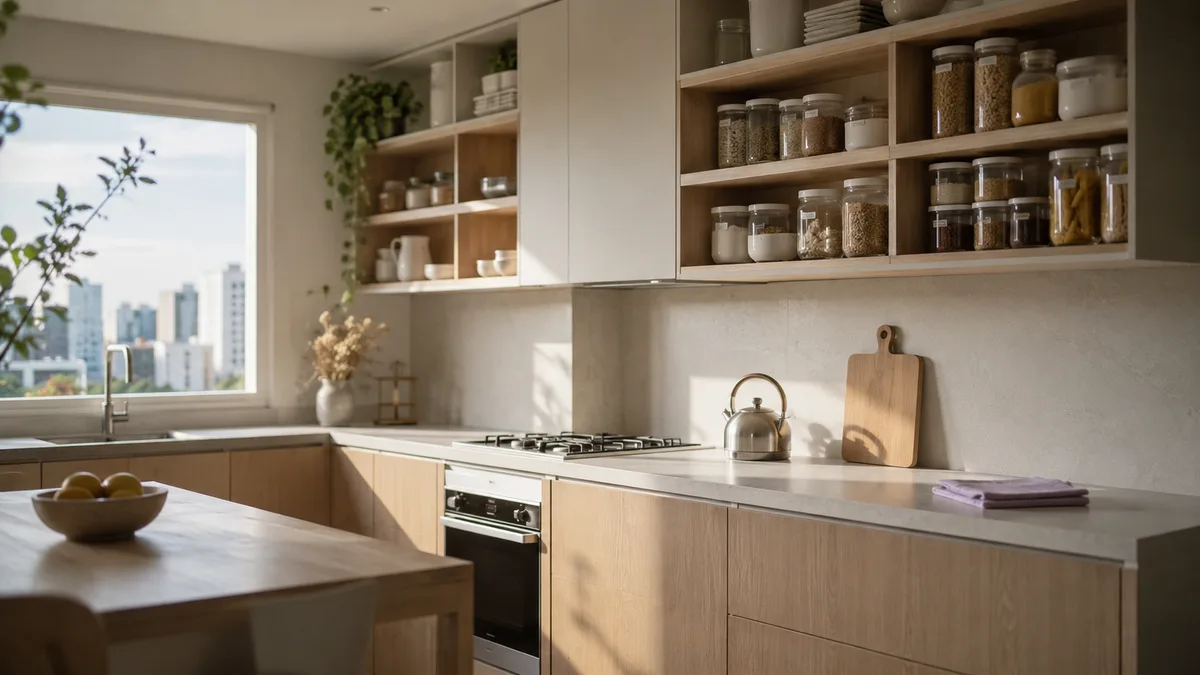
Why is the kitchen the space that resists organization the most?
The kitchen concentrates more item categories than any other room and has no natural pause: every day new items arrive, every day items leave and need to return to their place. The core problem is visibility. Items stacked in front hide the ones behind, food expires without being seen, and any small disorganization accumulates over days of heavy use.
The kitchen concentrates more item categories than any other room. Perishable and non-perishable food, cooking utensils, pots, appliances, cleaning products, packaging, disposal materials. Each category has a different storage logic. Together, in a space that is often no more than 8 square meters, they create a system with a high potential for collapse.
The structural problem of the kitchen is that it has no natural pause. Every day new items arrive, every day items are used and need to return to their place, and every day there is a decluttering decision being postponed. With intense daily use, any small disorganization accumulates fast.
The blind-cabinet problem
In most of the kitchens I work in around São Paulo, the real bottleneck is visibility, not space. Items stacked in front hide the ones behind. Food bought last week sits in front; the ones from three weeks ago, at the back, near expiration and invisible. The result shows up on the grocery bill and in the organic waste every week.
The mistake of organizers before sorting
Airtight containers, spice racks, drawer dividers, cabinet organizers: the natural impulse is to buy before starting. The result is almost always product the wrong size for shelves not yet measured, and a quantity calculated for a volume that will shrink 20 to 35 percent after sorting. The right containers come after the real space becomes clear, not before.
How does organization change by type of kitchen?
Large kitchens, integrated open-plan kitchens, and compact kitchens have distinct challenges. The sorting process is the same in all three. What changes is the implementation strategy after the real volume becomes clear and the available space is measured.
Large kitchen (over 12 square meters)
The large kitchen has more space and, often, more accumulation. The advantage is that you can create truly separate zones: prep, cooking, dry storage, cleaning. The risk is using that space to store items that do not belong in the kitchen: appliances from other rooms, cardboard packaging, rarely used utensils. Extra space easily becomes a storage unit when there is no criterion for input and output.
Open-plan kitchen integrated with the living room
In São Paulo, 81.6% of the properties launched between January and July 2023 measured up to 45 square meters, according to Secovi-SP. In most of these apartments, the kitchen is integrated with the living room. That changes organization in one specific point: what is on the counter and in the open cabinets is part of the décor, not just of function. Unused appliances go in closed cabinets. The counter needs a stricter daily cleaning because it is always in view of anyone who enters the apartment.
Compact kitchen (up to 6 square meters)
The average area of two-bedroom properties in São Paulo dropped from 58 square meters in 2004 to 37 in 2024, a 36% reduction in twenty years. The kitchen followed that compression. In compact spaces, the strategy is smart use: extra shelves or door organizers to use all the available height, zero unnecessary objects on the counter, and stricter sorting than in any other type of kitchen. High volume in a small space makes any system unworkable within days.
What to organize first in the kitchen: counters, cabinets, or pantry?
The correct sequence starts with sorting. Reorganizing without decluttering first only spreads too many items in insufficient space. After sorting, the order is: pantry and food cabinets first, utensils and pots next, drawers, and the counters last. The counter stays full because the cabinets cannot hold everything, so it is solving the cabinets that keeps it clear.
Why the pantry comes first
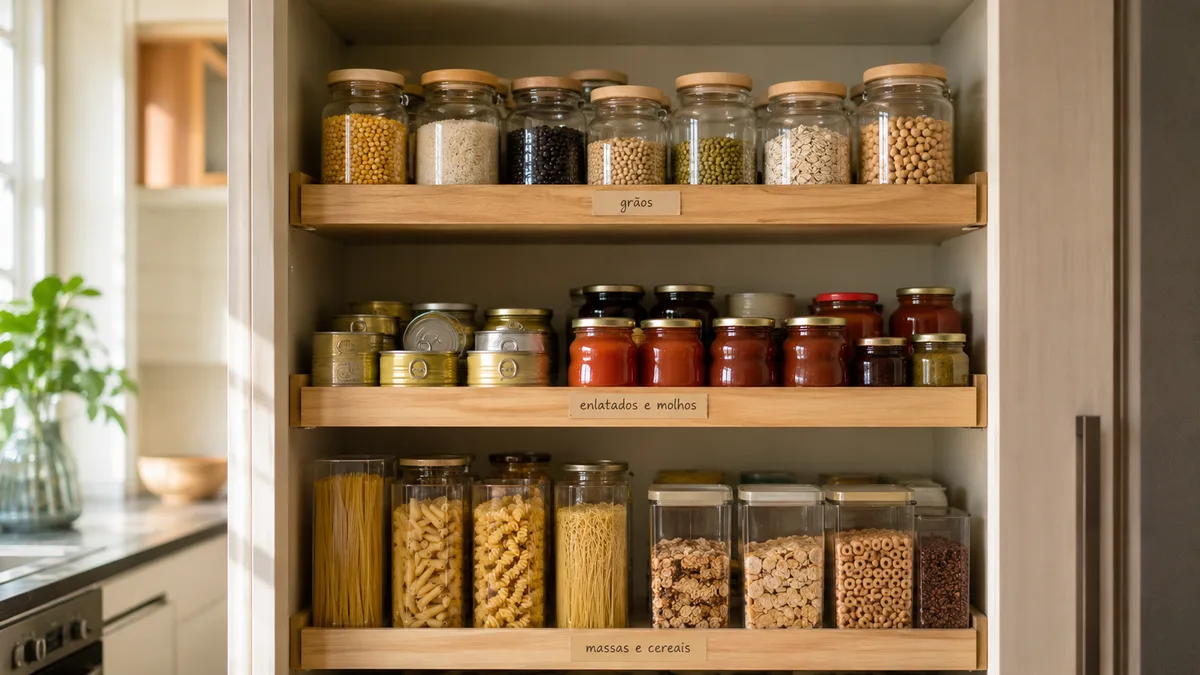
The pantry is where the waste happens. Food near expiration stays hidden behind new packaging, and the weekly shop increases the volume without the older items leaving. The FIFO system, first in, first out, solves this: when putting away new items, existing ones go to the front and the newly bought ones go behind. A few minutes with each shop eliminate the main cause of waste in the home kitchen.
Why the counter comes last
The counter is the most visible space and the most tempting to organize first. The problem is dedicating time to it while the cabinets still hold items with no fixed destination. What is on the counter ended up there because the cabinets cannot hold everything, so the overflow stays out. Fix the cabinets first and a clear counter holds on its own.
- Sorting: take everything out of the space, separate by category, decide the destination of each item
- Pantry: apply the FIFO system, label shelves by category, define height by frequency of use
- Pot and utensil cabinets: zones by type, the most-used at immediate-access height
- Drawers: dividers by category, no mixing between cooking and serving utensils
- Counter: only what is used daily stays on it; the rest goes into a cabinet
The kitchen has too many categories for a generic system to work. The in-person diagnostic maps what is stuck before any reorganization.
Request an assessment →How do you organize kitchen drawers and cleaning products?
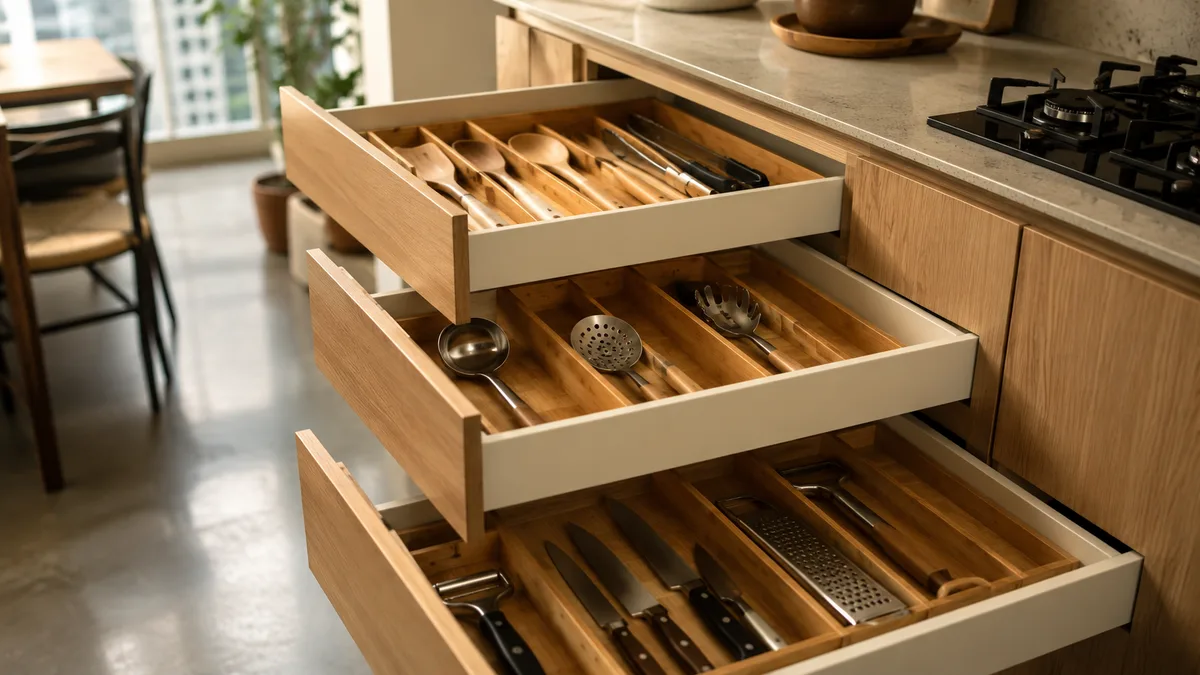
Drawers are organized by usage category, with internal dividers: one drawer for cooking utensils, another for serving utensils, another for cutting items. The "everything else" drawer is the first sign of collapse. Cleaning products go in the cabinet under the sink, separated from anything food-related, organized by product type, with bleach or ammonia ones on a higher shelf when there are children or pets in the home.
Drawers and cleaning products are the two categories that most often fall outside the system in any kitchen organization. Drawers become a storage unit for objects with no destination. Cleaning products get mixed with food items or scattered across several places with no clear usage criterion.
Drawers
The criterion for organizing a drawer is category, not size or frequency of use. One drawer for cooking utensils: spatulas, wooden spoons, tongs. Another for serving utensils: ladle, slotted spoon, pasta server. Another for cutting items: knives, peelers, graters. Dividers within each drawer prevent mixing objects from different categories.
What does not work: the "everything else" drawer. When a drawer becomes a dumping space, nothing has a fixed destination and any item with no obvious place ends up there. That drawer grows until it takes up two, then three.
Cleaning products
Cleaning products have their own zone, separated from anything food-related. The most functional place is the cabinet under the sink, with internal organization by product type: for surfaces, for dishes, for floors, all-purpose. Products with bleach or ammonia go on a higher shelf when there are children or pets in the home. Sponges and scrubbers have a fixed spot, usually a simple sink organizer. What is scattered across two or three different cabinets will never have real inventory control.
How does the professional kitchen organization process work?
The process has four steps that depend on the correct order: diagnostic, sorting, implementation, and maintenance. Skipping or inverting any of them compromises the result. The professional sequence solves in two days what solo attempts rarely finish, because it keeps a constant pace and criteria from start to finish.
- Diagnostic: an in-person visit of 1 to 2 hours to map the space, volume of items, usage routine, and where the system is failing
- Sorting: every item comes out of place, separated by category, with four possible destinations: keep, donate, sell, or discard
- Implementation: zones by type of use, a FIFO system in the pantry, drawer dividers, labeling where needed
- Maintenance: fast-return guidance, how to recover when the system gets off track, a biweekly pantry review
In kitchen sorting, the items that leave tend to surprise the client. Duplicate utensils, appliances unused for years, lidless containers, empty packaging kept "just in case," expired food hidden at the back of the pantry. On average, 20 to 35 percent of the volume leaves in the process. That freed-up room is what lets the system hold.
Why kitchen sorting does not work well alone
In the kitchen, sorting decisions have a specific component: food. Discarding food, even expired, even unused for months, has a real emotional and financial cost for many people. A professional present keeps the criteria objective without pressuring, identifies what still has use and what is taking up space with no function, and paces the time so the sorting finishes in the day. Without that structure, the process stops halfway or stretches over weeks.
When is it worth hiring and when can you do it yourself?
It depends on the accumulated volume, the history of previous attempts, and how much time you have to dedicate to the process. Some situations resolve without professional help. And there are clear signs of a structural problem that repeated attempts in the same space rarely solve.
You can probably do it yourself when
- The kitchen has a reasonable volume and you have sorted recently
- The problem is about the system: you know what you have, but not where to put it
- It is the first organization attempt in that space and there is no history of relapse
It is worth calling a professional when
- You have organized the kitchen three or more times and it went back to the same state
- There is expired food in the pantry you did not know was there
- The counter has fixed items that should not be there but have nowhere to go
- You buy items at the store you already have because you cannot see the stock
- There are appliances or utensils unused for years taking up cabinet space
None of these signs is a personal failure. They are indicators that the current system is not calibrated to the real volume and usage routine of that kitchen. A functional kitchen is not a perfect one. It is simply one where you find what you need in under 20 seconds and get back to cooking without rearranging anything first.
Frequently asked questions about kitchen organization in São Paulo
What does professional kitchen organization include?
At a minimum: a diagnostic of the space, sorting of food and utensils, creating zones by type of use, a pantry system with expiration control, and organizing drawers by category. More complete projects include consultation for planned cabinetry, organizing cleaning products, and weekly maintenance guidance. The scope is defined at the diagnostic visit, not before.
What is the difference between organizing a large kitchen and an open-plan kitchen?
In a large kitchen, the work is creating distinct zones with a fixed destination for each category: food, utensils, pots, appliances, and cleaning products. In an open-plan kitchen integrated with the living room, the visual factor becomes a criterion: counters and open cabinets have to work and look organized because they are on view all the time. The sorting process is the same in both cases. What changes is the emphasis placed on the system's appearance.
Why does food expire before being used even after organizing?
The problem is usually not the organization itself, but the absence of a FIFO system (first in, first out). When new items go in front and older ones go to the back, the ones near expiration stay hidden and expire before being seen. The solution is simple: when putting away new groceries, move existing items to the front and place the new ones behind. A few minutes with each shop eliminate the biggest cause of household waste.
Do I need to buy organizers before calling the personal organizer?
Do not buy anything before sorting. The most common mistake is buying containers, boxes, and dividers for a volume that no longer exists after decluttering. Most kitchens have between 20 and 35 percent of items that leave during sorting: expired food, duplicate utensils, never-used appliances, lidless containers. Buying beforehand risks the wrong size for cabinets not yet measured and the wrong quantity for the real volume.
How do you organize a small pantry without much space?
Three strategies work in compact pantries. First, rigorous sorting: a small pantry cannot hold a large stock. Second, vertical use with extra shelves or door organizers: every centimeter of ignored height is lost space. Third, a FIFO system applied consistently: items near expiration go in front, newly bought ones go behind. A well-organized small pantry works better than a large pantry with no criteria.
How long does it take to organize a kitchen with professional help?
A standard São Paulo apartment kitchen takes an average of 1 to 2 days of work, depending on the volume of items and the speed of sorting decisions. Kitchens with a large pantry or many years of accumulation can take an extra day. The stage that varies most is sorting food and utensils: when decisions are quick, the process is shorter. The initial diagnostic sets a realistic estimate for that specific space.
Why does the kitchen become messy again after being organized?
Three main causes. Too much volume for the space: with no margin in the cabinets, any system collapses in the first weeks. A high return cost: when putting an item away takes more than 20 seconds, it stays on the counter. And continuous input with no output: every weekly shop brings new items without the old ones having a defined destination. A kitchen that holds has a margin, a fast return for each category, and a biweekly pantry review.
What do you do with utensils you never use but cannot discard?
Professional sorting uses a real-use criterion: when the item was last used, whether the home has room to store it without compromising daily life, whether there is a concrete destination in sight. Items with high sentimental value or high cost get a transition box: kept outside the kitchen cabinets for 30 to 60 days. If there is no search in that period, discarding becomes much easier. The kitchen is not the right place to store items the person does not want to discard.

About the author
Silvana Santanna →Personal Organizer in São Paulo, specialized in residential move organization and functional organizing projects for homes, closets, kitchens, trousseaux and home offices. Creator of the Casa Pronta™ Method, with more than 100 projects completed across São Paulo and the greater metro area.
A kitchen that works every week,
not just the day after you organized it.
A diagnostic visit to understand what is not working in your space.