Trousseau Organization Guide for São Paulo
By type of trousseau, by what to actually keep, and by professional process. Wedding, baby layette, and bed, bath, and table linens in the São Paulo apartment. By Silvana Santanna, certified personal organizer.
Neste guia você verá:
São Paulo recorded 239,000 marriages in 2024, according to the Seade Foundation. That same year, IBGE recorded 471,000 births in the state. That is nearly 710,000 São Paulo families going through a change that starts with the same question: where to store all of this?
This guide brings together everything that involves trousseau organization in São Paulo: by type of trousseau, what makes sense to keep, and the professional process from end to end.
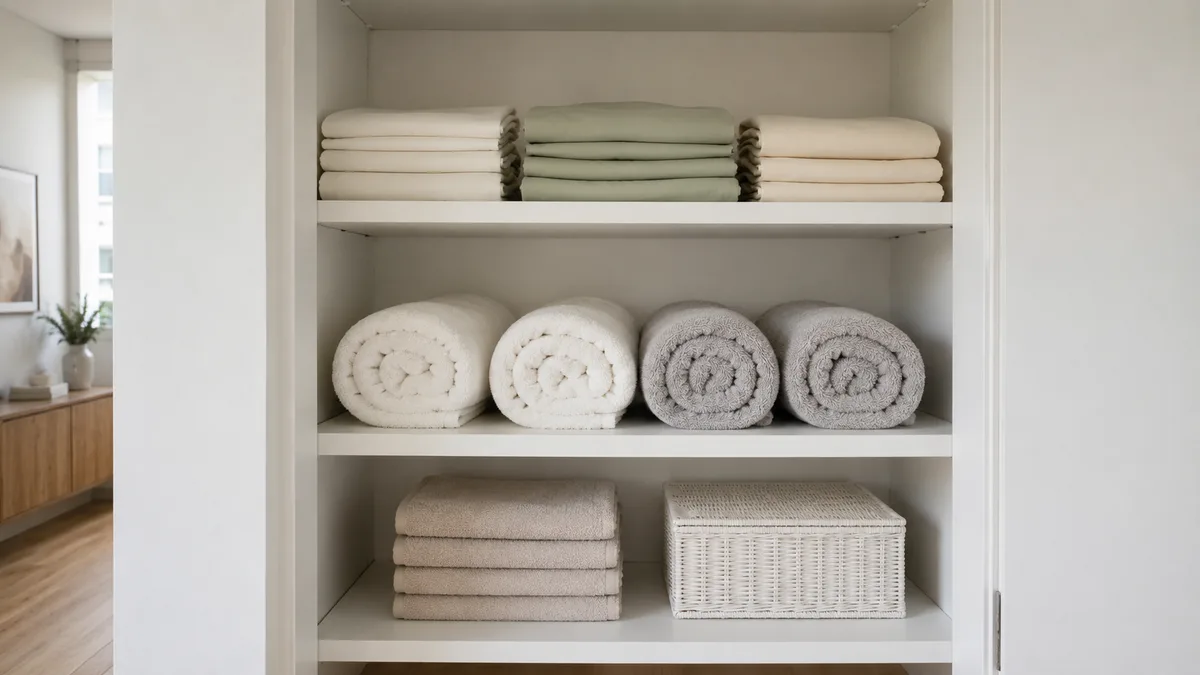
Why does a trousseau accumulate more than the space can hold?
A trousseau arrives in concentrated volume, over a few weeks, from a wedding registry, a baby shower, and post-partum gifts, without anyone measuring the available space first. In São Paulo apartments, where 75% of recent launches are up to 45 square meters, the couple's wardrobe rarely holds the volume of a complete wedding registry.
A trousseau is the only kind of household accumulation that arrives in volume before the person understands what their real space is. A wedding registry, a baby shower, post-partum birthday gifts: the items arrive within a short window of weeks, and the destination for each piece was rarely planned in advance.
The problem grows in a scenario where, between January and July 2023, 81.6% of the properties launched in São Paulo measured up to 45 square meters, according to Secovi-SP. A couple's wardrobe in an apartment that size was not designed to hold a complete registry trousseau. And the nursery, often 8 to 10 square meters, does not hold the volume of a baby shower without rigorous sorting of what will actually be used.
The wedding-registry problem
A registry is planned to make sure guests have something to choose from, not to calibrate what the couple actually needs. The practical result: tablecloths for 12 people in an apartment where meals are for two. Cup sets that never leave the box. Bedding sets in the wrong size for the existing bed. Most registries result in a volume more than double what the space can hold.
The baby-layette problem
In the baby layette, the most expensive mistake is buying by category when you should buy by phase. Newborn-size clothing lasts 2 to 4 weeks of real use. Buying 20 newborn bodysuits means storing 18 bodysuits that will never be worn because the baby grew before the packaging was opened. The correct logic is to buy little in the current size and restock at the next phase, which few baby-shower registries reflect.
How do you organize a wedding trousseau without excess?
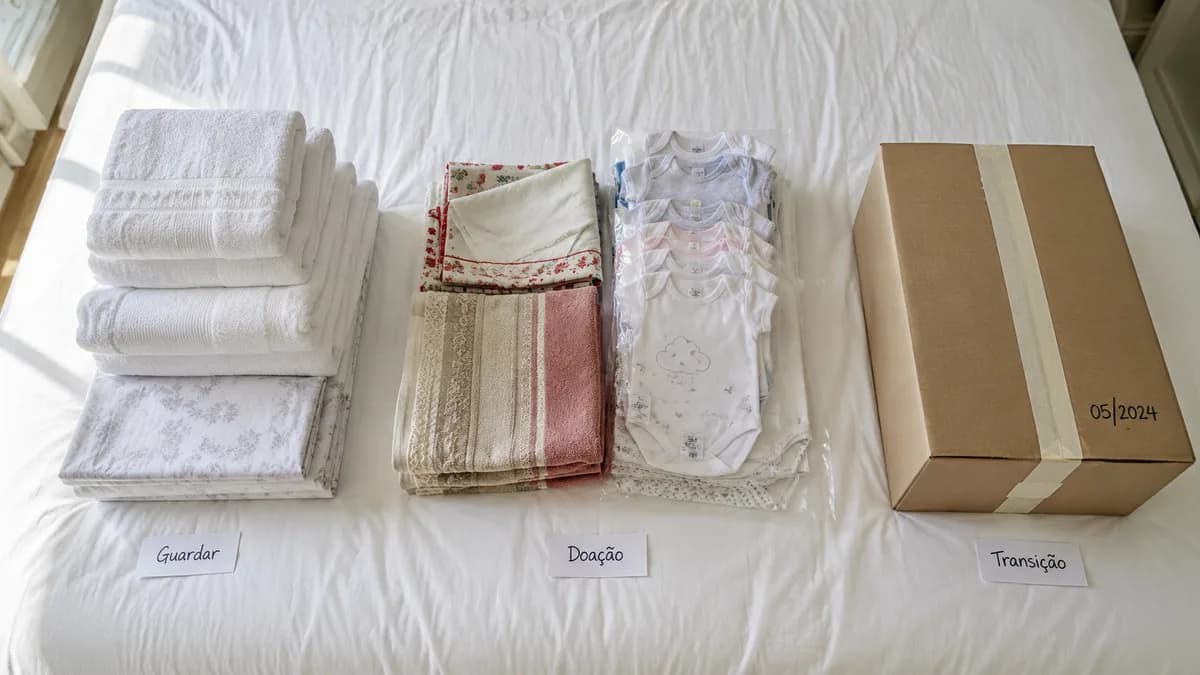
The first step is sorting, not reorganizing. Map the total volume of what arrived, cross it with the available space, and define the destination of each piece: keep, donate, redistribute, or into a transition box.
How many bed, table, and bath pieces does a couple need?
The functional reference for a couple in a São Paulo apartment: 3 sheet sets per bed (one in use, one clean in the wardrobe, one in the wash), 2 to 3 bath towels per person, 4 to 6 dish towels, and 1 to 2 tablecloths for the size of the table that exists, not the dream table. Above that, each extra piece compresses the shelf space and makes access to what is used daily harder.
What to do with duplicate or out-of-context gifts?
Gifts carry an emotional cost in sorting: discarding a gift from someone close is different from discarding your own purchase. Professional sorting does not force decisions. The process defines an objective criterion, the real use of the item in the context of that apartment and that couple, and offers alternatives beyond discarding: redistribution to family, donation with a concrete destination, sale of higher-value items. That makes the decisions faster and less loaded.
- Map the entire volume before any organization: take everything out of the packaging and separate by category
- Measure the real available space: linear meters of shelf, depth, and height of each cabinet
- Define a usage reference: how many pieces of each type will be used in the next 90 days
- Separate by destination: keep, donate, redistribute, a transition box for hard-decision items
- Organize by category and frequency of use, with the most-used at immediate-access height
A wedding trousseau with too much volume for the space: the in-person diagnostic maps what fits before any decluttering decision.
Request an assessment →How do you set up the baby layette in a small apartment?
Set it up in two separate batches: before the birth, buy only what is needed for the first 7 days (newborn clothes in a small quantity, crib, basic hygiene). Everything beyond that, including clothes from size 3 months up, buy later, when the baby's real growth becomes clear.
Setting up the baby layette has two distinct moments: before the birth and after. Mixing them is the cause of the overloaded nursery that paralyzes instead of working. What needs to be ready at birth is far less than the market and baby-shower registries suggest.
What to buy before the birth
Before the birth, the criterion is: what is needed in the first 7 days. A crib or bassinet, a changing table, a basic set of newborn clothes in a small quantity (8 to 10 bodysuits, 4 rompers, 2 to 3 pajamas), a blanket, bath towels, and hygiene items. Everything beyond that can be bought later, when the baby's weight and growth become clear. Large furniture, like a bathtub, a diaper pail, and a stroller, has a real use quite different from what is imagined before birth.
What to wait to buy later
Clothes from size 3-6 months up: most babies reach that size between 6 and 10 weeks of life. Buying beforehand means not knowing what season it will be in that phase, and the clothing can become obsolete before it is opened. Sensory toys and a rocker vary a lot by baby; it is worth testing before buying. In the first month there is rarely a long outing, so the premium version of the stroller can wait until the baby's real routine becomes clear.
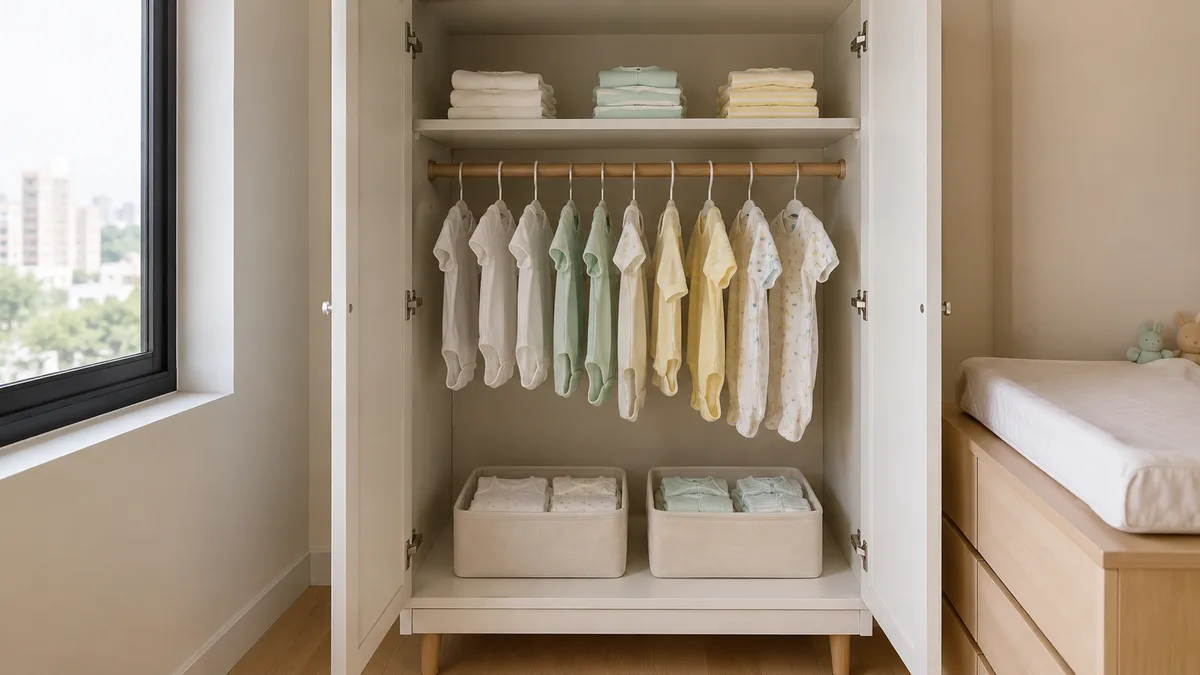
How to organize the baby wardrobe in a compact space
A baby wardrobe in a small apartment works better organized by clothing size than by category. When the clothes in use are in a clear zone and the next sizes are separated below or above, the change every 2 to 3 months is quick: remove one batch, insert the next. Organizing by type, bodysuits in one drawer, rompers in another, creates confusion when the sizes mix during the phase transition.
What do you do with trousseau pieces that were never used?
Apply the real-use criterion: does the piece have room in the wardrobe without compressing what is used daily? Is there a concrete usage situation in the next 90 days? Pieces with no clear answer go to donation, redistribution, or a sealed transition box for 30 to 60 days before any final decision.
Unused trousseau pieces have a specific problem: they are new, they cost money for whoever gifted them, and they were often chosen with care. That creates a resistance to discarding that does not exist with other household items. Sorting resolves this with criteria, not with pressure.
The decision criterion
Three practical questions for each piece: is there real space to store it without compressing what is used every day? Is there a concrete usage situation in the next 90 days? If you needed it, how long would it take to find? When the answers are no, maybe, and never, the piece is taking up the space of another that answers yes, yes, and immediately.
The transition box
Pieces with high emotional cost or high purchase value do not need to be discarded on the spot. The transition box is a sealed box, outside the wardrobe, with a 30 to 60 day deadline. If there is a search in that period, the piece returns to the system. If not, discarding becomes much easier because it became clear that its absence caused no real problem. The kitchen, the clothing wardrobe, and the nursery are not a storage unit for the pieces the person is not yet ready to discard.
How does the professional trousseau organization process work?
The process follows four steps in a mandatory sequence: diagnostic, sorting, implementation, and maintenance. The sequence matters because each step depends on the result of the previous one. Sorting without a diagnostic does not calibrate to the real space; implementation without sorting distributes too much volume. Without an implemented system, maintenance has no base.
- Diagnostic: an in-person visit to map the available space, the total trousseau volume, the usage routine, and the collapse points of the current system
- Sorting: every piece comes out of place, separated by category, with a defined destination: keep, donate, redistribute, or transition box
- Implementation: zones by trousseau category, a storage system by frequency of use, labeling where needed for easy maintenance
- Maintenance: guidance on how to recover after each of the baby's phase changes, how to manage new items that arrive, and when to review the system
Trousseau projects have a high output volume because most arrive with duplicates, gifts out of the usage context, and items in a size or style that does not fit the real apartment. It is common for 25 to 40 percent of the pieces to go somewhere other than the wardrobe. That freed-up volume is what lets the system work once it is in place.
How long does it take?
A wedding trousseau in a São Paulo apartment takes an average of 1 to 2 days, depending on the total volume and the speed of sorting decisions. A baby layette in a small room is usually completed in 1 day. Projects involving both, setting up the wedding trousseau plus preparing the nursery, are scheduled in stages to respect the expectant mother's energy availability. The diagnostic defines the real timeline before the work begins.
When is it worth hiring and when can you do it yourself?
Some situations resolve with personal organization and rigorous sorting. Others have clear signs that the current system is not calibrated to the real volume and space: repeated attempts with the same setup rarely change the result.
You can probably do it yourself when
- The trousseau volume is small and has been sorted recently
- The available space is enough for what exists and the problem is only internal organization
- Sorting decisions are easy: there are no pieces with high emotional cost to discard
It is worth calling a professional when
- The wedding trousseau arrived all at once and the wardrobe does not close or has compromised access
- The nursery is set up but does not work: what you need is not within reach at the right moment
- There are trousseau pieces in original packaging for more than 6 months with no defined destination
- You reorganized the wardrobe more than once and it went back to the same state within weeks
- Sorting the gifts is stuck on emotional cost and the baby's arrival date is near
None of these signs is a personal failure. They are indicators that the volume arrived faster than the space and system can absorb. A trousseau that works has a defined place for each piece and access in under 20 seconds to what is used every day.
Frequently asked questions about trousseau organization in São Paulo
What does professional trousseau organization include?
At a minimum: a diagnostic of the available space, sorting of all pieces by type and condition of use, creating separate zones by category (bed, bath, table), a storage system suited to the real volume, and maintenance guidance. Full trousseau projects include analyzing pieces from wedding or baby gifts, defining what to keep, what to redistribute, and what to discard. The scope is defined at the in-person visit, after mapping the space.
How many sheet sets and towels do you need to have?
For a couple in a São Paulo apartment, the functional reference is: 3 sheet sets per bed (one in use, one clean, one in the wash), 2 to 3 bath towels per person, and 4 to 6 dish towels. Above that, storage starts to compress the shelf space. Most wedding trousseaus arrive with more than double that reference. Sorting defines what stays without compromising daily function.
How do you organize a baby layette in a small room?
In São Paulo apartments, where 75% of recent launches are up to 45 square meters, the nursery is usually between 8 and 12 square meters. The strategy is to prioritize real usage phases: a newborn wears newborn-size clothes for only 2 to 4 weeks; buying little in that size and topping up later avoids storing piles of clothes the child will never wear. The baby wardrobe works better organized by clothing size than by category, with the pieces in use at immediate-access height and the next sizes stored separately below or above.
What do you do with a wedding trousseau that was never used?
Sorting uses a criterion of real use and available space. Pieces that never left the packaging, that do not fit the couple's style of use, or that are duplicated go to donation, redistribution to family, or sale. Pieces with high sentimental value get a transition box: kept outside the wardrobe for 30 to 60 days. If there is no search in that period, discarding becomes easier. Storing everything in a wardrobe that cannot hold it compromises the system for the pieces used every day.
Do I need to buy organizers before calling the personal organizer?
No. Buying before sorting is the most common mistake in trousseau projects. The volume of pieces that leaves in the decluttering and donation process tends to be high: wedding trousseaus and baby layettes have duplicates, unrequested gifts, and items that do not match real use. Boxes and dividers bought beforehand arrive the wrong size for shelves not yet measured and in a quantity calculated for a volume that will shrink. The right organizers come after the real space becomes clear.
What is the difference between organizing a wedding trousseau and a baby layette?
The wedding trousseau tends to have a high volume of bed, table, and bath pieces from a gift registry, often above the apartment's real storage capacity. The challenge is sorting duplicate items and the criteria for discarding gifts. The baby layette has a different challenge: clothes become obsolete every 2 to 3 months due to growth, so management is dynamic, with constant input and output of pieces. Both require rigorous sorting, but the baby layette demands a system that follows the frequent change of size.
Why does a trousseau take up more space than it seems before opening?
Bed and bath linens compressed in gift packaging take up 2 to 3 times more space when opened and folded under real usage conditions. A plush towel compressed in a gift box looks small; unpacked, it takes up a whole shelf. This is especially critical in small São Paulo apartments, where bedroom wardrobe space is limited. The in-person diagnostic measures the available space before any decision about what to keep.

About the author
Silvana Santanna →Personal Organizer in São Paulo, specialized in residential move organization and functional organizing projects for homes, closets, kitchens, trousseaux and home offices. Creator of the Casa Pronta™ Method, with more than 100 projects completed across São Paulo and the greater metro area.
A trousseau that fits the apartment
and works every week.
A diagnostic visit to map the real space before any organization decision.