How to Organize a Small Laundry Room in São Paulo: 4 Functional Zones for Maximum Use
Organize your small laundry room with a professional method: 4 functional zones, vertical space use, humidity control in São Paulo, and which organizers are truly worth it.
Neste guia você verá:
The laundry room is one of the most overlooked spaces in the home, and one of the most used. In São Paulo apartments, where the service area often measures no more than 3 m², disorganization creates a domino effect: clothes that take forever to come out of the machine, cleaning products piled up with no logic, brooms falling to the floor, and a constant feeling that the space is never enough.
The problem is rarely a lack of space. It is a lack of system. A well-organized 2 m² laundry room works better than a 6 m² one with no structure.
What comes up most often in these projects: dirty clothes on the floor because there is no basket with a fixed spot; clean clothes piled on top of the machine waiting to be hung; a pile of clothes to iron that grows for weeks; cleaning products mixed with detergent and fabric softener because zones were never separated; and the clothesline installed in the only spot available, which happens to be right in the middle of foot traffic. In laundry rooms where the sink, machine and cabinet share the same square meter, every appliance competes for space with the next.
In most cases, renovation is not the fix. Defining zones and creating a logic of use for a space everyone uses, but that was never planned, is. The bathroom and laundry guide covers both wet rooms together, including expiry, disposal and mould control.
Diagnosis: what is holding your laundry room back
Before buying any organizer, understand what is causing the dysfunction. In most small laundry rooms, the same problems repeat:
- Excess stock: a bulk box of detergent, ten types of degreaser, three brooms. The laundry room is not a storage warehouse.
- Products with no fixed spot: each item drifts between the counter, the floor and the top of the machine. Without a fixed spot, mess is inevitable.
- Wasted vertical space: most laundry rooms use only floor and counter level: the 150 cm above stay empty.
- Poorly planned drying area: clothes drying take over the only circulation space.
- Dirty clothes basket with no defined spot: it ends up wherever it fits, a spot that changes every day.
She thought the problem was size. The laundry room had space for everything: nothing was in its place.
In a 72 m² apartment in Pinheiros, a client called me because her 3 m² laundry room had become unusable. She told me she felt frustrated every time she walked in: brooms falling as she reached for the fabric softener, last week's clothes still on top of the machine, and four types of detergent on the counter because she never decided which one to use. She thought she needed a renovation to fix it. I mapped the space and the problem became clear: a washing zone, a drying zone and a cleaning products zone were sharing the same square meter, with no boundary between them. Every item was there. None had a fixed spot. We split it into four zones without moving a single water or power point: fabric softener and detergent next to the machine, a retractable clothesline on the back wall, a wall mount for brooms and mops on the side, a dirty clothes basket in the corner. Two months later she told me she had stopped avoiding the laundry room. The renovation would have cost time and money to fix a positioning problem.
The 4 zones of a functional laundry room
The zone method assigns a purpose to each area of the space. When everything has a fixed spot tied to its function, maintenance becomes automatic.
Zone 1: Washing
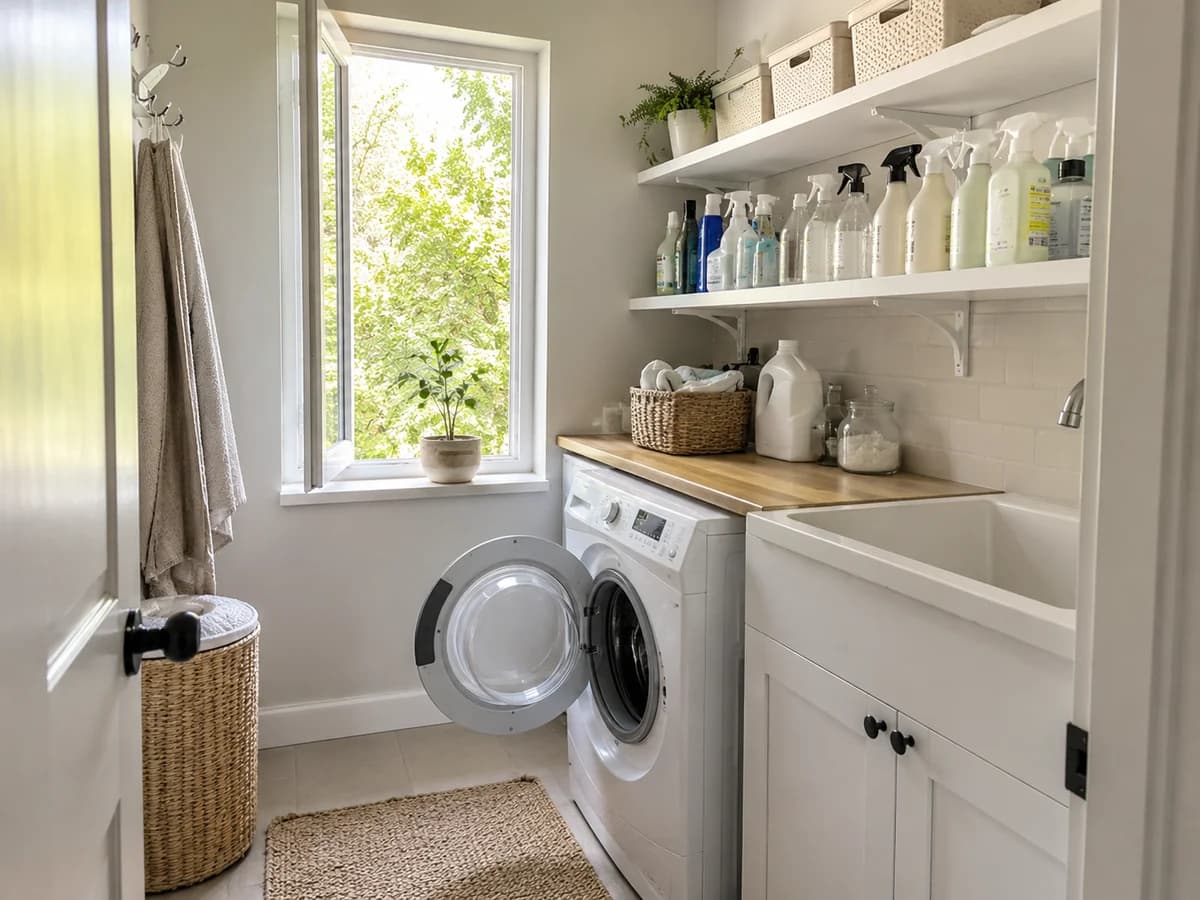
Around the washing machine: fabric softener, liquid or powder detergent, bleach and stain remover stay here, at most an arm's length from the machine. Quantity: only what is in active use (not the entire stock). A wall-mounted detergent dispenser next to the machine eliminates the work of opening and closing packages with every wash.
Zone 2: Drying
The clothesline, dryer or balcony area. If the laundry room has no balcony, a retractable wall-mounted clothesline (models from 4 to 8 meters, no drilling: high-strength adhesive) creates drying space that disappears when not in use. A foldable floor clothesline takes up less than 10 cm when closed and can be stored behind the machine or in a cabinet.
Zone 3: Ironing
If you iron in the laundry room: the iron and ironing board belong in this zone. A foldable wall-mounted ironing board (fixed to the side wall) frees the floor completely when closed. The iron: on a wall mount or the shelf closest to the outlet, never on the counter.
Zone 4: Cleaning products
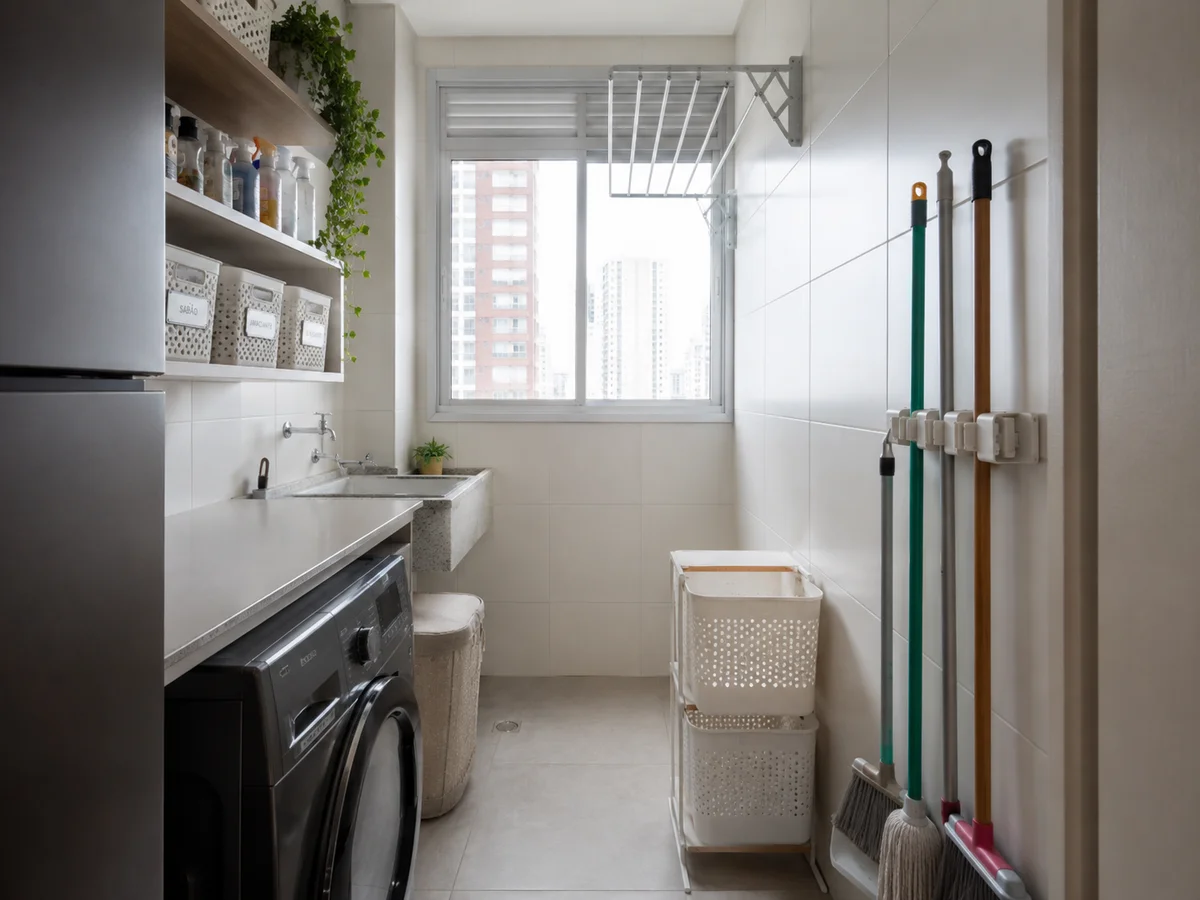
Brooms, mops, cloths, disinfectant, bleach, all-purpose cleaner. This zone tends to be the messiest because items come in incompatible shapes. Solution: a wall mount for broom and mop handles (organizes items vertically and frees the floor), and a dedicated shelf or cabinet for bottled products.
Use the vertical space
In a small laundry room, horizontal space is scarce. Vertical space is almost always available. Most apartments have a 2.5 m ceiling height in the service area. That gives you at least 180 cm of usable wall above the counter or floor.
How to use each level
- Eye level (120 to 160 cm): products used every week: detergent, fabric softener, stain remover. Easy access, no effort.
- Shoulder level (160 to 190 cm): products used biweekly or monthly: immediate stock (not the full reserve), seasonal products.
- Above 190 cm: rarely used items: heavy-duty cleaning products, spare cloths, empty packaging waiting for recycling.
- Below 80 cm: dirty clothes baskets, the base of a foldable clothesline when stored, irregularly shaped items.
Solutions with no construction work
- Wall shelves with adhesive mounts (capacity up to 15 kg per mount on a smooth surface);
- Magnetic mounts for broom handles on metal walls or with an attached magnetic plate;
- Organizers that fit over the machine (a suspended-shelf type): they make use of the 40 cm between the machine and the ceiling with no drilling;
- Fabric baskets with hooks that hang from a rod or horizontal bar, creating overhead storage.
Humidity and mold: São Paulo's specific problem
São Paulo has relative humidity that often exceeds 80% for much of the year. For laundry rooms (spaces with water and little ventilation), this creates ideal conditions for mold on walls, the machine's rubber seal, and cleaning cloths.
Five practical control measures
- Ventilation: if the laundry room has a window, keep it open as much as possible. No window: install a bathroom-style exhaust fan on the wall (simple, low-cost work) or use an electric dehumidifier.
- Machine door: always open between uses to ventilate the drum. A damp rubber seal closed for hours is the main cause of mold in the machine.
- Wet clothes: never leave them in the machine after the cycle. If you will not be able to hang them soon, schedule the wash for a time when you can hang them right after.
- Cleaning cloths: wash and dry completely before storing. A damp cloth folded in a drawer grows mold within 24 hours.
- Walls: anti-mold paint in the laundry room (especially on the wall behind and beside the machine) significantly reduces incidence. It is not a guarantee, but it greatly cuts down how often cleaning is needed.
The laundry room smelled of mold even freshly cleaned. She had repainted the wall three times in two years.
In an 85 m² apartment in Moema, a client called me because she had given up trying to fix the mold in her laundry room. She told me she painted with anti-mold paint, the smell would disappear for three weeks and then come back. The laundry room had no window. I asked about her routine and it became clear: clothes stayed in the machine until the next morning, the machine door stayed closed all week, and cleaning cloths were stored still damp in a drawer under the machine. She told me she felt embarrassed when the housekeeper mentioned the smell. The anti-mold paint treats the symptom on the wall. The behavior inside the laundry room was creating the conditions for the mold to return every week. We put a compact dehumidifier on the outlet and set two behavior rules: clothes come out of the machine within two hours of the cycle ending, cloths only get stored once fully dry on the line. Three months later she messaged me: the wall was clean for the first time in two years. In a closed laundry room, mold comes back as long as the behavior does not change.
Which organizers actually work
The most common mistake: buying organizers before organizing. The result is products that do not fit the space or that solve the wrong problem. The correct order is: empty out, discard, decide what stays, measure the space, then buy.
Worth the investment
- Wall mount for broom handles: completely frees the floor, organizes 4 to 6 items in 30 cm of wall;
- Retractable wall-mounted clothesline: essential in a laundry room with no balcony;
- Dispensers for liquid detergent and fabric softener: eliminate the clutter of open packaging on the counter;
- Adjustable wall shelves: let you reconfigure the space as needs change;
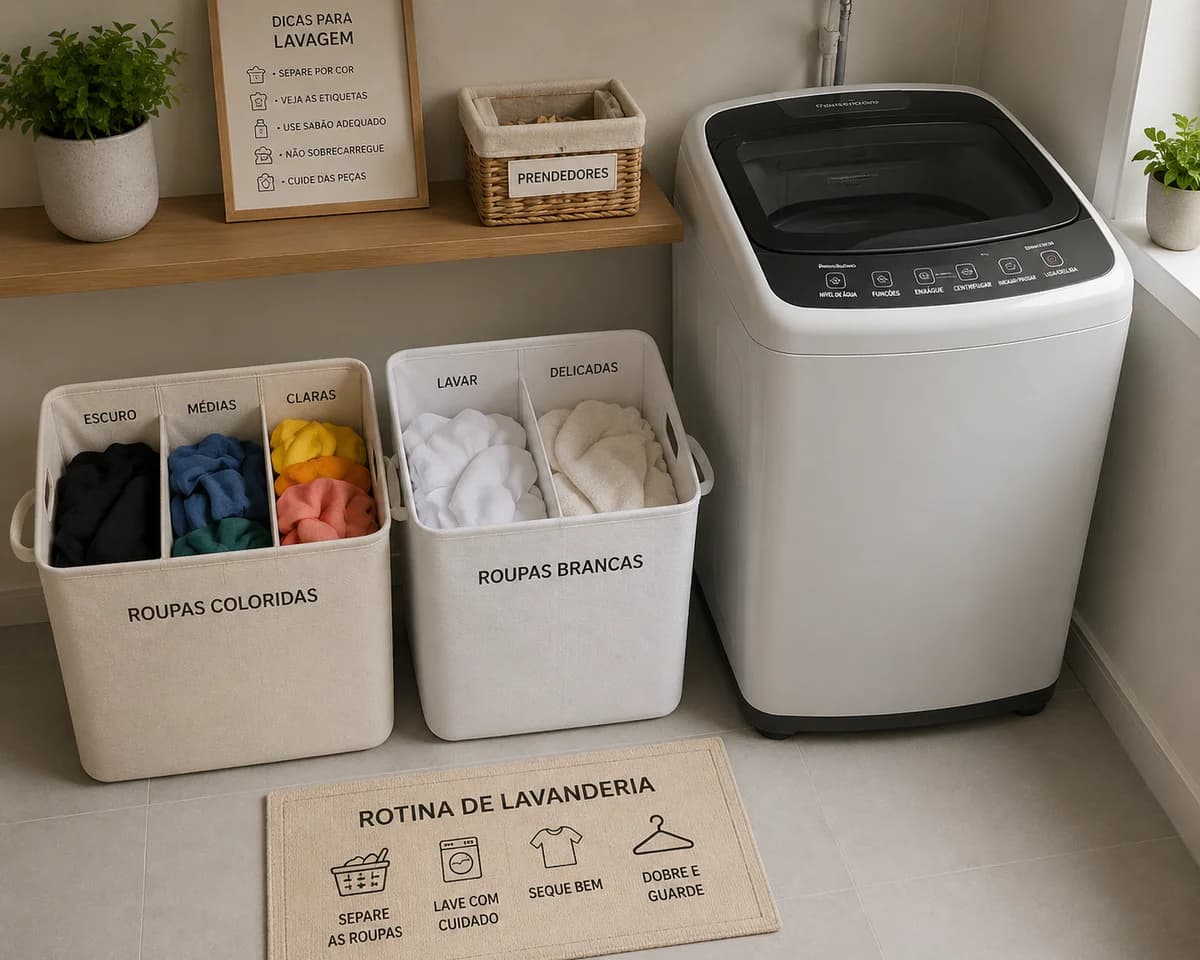
- Dirty clothes basket with dividers (colors/whites/delicates): cuts down sorting time at wash day.
Not worth it for a small laundry room
- Floor carts with many shelves: they take up circulation space;
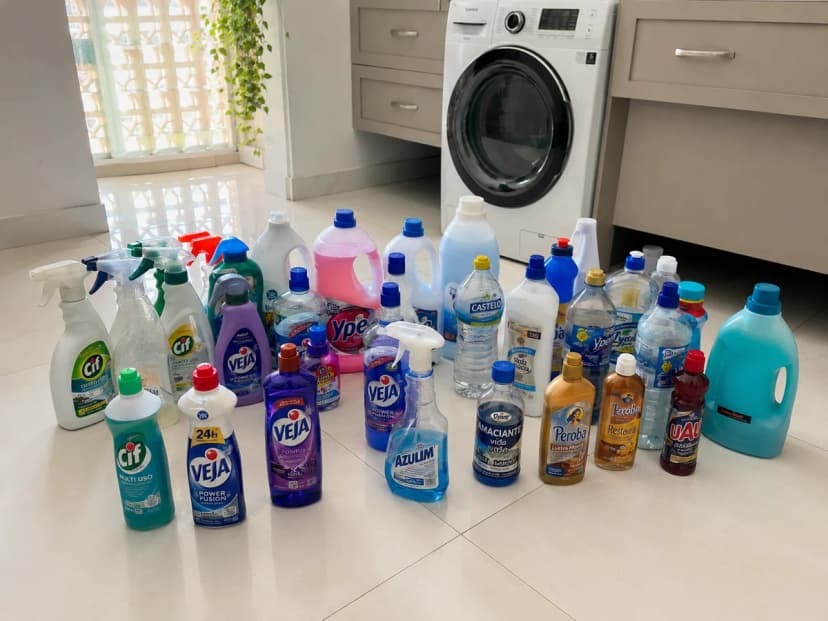
- Stocking 10 different products when 4 are enough;
- Decorative boxes that hide items but do not organize them: you lose visibility of your products and they expire unused.
A small laundry room that works well comes down to well-defined zones, not more space.
See home organization →The laundry room fell into disorder within two days. She would reorganize on the weekend, and two weeks later it looked the same.
In a 65 m² apartment in Vila Madalena, a client called me because she had organized her laundry room three times in the past four months and the result never lasted a week. She told me she thought she just was not good at organizing, and that maybe the space was too small to work. The laundry room measured 2 m² with a machine, a sink and one shelf. I visited. The system was right: defined zones, a broom mount on the wall, a shelf with products separated by use. What was missing was a return rule. Every item went back wherever there was space available. We set three rules: a product used goes back to its shelf before you leave the laundry room, folded clothes do not sit on top of the machine for more than 24 hours, the machine door stays open at all times. Two months later she wrote to me: she had stopped reorganizing. A small laundry room falls apart fast without defined return rules.
Weekly maintenance routine
An organized laundry room stays that way with 5 minutes a week (if the system was built well). If you are spending more than that, it is a sign some zone is not working.
- Cleaning products going back to their spot after use (not the counter)
- Clothes coming out of the machine right after the cycle
- Machine door open between uses
- Cloths washed and fully dried before storing
- Stock reviewed monthly: discard what expired, restock what is running low
- Window or exhaust fan running whenever the laundry room is in use
Frequently asked questions about laundry room organization
How do I organize a laundry room with no cabinet?
Without a cabinet, the key is using vertical space with open shelves, wall mounts for brooms and mops (no drilling available: use high-strength adhesive strips), and stackable baskets on the floor. Organize by frequency of use: what you use every week stays at eye level; what you use monthly goes on the top shelf. A retractable wall-mounted clothesline solves the drying problem without taking up permanent space.
How do I prevent mold in the laundry room?
Three practical measures: first, never leave wet clothes in the machine after the cycle ends, take them out immediately or schedule your wash for a time you can hang them right away. Second, keep the machine door open between uses to ventilate the drum. Third, use a dehumidifier if the laundry room has no window or proper ventilation. In São Paulo, where relative humidity often passes 80%, ventilation control is essential.
Where should I store cleaning products in a small laundry room?
Daily-use products (detergent, fabric softener, bleach): on the shelf closest to the machine, at eye level, in a quantity of 1 to 2 units each. Extra stock: in a closed box on the top shelf or in another room. Never store a large stock in a small laundry room. It takes up functional space and products end up expiring before use.
Is it worth buying organizers before renovating the laundry room?
No. Buy organizers only after the final layout of the laundry room is defined. Shelves and mounts bought for one space rarely fit another. If a renovation is planned for the next 12 months, invest only in low-cost, temporary solutions. Permanent organizers (built-in mounts, embedded shelves, under-counter cabinet) are decided after the cabinetry project or the masonry renovation is finished.

About the author
Silvana Santanna →Personal Organizer in São Paulo, specialized in residential move organization and functional organizing projects for homes, closets, kitchens, trousseaux and home offices. Creator of the Casa Pronta™ Method, with more than 100 projects completed across São Paulo and the greater metro area.
Related posts
Ready to have your home organized
without lifting a finger?
Project assessment visit.