How to Organize Bed, Table and Bath Linens: A Professional Guide
Professional guide to organizing bed, table and bath linens: the right quantity per family, where to store them, folding technique, rotation system and how to maintain it. Personal organizer SP.
Neste guia você verá:
How many sets you really need
The math is simple: you need enough sets to have one on the bed, one in the washer, and one clean spare. For most couples' beds with no small children, that means 3 sets.
What happens in practice is different. I find clients with 12, 15 bed sheet sets for two people. Some were wedding gifts. Some were bought on sale. Some came from their parents' house. They all take up closet space that could be used for something else, and at least half of those sets have not been used in the past two years.
The math by family type
- Couple with no children: 3 sets per bed. Weekly change, one clean set always available.
- Family with a child up to 5 years old:4 to 5 sets for the child's bed. Nighttime accidents and middle-of-the-night vomiting require a quick change, sometimes more than once a week.
- Guest room with occasional use: 2 sets. One on the bed, one spare. There is no point having more, because storing too much for a rarely used room just means finding a musty set when you finally need it.
- Single bed in a teen's room: 3 sets, with an agreed weekly change routine. Without an agreement, the change never happens.
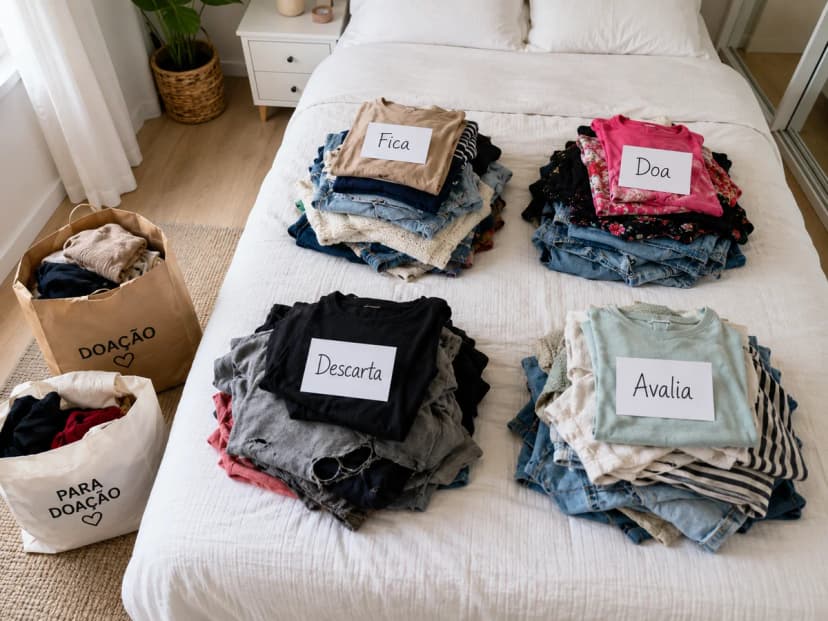
If you have more than these numbers, set aside a day for a sort-through. Donate what is in good condition, discard what has deteriorated. The space freed up in the closet is worth more than the sense of security that comes from having a "reserve."
If the excess came from a wedding registry or from purchases made before moving in together, the problem has a specific origin. How to put together a home trousseau for newlyweds explains how to avoid this pattern from the start.
Three situations I handled
In these three cases, the problem was in the system, not in the volume of linens.
14 bed sheet sets for three beds
A couple in Cambuci with a 3-year-old. Three beds, 14 sets in total: some from wedding gifts, some from clearance sales, some that came from their parents' house. There had never been a sort-through. When we emptied the closet, we found 4 sets with completely loose elastic and permanent stains the clients thought might still come out. They could not.
The mother hesitated before discarding two of the ruined sets. "We bought that one when we got married." I understand. But a set with loose elastic does not go back on the bed. It only takes up drawer space.
We settled on 3 sets per adult bed and 4 for the child's bed. A whole drawer in the closet was empty for the first time since they had gotten married. The "security" of having a reserve was taking up space with pieces that would never be used again.
The lesson: a linen reserve has value when the set is in usable condition. Otherwise, it is just occupied space.
The stack she could never finish digging through
In this case, the three sets were enough. The problem was in how they were stored.
A professional in Santana, a 50 m² apartment, one single bed. Three bed sheet sets stored in a stack. Every week she pulled everything out to find the right set. When she was in a hurry, she put the freshly washed one on top. The result: she always used the same set, the one on top, while the other two sank further and further to the bottom.
She told me she felt careless every week during that moment. The problem was a system that rewarded the set on top and buried the rest.
We introduced the pillowcase packaging method and rotation from the back of the shelf. Three weeks later she messaged me: "I never have to dig through the shelf anymore."
The lesson: a stack with no rotation picks a favorite by default. The rest sink further and further down until no one remembers they are there.
The family searching for a towel at 10 p.m.
When everything is centralized in the same closet, the home looks organized. Until you need a towel after ten at night.
A family in Lapa, three children, a four-bedroom, two-bathroom house. Linens centralized in the laundry room: towels from every bathroom, sheet sets from every bedroom, tablecloths. It looked organized because everything was together. In practice, anyone needing a towel after 8 p.m. had to walk through the whole house to fetch one from the laundry room.
The mother described what it was like: three children stepping out of the shower in different rooms, each one heading to the laundry room, her answering questions shouted from inside a bedroom. Every night. She blamed her children for being careless. The towel was simply far from where the kids needed it.
We decentralized: each bedroom's sheet set in that bedroom's closet, each bathroom's towels in the nearest closet. The laundry room became the spot for extra stock and seasonal items. Two weeks later the mother called me: "Everyone stopped asking where the towel was."
The lesson: centralizing linens looks organized. When storage is far from the point of use, centralizing only lengthens the path.
Where to store: the logic most people ignore
The rule for where to store is always the same: as close as possible to the point of use. The couple's bedroom sheet set stays in the couple's bedroom closet, not on the laundry room shelf. Bath towels stay in the bathroom closet or in the bedroom closet nearest the bathroom. Pool towels stay with the luggage, in storage.
The mistake of the centralized linen closet
Many homes have a hallway or laundry room closet where everything goes: sheet sets from every bedroom, towels, dish towels, tablecloths. It looks organized because everything is together. But in practice, whoever needs to change a child's bed at 11 p.m. walks down the hallway to grab the set from the central closet, goes back to the bedroom, makes the bed, then comes back with the dirty sheets for the laundry room.
The system works better when linens are decentralized: each bedroom's sheet set stays in that bedroom's closet, and each bathroom's towels stay in that bathroom's closet. The central closet is reserved for extra stock and for occasional-use items (a party tablecloth, a guest bed sheet set).
Small apartment with no bathroom closet
When the bathroom has no closet, towels go in an open basket or in the closet of the nearest bedroom. What does not work is folding the towel and placing it on top of the toilet tank or any damp surface. A towel in a humid environment starts to smell quickly, even while clean.
Folding and packaging technique: how to find any set in 10 seconds
The most common problem with bed sheet sets on a shelf is how they are stored. Stacking without packaging creates an unstable pile where whatever you need is always at the bottom, and grabbing a specific set means disorganizing the whole stack.
The pillowcase packaging method
This is the method I use in every project. It works for any bed size and keeps the full set as a single compact unit.
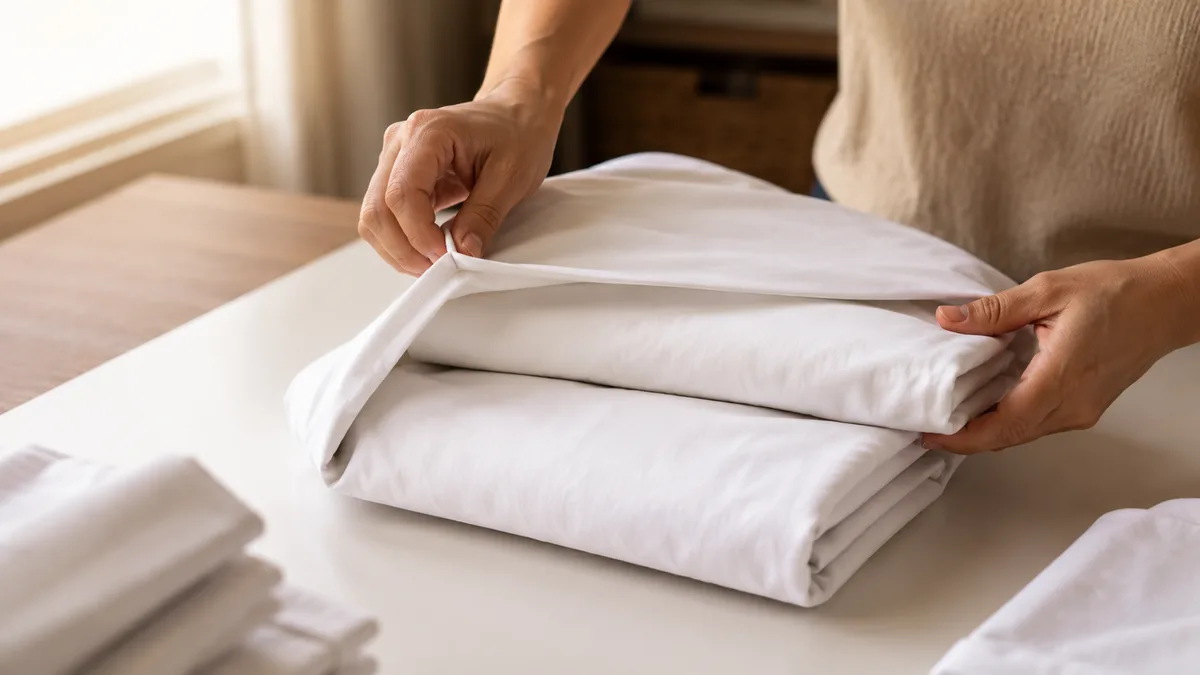
- Fold the fitted sheet into a rectangle, in half lengthwise and then in thirds
- Repeat with the top sheet, to the same size as the fitted sheet
- Fold the pillowcases in half lengthwise
- Take one of the set's pillowcases and keep it open
- Place the folded fitted sheet inside the pillowcase
- Add the folded top sheet on top
- Add the remaining folded pillowcases
- Close the outer pillowcase around everything, forming a package
- Store the package on the shelf with the pillowcase opening facing down
The result is a package the size of a pillowcase that holds the complete set. You can see at a glance how many sets you have. To grab a specific set, hold the package by the side and bring the whole thing out without disturbing the others.
How to store on the shelf to make the most of the space
Sheet set packages stand upright on the shelf, like books, with the pillowcase opening facing down. That way you see every package face-on and can grab any one of them without removing the others. If the shelf is tall, use two levels: couple sets on the bottom, single sets on top, separated by a label.
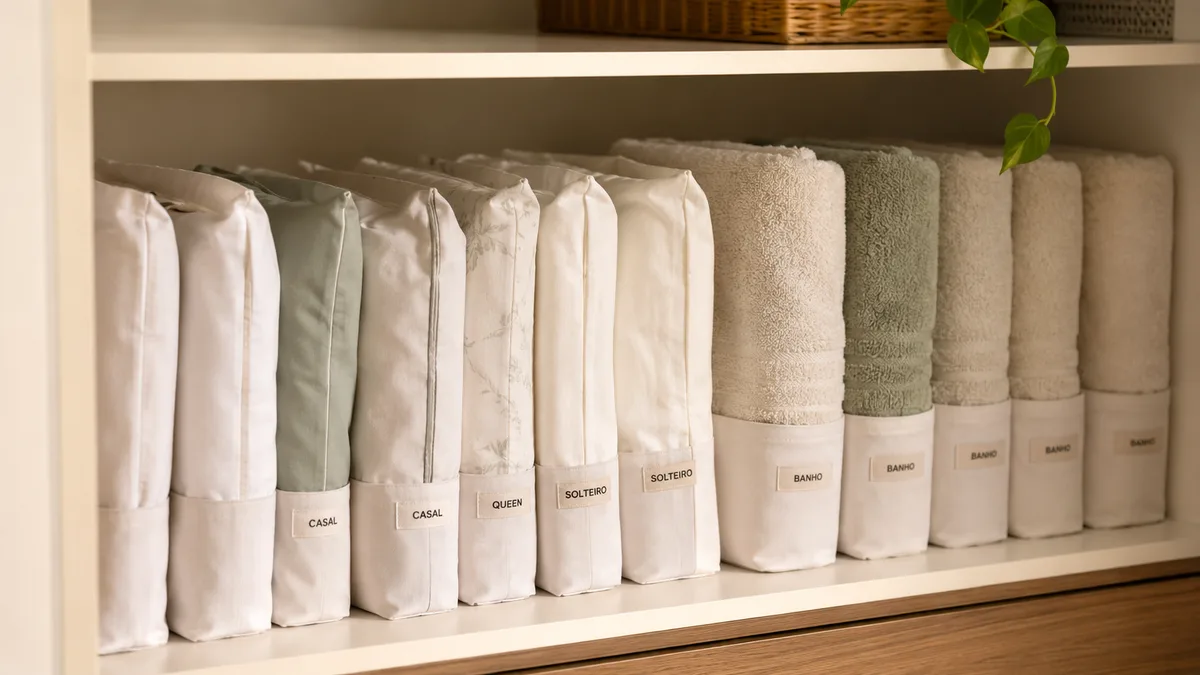
Linens organized by type, frequency of use and available space: no miracle folding trick, no impossible shelf.
See the linen organization service →Table and bath linens: the system based on frequency of use
Bath towels
Bath towels fall into three categories that need different spots: daily use (hung in the bathroom or on a hook in the bedroom), clean reserve (bathroom or bedroom closet), and pool or beach towels (with the luggage and outing gear, not in the bathroom closet).
Folding a towel for the shelf follows the same logic as a sheet set: fold in half lengthwise, then in thirds, and store upright. A towel stored lying flat in a stack makes it impossible to see how many you have without taking the stack apart. Upright, you see everything.
Table linens
Frequently used tablecloths stay near the dining table or in the kitchen closet. Party or occasional-use tablecloths stay in the linen closet, wrapped in a zip plastic bag or a fabric sack to prevent yellowing. Cloth napkins stay with the tablecloth they are used with, never mixed with everyday napkins.
Placemats are the item most likely to get lost. They always end up mixed with dish towels or bath towels. The solution is a dedicated box or basket just for placemats, inside the kitchen closet, on an easy-to-reach shelf.
Dish towels and oven mitts
The dish towel is the highest-turnover item in a home's linen collection. A damp dish towel builds up bacteria in under 24 hours, so a daily change is not overkill. With a daily change, you need at least 7 clean towels available per week. Store the clean ones in an easy-to-reach drawer near the sink.
Rotation and maintenance: how to extend the life of your linens
Linens that stay in the same stack age unevenly. The sets on top get used frequently and wear out faster. The ones at the bottom go months without coming out and deteriorate from lack of use and the weight of the pieces on top.
A simple rotation system
After washing and folding a set, place it at the back of the shelf, not at the front. The one at the front is always the oldest, the one that goes on the bed next. The freshly washed one goes to the back. With this cycle, every set in the house gets equal use and wears evenly.
For bath towels, the same principle applies: the freshly washed towel goes to the back of the shelf or to the least-used hook. The one on the main hook moves to the closet as a reserve.
A twice-yearly linen review
Twice a year, review everything: check the elastic on fitted sheets (if it has lost tension and no longer stays on the bed, it is time to replace it), assess permanent stains, check the condition of your towels (a towel that no longer absorbs after washing has fabric saturated with fabric softener and needs to be discarded). This twice-yearly review avoids surprises when you need a clean bed sheet set and discover half your linens are unusable.
Frequently asked questions about organizing bed, table and bath linens
How many bed sheet sets do I actually need?
For a couple with no children: 3 sets per bed. For a family with a small child or baby: 4 to 5 sets for the child's bed, because accidents and nighttime vomiting call for a quick change. For a guest room used occasionally: 2 sets are enough. Above these numbers, you are storing linens you never use and taking up space with pieces that may be deteriorating unseen.
How do I store a bed sheet set without it falling apart when I grab it?
Fold the top sheet and the fitted sheet into rectangles of the same size. Fold the pillowcase in half lengthwise. Place the fitted sheet, the top sheet and the pillowcases inside one of the set's pillowcases, folding everything together into one compact package. That way the whole set stays in a single unit that will not come apart on the shelf. To grab it, you hold the outer pillowcase and the entire set comes with it.
Where should I store bed linens in a small apartment?
The best options in order of practicality: the top section of the closet in the bedroom where the bed is (logical, close to where it is used); the hallway closet, if there is one; under the bed with a sliding-lid storage box (good for seasonal items you use less often); and the bottom drawer of a wardrobe, if there is space. What to avoid: storing in two different places, because you will always forget where the set you are looking for is.
How often should I change towels and bed sheets?
Bed sheets: a weekly change is the standard recommended by dermatologists. With 3 sets per bed, you use one, wash one and keep one in reserve. Bath towel: every 3 to 4 uses, or twice a week. Face towel: every 2 days. Dish towel: daily or after each use. Tablecloth: weekly, or after each use if it gets stained. These intervals keep things hygienic without wearing out your linens faster than necessary.

About the author
Silvana Santanna →Personal Organizer in São Paulo, specialized in residential move organization and functional organizing projects for homes, closets, kitchens, trousseaux and home offices. Creator of the Casa Pronta™ Method, with more than 100 projects completed across São Paulo and the greater metro area.
Ready to have your home organized
without lifting a finger?
Project assessment visit.