How to Organize a Small Closet in a São Paulo Apartment: What Stays and What Goes
The built-in closet the builder hands you has a single high rod, shallow drawers and an overhead cabinet out of reach. How to use all three, and how to decide what stays.
Neste guia você verá:
- 01The test that tells you the closet is too full
- 02What the builder hands you, and what to do with it
- 03The criteria for what stays and what goes
- 04Vertical folding: the answer to a shallow drawer
- 05Zoning the single rod
- 06Storing off-season clothes with no attic
- 07Which space maximizers are actually worth it
- 08The rule that keeps everything organized
The test that tells you the closet is too full
Slide your hand between any two hangers on the rod. If it glides through without force, the rod still breathes and the problem is one of method. If you have to push pieces aside, the rod is past its limit, and at that point no organizer helps. Do the same with a drawer: if you have to compress it to close it, the volume is already above real capacity.
When someone calls me complaining about a small closet, the first thing I ask for is a photo. And what shows up is almost never a closet that is too small. It is a closet with too many clothes.
The distinction matters because it defines the way out. If it were size, the answer would be new cabinetry or a different home. Since it is volume, the solution does not involve renovation.
The most expensive mistake is buying organizers before decluttering. Baskets, boxes, dividers, an extra rack: all of it pushes the problem forward, and the closet falls back into chaos within two weeks. The correct order is always declutter first, organize after, because only then do you know what you need to buy, if you need to buy anything at all.
What the builder hands you, and what to do with each part
Nearly every new 60 to 90 m² apartment in São Paulo is sold with built-in bedroom cabinetry, and it repeats the same design: a single high rod, shallow drawers in the center column, and a closed overhead cabinet at the top. The design looks good on the floor plan and creates three dead zones in real life. Each one has a specific fix.
The single high rod
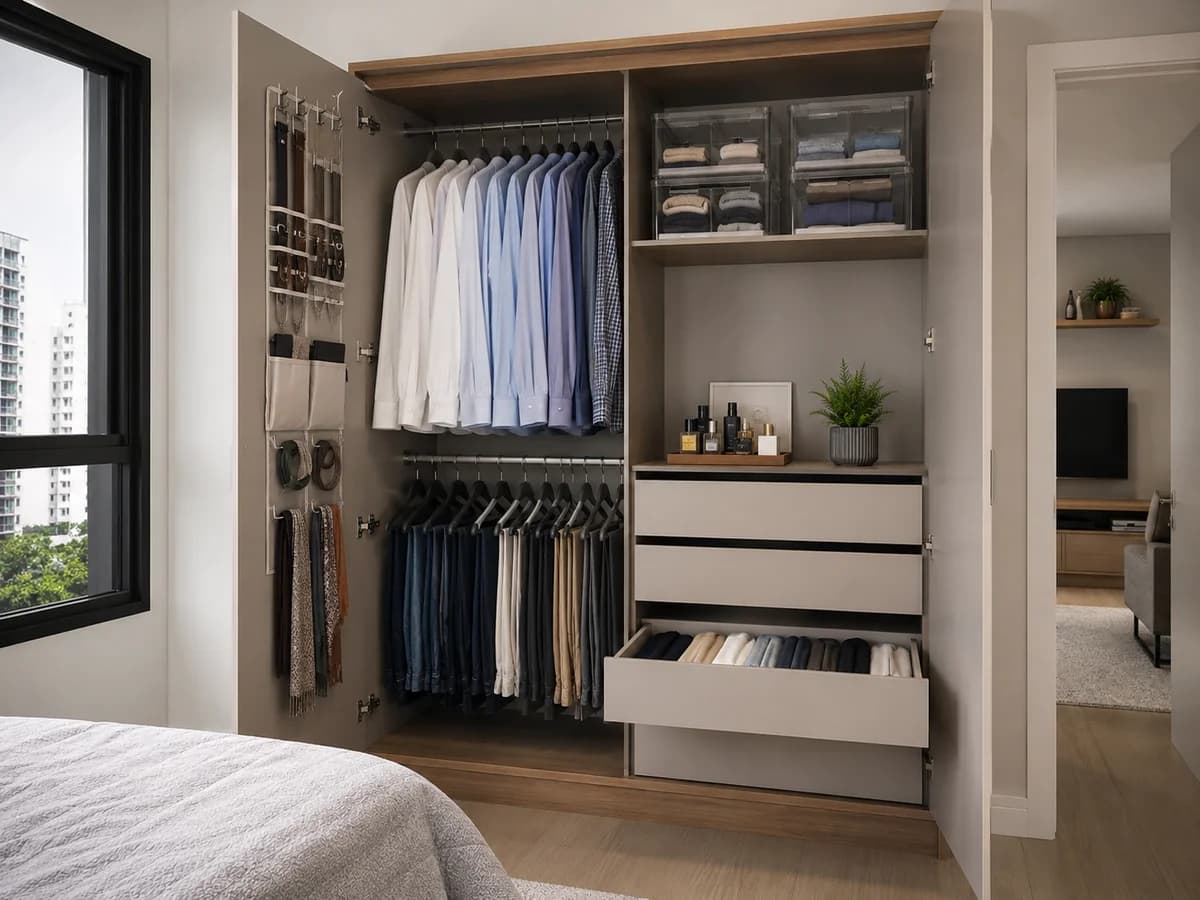
The rod height is calculated for long dresses and coats. T-shirts, shirts and blazers take up a little more than half of it, and below their hems an entire band of air is left over. That band is the biggest gain available in the closet and it costs no renovation: a second rod hanging from the original, along the stretch of short pieces, doubles the hanging space. Measure the clear height between the rod and the closet floor first, because that is what decides whether the lower pieces drag.
The shallow drawer
Builder-grade drawers tend to be shallow on purpose, so more of them fit in the column. A stack of t-shirts does not work there: either you stack low and waste the area, or you stack to the rim and the drawer will not close. It is exactly the scenario where vertical folding pays off most, which is why it gets a whole section further down.
The overhead cabinet out of reach
The overhead cabinet is the top section you can only reach from a step ladder. That alone is why it becomes a dead archive: things go in and never come out. The rule that keeps it useful is simple. Only what is light, bulky and seasonal goes up there, always in a box with a handle and a front label you can read from the floor. If you have to climb to find out what is in there, the label failed.
The blind band behind the hangers
Closet depth is greater than the shoulder of a hanger, which leaves a band behind the hanging clothes. It is no good for clothes in use, because you cannot see what is there, but it handles flat seasonal boxes well, laid down with the label facing out.
The criteria for what stays and what goes
Decluttering is the part people resist the most and, paradoxically, the one that transforms the most. It is not an exaggeration to say clients who declutter seriously solve 70% of their space problem before they even touch an organizer.
In an apartment, these criteria have to be harsher than in a home with an attic, a basement or a guest closet. The bedroom closet is the entire storage of the property. Everything sitting in it occupies the place of a piece you actually wear.
How to audit your closet
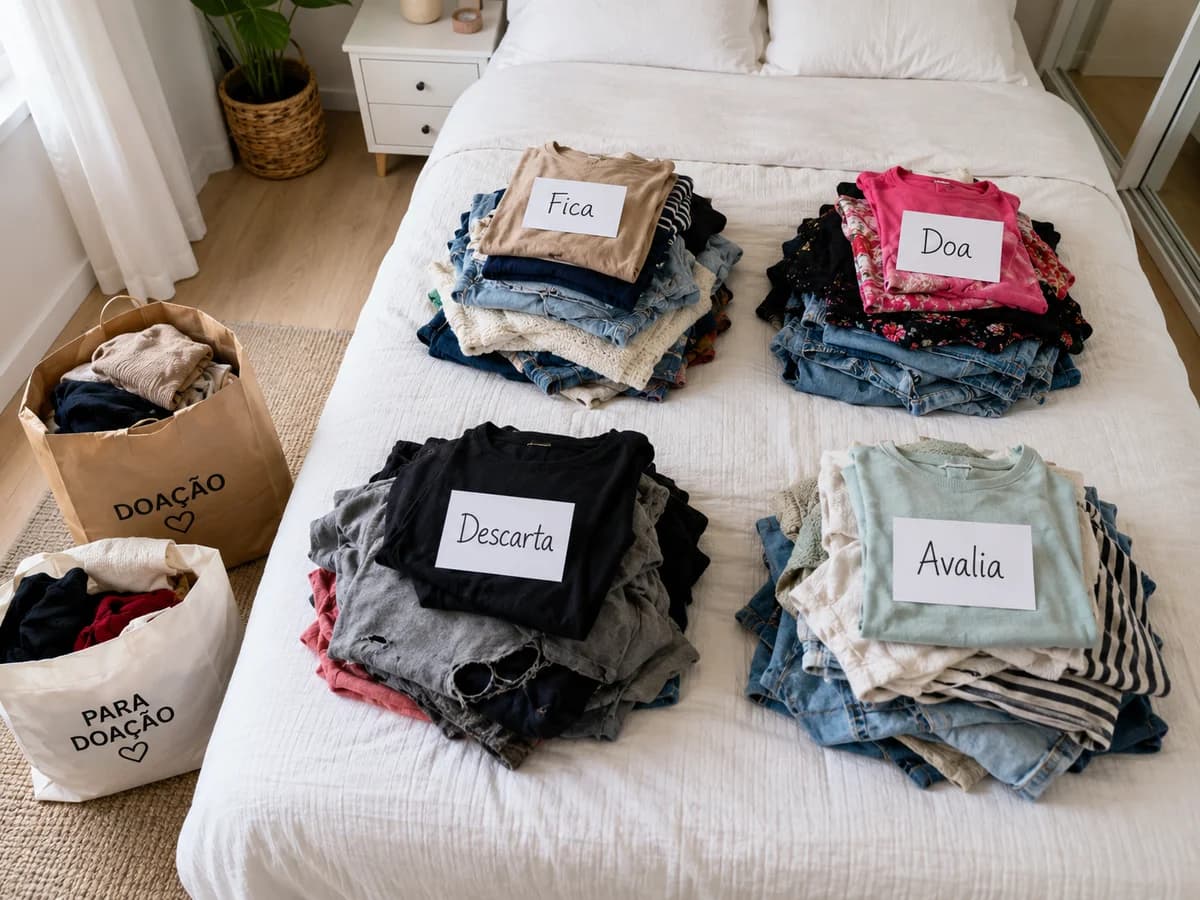
Set aside a stretch of free time: a full audit takes between 2 and 4 hours depending on how many clothes you have. Take everything out: off the rod, out of the drawers, off the shelves, out of the overhead cabinet, out of the band behind the hangers. Everything. Put it on the floor or on the bed.
Now create four distinct groups:
- Keep: clothes you wear, that fit you well today, that are in good condition, and that make sense for your current lifestyle.
- Donate: clothes in good condition that you no longer wear. These can go to a thrift shop, a donation center, someone you know, or resale platforms.
- Discard: worn out clothes, torn pieces, permanent stains, socks with holes, old underwear. These go straight to the trash.
- Undecided: pieces that raise doubt. Try them on. If it does not look good today, not "when I lose weight," not "for some future occasion," but today, the piece goes to donation.
The three questions that decide each piece
- Have I worn it in the last 12 months?
- Does it fit the body I have today?
- Does it have a place in my real routine, not an imagined one?
- If it stays, am I willing to give up another piece for the same rod space?
The 12 month rule is the clearest one: if you have not worn it in 12 months, you will not wear it. There are legitimate exceptions: formal wear for graduations and weddings, a piece with real sentimental value (not attachment out of guilt for having paid a lot for it). But limit exceptions to 5 pieces at most. More than that is an excuse.
An important point for anyone living in São Paulo: the city's winter is much milder than the collective imagination suggests. Temperatures below 15°C occur on average for only 10 to 15 days a year. If you have 5 heavy wool coats for a climate that calls for them less than two weeks a year, there is real excess volume for the actual use. One mid-layer knit, one light jacket and one heavy coat cover the city's routine.
Only after decluttering: count what is left, measure the space available in the closet, and decide what, if anything, you will need to buy to organize what remains.
Someone who opens a full closet and stands in front of it not knowing what to wear is not without clothes. They are without access to what they have.
In a 55m² apartment in Vila Madalena, I worked with a client who would open her closet in the morning, stand in front of it for two minutes, and close it again without picking anything. The closet had two doors and 87 hanging pieces, double what the space could hold comfortably. Clothes from three different phases of her life: internship, first job, current routine. Many still had tags on. Pants that had not fit in three years, t-shirts that had become rags but stayed "just in case."
We spent three hours sorting. The criteria: did you wear it in the last 12 months? Does it fit today? The rod went from 87 down to 34 pieces. She did not need to buy a single organizer. What changed was being able to open the closet and see everything at once, without having to flip through it all.
The takeaway: a closet that seems to have no more room almost always has too many clothes that are not being worn. Sorting reveals how much space exists before any organizer. It usually also reveals that the problem was never the size of the closet.
A small closet with too much stuff is not a wardrobe problem. It is a method problem. The method exists.
See home organization services →Vertical folding: the answer to a shallow builder-grade drawer
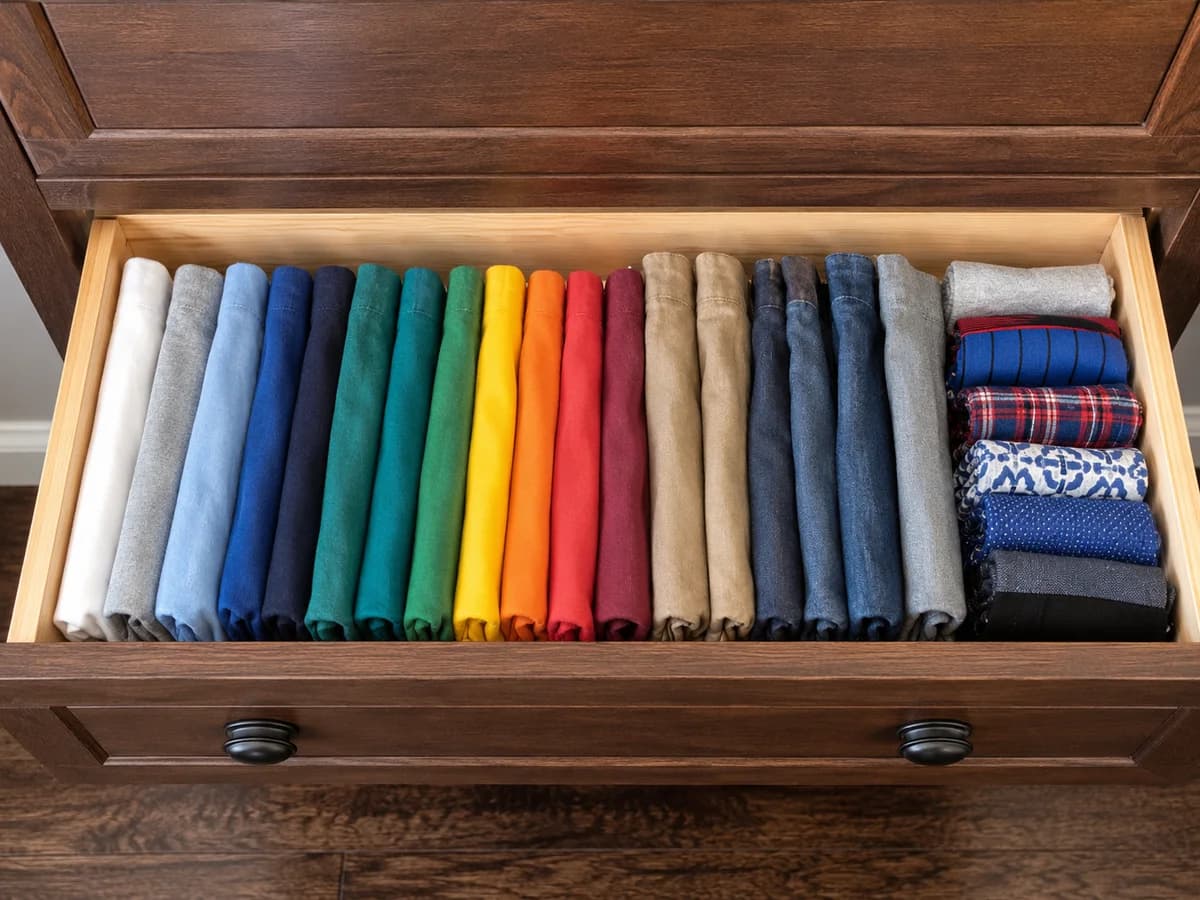
Vertical folding, popularized by Marie Kondo, is what impresses clients most the first time they see it. A drawer that used to hold 8 stacked t-shirts ends up holding 20, 22, sometimes 24 pieces, all visible at once.
In a shallow drawer, the standard in apartment cabinetry, the gain is bigger still, because a tall stack is exactly what does not fit there. A piece standing upright uses the drawer's depth, which exists, instead of its height, which does not.
Why stack folding does not work
With traditional folding you only see the piece on top. Every time you need a specific t-shirt you go through 5 or 6 others to reach it, and the drawer stays in permanent disarray. Vertical folding solves this: each piece stands upright like a file in a filing cabinet, all visible at once, and you pull out any one without moving the others.
A t-shirt drawer is usually not too full. It is just folded the wrong way.
In an apartment in Consolação, the husband said that every morning he pulled out a t-shirt and dug through the whole drawer to find the right color. They had 28 t-shirts stacked in two drawers, the way stores display them. The pile reached the top edge. The wife reorganized it every week.
I taught them vertical folding that same day. His 28 t-shirts plus her 12 fit into a single drawer, all standing up and visible at once. The second drawer became shorts and pajamas. The husband grabbed the right t-shirt on the first try, without removing anything on top of it. The wife stopped reorganizing.
The takeaway: stack folding creates the problem. Every piece you pull out disrupts everything underneath it. Vertical folding eliminates that because you pull out one piece without touching the others.
How to fold vertically: step by step
Here is how to do it with a basic t-shirt, the most common item and where the difference is most visible:
- Step 1, lengthwise fold: with the piece laid flat, fold one side toward the center, bringing the sleeve with it, and repeat on the other side. The t-shirt ends up about 10 to 12 cm wide.
- Step 2, hem fold: fold the bottom hem toward the collar, stopping about 3 cm short of the neckline.
- Step 3, thirds fold: fold again into two or three thirds, until the rectangle is firm enough to stand on its own. If it tips over, it is too big. Fold it once more.
- Step 4, balance test: stand the rectangle up on the table. If it holds itself up, it is folded right. In the drawer, the pieces lean on each other.
Which pieces to fold vertically
- T-shirts, blouses and shirts (without delicate buttons)
- Shorts
- Pants folded in quarters (do not hang jeans, they are better off folded vertically)
- Underwear (folded into rectangles, not rolled up)
- Socks (folded flat, one on top of the other, never rolled into a ball, which stretches the elastic)
Thick sweatshirts and knit sweaters are the exception: vertical folding may not work well with very thick fabrics that do not hold their shape. For these, a shelf with a low stack (4 pieces at most) works better.
How do you zone a single rod?
The rod is where most people struggle the most to keep things in order, because it is also where clothes "temporarily" land before being washed, and where pieces out of place pile up without anyone noticing. For anyone sharing a closet with a partner, the first decision is splitting by person: each one has a defined section before categorizing. See the complete method in how to organize a shared bedroom, including how to split a closet without conflict.
Organize by category, then by color
The most functional way to divide the rod starts by category of use, from left to right:
- Casual: everyday shirts, blouses, frequently worn pieces
- Work / social: blazers, dress shirts, fabric pants
- More formal pieces: party dresses, suits, occasion wear
- Coats and jackets: at the end of the rod, since they are bulkier
Within each category, organize by color from lightest to darkest. The result looks visual, but it has a practical function: you find any piece in seconds without having to flip hanger by hanger.
Group the short pieces into one continuous stretch of rod rather than scattering them. That continuous stretch is what lets you install the double rod underneath without cutting into the space for long pieces.
Matching hangers: the detail that changes everything
Mismatched hangers (the thick plastic kind from the supermarket mixed with wooden ones, wire ones, dry cleaner hangers) create visual chaos and waste space. Each thick plastic hanger takes up about 2 cm. A slim velvet one takes up 0.5 cm. On a 1 meter rod holding 40 pieces, that difference adds up to 60 cm of free space, the equivalent of 10 to 15 extra pieces. Non-slip velvet also solves the t-shirt that keeps sliding off the hanger.
The double rod: the biggest gain in a builder-grade closet
For short pieces (shirts, blouses, blazers, jackets), you are only using half the available height on the rod. The bottom part, below the hems, is dead space, and it is the easiest dead space to recover in the entire bedroom.
The solution is to install a second rod below the original one. There are rod extenders, metal or acrylic bars that hang from the original rod and create a second rod below it, sold at any organization store. Install one along the stretch of short pieces and you will have created 50 to 60 cm of extra hanging space, with no screws, no renovation, no carpenter. Measure the clear height down to the closet floor first: that is what decides whether the lower pieces drag.
What should not stay on a hanger
- Knits and heavy sweaters: the hanger stretches out the shoulder of the piece over time. Knits belong folded on a shelf.
- Jeans: they take up too much room on the rod and are better off folded vertically in a drawer or on a shelf.
- Damp or slightly wet clothes: mold and odor, guaranteed, and in São Paulo that happens fast between October and March.
Where off-season clothes go in an apartment with no attic or basement
Seasonal rotation means moving off-season clothes to secondary storage and handing that space back to the active closet. In a four-season city, this is obvious. In São Paulo the practice gets skipped, and the closet loses 20 to 30% of its space all year round. Once the pieces are separated, it is worth checking how to store winter clothes without ruining them, because the wrong packaging ruins more coats than moths do.
The difference is that an apartment has no attic, no basement and rarely a spare storage room. There are three possible destinations, and each takes a type of piece:
- The overhead cabinet: for what is light and bulky, like a duvet or a heavy knit coat. Use a box with a handle and a front label you can read from the floor, because you will reach it from a ladder and you do not want to discover the contents on the way up.
- Under the bed: flat boxes with lids, never loose pieces, and never the plastic dry cleaner bag, which traps moisture. Wash pieces before storing them: starch and grease attract insects.
- The garage storage unit: only what is not natural fabric, in a closed plastic bin raised off the floor, on a pallet or shelf. The unit has no ventilation and moisture rises from the slab. Wool, cotton and linen should not go down there.
São Paulo's real seasons
In practice, São Paulo has two climate seasons that matter for your closet:
- Warm season (October to March): light clothes, beachwear, linen and thin cotton pieces, sandals and open shoes.
- Less warm season (April to September): one extra layer of knit, light jackets, closed sneakers. São Paulo's "winter" rarely calls for more than that.
Heavy wool coats, gloves, beanies and scarves are worn in São Paulo for at most 10 to 15 days a year, during the cold snaps that arrive in June and July. These pieces do not need to take up space in your active closet all year long.
When to make the swap
Twice a year: in October, at the start of the heat, and in May, at the start of the cooler period. For bulky pieces, vacuum compression bags reduce volume by 50 to 70%, which makes a real difference in the overhead cabinet. A well-done rotation frees up 30% of your active closet space, without discarding a single piece and without buying a single extra organizer. It is the fastest space gain there is, and the only one that asks for nothing in return.
Which space maximizers are actually worth it
After decluttering, vertical folding, and zoning, if you still feel like you are short on space, these are the items with the best return for a built-in closet in a São Paulo apartment. Each one solves a specific dead zone of builder-grade cabinetry:
What is actually worth it
- Double rod extender: recovers the band below the short pieces and creates 50 to 60 cm of extra hanging space. It is the smallest investment on this list and the one with the biggest return.
- Drawer dividers: turn a shallow drawer into spaces organized by category and keep vertical folding from collapsing over time. Immediate visual and practical impact.
- Stackable clear storage boxes: for the overhead cabinet and the band behind the hangers. They store seasonal pieces and occasional-use items with full visibility of the contents.
- Acrylic shoe racks: stack 4 to 6 pairs in the space of 1 pair in a box. They solve the closet floor when there is no shoe niche, as the guide to organizing shoes in an apartment explains.
- Over-the-door organizer: pockets or hooks fixed to the inside face of the closet door. Ideal for belts, scarves, and flat shoes. For storing bags in the closet without them losing shape, the method by material and frequency of use makes a difference. Check that the door still closes with the organizer full.
What is not worth it
- Opaque decorative baskets: if you cannot see what is inside without opening it, you will forget it is there. The contents turn into a pile of random items.
- Any organizer bought before measuring: the most beautiful product in the world does not work if it does not fit your space. Always measure before buying: available width, depth and height.
- External garment racks as a permanent solution: these can work as a temporary fix during reorganization, but in most rooms I see them in, they became permanent. In an apartment bedroom, a rack also steals circulation space, and that costs more than the space it gives back.
What is the rule that keeps a closet organized over time?
Organizing a closet once does not solve the problem forever. What keeps the system working for months and years is a set of simple habits, practiced consistently.
One in, one out
This is the most important rule for anyone with a small closet: every time a new piece comes into the house, one goes out. No exceptions. Bought a new t-shirt? An old t-shirt goes to donation. Got a clothing gift? A piece you wear the least goes away.
This rule sounds simple, but it is powerful because it prevents the gradual buildup that happens without you noticing. In 12 months without this rule, an organized closet accumulated on average 20 to 30 pieces that "just came in."
Five minutes a week and a check at 90 days
Once a week, at the same time you put away clean laundry, put back any piece that is out of its zone and run the hand test again on a stretch of rod. It warns you before the closet reaches the overflow point. At 90 days, do a bigger check: whatever you thought you would wear and did not goes to donation, and any zone that caused friction in daily use gets reviewed.
A reorganized closet that falls back into chaos within a few months almost always has the same cause: new pieces coming in with none going out.
A teacher in Ibirapuera called me because her closet had gone back to chaos eight months after an organization done by another consultant. She thought the system had not worked. When we opened it, the system was intact. What had changed: 31 new pieces had come in since the organization. None had gone out. Sale purchases, some still with the tag on. "I bought it because it was cheap" described most of them.
We decluttered the new pieces plus the corresponding older ones that had lost their place. We stuck a post-it on the inside of the closet door: "Did something new come in?" The closet went back to its organized state without needing a whole new session.
The takeaway: organization does not maintain itself. The folding method and the zoning matter, but what makes the system last is the habit of controlling what comes in.
A small closet is one of the space types covered in the closet and clothes organization guide, which also covers a planned walk-in closet, a shared bedroom, shoes, bags and accessories.
Frequently asked questions about a small closet in an apartment
How do you know when a closet is too full?
There is a physical test that saves you from counting: slide your hand between any two hangers on the rod. If it glides through without force, the rod still breathes. If you have to push pieces aside, the rod is past its limit, and no organizing technique fixes that. The same goes for a drawer: if you have to compress it to close it, the volume is above real capacity and the folding will collapse within days.
What do you do with the dead space below the rod in a builder-grade closet?
The cabinetry that comes with the apartment usually delivers a single high rod, good for long dresses and coats and useless for t-shirts and shirts, which take up half that height. Install a second rod hanging from the original, under the stretch of short pieces. You double the hanging space with no drilling and no renovation. Measure the clear height between the rod and the closet floor first, because that is what decides whether the lower pieces drag.
Where do you store off-season clothes in an apartment with no attic or basement?
There are three destinations and each has a rule. The overhead cabinet takes what is light and bulky, in a box with a handle and a front label, because you will reach it from a step ladder. The space under the bed takes flat lidded boxes, never loose pieces. The garage storage unit takes only what is not natural fabric, in a closed plastic bin raised off the floor, because it has no ventilation and moisture rises from the slab. Wash everything before storing it.
How many winter coats make sense if you live in São Paulo?
Fewer than most closets hold. Winter in São Paulo is mild: temperatures below 15°C occur on average for only 10 to 15 days a year, concentrated in the cold fronts of June and July. One mid-layer knit, one light jacket and one heavy coat cover the city's real routine. Everything else occupies, all year long, the rod space a piece you actually wear would need.
Want professional help?
A closet organized by a personal organizer in São Paulo
A system tailored to your real routine, and to the cabinetry your home already has. Silvana Organizer serves São Paulo and the surrounding area.
Request an AssessmentServing São Paulo and the surrounding area

About the author
Silvana Santanna →Personal Organizer in São Paulo, specialized in residential move organization and functional organizing projects for homes, closets, kitchens, trousseaux and home offices. Creator of the Casa Pronta™ Method, with more than 100 projects completed across São Paulo and the greater metro area.
Related posts
How to Organize a Closet for Good: 4 Zones That Stay Tidy for Weeks
12 min · Read article →
How to Organize Shoes in a São Paulo Apartment Without Mold
10 min · Read article →
How to Organize Bed, Table and Bath Linens: A Professional Guide
11 min · Read article →
Ready to have your home organized
without lifting a finger?
Project assessment visit.