How to Organize a Closet Once and For All: The Method That Actually Lasts
The professional method for organizing a closet that stays organized for real, not just for a week.
Neste guia você verá:
Have you ever organized your closet over a weekend, felt satisfied with the result, and two weeks later found it a mess again? That is not a lack of discipline. It is a lack of method.
After organizing hundreds of closets in São Paulo, I learned one thing: most people organize to take a photo. They stack everything neatly, buy matching little boxes, fold clothes upright. It looks beautiful for a few days. But the system does not survive the real routine: the rush of a Monday morning, the outfit you try on and never wear, the new piece that has no defined home.
In this guide, I will walk you through the method I use with my clients: an organization that works in real life, not just in the photo.
Why does the closet go back to being messy even after it is organized?
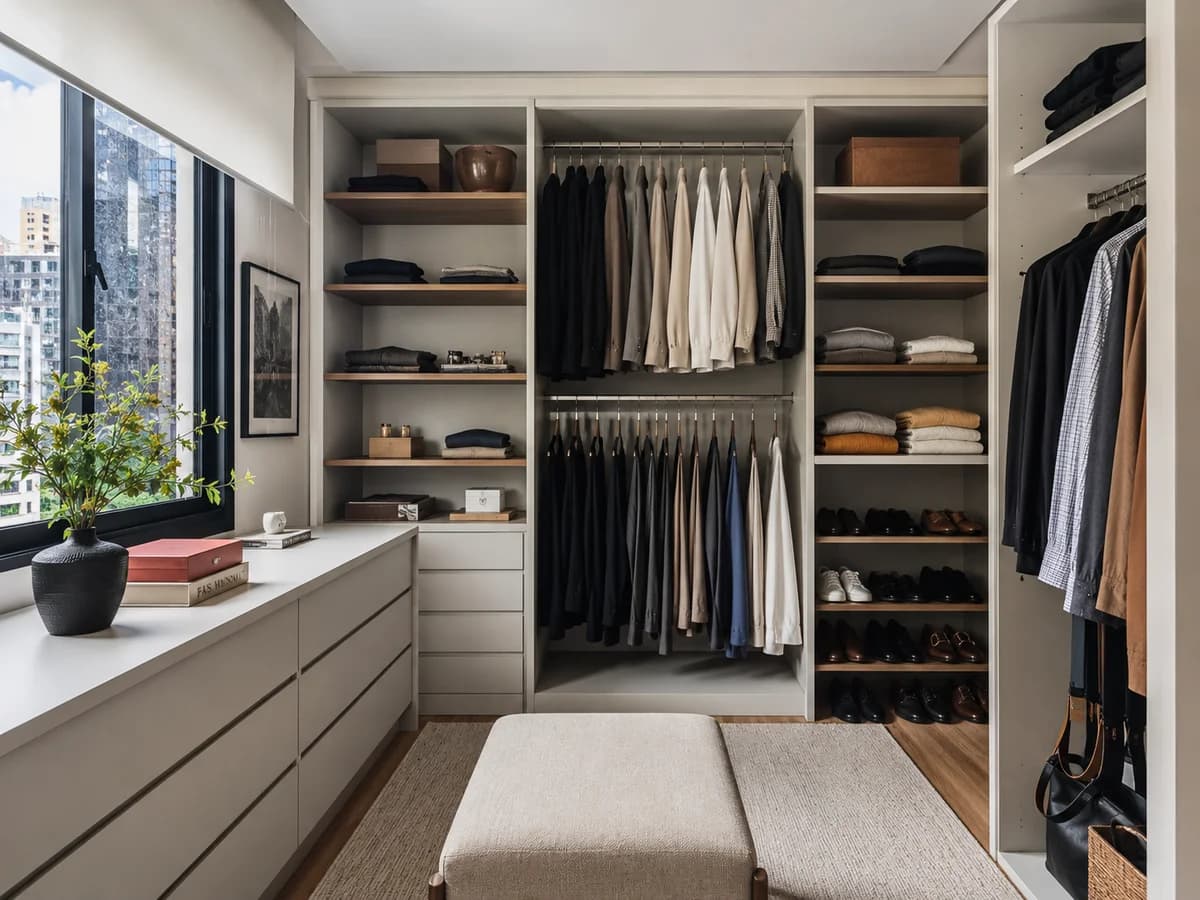
Three main reasons: too much volume (more clothes than the available space can hold collapses any system), aesthetic organizing instead of functional (sorting by color does not reflect how you actually use your clothes), and no fixed home for each item. Without a permanent spot for every piece, clutter is the inevitable result.
Organizing without a method is just tidying up temporarily. There are three reasons closets fall back into chaos:
- Too much volume: when you have more clothes than the space can hold, any system collapses. No organization can hold 80 pieces in a space meant for 50.
- An aesthetic system, not a functional one: organizing by color looks nice, but it does not reflect how you use your clothes. You do not think "I will grab something blue." You think "I need a blouse for a meeting."
- No "fixed homes": when each piece does not have a specific, permanent spot, everything ends up wherever. Clutter is the natural result of a system with no defined addresses.
Three attempts in four years, three different systems. The closet went back to chaos in under two weeks each time.
In a 110-square-meter apartment in Jardins, a client called me because her closet had been organized three times in four years. Each attempt used a different system: by color, by piece type, by length. She told me she felt embarrassed when guests asked about the closet; it was the only room in the house she could not figure out how to fix. I looked at the closet and understood the pattern in minutes: work blouses sat in a section sorted by color, which meant walking through half the closet just to put together an outfit. Gym clothes and sleepwear shared the same shelf. Every morning turned into an investigation. We reorganized by frequency of use and context: work, casual, gym and home in separate sections, at the height each group deserved. Within two weeks, she told me she was getting dressed seven minutes earlier every day. The three previous systems had looked good; the fourth one worked in the morning.
Why is decluttering mandatory before you start?
Because without decluttering, you organize unnecessary volume, and any system collapses under the excess. Take everything out of the closet, sort it into keep, donate and discard. Only after getting rid of what you do not use will you know the real available space and which organizers to buy.
This is the step most people skip, and the reason the result does not last. There is no such thing as efficient organization with excess volume.
Before you touch a single storage box, empty the whole closet and sort every piece into four categories:
- Keep: I wear it regularly and feel good in it
- Donate: it is in good shape, but I have not worn it in over a year
- Discard: it is damaged, stained or too worn
- Unsure: put it in a separate box for 30 days; if you did not miss it, donate it
Rule of thumb: if you did not wear a piece in the last year, the chance you will wear it next year is very low. The exception is clothing for specific occasions (graduation, a wedding, a gala event): those deserve a dedicated spot set apart from the rest.
A closet organized by a professional has a detail that DIY rarely captures: the system is built around the person who uses it, not around how it should look.
See the residential organization service →How does the 4-zone method work for dividing your closet?
After decluttering, the organization follows a simple logic: the more you use something, the more accessible it needs to be. Split the closet into four zones:
Zone 1: Daily use (at eye and hand height)
This is where the pieces you wear every week go: work blouses, everyday pants, daily clothes. This space should be the most accessible, clear and visible in the closet. No stacking, no squeezing things in.
Zone 2: Frequent use (shelves and center drawers)
Clothes you wear a few times a week: gym clothes, pajamas, loungewear, underwear. These should be organized by category, not mixed together.
Zone 3: Occasional use (high or low shelves)
Clothes you wear once a month or less: party dresses, suits, special blazers. These can stay on hangers, but in a space separate from the daily zone.
Zone 4: Seasonal storage (outside the closet or at the very top)
Winter clothes in summer (and vice versa). These should be kept in labeled boxes, ideally with a photo of the front so you know the contents without opening them. Vacuum-seal bags work well if you have limited space.
Hangers or folded? The right answer for every piece
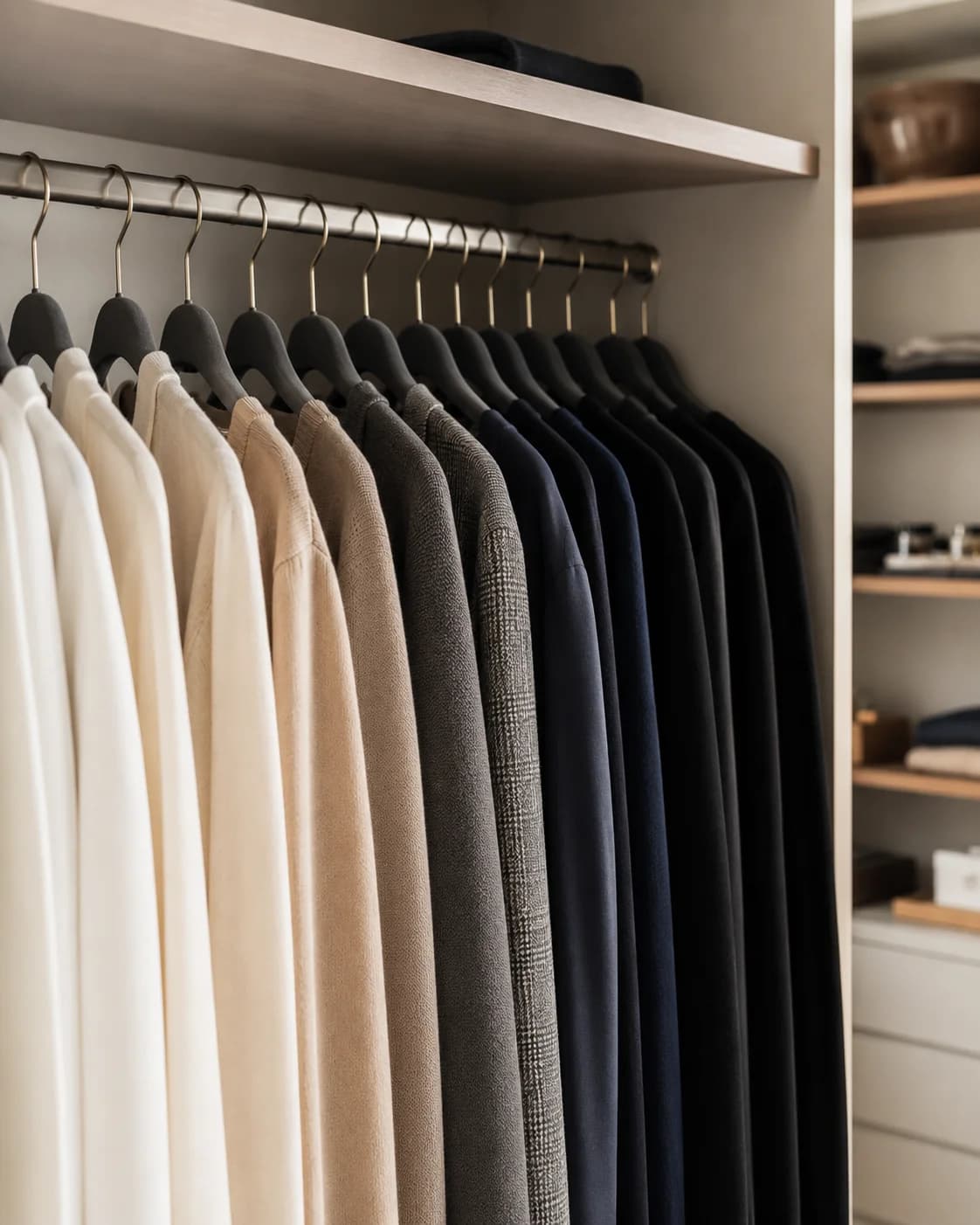
Pieces that wrinkle go on hangers: blouses, shirts, blazers, dresses and dress pants. Knitwear, t-shirts, sweatshirts and pajamas get folded on a shelf. Underwear and socks go in a drawer. The rule is simple: a hanger preserves the drape; folding saves space for pieces that do not lose their shape.
There is no universal answer, but there is a logic:
- On a hanger: blouses, shirts, blazers, dresses, dress pants, jackets and anything that wrinkles easily.
- Folded on a shelf: t-shirts, knitwear, sweatshirts, shorts, gym clothes, pajamas.
- In a drawer: underwear, socks, small accessories.
- Hung on the door or on hooks: frequently used bags, belts, scarves. For a complete system on how to store bags in the closet without them losing shape, there is a dedicated guide on the topic.
The closet had 84 pieces on the rod. She regularly wore fewer than 30.
In a 92-square-meter apartment in Itaim Bibi, a client called me three months after renovating her closet. She had invested in a custom wardrobe, built-in lighting and glass shelves. She told me she still felt the closet was confusing every time she needed to get dressed, and thought she had planned the project poorly. There were 84 pieces on the rod and she regularly wore fewer than 30. The hangers were four different types: wire hangers from the dry cleaner, colored plastic ones, a few velvet. Work blouses shared the rod with party dresses and gym t-shirts. We swapped every hanger for the same model of thin velvet hanger. We split the rod into four sections: work, casual, party and gym, from lightest to darkest within each. Of the 84 pieces, 23 went to donation. With 61 pieces in defined sections, she told me she got dressed without needing to open two wardrobes to put together an outfit. The custom wardrobe became functional once we built the system inside it.
Internal organization: how to categorize so it actually works
Within each zone, organize by category of use, not by color, not by fabric type. The logic is always: how do you think when you are getting dressed?
Example categories for the daily zone:
- Work/meetings: dress blouses, pants, blazers
- Casual: t-shirts, jeans, light blouses
- Gym: leggings, tops, training shoes
- Home: comfortable loungewear
Within each category, you can then organize by color if you like, from lightest to darkest. This makes it easier to find the right piece without digging through everything.
If the closet is shared with a partner, define each person's section before categorizing. Splitting by person is the most important step in shared closets, and it goes beyond the wardrobe: see how to organize a shared bedroom completely, with the individual-territory method inside a shared space.
Drawers: the place organization always collapses first
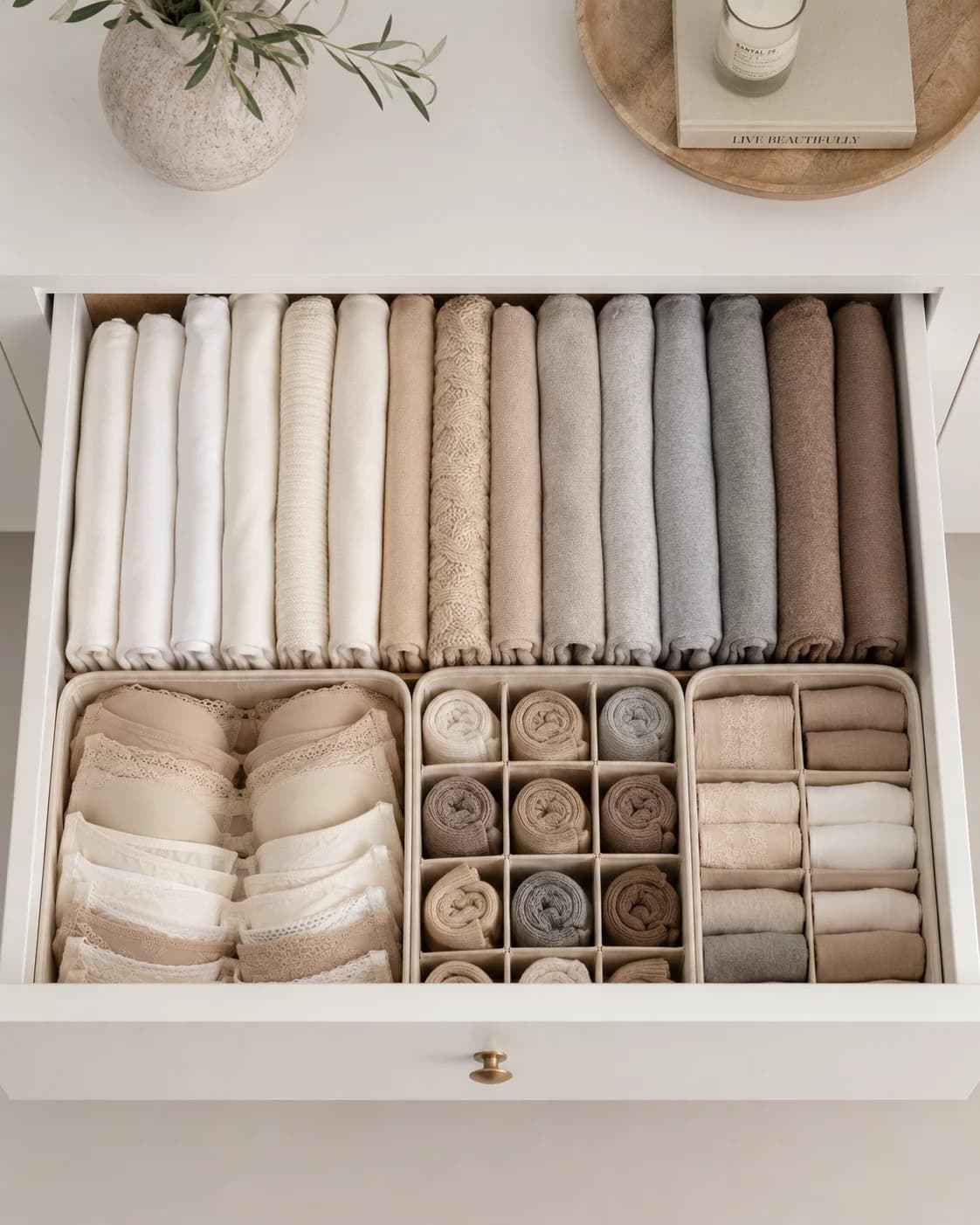
Messy drawers are not a laziness problem: they are a system problem. Without dividers, everything gets mixed together. The fix is simple: drawer dividers (cardboard or acrylic boxes work) and one rule: every category has its own fixed spot.
For underwear and socks, folding into a rectangle and storing upright (instead of stacking) completely changes the experience. You see everything at once, without digging through the whole drawer every time you need a pair of socks.
What are the most common closet organization mistakes?
The five mistakes that sabotage any closet: buying organizers before decluttering, keeping clothes "that might fit someday," mixing seasons in the same space, leaving items with no fixed home, and ignoring the inside of the closet door, which can double your available storage.
- Buying organizers before decluttering. You will end up organizing things you should not be keeping, and there will not be enough space for what actually matters.
- Keeping clothes that "might fit someday." If it does not fit now, it takes up space now. Donate it.
- Mixing seasons. Winter clothes in summer take up space that clothes you actually wear right now need.
- Leaving items with no "fixed home." "I will just put it here for now" is the start of every mess.
- Ignoring the closet door. The inside of the door is underused space. Hooks, over-the-door shoe organizers and door racks multiply your available storage.
The closet had room for 60 pieces. In March, winter clothes took up 40% of it.
In a 78-square-meter apartment in Higienópolis, a client called me because her closet had become too full just two months after being organized. She told me she felt overwhelmed at not being able to maintain the result, and thought she was simply the wrong person for systems. The closet held 90 pieces in a space meant for 60. Coats, wool pants and heavy knitwear took up half the rod in a warm month of March. Her daily clothes shared tight space with pieces she would not touch for the next five months. We separated the seasonal clothes into three boxes labeled with a tag and a photo of the front, stored at the top of the closet. With the season out, 52 pieces remained in circulation. She told me it was the first time in two years she could see every piece without moving another one out of the way. Separating seasonal clothes frees up more space than any amount of t-shirt decluttering would. The next step is the packing itself: see how to store winter clothes without creasing or molding them before you close the boxes.
How do you keep the closet organized day to day?
Maintenance is simpler than the initial organization, as long as the initial system is good. Three habits keep it going:
- The "one in, one out" rule: bought a new piece? Donate one you do not wear.
- Worn clothes go straight to the right spot (hanger, laundry hamper), never on a chair or the bed.
- Quarterly review: every 3 months, spend 30 minutes reviewing what is piling up and not being used.
When is it worth hiring a personal organizer for your closet?
It makes sense to hire a personal organizer when:
- You have already tried organizing it yourself and the result did not last;
- You are moving and want to arrive at the new home with everything in place;
- You struggle with decluttering (a personal organizer helps with that process without judgment);
- The closet is large or complex and you do not know where to start;
- You want a professional, lasting result, not a temporary tidy-up.
If the method made sense to you, the next step is to see how it applies to your own space.
Learn about the service →Done with the closet? The natural next step is organizing the small wardrobe with the same decluttering and vertical-folding method, and setting up a solution for shoe organization within the system. For a full view by space type, by item category and the complete process, see the closet and clothes organization guide.
Frequently asked questions about closet organization
Why does my closet go back to being messy even after I organize it?
Because most organizing follows aesthetic logic, not logic based on use. When the system does not reflect your real routine, the space falls apart within days. The fix is to organize by frequency of use and create fixed homes for every category.
Do I need to buy organizers before I start?
No. First declutter, then measure the real space, and only then buy the right organizers. Buying beforehand is the most common mistake. You may end up organizing things you should not even be keeping.
How long does it take to organize a closet professionally?
A medium-sized couple's closet takes between 4 and 8 hours with a personal organizer. The time varies depending on the number of items and how much decluttering is needed.
Is it worth folding clothes vertically (the KonMari method)?
It depends on your profile. If you have drawers and time to fold, it works. If you are more practical, a well-organized hanging system by category is easier to maintain. The best system is the one you can actually sustain in your routine.
How do I organize a small closet with not enough space?
Small closets demand discipline around clothing volume and smart use of vertical space. Use slim hangers, add an extra rod for shorter pieces, stackable organizers, and store seasonal clothes outside the closet.
Want professional help?
Closet organized by a certified personal organizer
Silvana Santanna organizes closets in São Paulo with a method specialized for high-end homes. Personalized project assessment.
Request a closet quote on WhatsAppServing São Paulo and the surrounding area

About the author
Silvana Santanna →Personal Organizer in São Paulo, specialized in residential move organization and functional organizing projects for homes, closets, kitchens, trousseaux and home offices. Creator of the Casa Pronta™ Method, with more than 100 projects completed across São Paulo and the greater metro area.
Related posts

How to Let Go of Belongings Without Guilt: 5 Practical Questions to Decide
12 min · Read article →

How to Organize a Kitchen by Zones: A System That Works in Any Size
11 min · Read article →

Custom Cabinetry Consulting with a Personal Organizer
12 min · Read article →
Ready to have your home organized
without lifting a finger?
Project assessment visit.