How to Organize a Shared Bedroom: 4 Zones for a Couple to Divide the Space
How to organize a shared bedroom with a professional method: individual zones, a divided wardrobe, and how to keep it up when you both have different routines. Personal organizer in São Paulo.
Neste guia você verá:
- 01Why a messy bedroom causes more fights than money
- 02Where to start: diagnosing the shared space
- 03How to divide the bedroom into zones for two
- 04The couples wardrobe: how to divide it without a war
- 05How to maintain it when you both have different routines
- 06Three shared bedrooms I have organized
- 07Frequently asked questions
Why does a messy bedroom cause more fights than money?
I took on a couple from Moema to organize their bedroom. He, an architect. She, a financial analyst. Two years living together, and the subject of "organizing the bedroom" never went beyond an exchanged look. Her side of the wardrobe was spotless. His side had clothes folded any which way, shoes scattered across three spots in the room, and the chair next to the bed with a week worth of clothes piled on it.
She had stopped complaining. She had given up on complaining, which tends to be worse. He knew he was in the wrong and got defensive before anyone even opened their mouth. Two years of built up tension around a problem that had never been treated as a system problem, only as a habit problem.
This pattern shows up in nearly every couple I work with. A survey of 708 Brazilian couples conducted by the Instituto do Casal confirmed what I see in my sessions: household disorganization is the leading cause of fights in couples life, cited by 51 percent of respondents, ahead of money (46 percent) and lack of communication (48 percent). The bedroom absorbs a large share of that friction because it is the last room you see before sleeping and the first when you wake up.
For the Moema couple, the first thing I did was create an official place for the habit he already had. A wall hook rack with three hooks near the wardrobe for clothes that had been worn but were not dirty. A clear physical boundary in the wardrobe, proportional to each person volume. Six weeks later, he was using both. The bedroom belonged to both of them.
The habit already existed. It was missing a destination.
The difference between a bedroom that works and one that does not rarely comes down to the size of the space or the price of the furniture. It comes down to having clear zones, well defined individual territories within the shared space, and a maintenance system simple enough for both people to follow.
Where to start: how to diagnose what is not working
Before buying any organizers, it is worth mapping out what specifically is not working in the bedroom. Most problems fall into four categories: blocked circulation, a wardrobe with no clear division, surfaces that collect everything, and a lack of individual space for each person. Identifying which of these categories is generating the most friction points you to where to start.
Do this diagnosis by walking through the bedroom with a critical eye. Do not look for solutions yet. Look for friction points: where you stop, trip, cannot find what you need, or accumulate things without meaning to.
Diagnostic checklist
- Can you walk around both sides of the bed without brushing against furniture?
- Does each person have their own nightstand (or shelf)?
- Does the wardrobe have a clearly defined section for each person?
- Is there a fixed spot for clothes that were taken off but are not dirty?
- Do surfaces (headboard area, dresser) have a visual limit: only the essentials?
- Do each person daily use items have a fixed, accessible spot?
Every "no" on this list is a friction point that will need reorganizing. Do not try to fix everything at once: start with the problem that bothers you both the most and move on from there.
Something I notice often in my sessions: a couple rarely has the same pain point. One person complains about the wardrobe, the other complains about the cluttered nightstand. It is worth having that conversation before you start organizing. Setting priorities together saves time and avoids redoing work.
For couples setting up their first home together, the bedroom tends to be the room with the most space conflict, especially when the trousseau has not yet been allocated by room. In that case, it is worth starting with the newlyweds trousseau guide before organizing the bedroom itself. A couple who would rather solve the bedroom with professional support can see the process on the personal organizer in São Paulo page.
How to divide the bedroom into zones that work for two
A shared bedroom works well when it has four distinct zones: a sleep zone (the bed and its immediate surroundings), a changing zone (wardrobe and hook rack), a relaxation zone (reading, TV if there is one), and a personal care zone (dresser, vanity table). Defining where each zone sits before positioning any furniture keeps functions from blending together and creating the clutter everyone complains about.
Sleep zone: circulation on both sides
The bed should have at least 60 to 70 cm of clear passage on both sides. That is not excessive, it is the minimum for both people to get in and out without dancing around each other. In small bedrooms, this sometimes means centering the bed and leaving minimal space at the foot, while always preserving both sides.
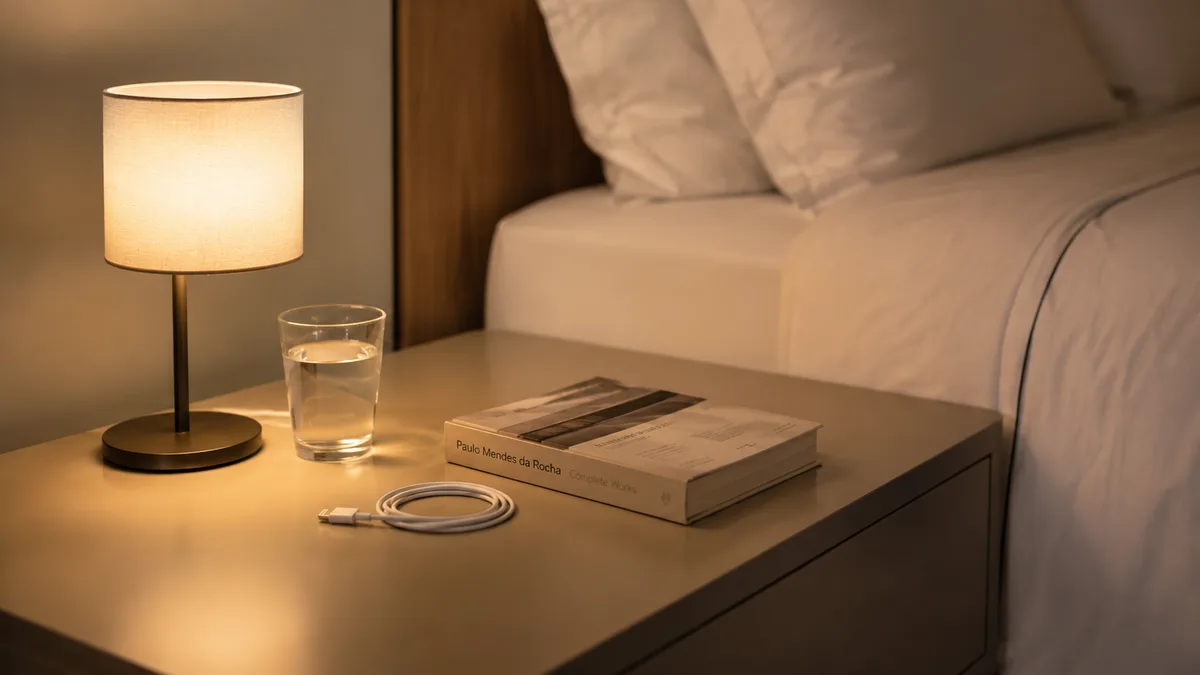
Each side of the bed needs its own surface for the person sleeping there. A nightstand, a floating shelf, or a wall niche. The format matters less than the principle: each person has their own space, without needing to reach over to the other side for glasses, water, or a book.
When the bedroom became an office and never went back to being just a bedroom
I worked with a couple from Pinheiros who, two years after mandatory home office ended, were still sleeping in a room that looked like a meeting space. Her nightstand: a charger, a notepad, two remote controls, a work water bottle, and headphones. His nightstand: more of the same. The bed pushed against the wall left his side with no way out, which in practice meant only she got out of bed in the morning without waking him.
She had been complaining about poor sleep for months. She thought it was the mattress. We had replaced the mattress six months earlier and the problem persisted.
We made two changes: we centered the bed to free up 65 cm on both sides, and we set a visual rule for the nightstands: four items each. Everything work related left the bedroom. Three weeks later, she sent a message saying she had slept six hours straight for the first time in a long while.
A bedroom environment is an active stimulus. Visual clutter and work objects keep the nervous system on alert even when a person thinks they are relaxing. The bedroom should be the calmest room in the house. For many couples I work with, it is one of the most charged.
The changing zone: the most overlooked spot
Most bedroom clutter starts here. Clothes get taken off, are not dirty enough for the hamper, but do not go back into the wardrobe either. They land on the chair, in the corner of the room, on the edge of the bed.
A wall hook rack with two or three hooks per person solves the problem without conflict. It creates an official spot for clothes that were taken off but are not dirty yet. Each person has their own hooks, and clothes that would otherwise sit in limbo go there instead of on the floor. This single adjustment eliminates the biggest source of visual clutter in shared bedrooms.
Relaxation and personal care zone
If the bedroom fits an armchair or reading corner, it is worth defining it physically, even with just a small rug and a lamp. A space with no defined function collects objects. A space with a defined function stays cleaner because there is a clear logic for what belongs there.
The dresser and vanity table belong to the personal care zone. If you both use the same piece of furniture, it is worth splitting it physically: top drawers for one person, bottom drawers for the other, or the right half for one and the left for the other. A visible boundary reduces territorial creep. In practice, this is what generates the most day to day friction.

A shared bedroom with two different styles needs a system that works for both of you, without daily negotiation.
See home organization →The couples wardrobe: how to divide it without a war
Dividing the wardrobe is where most organizing conflicts begin. The space is rarely divided proportionally to each person actual volume of clothes. One side overflows, the other has slack, and the encroachment starts slowly, one piece at a time. Handbags are usually the first category to spill onto the other person side, and the post on where to store handbags in the bedroom and closet settles that part before you divide the rest.
When the "big" wardrobe became the problem
I worked with a couple in Higienópolis who had a wardrobe four meters wide. Plenty of space, no apparent conflict. But when I did the inventory, I found a division that had formed on its own over three years: 70 percent of the space held her clothes, 30 percent his. The original split had been 50/50.
What had happened: he had three times fewer clothes than her. His side had slack. Her pieces gradually migrated in to fill the empty space. He never complained, he just gave up. By the time I got to them, he had not put clothes in the wardrobe for two years. Everything sat on the chair or in an open garment bag in the corner of the room.
I redid the division based on real volume: 60 percent for her, 40 percent for him. I reorganized his side with three clearly defined internal zones. Six weeks later, the garment bag was empty and the chair had disappeared.
Divide by volume, not by equal area
A fair wardrobe split is not necessarily 50/50 in rod length. It is proportional to what each person actually has. Do an inventory of both people clothes before deciding on the split. Empty everything out, separate by person, and assess the real volume. Often, one person has twice as many clothes as the other, and an "equal" split ends up creating clutter on one side from day one.
Organize each side with the same logic
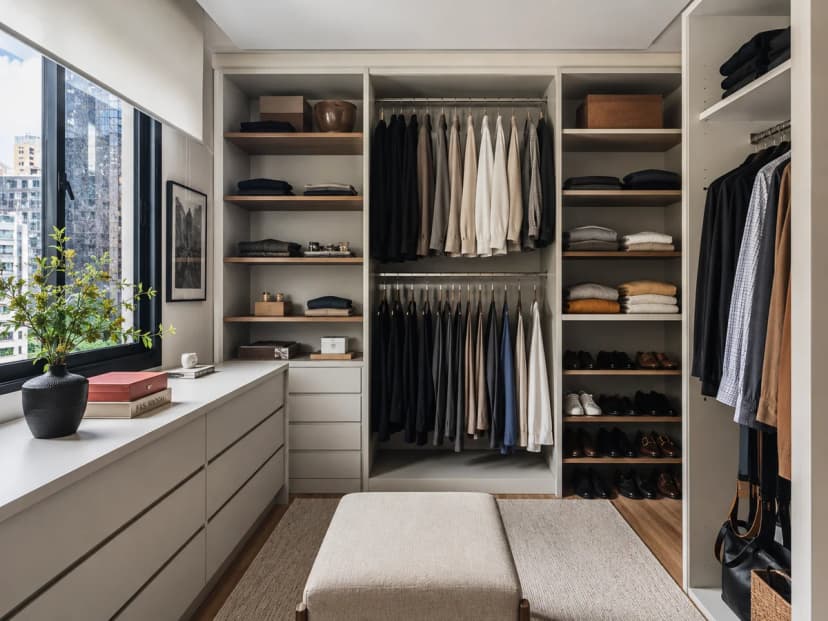
Each side of the wardrobe should follow the same internal system, even if the clothes are completely different:
- Top rod: clothes that need a hanger: blazers, dress shirts, dresses, folded trousers. Organize left to right by category or by frequency of use.
- Shelves: folded clothes: t-shirts, sweatshirts, shorts, pajamas. Vertical folding (KonMari or similar) lets you see every piece without messing up the stack.
- Drawers: underwear, socks and small accessories. Drawer dividers keep everything from turning into a jumble when the drawer gets opened in a rush.
- Bottom section (if there is one): shoes organized in pairs, facing outward. Clear boxes for shoes used less often.
Off season clothes (winter coats in summer, beachwear in winter) should not take up prime wardrobe space. They go into organizing boxes inside a bed with drawers, on high shelves, or in labeled storage boxes.
The territory principle
Each person in the couple has their own side and their own internal logic. What is on the other side is not their concern, as long as the agreement not to invade each other space is respected. That clarity of boundary resolves most wardrobe conflicts without needing a difficult conversation.

How to keep the bedroom organized when you both have different routines
Bedroom organization fails when it depends on individual discipline. One wakes up at 6am, the other works until midnight. One tidies up right away, the other whenever there is time. If the system requires synchrony, it will work for two weeks and then fall apart.
The 5 minute protocol before bed
The most efficient time to maintain the bedroom is before bed, not in the morning rush. Five minutes: the day clothes go to the hook rack or the hamper, the nightstand is left with only what truly needs to be there, floor clear. This protocol does not require synchrony between the two of you. Each person does it on their own time, before lying down.
The sorting chair
For anyone with the habit of dropping clothes on the floor or the edge of the bed, the most honest solution is to create an official spot for that. A simple design chair or a small bench in the corner of the room, near the wardrobe, becomes a sorting point for clothes that were taken off but are not dirty. The bedroom stays free of scattered clothes, and the chair becomes the signal that it is time to put pieces back where they belong.
Surfaces with a defined limit
Nightstands are the surfaces that accumulate the most in a shared bedroom. The rule that works in practice: each nightstand has a limit of five items. Whatever comes in makes something else go out. It does not need to be exactly five, but there needs to be a limit both people visually recognize as within range or too full.
Monthly 20 minute review
Once a month, each person reviews their side of the wardrobe. It is not a full reorganization: it is checking whether any unused piece can go. Twenty minutes per person is enough for this level of review. Over time, the volume of clothes stabilizes and the review gets faster and faster.
Three shared bedrooms I have organized
In each one, the complaint was different. The underlying point was the same: the system did not work for both people at the same time.
The habit with no destination
A couple from Tatuapé, married four years. He very organized: folded clothes, tidy wardrobe, always clean floor. She had a habit set in over four years: coming home from work, she would take off her clothes and leave them on the floor or on the chair. Every night. She knew that was how it was, could not change it, and felt guilty every time he walked through the bedroom without saying a word. The silence was worse than any argument.
He told me privately that he had given up bringing it up. Two years of silence around a pattern that showed up every day.
I talked with both of them together. Her habit was not negligence: it was automatic. The solution was not to ask her to change. It was to create a place for the habit to land that was not the floor.
We installed a three hook rack in the corner of the room, next to the wardrobe. An official spot for clothes that were taken off but are not dirty. Four weeks later, the floor was clean. The habit continued. It had gained a destination.
The takeaway: some habits will not change with conversation. For those, you build a place that accommodates them without conflict.
A first apartment together raises a question no one explains beforehand: how to divide the space without either person feeling like an intruder on the other.
The couple first apartment
A couple from Brooklin, newly married, first apartment together. A 12m² bedroom, her wardrobe and his wardrobe side by side. Three months after moving in, the bedroom was in constant conflict: clothes mixed up on the rods, drawers with no clear ownership, a shared nightstand with objects from both of them. Neither knew where the other stuff was.
She told me she felt embarrassed complaining because the apartment belonged to both of them. Asking for her own space felt petty. But she felt the bedroom never felt like hers.
We defined the territories clearly: her wardrobe, his wardrobe, her drawer in the shared piece of furniture, his drawer. Each nightstand with one person items. Two adults with different histories sharing the same bedroom need individual space, even while living together.
The takeaway: a shared bedroom with no defined territories becomes no one territory. A visible boundary within the shared space reduces daily friction.
The bedroom that became storage after the baby
A baby changes everything about a shared bedroom. This case showed it in two months.
A couple from Vila Madalena with a 7 month old baby. Their bedroom had become a landing spot for everything: baby clothes that did not fit in the nursery, a stroller, a hospital bag still with items inside, maternity clothes kept "for later." Both of them were sleeping in a hallway of objects that did not belong in that room.
The mother told me she missed the bedroom. "It feels like there is no longer a place that is ours." Seven months of sleep deprivation, a bedroom overtaken by everything with nowhere else to go, and the one space meant for rest was more cluttered than the rest of the house.
We spent three hours redistributing things: whatever belonged to the baby went to the nursery, whatever belonged to maternity went into a box on top of the wardrobe, the stroller went to the hallway. Their bedroom went back to holding only what belonged to the two of them.
The takeaway: a shared bedroom with a baby needs active screening of what comes in. The couple rest space carries weight in the recovery of someone already sleep deprived.
When the bedroom goes through several attempts and returns to the same state within weeks, what is missing is a plan. Request an assessment of the bedroom: dividing space between two people rarely resolves without someone from outside measuring how much each person owns.
Frequently asked questions about organizing a shared bedroom
How do you organize a small shared bedroom without renovating?
A small shared bedroom works best with the bed centered and a 60 cm clearance on both sides, which keeps circulation open without any construction work. Replace nightstands with floating shelves: they free up the floor and create vertical space. A wardrobe with a full length mirror on the door visually doubles the room and removes the need for a separate wall mirror. A bed with built in drawers handles bedding, blankets and seasonal items without an extra cabinet. Light colored walls and minimal decor on surfaces finish the job without spending anything on renovation.
What do you do when one partner is organized and the other is not?
A clash in organizing styles is more common than it seems, and it has a structural solution, not a behavioral one. Create clearly defined territories: each person has their own side of the wardrobe, their own drawer and their own nightstand. The messy side does not spill into the organized side. The system needs to be simple enough for both people to follow. A system that is hard to maintain is not the fault of the person who does not follow it: it is a design problem. Often the solution is a sorting chair near the wardrobe for whoever has the habit of dropping clothes on the floor. The problem does not disappear, but it stays contained.
What is the right order to organize a shared bedroom from scratch?
Start with decluttering, not with organizers. Empty the wardrobe completely and sort through everything, because no system works with an excessive volume of clothes. Then define the zones: where the sleep area is, where the changing area is and where personal care items go. With the zones defined, position the furniture to guarantee 60 cm of clearance on both sides of the bed. Last, buy organizers: you will have exact measurements and know what you truly need, without wasting money on items that do not fit or do not solve the real problem.
How often does a shared bedroom need to be reorganized?
With a well built system, a bedroom does not need frequent reorganizing. It needs brief maintenance. Set aside 5 minutes a day, ideally before bed, to put clothes away and clear the nightstand surfaces. Once a month, review the wardrobe for 20 minutes. A full reorganization, where you reassess zones and let go of what you stopped using, is usually needed once a year or after significant routine changes, such as moving, a new baby, or starting a home office. With daily maintenance kept up, that yearly review takes less than two hours.

About the author
Silvana Santanna →Personal Organizer in São Paulo, specialized in residential move organization and functional organizing projects for homes, closets, kitchens, trousseaux and home offices. Creator of the Casa Pronta™ Method, with more than 100 projects completed across São Paulo and the greater metro area.

Ready to have your home organized
without lifting a finger?
Project assessment visit.