How to Put Together a Wedding Trousseau in São Paulo: A List by Room
How to put together a wedding trousseau without excess: what to actually buy, how to organize it by room, and how to avoid unnecessary purchases. Personal organizer in São Paulo.
Neste guia você verá:
- 01Where to start before putting together the trousseau list?
- 02What does a wedding trousseau actually need to have?
- 03How to organize the trousseau by room from day one?
- 04Which items do couples always regret buying before moving in?
- 05How can a gift registry turn into a clutter trap?
- 06How to keep the trousseau organized once the routine kicks in?
Where to start before putting together the trousseau list?
The biggest problem with a newlywed trousseau is not what was left out. It is what was bought before the couple knew where it would be stored. Before listing a single item, the couple needs to measure the available closets, define how often they will do laundry, and understand what one of them already has at home. Putting the list together without those answers is where most of the excess that shows up in the first few months of marriage comes from.
Brazil's national statistics agency (IBGE) recorded nearly 949,000 civil marriages in 2024. Many of those couples will spend their first months with gifts still in boxes, closets that will not close, and the feeling that the new home never quite comes together. It is not a lack of effort. It is a lack of sequence.
The trousseau list is usually put together before the couple knows how they will use the space. Before measuring the closet. Before understanding the routine they will build together. The result shows up in the first few weeks: items that do not fit, gifts with no home, purchases that seemed essential and now sit unused on shelves.
Before putting together any list, the couple needs to answer four questions:
- What is the real size of the closets? Measure in centimeters, do not estimate. A closet with 60cm of depth holds a folded sheet set one way; 45cm of depth holds it another way.
- How often does the household do laundry? A couple that washes weekly needs less stock than a couple that washes every two weeks.
- Will they host guests often? This determines whether it is worth having a separate set for special occasions or whether one functional set will do.
- Does one of them already live in the space? If so, the closets already have volume in them. Every new purchase needs to fit into what is left.
With those answers, the list stops being generic and gains a real criterion. Every item bought has a defined place to go. That avoids the most common situation I see with newlywed clients: closets stuffed with items that were never actually assigned a place.
What does a wedding trousseau actually need to have?
A functional trousseau has three main categories: bed, bath, and kitchen. Everything beyond those three can wait. Setting up the essentials first and filling in the rest over time, as the routine reveals what is missing, is the path that generates the least regret.
She arrived with six bed linen sets and eight towel sets. The closet was already full before she had even unpacked her shoes.
A bride from the Brooklin neighborhood had bought her entire trousseau well ahead of time. The idea was to be practical: buy everything at once, good quality, made to last for years. Her groom already lived in the 55m² apartment, so half the closet was already taken. When the items arrived, there was no physical room to store them. The tension between them did not come from the excess itself, but from a mismatch in expectations: he thought it was too much, she thought she was being prepared.
We cut it down to three bed linen sets per person and four towel sets, installed an extra shelf in the laundry room for the surplus stock, and set up a rotation system. With the closet at 40% free space, the couple understood that the criterion is not quantity, it is a system. Two extra towel sets ended up living in a suitcase for eight months for lack of space.
The lesson: a trousseau is not a stockpile for years. It is a system for the current routine.
Bed: the minimum that works
- 3 queen or double bed linen sets: one on the bed, one washed and put away, one spare
- 4 pillows with extra pillowcases (2 per person)
- 1 blanket or comforter suited to the season the couple will actually use it in
- 1 mattress protector
Bath: quantity by habit, not by checklist
- 4 bath towels per person (a longer laundry cycle calls for more)
- 2 hand towels per person
- 2 bath mats: one in use, one being washed
- Separate guest towels, only if the couple hosts often
Kitchen: utensils you will actually use
- A set of pots and pans in the sizes the couple will use in their daily routine
- Plates, glasses, and cutlery for the number of people living there plus two
- Basic prep utensils: one of each piece, not a full set
- Containers with lids for leftovers and food storage: 6 to 8 to start
Table settings (tablecloths, placemats, charger plates, special glassware) belong in the trousseau if the couple hosts often. If not, it is a purchase that goes on a high shelf and stays there for years.
How to organize the trousseau by room from day one?
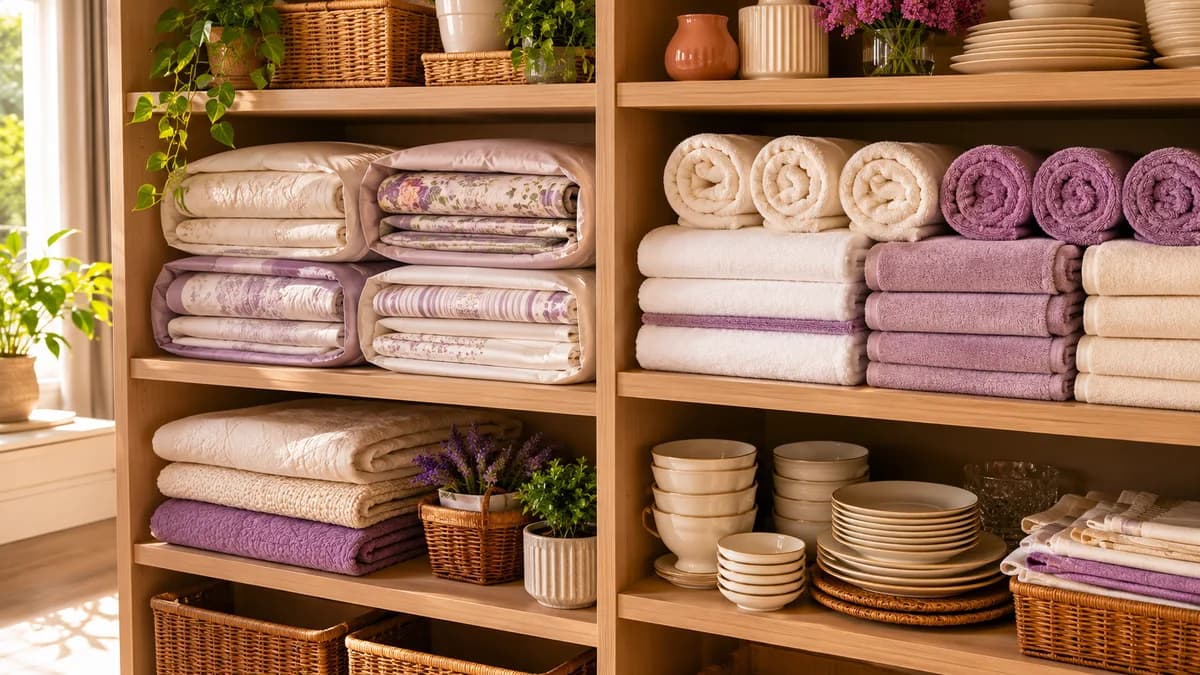
Organizing the trousseau by room from day one means not storing items wherever they fit. Each category gets a fixed spot, and that spot is defined before anything gets put away. Reorganizing after everything is already stored takes twice as long and creates friction for both people.
Linen closet
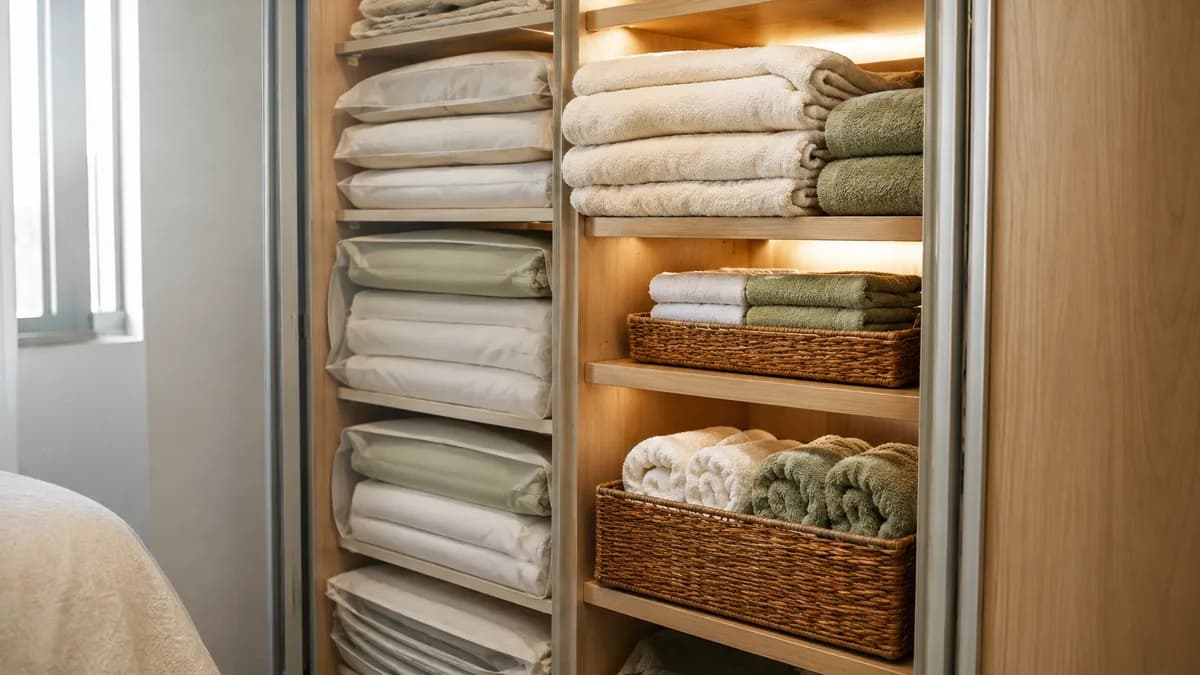
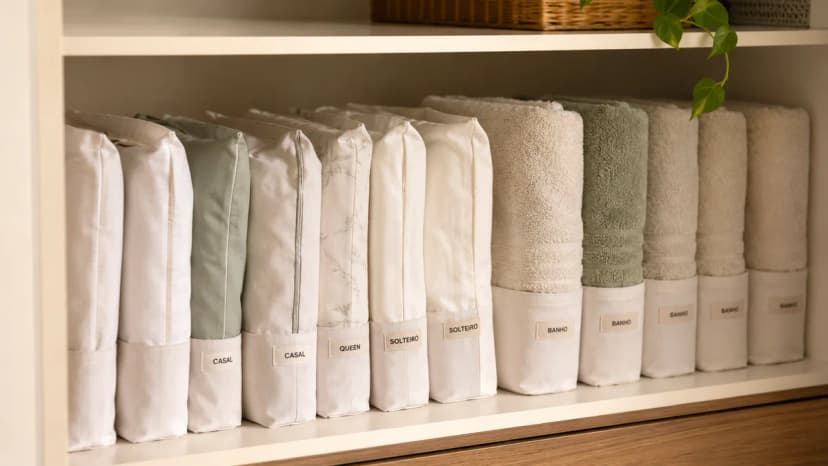
Split it by room: one area for bed linens, one for bath linens. Within each area, organize by frequency of use: the most used items go on the shelf at eye level, the spares go up top. Store each complete bed linen set packed inside its own pillowcase. It saves space, makes things easy to find, and keeps loose pieces from mixing with complete sets.
Kitchen
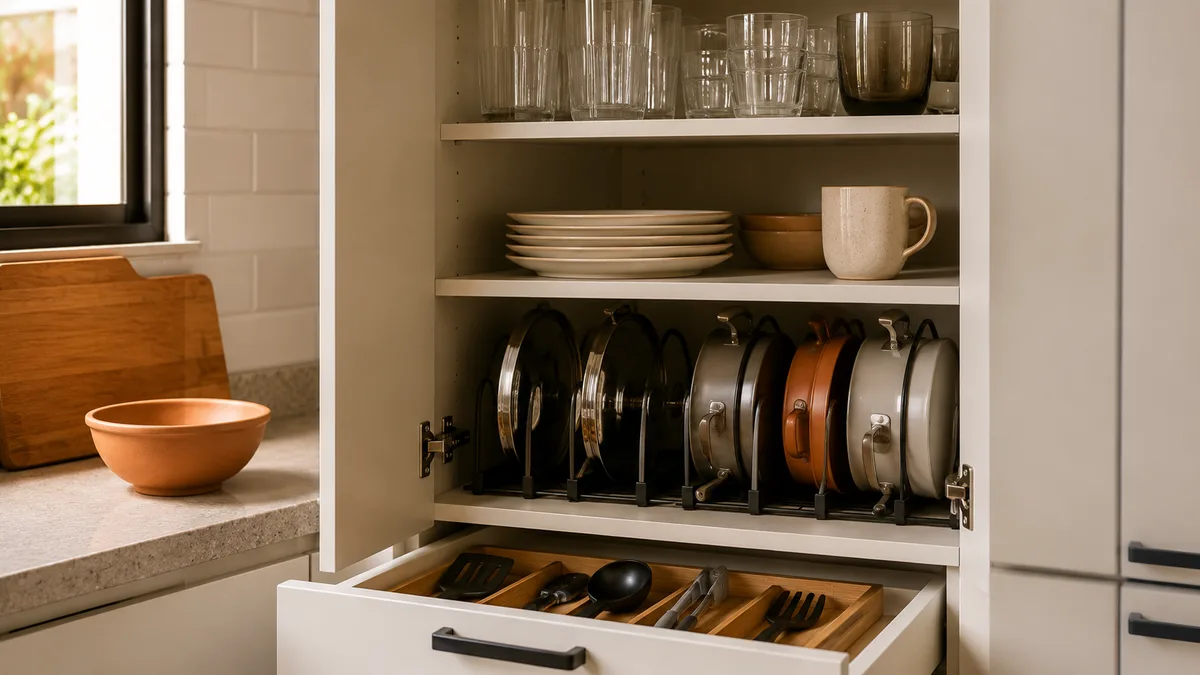
Before storing any utensil, map out the zones: where prep happens, where food gets stored, where serving items live. Daily-use utensils go on easy-access shelves. Occasion items go on higher shelves or in labeled boxes.
Bathroom
Daily-use towels stay on the towel rack or an open shelf within easy reach. The stock of clean towels goes to the linen closet or the bathroom cabinet. Never stack in-use towels together with spares in the same space. Rotation stops happening and the same pieces get worn out while the others sit unused.
Newlyweds who arrive at their new home with the trousseau already assigned by room do not spend months figuring out where to put everything.
See trousseau organization services →Which items do couples always regret buying before moving in?
The trousseau items that generate the most regret share one trait: they were bought before the couple knew how they would use the space and what their real household routine would look like. The mistake is not the product itself, it is the timing of the purchase.
- Oversized cookware sets: a 24cm pot for a couple that cooks for two. It takes up space, is hard to wash, and gets used far less than planned.
- A 12-piece plate set: a couple that rarely hosts ends up with twelve plates stacked and unused. Plates for 6 to 8 people cover most real situations.
- Glassware specific to each drink type: red wine glasses, white wine, champagne, water. Four different types for a couple who opens a bottle of wine on weekends. One versatile, quality glass gets the job done without taking up half a kitchen shelf.
- Decorative dish towels: bought in bulk to match the kitchen, they stay tucked away so they do not get dirty. The dish towels that actually get used are the ones the couple already had.
- Baking and pastry tools: for a couple that does not bake. They fill an entire drawer and stay untouched for years.
- Storage bins bought before measuring the closet: purchased with the best of intentions, they arrive home and do not fit the shelf, do not suit the item they were meant to hold, or duplicate what was already there.
How can a gift registry turn into a clutter trap?
A wedding gift registry solves a real logistical problem: it keeps the couple from receiving ten identical sets of glassware. But it creates another one: it encourages the couple to list items they would never buy on their own, because it is a gift and will be useful someday.
In the third week after the honeymoon, the guest room of an apartment in Moema had turned into a storage room full of sealed boxes.
A couple in their early thirties had received more than 80 gifts. The registry had been put together carefully, but without thinking about the available space or the routine they would end up having. They got back from the trip, the boxes were there, and neither of them knew where to start. The bride felt guilty about exchanging gifts from people she loved; the groom thought they needed to keep everything.
When we did the sort, 23% of the items were exchanged or donated. Not because they were bad gifts, but because they did not fit the space or the couple's routine. A 12-piece plate set, a gift from the bride's grandmother, sat in a sealed box for four months before she agreed to store it, protected, on a high shelf, and admitted it would only be used on special occasions, not day to day. The apartment ended up with a linen closet with a defined system. Before the sort, half the items had no specific place to go.
Putting together a gift registry without thinking about the available space is where a good part of the clutter in the first few months of marriage comes from.
How to build a registry without creating future clutter
- Measure closets and linen storage before adding a single item to the registry
- For every item on the list, define where it will go once it arrives home
- Limit the quantity per category: a maximum of 4 bed linen sets, not 6
- Prefer registries with a credit option: the couple redeems and buys what they actually need
- Include daily-use items before special-occasion ones
- Remove items that would only make the list because they are a gift. If you would not buy it, do not list it
How to keep the trousseau organized once the routine kicks in?
The best-built system on day one disappears within 60 days without a maintenance routine. Once the couple's real life kicks in, with work, adjustment, kids, and the rhythm of the household, the trousseau starts losing its place and piling up wherever it fits. Maintenance is not reorganizing everything every week. It is two or three simple habits that keep the system from collapsing.
Two months after moving in, the dining room of a couple in Perdizes was still a maze of boxes.
There were 14 boxes of trousseau items. The couple, in their mid-thirties, had moved into their own 80m² home during an intense period: she had two kids from a previous marriage, and both of them had heavy work schedules. Every week, the plan was to organize over the weekend. The weekend came and went. They cooked with the bare minimum available and kept using the same two towels because the rest was still in boxes.
The boxes in the room were not just a visual annoyance. It was the weight of postponed decisions that hit them every time they walked in. When we organized everything, in four hours of sorting split by room, she said the house finally felt like a home. During the sort, a box with her ex-husband's belongings sparked a difficult conversation. The solution was to throw the box away without opening it. Her decision.
Closed boxes are postponed decisions. Every week that passes raises the emotional cost of opening them, it does not lower it.
Three habits that keep the system alive
- Rotate the stock when you do laundry: when clean towels or sheets come back to the closet, put the clean ones behind the ones already there. The oldest go out first. Without this, the same pieces stay in constant use while the others sit unused and age.
- Do not store anything without a defined place: if a new item comes into the house and has nowhere to go, solve that before putting it away. Storing it "for now" anywhere is the start of clutter.
- A 30-minute quarterly review: every three months, open the closets and assess what has not been used. The couple will find items they thought they would use and never did. That is the moment to exchange, donate, or reorganize.
Trousseau organization is not about perfect closets. It is about a system the couple's real routine can actually keep up. An honest start, matched to the real space and real habits, is what lasts. A system built for the life the couple actually has works. Built for the life the couple thinks they will have, it falls apart in two months.
Frequently asked questions about newlywed trousseaus
How many bed linen sets are enough for newlyweds?
For a couple that washes bed linens weekly, three sets are enough: one on the bed, one washed and put away, one spare. Four sets work well for a couple that washes every two weeks or likes some variety. More than that tends to be excess that takes up space without any real benefit. The most common mistake is buying six or more sets before living together, without knowing the couple's actual laundry frequency once they share a routine.
Is it necessary to buy the entire trousseau before getting married?
No. Buying everything before living together is one of the main causes of excess and regret in a trousseau. The couple does not yet know how they will use the space, what size the closets really are, or which habits they will build together. The best approach is to buy the essentials first: bed and bath items for daily use, basic kitchen utensils. The rest comes in gradually, as the routine reveals what is actually needed. Registry gifts help cover the remainder without waste.
What should you do with wedding gifts that will never be used?
Exchange, sell, or donate them. Keeping something out of emotional obligation is the choice that hurts the space and the organization of the new home the most. If the gift was given with love, the couple can use its exchange value to buy something that will actually fit into the routine. Many bridal registries allow an exchange for store credit. For gifts from close family that are unlikely to be exchanged, the answer is to find a proper storage spot, a labeled box on a high shelf, and to be honest about how often it will really be used.
How do you organize a trousseau in a small apartment?
In a small apartment, the size of the available space sets the maximum quantity of items, not the standard trousseau checklist. Before buying or storing anything, measure the actual closets and calculate the available capacity. Prioritize bed linen sets folded compactly and packed inside their own pillowcase, rolled towels instead of stacked ones, and kitchen utensils limited to what the couple actually uses at least twice a week. Items for guests go in a labeled box in the least accessible closet.

About the author
Silvana Santanna →Personal Organizer in São Paulo, specialized in residential move organization and functional organizing projects for homes, closets, kitchens, trousseaux and home offices. Creator of the Casa Pronta™ Method, with more than 100 projects completed across São Paulo and the greater metro area.

Ready to have your home organized
without lifting a finger?
Project assessment visit.