How to Store Handbags in a Closet or Bedroom: 7 Practical Solutions
Handbags and accessories work best when they follow the same logic as the rest of the closet: frequency of use, preservation, visibility and less hidden clutter.
Neste guia você verá:
- 01Inventory and discard: the step with no shortcut
- 02Handbag categories and how to store each one
- 03How to store them without warping
- 04Where to store handbags when the closet runs out of room
- 05Belts, scarves, jewelry and eyewear
- 06Rotation by use: the system that lasts
- 07Which organizers to use (and when to buy them)
Handbags and accessories seem like a minor category until they start getting in the way of how the closet works. The good leather handbag warps on the shelf, the everyday one turns into a dead file of receipts and expired lipstick, the jewelry drawer tangles, and the less visible pieces simply disappear from your rotation.
The point here isn’t fashion. It’s function. When handbags, belts, scarves, eyewear and jewelry follow the same logic as the rest of the closet, you see more clearly what you actually use, take better care of what’s worth keeping, and stop buying duplicates simply because you couldn’t see what you already had.
Inventory and discard: the step with no shortcut
Before buying any organizer, you need to know exactly what you have. Pull every handbag and accessory out of wherever they’re kept (closet, under the bed, shelves, bedroom cabinets) and put it all together in one spot.
Now evaluate each piece with three questions:
- "Have I used it in the last 12 months?" If not, it’s a candidate for discard (except high-value pieces reserved for specific occasions, like graduations or weddings).
- "Is it in good condition?" A handbag with a broken strap you’ve been meaning to fix for two years probably isn’t getting fixed. Repair it or discard it before storing it.
- "Does it match my current wardrobe?" Handbags from an old style that no longer serve any real purpose in your routine take up space that pieces you actually wear could use.
This is also where the less obvious excess shows up: a wallet forgotten inside an old handbag, duplicate sunglasses, scarves no one ever reaches for, and small accessories bought again and again in parallel because the earlier ones vanished from sight.
In a 95m² apartment in Perdizes, the client said she had "a few handbags scattered around the closet." When we asked her to pull everything out of wherever it was kept, it came from four places: the closet, under the bed, a hallway cabinet and the guest room shelf. Thirty-four handbags in total.
Eleven still had things inside: forgotten wallets, receipts, a lipstick expired since 2022 and a canceled health plan card. She looked at it all and said, "I didn’t even know I had all these." She discarded 19, and the 15 that remained fit on one open shelf in the closet, all visible.
The takeaway: handbags scattered across four rooms signal an absence of system. Each one ended up wherever there was room the moment it entered the house.
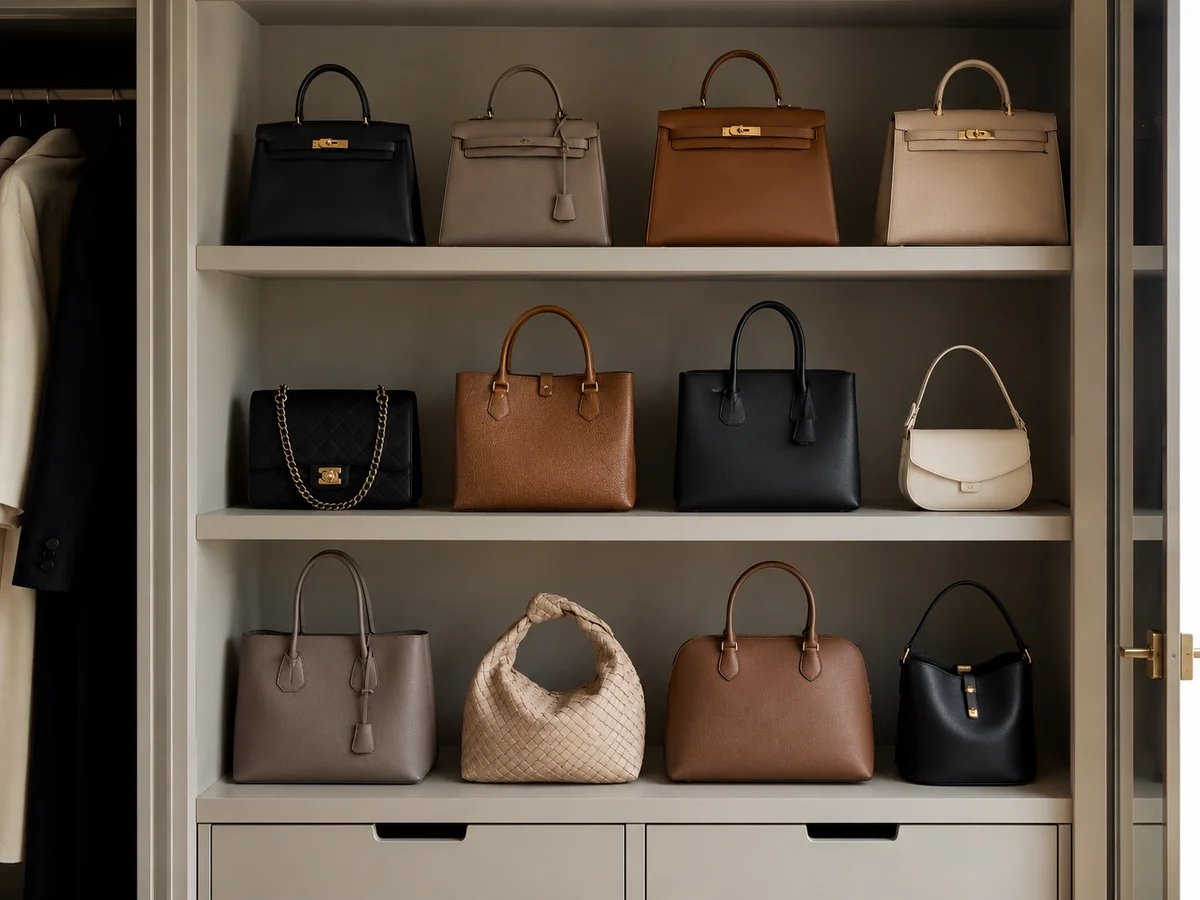
Handbag categories and how to store each one
Handbags fall into groups with different storage needs. Classifying them before storing is what ensures each piece is stored correctly.
Daily use (work, errands, outings)
The handbags you use every week need immediate access: open, visible storage, without having to open a box or dig anything out. A standing shelf, closet hooks or a hanging rod. Never stacked. You’ll always reach for the ones on top and forget the ones underneath.
These are the pieces that deserve the most accessible zone in the closet. When they end up behind occasion handbags, the tendency is to just dump everything on a chair or in the hallway when you get home.
Occasional use (dinners, events, short trips)
Used a few times a year. These can sit on a higher shelf or in a labeled cotton bag. Access doesn’t need to be immediate, but the labeling does need to be clear: without opening it, you should know what’s inside.
Special occasions (weddings, graduations, international travel)
Used rarely, and of high emotional or financial value. Store with shape-holding filling, in a cotton bag or the original box, on a top or less accessible shelf. Never stacked.
Backpacks and sports bags
Irregular shapes that don’t stand upright. Hang on a hook (the most practical option) or lay flat in an open basket. Gym backpacks: store empty and open to let them air out. A closed backpack with damp clothes inside grows mold within 24 hours.
Beach bags and reusable totes
These can be folded in a basket or a dedicated box. They don’t need prime space. Easy access is enough.
How to store them without warping
Improper storage ruins quality handbags within a few months. Each material has its own specific needs.
Structured handbags (leather, patent leather, rigid synthetic)
- Always upright, never stacked;
- Filled with crumpled kraft paper, packing air pillows or a dedicated handbag pillow to hold the shape;
- Never bubble wrap in direct contact with leather (it scratches the surface);
- Never newspaper (the ink transfers to the lining);
- Straps laid over the handbag or tucked inward: don’t let them hang outside and crease.
Fabric, nylon and canvas handbags
- Can be carefully folded if not in use;
- If in frequent use: keep upright on the shelf;
- Wash when needed before storing: dirty fabric traps odor.
Straw, rattan and natural-material handbags
- Never stack them: the weight warps and breaks the fibers;
- Store upright or hanging;
- Keep in a ventilated spot: natural materials can mold if stored in a closed cabinet for too long.
| Handbag type | How to store it | Main care point |
|---|---|---|
| Leather / patent leather (structured) | Upright, filled with kraft paper | Never stack, and never use bubble wrap directly on leather |
| Fabric / nylon / canvas | Upright if in use; folded if stored long-term | Wash before long-term storage |
| Straw / rattan / natural fiber | Upright or hanging, in a ventilated spot | Never stack: it warps and breaks the fibers |
| Clutch | Lying flat, stacked horizontally with fabric between them | Always keep a protective layer between each piece |
| Rarely used / high-value handbag | Cotton bag or original box with filling | Never a plastic bag: it traps moisture and causes mold |
| Backpack / sports bag | Hung on a hook or in an open basket | Store empty and dry: a closed, damp backpack molds within 24h |
In Vila Mariana, a client in a 110m² apartment had a genuine leather Italian handbag with a sunken base. It had spent two years underneath two other handbags on the shelf, and the accumulated weight compressed the leather with no internal filling to hold its shape. She only noticed the damage when she wanted to show the handbag to her daughter.
The handbag was partially restored with kraft paper and controlled humidity. The rest received paper-bag filling inside and individual cotton bags. What changed on the shelf: no handbag rests on top of another anymore.
The takeaway: leather stored under weight loses its shape within a few months and doesn’t fully return to what it was. Storing it upright with internal filling is part of caring for any valuable handbag.
Where to store handbags when the closet runs out of room
A handbag that does not fit in the closet goes on the top shelf of the wardrobe, on a hook on the side of the door, or in a closed box under the bed. The order of choice stays the same: first the vertical space you already have, then the doors, and only last the gap under the bed, which is the worst place for leather because of dust and still air.
In the bedroom, outside the closet
- Top shelf of the wardrobe: holds occasional-use handbags upright, with a divider between them so they do not topple onto each other;
- Hook on the side of the wardrobe or behind the door: handles the two or three bags you use that week without taking up shelf space, as long as the strap is wide enough not to leave a mark;
- Open shelf on the wall above the dresser: turns structured handbags into part of the room and keeps everything visible, which is what makes the system last;
- Bench with a lid at the foot of the bed: stores beach bags, totes and gym bags, none of which need daily visibility.
In a small apartment
In the first months of 2024, 81.6% of the properties launched in São Paulo were compact units, according to Secovi-SP. In a small footprint the floor is the most contested resource in the bedroom, so the rule flips: no handbag goes on the floor, everything goes up.
- Use the height between the last shelf and the top of the wardrobe, which usually sits empty out of habit rather than lack of space;
- A tension rod between two side panels creates an extra bar to hang from without drilling the wall;
- A clear stackable box protects the handbag and still lets you see what is inside without taking everything down.
A lack of storage is almost never the right diagnosis.
I worked on a 42m² apartment in Campo Belo where the handbags were all on the bedroom floor, lined up against the wall behind the door. The client thought the problem was a lack of storage. It was not: the wardrobe had 40 cm of dead space between the top shelf and the ceiling, enough for the seven bags sitting on the floor. She told me she walked past them every day and had stopped seeing them. Moving those seven bags up took twenty minutes and gave the bedroom its walkway back.
Belts, scarves, jewelry and eyewear
Accessories have small, irregular shapes that make storage challenging. The most common mistake is storing them all together in one box, where they twist, tangle and become impossible to find.
Belts
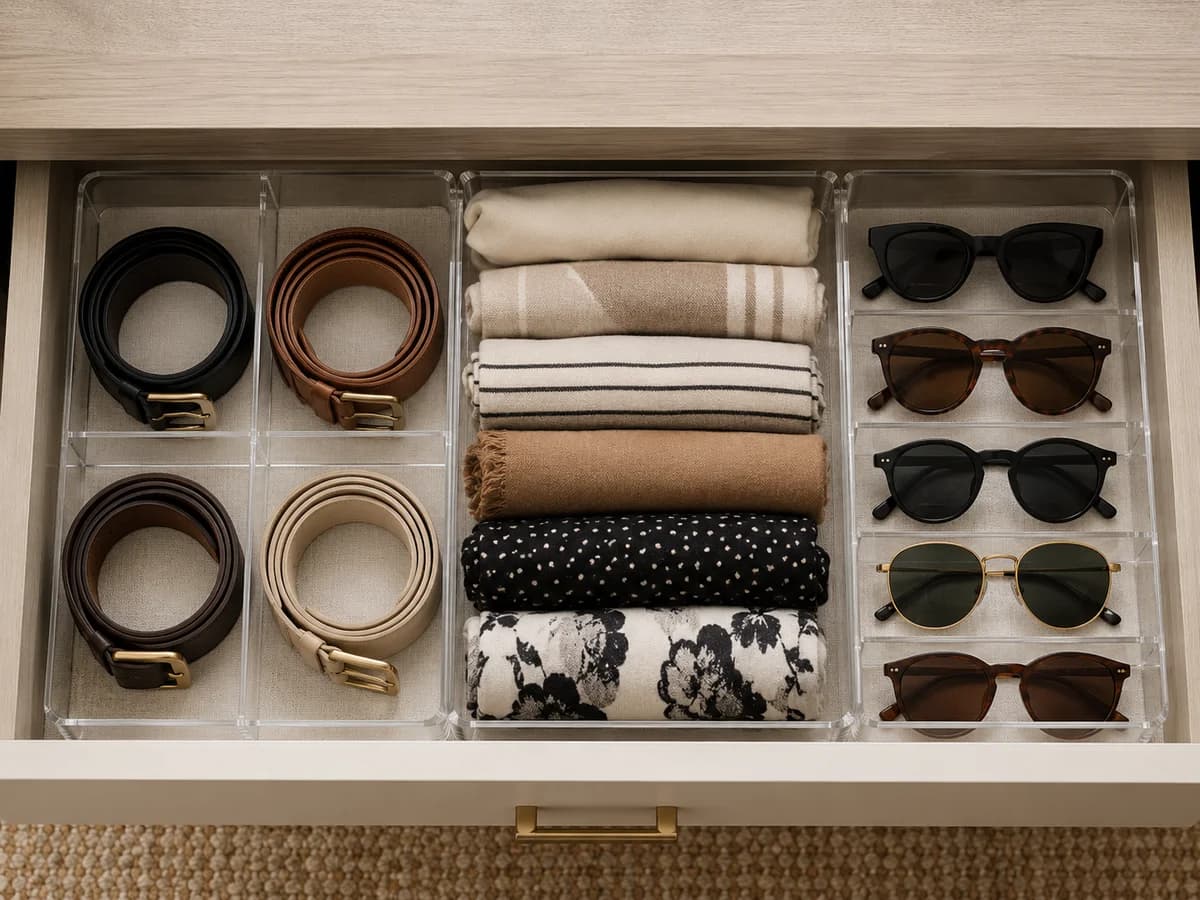
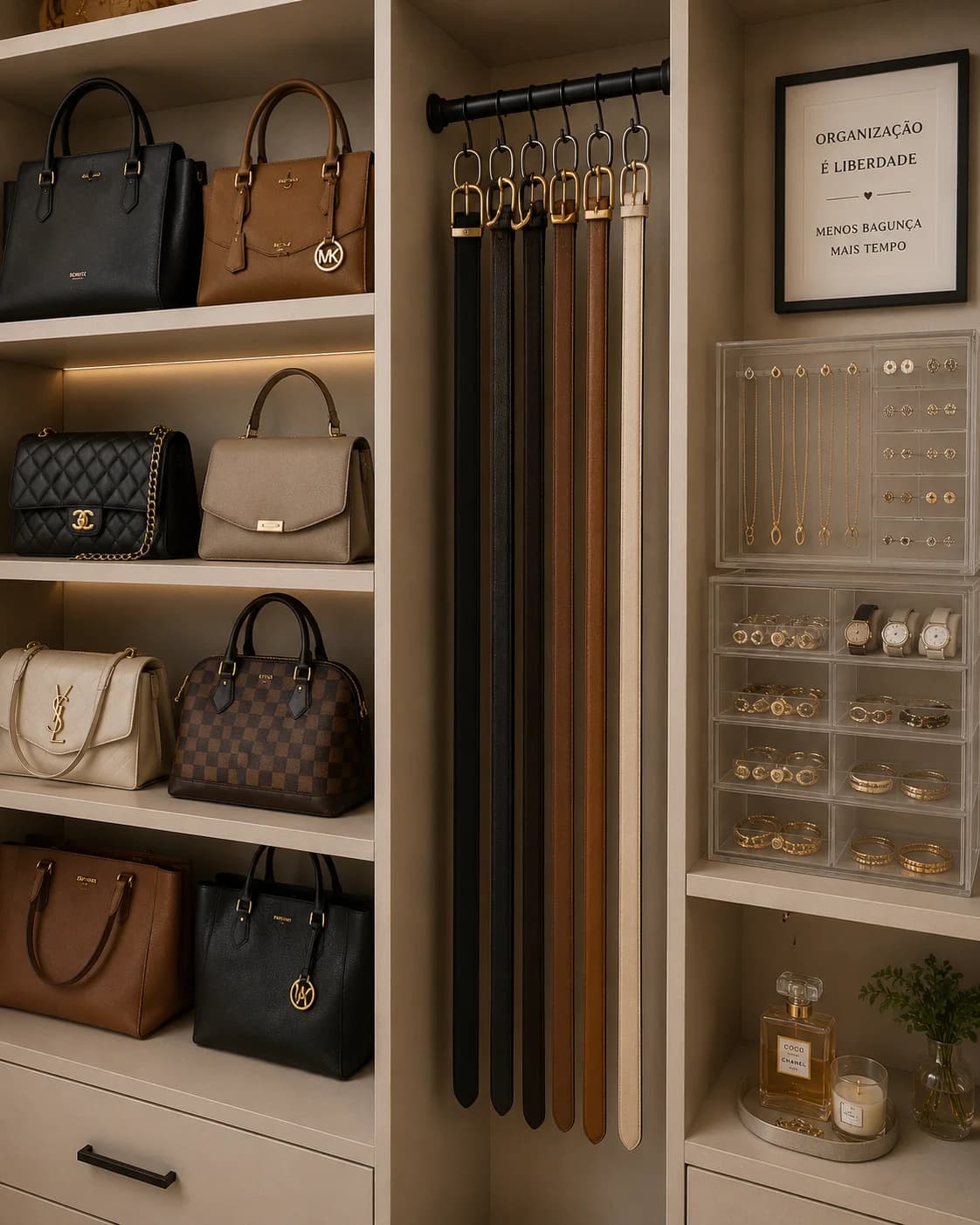
Three options work: hanging (buckle facing up, on a horizontal rod in the closet), rolled vertically in a drawer with dividers, or a wall-mounted belt organizer. The most visual method is hanging: you see all of them and never have to search. Never store them tightly packed in a box: a permanent crease damages the leather.
Scarves
Folded into squares and stored upright (like books on a shelf) in a box or drawer: you see all of them. Or rolled and stored in a box with dividers. The most practical version: a plastic ring or a hanger with several bars (one scarf per bar), hung in the closet.
Jewelry and costume jewelry
Each piece in its own compartment. Acrylic organizers with dividers are the most versatile: you see everything without opening anything. Necklaces: each one in its own velvet pouch or hung on a wall mount to avoid tangling. Earrings: an organizer with holes or a metal grid where you fit each pair together. Rings: a velvet roll or a roll-slot holder in the organizer.
For silver jewelry: an anti-mold sachet or a piece of chalk inside the organizer absorbs moisture and slows oxidation, essential in São Paulo’s climate.
A tangled drawer usually hides two problems at once: a forgotten piece and a duplicate piece. Once everything is visible, the excess becomes far more obvious.
In a 12m² closet in Higienópolis, there was an entire drawer of jewelry no one could use properly. Necklaces tangled with bracelets, loose earrings with no matching pair, rings at the bottom. Three necklaces had broken from being pulled too hard. The client had bought an organizer twice, but placed the pieces mixed together inside the compartments. Within a week, it was back to the same mess as before.
We separated everything by type first: necklaces, earrings, rings, bracelets. Each group went into a velvet pouch or its own section of the organizer. The longer necklaces got a wall mount outside the drawer. The following week, she wore jewelry four days in a row, pieces that had sat in that drawer for two years.
The takeaway: a jewelry organizer only solves tangling once the pieces arrive already separated by type. Putting everything together in nicer compartments is just a pricier version of the same messy drawer.
Eyewear
Each pair in its case. Never loose. A leather or acrylic eyewear organizer with individual compartments on the dresser. If you have many pairs, a divided tray keeps everything visible and protected. Never store them lens-side down.
Rotation by use: the system that lasts
The biggest enemy of handbag and accessory organization is accumulation without rotation. You stop using whatever sits at the back, at the bottom or inside a closed box. Even a perfectly organized system gets forgotten if it isn’t visible.
Organizing by frequency of use
- Prime zone (eye level, front of the shelf): what you use every week;
- Support zone (shelf above or below, or the back): what you use monthly;
- Storage zone (top shelf or closed cabinet): what you use rarely but need to keep.
Seasonal review
Twice a year (at the start of summer and winter), review your handbags and accessories. Move whatever has fallen out of frequent use into storage. Bring back into the prime zone whatever’s about to come into rotation. Assess what can be discarded or donated. This review takes 30 minutes and keeps the system from going stale.
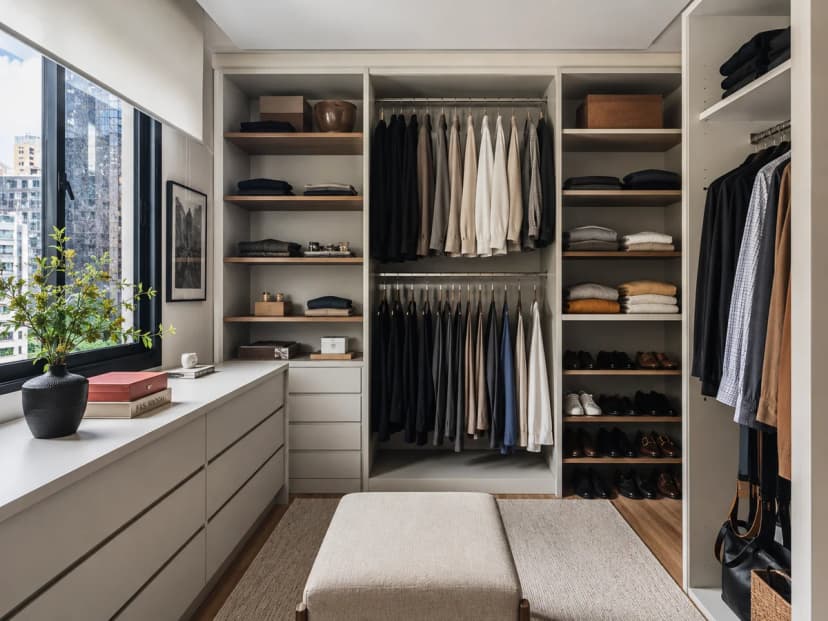
Organized handbags are part of a closet that works as a whole, not as independent drawers.
See residential organization →If your wardrobe is compact, the post how to organize a small wardrobe can help you adapt this approach to smaller spaces. When the problem stops being the bag and becomes the whole closet, a personal organizer in São Paulo rebuilds the system from scratch.
Which organizers to use (and when to buy them)
The golden rule: buy organizers only after decluttering and after knowing exactly what you’re organizing and in which space. Buying beforehand is the path to boxes that don’t fit, dividers of the wrong size, and organizers that create more problems than they solve.
Worth the investment
- Acrylic organizer with modular dividers: versatile for jewelry, eyewear and small accessories: it reconfigures as your collection changes;
- Labeled cotton bags: for stored handbags: cheap, protective and identifiable without opening;
- Tension rod (no screws) for belts and handbags: solves vertical storage without any construction;
- Adjustable drawer dividers: adapt any drawer for folded accessories.
Not worth it for this purpose
- Decorative boxes without labels: you’ll forget what’s inside;
- Jewelry organizers with a built-in mirror and many tiny drawers: too little space per compartment, hard to keep tidy;
- Handbag hangers with too many hooks that get overloaded: handbags press against each other and warp.
- All handbags inventoried and decluttering finished before organizing
- Structured handbags stored upright with shape-holding filling
- Cotton bags or labeled boxes for stored handbags
- Belts hung or rolled (never folded in a box)
- Jewelry in individual compartments with an anti-mold sachet
- Seasonal review twice a year for rotation and decluttering
When handbags and accessories have taken over the entire closet and nothing stays visible for long, it’s worth requesting a quote for a professional assessment. This category tends to improve significantly once it becomes part of a complete closet system.
Frequently asked questions about organizing handbags and accessories
How do you store handbags so they don’t warp?
Structured handbags (leather, patent leather) need internal filling to hold their shape: use crumpled kraft paper, packing air pillows or dedicated handbag pillows. Never bubble wrap directly against leather (it scratches) or newspaper (the ink transfers). Fabric or nylon handbags can be carefully folded or stored lying flat. Straw and rattan handbags: never stack them. Store upright or hanging.
Should you keep handbags in their original box?
Only for high-value handbags you use rarely: the box protects against dust and light. For everyday handbags, the box becomes an obstacle: you stop using what’s hard to reach. The ideal solution for everyday handbags is open storage: a shelf with handbags standing upright, visible. For stored handbags, a cotton bag is more practical than the box.
How do you organize belts without rolling them up?
Belts rolled up and tossed in a drawer lose their shape and become hard to find. Three options work: hanging (buckle up, on a horizontal bar in the closet or a rod with hooks); rolled vertically in a box or drawer with dividers, each belt in its own compartment; or a wall-mounted belt organizer. The most visual, easiest method to maintain is hanging: you see all of them at once and never have to search.
How do you keep jewelry from tangling and oxidizing?
To prevent tangling: keep each piece in its own compartment (an acrylic organizer with dividers, a velvet envelope or an individual pouch). To prevent oxidation: store in a dry place (never the bathroom), and add an anti-mold sachet or a piece of chalk inside the organizer to absorb moisture. In São Paulo, where humidity is high, the sachet makes a significant difference for silver jewelry.
How do you store a leather handbag so it doesn’t crack?
A leather handbag needs internal filling (kraft paper or a handbag pillow) to hold its shape and keep the leather from folding and cracking over time. Store it somewhere ventilated, away from direct sun and heat sources: heat dries out leather quickly. In São Paulo, a silica sachet inside the cotton bag helps balance moisture and prevents both drying and mold. Occasional conditioning with a leather-specific neutral cream also extends the piece’s life.
Can you store a handbag in a plastic bag?
No. A plastic bag traps moisture inside, creating conditions for mold, lining detachment and leather deterioration. The right material for storing handbags is a cotton or non-woven fabric bag: it lets air circulate, protects against dust and doesn’t trap moisture. Original boxes with filling also work well for rarely used handbags, as long as the environment stays dry.
Where should you store handbags in a bedroom with no closet?
With no closet, the bedroom stores handbags in three places, in this order: the top shelf of the wardrobe, a hook on the side of the wardrobe or behind the door, and an open shelf on the wall above the dresser. The floor stays off the list, because a handbag on the floor collects dust, loses its shape and drops out of sight. Keep the two or three you use that week on the hook, within reach, and move the rest up to the top shelf upright, with a divider between them.
Where should you store handbags in a small apartment?
In small apartments, vertical storage is the best solution: hooks behind the bedroom or closet door, a tension rod with no screws on the wardrobe wall, or a narrow shelf placed higher up. Everyday handbags stay in the immediate-access zone; rarely used ones go into a tall basket or a labeled cotton bag on a top shelf. Seasonal rotation is essential: anything you won’t use in the next three months doesn’t need to occupy prime space.

About the author
Silvana Santanna →Personal Organizer in São Paulo, specialized in residential move organization and functional organizing projects for homes, closets, kitchens, trousseaux and home offices. Creator of the Casa Pronta™ Method, with more than 100 projects completed across São Paulo and the greater metro area.
Ready to have your home organized
without lifting a finger?
Project assessment visit.