How to Organize Shoes in a São Paulo Apartment: Shallow Niche, Humidity and a Short Entryway
The footwear system for apartment living in São Paulo: the niche the builder hands you, the wall that condenses through the wet cycle, and the entryway that does not exist.
Neste guia você verá:
- 01Why footwear rots in storage in São Paulo
- 02The decluttering that comes before measuring
- 03The shoe niche in a builder-grade wardrobe
- 04Bedroom wardrobe: door, floor and cold wall
- 05The entryway a São Paulo apartment does not have
- 06The two-season calendar: October and April
- 07How much footwear fits a 60 to 90 m² apartment
It's Monday morning, you're running late and you need the closed black shoes, the mid-heel pair. You dig through the niche under the hanging rod, open three wrong boxes and find one shoe. The other is up in the overhead cabinet, behind the suitcase.
In a São Paulo apartment, that scene has a design cause. The cabinetry that comes with the unit solves hanging clothes and drawers, then treats footwear as an afterthought: a shallow niche at the base of the wardrobe, fixed height, behind a door that stays shut from eight in the morning until seven at night. Anyone past a dozen pairs starts scattering the overflow wherever it lands, and wherever it lands is usually the overhead cabinet, under the bed, or the garage storage unit.
Then comes the second problem, the one generic shoe posts never touch: the São Paulo year has two seasons, a wet cycle from October to March and a dry period from April to September. Stored leather does not survive the first one without maintenance. This guide covers the three situations people here actually face: the builder-grade wardrobe, the entryway that does not exist, and the calendar that follows those two seasons rather than four.
Why footwear in São Paulo is ruined in storage, not in use
Shoes do not die in the rain outside. They dry. What kills leather in São Paulo is storage: closed, with no air moving, pressed against a surface that condenses. From October to March, with near-daily rain and high humidity at night, the inside of a closed cardboard box becomes exactly that environment.
Three spots in an apartment concentrate the risk, and it is worth knowing them before you build any system:
- The wall behind the wardrobe: when the unit backs onto the service-area wall or the facade wall, it sits against the surface in the bedroom that condenses most. The bottom niche, exactly where the shoes are, is the first spot to show it.
- The garage storage unit: no ventilation, a temperature that swings between day and night, and moisture rising from the floor make it the worst possible destination for leather and natural fabric. The cardboard of a brand box absorbs that moisture and hands it straight to the shoe.
- The bedroom with a split unit: air conditioning dehumidifies while it runs and stops when you switch it off. Through the whole day with nobody home, a closed wardrobe returns to the room's humidity. The unit is not a wardrobe humidity control, and counting on it is the most common mistake.
Prevention is simpler than treatment, and it runs on an annual rhythm rather than a one-off effort:
- Between October and March, the leather you rarely wear stays on an open shelf, not in a closed box.
- For boxes that stay closed, a silica gel or activated charcoal sachet, swapped every three months.
- Never store leather that is damp or even slightly wet. Let it dry completely first.
- Once a week, leave the wardrobe open for a few hours. On the dry afternoons from April to September, that airing pays off far more.
Leather doesn't give a warning. You open the box and it's already there.
In a 120m² apartment in Moema, a client opened a box that had been stored for eight months and found mold on three leather pairs: two boots and a pair of heels worn only once. She called me devastated: those were the boots she wore most. The wardrobe stayed closed all day, the boxes were the brands' original cardboard ones, and the bedroom had no air conditioning. In a São Paulo summer, a closed wardrobe with cardboard boxes and no ventilation is all a fungus needs to take hold. We placed silica gel sachets in the boxes and started leaving the wardrobe slightly open during the day. The leather shoes she wore less often moved to open shelves. The following season, not a single moldy piece. Six months of closed, unventilated cardboard in São Paulo: leather can't survive that.
The decluttering that comes before measuring the niche
Shoes are emotionally hard to let go of. They cost money. They have history. "Maybe I'll wear them for some special occasion." But in an apartment, decluttering is not a philosophy: it is the step that decides whether the volume fits the cabinetry already installed, without buying new furniture for a bedroom that has no spare wall.
Start by gathering everything, including what lives outside the bedroom: the niche, the overhead cabinet, under the bed, the garage storage unit, the box you haven't opened since the move. Then, four criteria to decide pair by pair:
- Physical wear: worn heel, sole separating from the shoe, permanent stains, dried-out leather beyond repair. Don't keep it to fix "one day." If you haven't fixed it by now, you won't.
- Doesn't fit right: pinches, hurts, slips off, or you try it on and take it off within five minutes. Discomfort is reason enough. You won't wear a shoe that hurts.
- "Maybe I'll wear it someday": if you haven't worn that pair in the last 18 months, be honest. The odds of wearing it in the next 18 are just as low. The exception is footwear for very specific occasions (wedding shoes, for example), which deserve a properly labeled box.
- Functional duplicates: two pairs of white gym sneakers, three pairs of black round-toe flats. When two pairs serve exactly the same function, keep the better or newer one and donate the other.
- Is it physically worn out (sole, heel, leather)?
- Does it cause discomfort: pinches, slips, hurts?
- Have I not worn it in more than 18 months?
- Do I have another pair that serves the same function?
- Is it outdated in a way that no longer feels like me?
Nobody knows how many pairs they own until they gather everything in one place.
In a 95m² home in Brooklin, a client told me she had "quite a few shoes but wasn't exactly sure how many." We gathered everything at once: 68 pairs, spread across two closets, the back of the bedroom wardrobe and boxes in storage since the previous move. We worked through them pair by pair using the four criteria. The phrase that kept coming up was "but it cost so much," for the worn-out pair and for the one that had never left its box. Three hours later, 31 pairs were going: most to donation and consignment, 4 discarded due to damage. The 37 that stayed fit the system. You don't know the real volume until you gather it all. After that, decluttering becomes concrete.
For every "yes" on that list, the decision is already made: discard or donate. For shoes in good condition, donating to thrift shops, charity drives or people you know always beats the trash.
The shoe niche in a builder-grade wardrobe
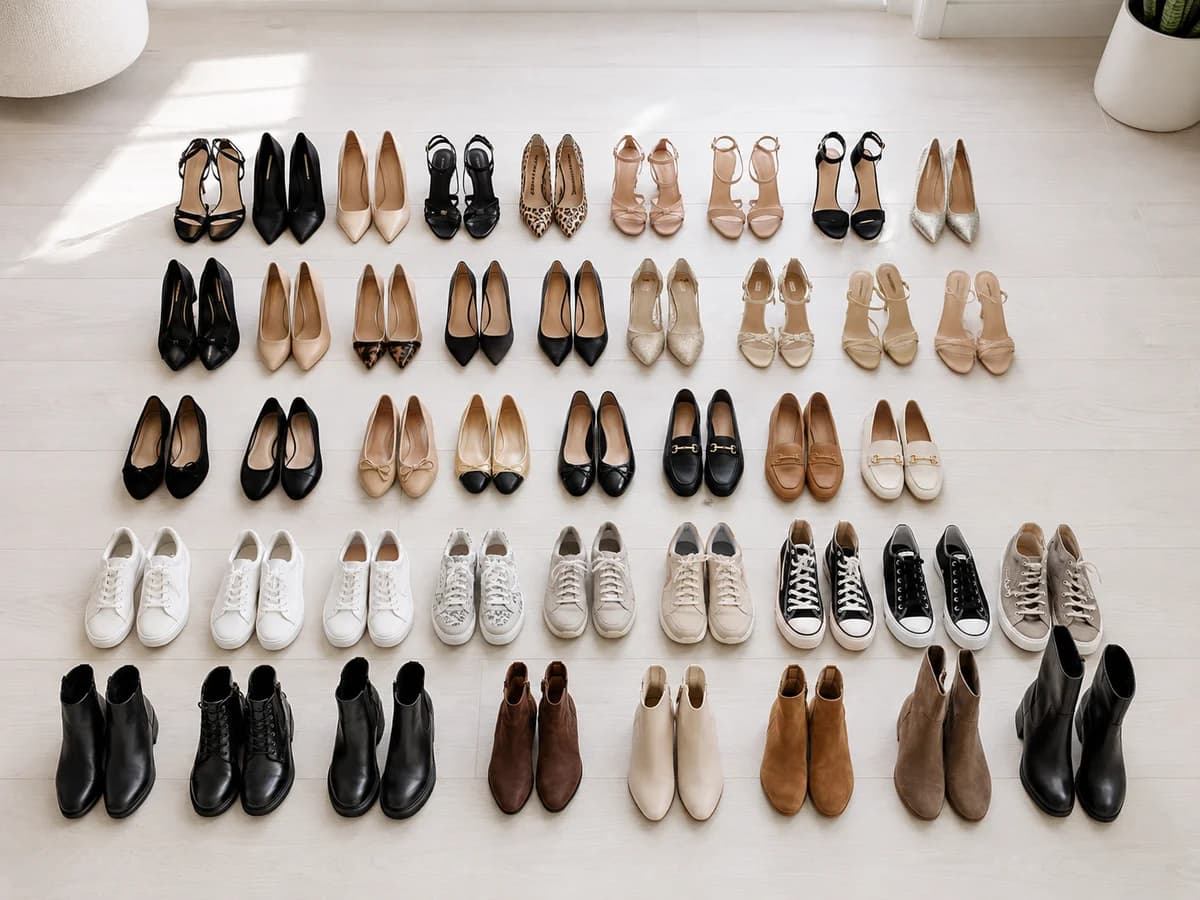
Nearly every apartment delivered in São Paulo in recent years comes with built-in bedroom cabinetry, and nearly all of that cabinetry solves footwear with a niche at the base of the wardrobe. It looks practical and misleads on two counts: the clear height between shelves is designed for flat shoes, and the depth is the wardrobe's own, built for a hanger rather than for a foot.
Before buying any organizer, write down three numbers: clear height between shelves, usable depth and opening width. Most of the stackable acrylic boxes sold as standard will not go into a low niche, and that is why so many people buy, test and return them.
What belongs in the factory niche
Reserve the niche for whatever is flat and fits the height that exists: flats, sandals, loafers, low-soled sneakers. It is also where the most frequently worn pairs should live, because it is the part of the wardrobe you reach by bending down only once.
What needs somewhere else
Boots, high heels and running shoes with a tall midsole fit a shallow niche neither lying down nor standing up. They go to the upper shelf of the wardrobe or the overhead cabinet, in standardized boxes. For boots, use shelf dividers to keep them upright: a boot left lying down folds at the shaft and loses its shape. Boot shapers, the cardboard or plastic inserts, preserve the structure while the boot is stored.
When the volume outgrows the niche
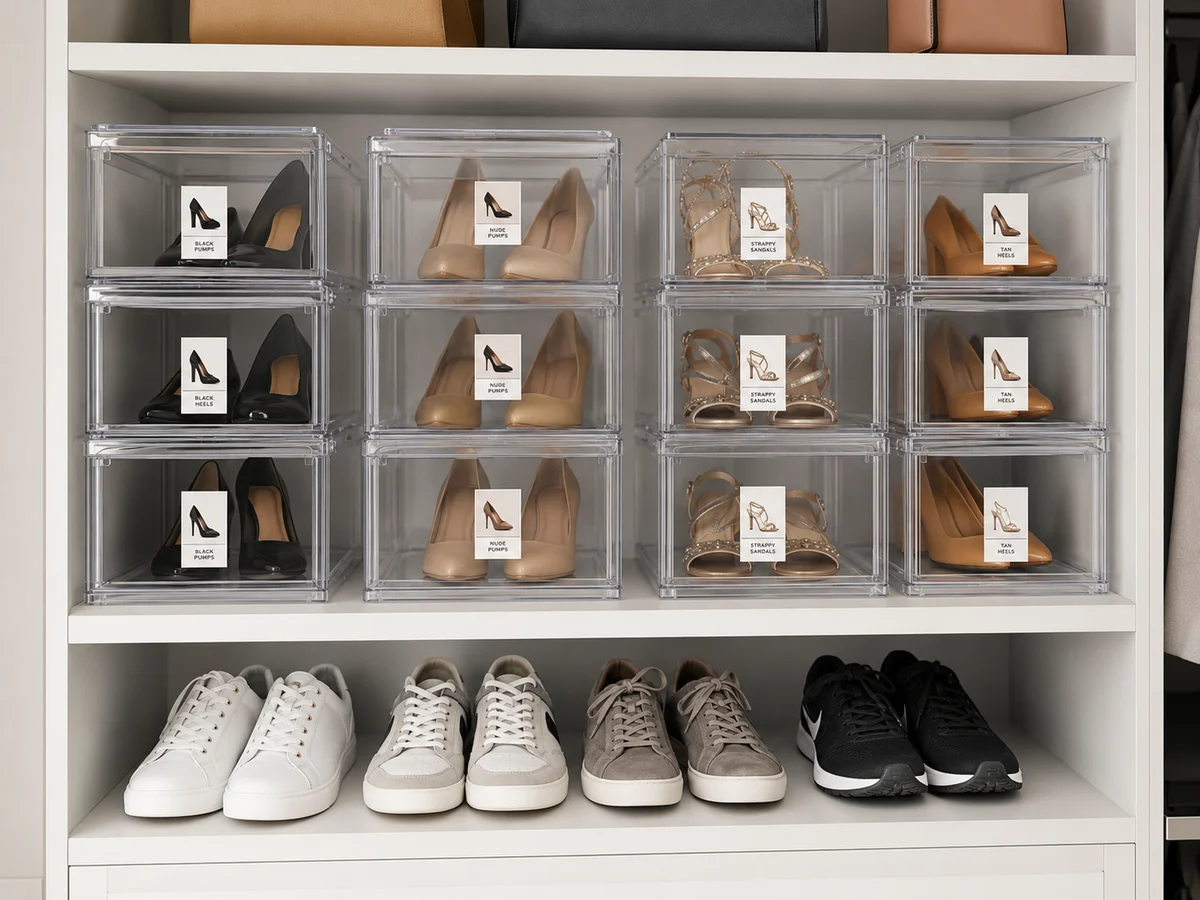
Past forty pairs, organizing demands a system rather than improvisation. Stackable clear acrylic boxes with a front label are the most efficient method: you see the contents immediately, they stack stably and they protect the pair. Organize by type, and within each type by frequency of use. The most worn at eye and hand height, the occasional ones in the overhead cabinet or at the lowest level.
The worst case is when the closet is organized and still doesn't work.
In a 6m² closet in Jardins, a client owned 52 pairs and spent up to 10 minutes looking for a shoe she knew she had. She told me she felt the problem was her, since the closet was organized. The real problem was the boxes: stacked up to 1.80m, all original brand boxes, each a different height. With boxes of different heights, your eyes slide past without landing on anything. We replaced them with 48 identical clear acrylic boxes, each with a front label and a photo of the pair. The closet ended up with 4 fewer pairs. She now finds any pair in under 30 seconds. The original brand box has one function: transport. Inside the house, it gets in the way of whoever needs to find something at 7 in the morning.
Bedroom wardrobe: the door, the floor and the cold wall
When the bedroom has no walk-in closet but a four or six door wardrobe along a single wall, footwear competes with everything else. There are three underused areas in there, and one you should avoid.
The inner face of the door
A door organizer with individual pockets holds between 12 and 24 pairs, depending on shoe size, and uses space that was completely wasted. It works for flats, flat sandals and low heels. It is not a solution for bulky sneakers or boots. Check that the door still closes with the organizer full before installing it: in a shallow wardrobe, some models jam the door.
The wardrobe floor
Plastic or acrylic shoe racks that stack on top of each other make use of the vertical space on the wardrobe floor. Keep the most frequently worn pairs in reachable positions. Don't stack the pair you wear every week under five others.
The back wall, which is the area to avoid
If the wardrobe backs onto the service-area wall or the facade, leave the back row for synthetic footwear and bring the leather forward, where more air moves. If you can pull the unit a few centimeters off the wall, that finger of space makes a real difference during the wet cycle.
The rule for daily shoes
For a tight wardrobe, one simple rule cuts the friction: everyday shoes stay outside the wardrobe, on a stand near the bedroom door or in the entryway zone. What's inside the wardrobe is stock, not routine. That keeps you from opening and closing it several times a week just to grab the same sneakers.
Organized shoes are the start. A wardrobe and an entryway working together is the result.
See home organization services →The entryway a São Paulo apartment does not have
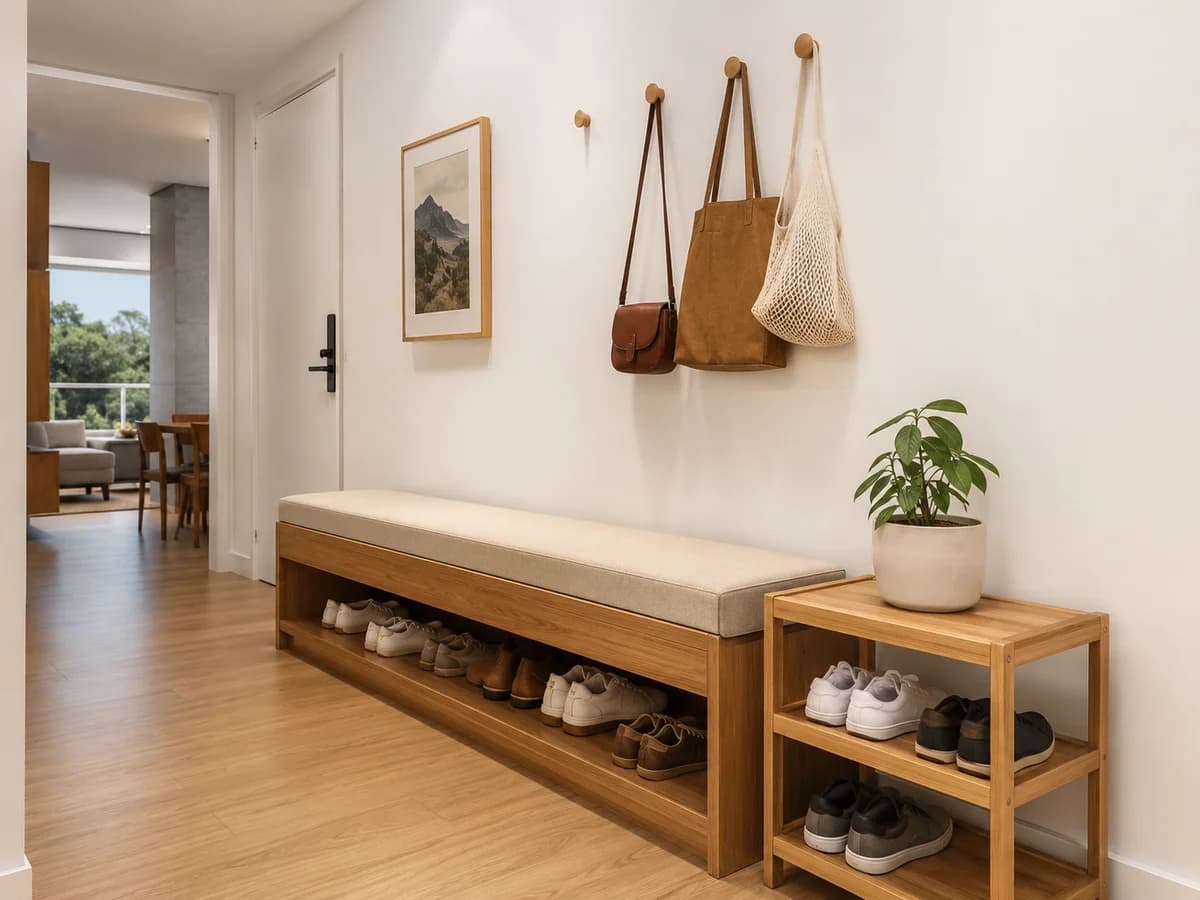
Imported guides talk about the mudroom, that transition room between the street and the home. In a 60 to 90 m² apartment in São Paulo, that room does not exist. The door opens straight into the living room, or into a stretch of hallway barely a meter long. A wide bench does not fit, an entry cabinet does not fit, and that is why the pile forms on the floor.
The measurement that decides everything is not the size of the room: it is the arc the open door sweeps. Open the door all the way and mark that arc on the floor with painter's tape. What you can install is whatever sits outside it, against the side wall, no deeper than 40 cm. Furniture chosen from a photo, without that mark on the floor, is what becomes an obstacle within a week.
What fits in 40 cm
- A low, narrow shoe rack: 6 to 8 pairs, enough for the week's rotation. It is the option that intrudes least on circulation.
- A narrow bench with storage: only when there is a free stretch of wall. It solves two things at once, a place to sit while putting shoes on and storage for a few pairs, and it is essential in a home with a small child or an older adult.
- High wall hooks: they don't store shoes, but they get backpacks and bags off the floor, and a clear floor is what stops the shoe pile from starting.
The shared hallway does not count. Most building bylaws here forbid leaving any object there, because the hallway is a fire escape route, and a shoe rack in the corridor tends to earn a notice from the building before it earns order at home. If your apartment's entry is literally the living room, the subject goes beyond footwear: the post on an organized entryway covers the whole zone, keys and mail included.
The rule that holds the entryway zone
Only the pairs worn in the last three to five days stay at the entry. The practical limit is two to three per person. Everything else goes back to the wardrobe the same day. Without that rule, any unit overflows within a week, and the shoe rack becomes the new pile, only raised off the floor.
When the home has children
Low hooks, at their height, for backpacks and bags. A shallow basket for their shoes, set where they can reach it on their own. When a child can put away their own shoes, they will. When the system requires an adult to do it, the shoe stays on the floor.
The two-season calendar: what to do in October and in April
São Paulo does not call for the wardrobe rotation that southern Brazil does. It does call for a maintenance rotation, and that one follows the two seasons of the year here: the wet cycle from October to March and the dry period from April to September. Two stops a year, an hour each, prevent the bill mold hands you all at once.
October: the turn into the wet cycle
- Take every rarely worn leather pair out of closed boxes and move it to an open shelf.
- Swap the silica gel or activated charcoal sachets in the boxes that stay closed.
- Put the boots away, but only once fully dry, and store them upright with an internal support.
- Check the row that touches the back wall of the wardrobe and bring the leather forward.
April: the start of the dry period
- Use the low-humidity afternoons to leave the whole wardrobe open for a few hours.
- Bring the boots back within easy reach and review what to let go of before returning them to the system.
- Check what has sat in the overhead cabinet and the garage storage unit since last year. A full cycle without use makes a pair a donation candidate.
Odor and drying, all year round
Activated charcoal sachets handle odor better than a scented spray, and without perfuming the leather. Place one inside each shoe you store for more than a week. Cedar shoe trees, the natural cedar inserts, do all three jobs at once: they absorb moisture, eliminate odor and keep the shape, which makes them especially useful for dress shoes. After a rainy day, stuff the boot shaft with newspaper and let it dry in a well-ventilated spot for at least 24 hours before storing. A boot put away slightly damp grows mold inside the shaft, and that is hard to remove.
How much footwear fits a 60 to 90 m² apartment
There's a simple rule: if you can't see all your shoes without moving others, you have more than your system can hold. It's not a judgment about absolute quantity. Thirty pairs can be easily manageable in a well-structured closet, while fifteen can be a problem in a wardrobe with no system.
In an apartment there is a second test, and it is harsher. Add up what is in the bedroom wardrobe, the overhead cabinet, under the bed and the garage storage unit. If the footwear only fits because the garage unit is part of the count, the volume has already passed what the home can hold, and the price of that shows up as mold on the leather that went down there.
When you reach that point, you have two legitimate options: expand the system inside the bedroom, with cabinetry or a better organizer, or reduce the volume. Both answers are valid. What doesn't work is pushing more volume into a system that can't hold it: the organization collapses, you lose track of pairs, you buy duplicates by accident, and the pile is back at square one.
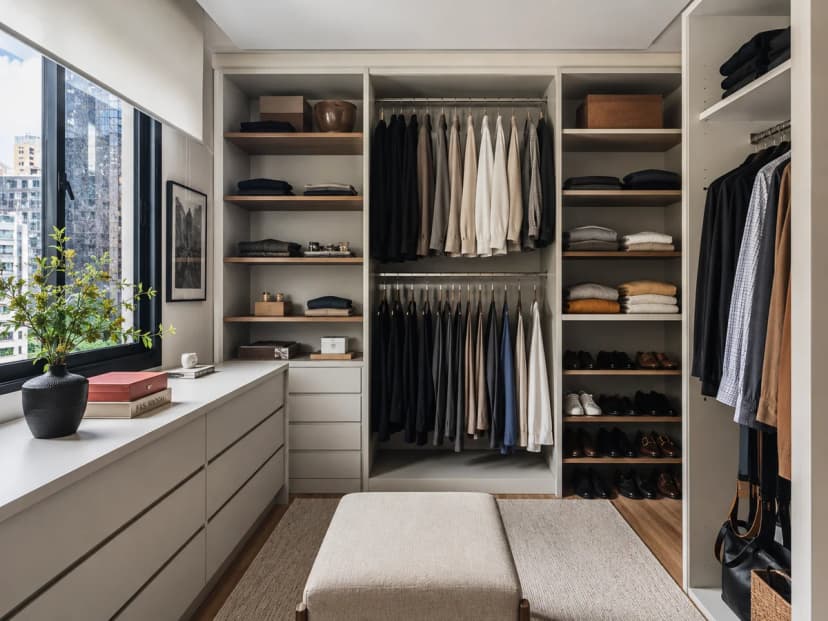
Shoes and handbags compete for the same shelf and the same wardrobe floor. The post on where to store handbags in the bedroom and closetcovers the category that tends to take up the height the shoes need. If the whole apartment is at its limit, the starting point is how to organize a small apartment in São Paulo.
Frequently asked questions about shoes in a São Paulo apartment
How do you prevent mold on shoes in a São Paulo apartment?
Take leather out of closed boxes during the wet cycle, which here runs from October to March. In those months, the leather pairs you rarely wear belong on open shelves. For boxes that stay closed, use silica gel or activated charcoal sachets and swap them every three months. Avoid the niche that backs onto the service-area wall or the facade, the two that condense most. And open the wardrobe for a few hours each week, ideally on the dry afternoons between April and September.
Will a clear acrylic box fit the shoe niche in a builder-grade wardrobe?
It depends on the clear height, and that is almost never what you assume. The factory niche tends to carry the wardrobe depth and a height designed for flat shoes. Measure three numbers before buying: clear height between shelves, usable depth and opening width. If the clear height does not take a standard stackable box, use the niche for whatever is flat and move boots and high heels to another part of the wardrobe.
Where do shoes go when the apartment door opens straight into the living room?
On a narrow unit no deeper than 40 cm, against the wall the open door does not sweep. Mark the arc of the open door on the floor before buying any piece of furniture: that arc decides what fits, not the square meters of the room. The unit holds only the pairs worn in the last three to five days. The shared hallway is not an option: most building bylaws here forbid leaving objects there because it is a fire escape route.
Can I store shoe boxes in the garage storage unit?
Not leather or natural fabric. The garage unit has no ventilation, the temperature swings between day and night and cardboard soaks up the moisture rising from the floor. If it is the only option left, send only synthetic footwear there, clean and dry, in a lidded plastic bin raised off the floor. And read the signal: once footwear needs the garage unit, the volume has already passed what the home can hold.

About the author
Silvana Santanna →Personal Organizer in São Paulo, specialized in residential move organization and functional organizing projects for homes, closets, kitchens, trousseaux and home offices. Creator of the Casa Pronta™ Method, with more than 100 projects completed across São Paulo and the greater metro area.

Ready to have your home organized
without lifting a finger?
Project assessment visit.