Cleaning Supplies Organization: How to Avoid Waste
How to organize a cleaning supplies cabinet with a professional method: categories, safety for kids and pets, and how to avoid wasting products and duplicate purchases.
Neste guia você verá:
Open the cabinet under the kitchen sink. What do you see? In most homes: a graveyard of half-empty bottles. Three different floor cleaners, two of them bought because you didn't remember you already had the first one. A stain remover you discovered today, forgotten behind everything else. Two bottles of the same product, one almost empty, the other still sealed.
This situation costs money (you buy what you already have), takes up space (products no one uses crowd out the ones you actually reach for) and can create real safety risks, especially in homes with children or pets.
A professional system for organizing cleaning products solves these problems, and it starts with a step most people skip.
What a personal organizer finds in this cabinet
Before any system, there is a sort-through. In practically every project, the cleaning cabinet holds the same things: two opened degreasers, an oven cleaner bought once and never used, three brooms in different sizes, duplicate bottles of bleach, and expired products no one checked because the packaging looked fine from the outside.
Along with the waste come the risks: bottles with no label because the contents were transferred from the original packaging, chemical products on a low shelf accessible to children and pets, and items that should never sit side by side. Bleach stored next to any acidic product releases toxic gas. This is not a matter of fussy labeling.
The work starts by taking everything out, checking expiration dates, discarding what no longer serves and separating stock from active-use items. Only then comes the organizing, and any extra stock, when needed, moves out of this cabinet.
The inventory: the first step is gathering everything
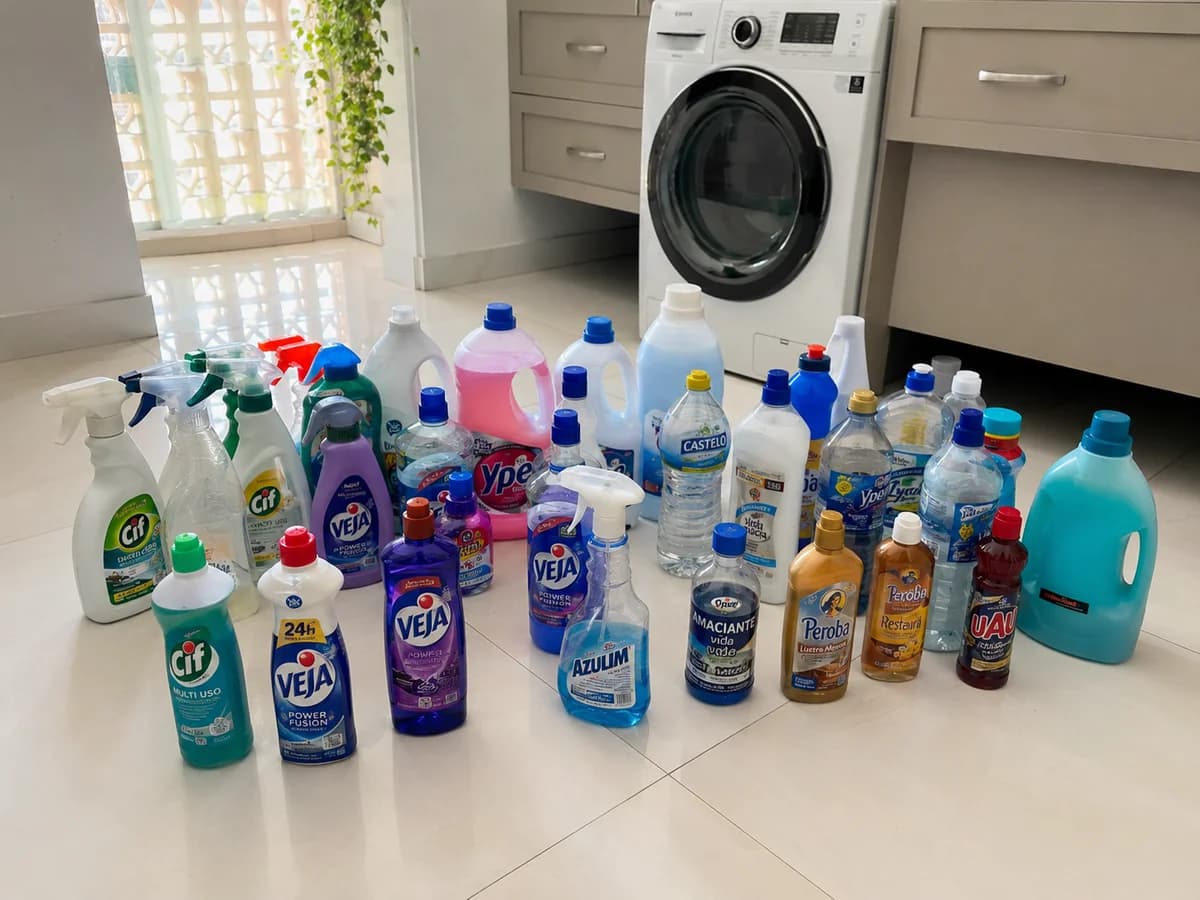
Before organizing anything, you need to know what you have. That means gathering in one place (a table, the laundry room floor, any large surface) every cleaning product from every spot in the house: kitchen cabinet, under the sink, bathroom cabinet, laundry area, storage room, balcony.
This process reveals things you probably didn't know you knew: expired products (yes, cleaning products do expire), duplicates you bought without realizing it, products you have never used and never will, and items stored in completely the wrong place (bathroom cleaner in the kitchen, dish soap in the laundry room).
With everything in view, discard right away:
- Expired products: check the expiration date, effectiveness drops, and some products can become unstable over time.
- Damaged packaging: broken cap, cracked bottle, completely unreadable label. If you no longer know what it is, throw it out.
- Products you genuinely will not use: that specific cleaner for a floor type you don't have, the product you bought on impulse and never opened.
What is left after this discard round is your real inventory, and that is what you will build the system around.
How to categorize cleaning products
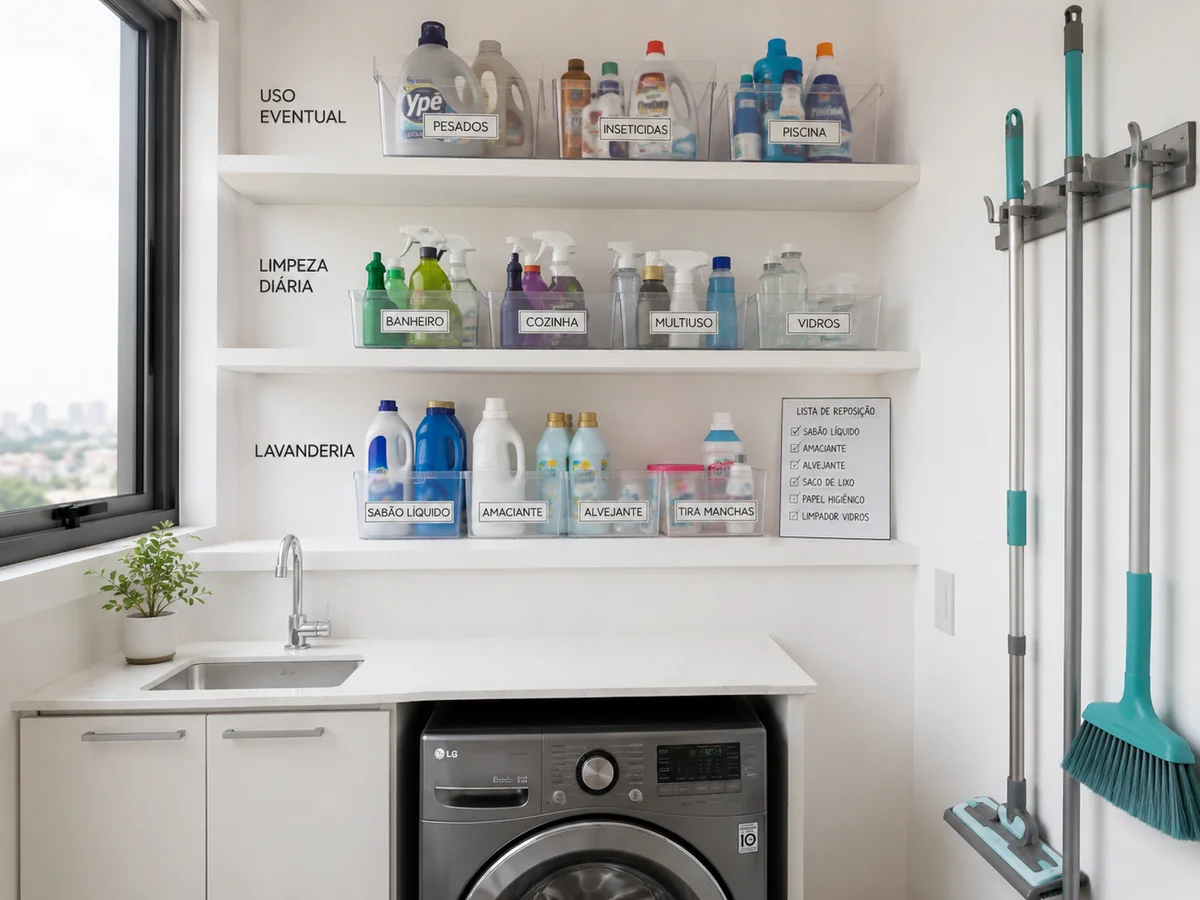
Categorize by function, not by room. Five groups cover any home: daily use (all-purpose, floor, dish soap), laundry (detergent, fabric softener, stain remover), bathroom (disinfectant, limescale remover), heavy-duty and occasional (bleach, drain cleaner) and tools (brooms, cloths, mops). Each group stays in the cabinet or area where it is used.
The most common mistake in cleaning product organization is categorizing by room ("kitchen products," "bathroom products"). It seems logical, but it creates problems: the all-purpose cleaner works in the kitchen and the bathroom, the disinfectant goes in the bathroom but also on the floor, and you end up with duplicates in every cabinet.
Professional categorization is by function, not by room. Five categories cover most homes:
Daily use
All-purpose surface cleaner, floor cleaner, dish soap, sponge. These are the products you use every week; they need to sit in the most accessible spot in the cabinet, at hand height, without having to move anything to reach them.
Laundry
Powder or liquid laundry detergent, fabric softener, stain remover. These stay grouped in the laundry area, not scattered around the house. When you go to do laundry, everything is in the same place.
Bathroom
Disinfectant, toilet cleaner, limescale remover. These can stay in the bathroom's own cabinet, as long as they are out of children's reach. In homes with a single bathroom, they stay in the central cleaning cabinet.
Heavy-duty and occasional
Drain cleaner, heavy-duty degreaser, bleach, floor wax, rust remover. These are used infrequently: they can sit on less accessible shelves, higher up or further back. But they need to be clearly labeled and separated from daily-use products.
Tools
Cloths, sponges, brooms, mops, wet mops, buckets. These need their own space, not mixed in with liquid products. Tools left leaning against liquid products build up moisture and contaminate the space.
Safety first: children and pets
This is the topic that generic posts about cleaning product organization systematically skip, and it can make the difference between a safe home and an accident. Let's be direct.
In a 90-square-meter apartment in Saúde, the client cleaned the bathroom every week and came out with burning eyes. She thought it was product sensitivity, that she needed to switch brands. When I mapped the cabinet under the sink, I found 23 bottles: half of them missing their original label, contents transferred into kitchen containers. Bleach in a clear all-purpose bottle. Concentrated vinegar in an unlabeled spray bottle. The two sat side by side. We labeled the products, separated them by risk color and discarded anything without traceable original packaging. Eleven bottles remained. She stopped leaving the bathroom with irritated eyes. When a product leaves its original packaging, it loses the one piece of information that prevents an accidental mix.
Storage rules for homes with children
For children under 5, any cleaning product is a risk, including ones labeled "natural" or "eco." The rule is absolute: anything toxic belongs in a cabinet above 1.5 m in height, with a latch, or with a lock. There is no exception.
- Use safety latches on low cabinets, even for less hazardous products.
- Never transfer cleaning products into food containers (a water bottle, a yogurt cup). Children associate the container with what they know, and may drink from it.
- Products with a pleasant scent (some perfumed cleaners, colorful soap pods) are especially appealing to small children. Extra caution is needed.
- In case of ingestion, call the Poison Control Center immediately: 0800 722 6001.
Risks for pets
Dogs and cats walk on the floor with their paws and then lick their paws. Floor cleaners and disinfectants that are relatively safe for humans can harm animals while the floor is still wet.
- Let the floor dry completely before letting pets walk on it, especially small dogs and cats.
- Ammonia-based products are particularly irritating to cats, whose sense of smell is far more sensitive than a human's.
- Soap pods are toxic to dogs if swallowed: keep them in a latched cabinet.
- Choose products with an eco certification for use in homes with pets.
Color-coded risk labeling system
A simple, visual solution: colored labels on the products. Red for products that need locked storage and should never be mixed. Yellow for products that must stay elevated, out of children's reach. Green for daily-use products with open access. You build the system once, and anyone who needs to use the cabinet (a cleaner, a caregiver, a family member) understands it immediately.
In a 75-square-meter apartment in Lapa, the client called me after finding her 3-year-old son holding a plastic bottle. It was a soda bottle, but it had concentrated detergent inside: she had transferred the product to save space. To the child, it was just a bottle with colorful liquid. There was no ingestion, but it was close enough. During the visit, we discarded bottles without original packaging, installed latches on the low cabinets and moved the most hazardous products to the high bathroom cabinet. The labeling system came next: red for what stays up high with a latch, yellow for restricted access, green for daily use. Anyone who opens that cabinet understands the code. For a small child, the packaging is the only code they know.
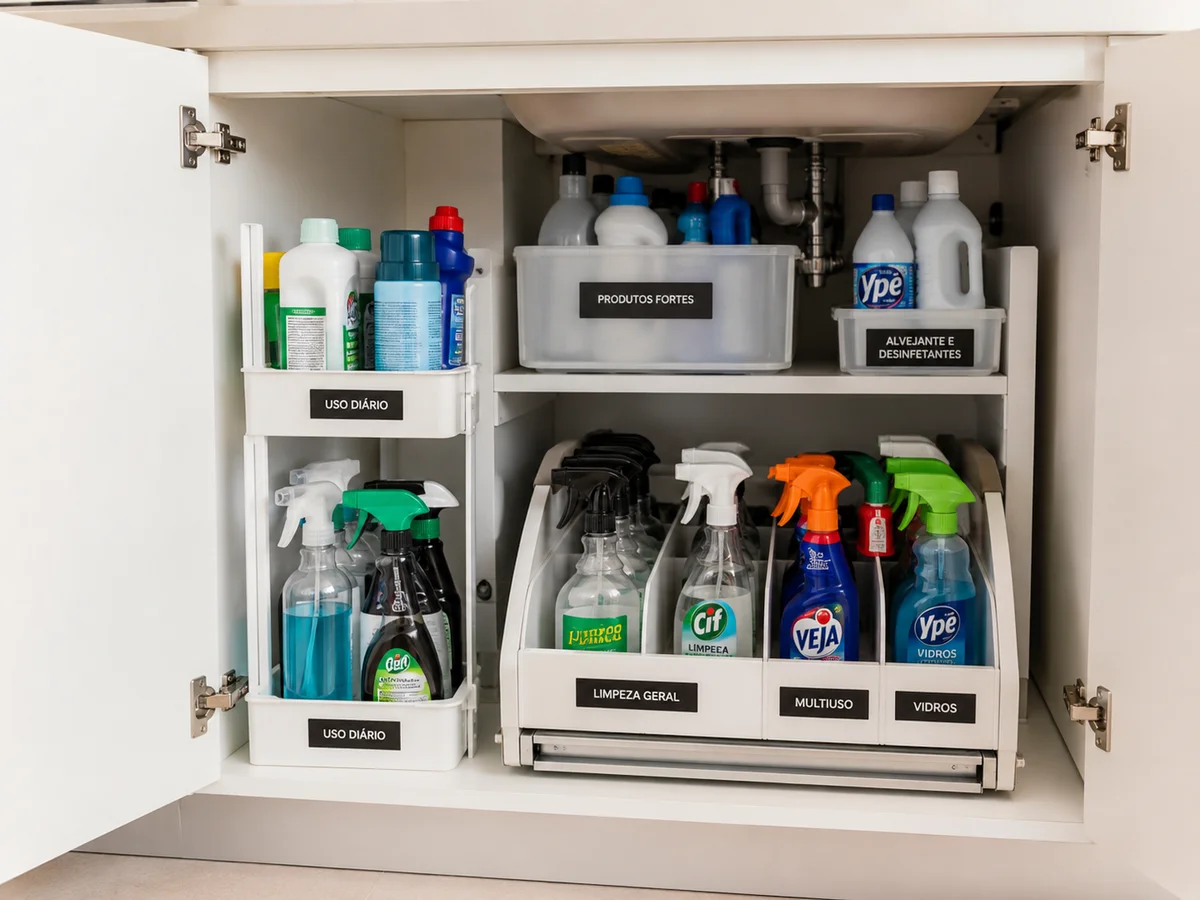
An organized laundry area and cleaning supplies cabinet are part of a complete home organization system.
See home organization →The ideal storage system
With the inventory done, products discarded and categories defined, it's time to build the physical system.
Under the kitchen sink
The space under the sink is the most used, and the most chaotic. A vertical caddy (a holder with handles for bottles) keeps bottles upright, accessible and prevents them from tipping over. If the cabinet allows it, a sliding drawer installed inside the space completely transforms accessibility. The goal is to never have to crouch down and remove several products just to reach the one you want.
Laundry area
A shelf dedicated exclusively to laundry products, at a height you can use standing up, without crouching or raising your arms. Cleaning products used while crouched or with arms raised tend to get stored wherever is "easiest," which undoes the system.
Cleaning tools (brooms, mops, wet mops)
The biggest mistake: leaving brooms and mops leaning against the wall or lying on the floor. They fall over, create an obstacle and collect dirt underneath. The right solution is a wall-mounted or behind-the-door hanging system: individual hooks or a multi-hook rack. Stored vertically, they take up almost no space and stay always accessible.
General principles of the system
- Transparency: choose containers or shelves where you can see what you have without moving anything.
- Label anything that leaves its original packaging. A product in an unlabeled bottle is a safety risk.
- Group by frequency of use: what you use every week stays within reach; what you use once a month can be less accessible.
How to avoid waste permanently
Waste has three causes: buying duplicates because a disorganized cabinet hides what you already have, products expiring because they were bought for a specific occasion and never used, and applying more product than necessary out of habit. A fixed list of 8 to 10 products solves all three at once.
Waste with cleaning products has three main causes, and all of them have a systemic solution.
Cause 1: buying duplicates because you can't see what you have
When the cabinet is disorganized, you go to the store and buy what you think is missing. With an organized, visible system, you know exactly what you have before you leave to shop. A fixed list of products (the same 8 to 10 you always use) eliminates impulse buys or purchases made out of confusion.
Cause 2: products expiring unused
Products bought for specific occasions ("I'm going to do a deep clean this weekend") or because they were on sale end up forgotten. The solution: only buy what is on your fixed list, and only buy when the current product is running low, not as excessive preventive stock.
Cause 3: using more than necessary
Most people use more product than necessary with each application, either because the label isn't clear or out of habit. Concentrated sprays diluted to the right measure and quality microfiber cloths do the same job with far less product.
- Do I have a fixed list of 8-10 products I always use?
- Do I check my stock before going to the store?
- Do I practice FIFO (first in, first out): do new products go to the back?
- Do I use concentrated refills to reduce volume and cost?
- Do I do a quarterly review to check expiration dates?
In a 105-square-meter home in Perdizes, the client told me she was always running out of product. When we did the full inventory for the first time, we found 31 bottles scattered across four spots in the house. Eight opened duplicates, including two degreasers and two floor cleaners. None of them were actually running low. She kept buying because at the store she never knew what she had at home. We consolidated down to 9 products and created a fixed list taped inside the cabinet, with one rule: only buy when the current product has less than a quarter left. Three months later she messaged me to say the cabinet still had the same 9 products in place. Whoever buys without an inventory always buys a little more than needed, until the cabinet no longer closes.
Concentrated refills: a habit change worth making
Buying the concentrated product and diluting it into smaller spray bottles reduces both the cost per use and the volume of packaging you throw away. The correct dilution is always on the concentrate's label. A 500ml bottle of concentrate can yield 5 to 10 liters of ready-to-use product, and takes up far less space in the cabinet.
Which products do you really need?
Most homes run well with 8 to 10 products: all-purpose cleaner, glass cleaner, degreaser, bleach, dish soap, laundry detergent, fabric softener, bathroom cleaner, floor wax and drain cleaner. A dedicated product for every surface is a myth created by the industry, not a real necessity.
The cleaning industry has an interest in making you believe you need a different product for every surface, every floor type, every material. The reality is that most homes work perfectly well with 8 to 10 products.
The essential list:
- All-purpose surface cleaner (counters, tables, appliances)
- Glass cleaner
- Degreaser (stove, range hood, greasy kitchen surfaces)
- Bleach (disinfecting and whitening)
- Dish soap
- Powder or liquid laundry detergent
- Fabric softener
- Bathroom cleaner / disinfectant
- Floor wax (if applicable to your floor type)
- Drain cleaner
"Special product for granite," "exclusive cleaner for stainless steel," "spray for reconstituted stone surfaces": in most cases, a good all-purpose cleaner with a quality microfiber cloth does the same job. The cloth makes more of a difference than the product.
Natural alternatives that actually work: baking soda for gentle surface scrubbing and odor absorption, diluted white vinegar for removing limescale (but never mixed with bleach). These alternatives have real limitations; they don't replace disinfectants in situations that require sanitizing, but they work well for daily upkeep.
Frequently asked questions about cleaning supplies organization
Which cleaning products can never be mixed together?
Never mix bleach with any acidic product (vinegar, limescale remover, acidic scouring powder): the reaction releases toxic chlorine gas. Never mix bleach with ammonia: it releases toxic chloramine gas. Never mix two different cleaning products without reading the labels first. When in doubt, use one product at a time and rinse well between each use.
How should cleaning products be stored in a home with small children?
Anything toxic belongs in a high cabinet with a lock, or in a cabinet with a key. Even products labeled "natural" or "eco" should stay out of reach of children under 5. Use safety latches on low cabinets even for less hazardous products. Never use food containers to store cleaning products, since children can mistake them for something else.
How many cleaning products do you really need?
For most homes, 8-10 products cover every need: an all-purpose surface cleaner, glass cleaner, degreaser, bleach, dish soap, laundry detergent, fabric softener, bathroom cleaner, floor wax (if applicable) and a drain cleaner. "Specialized" products for every surface are usually marketing: a good all-purpose cleaner does the job.
How often should you reorganize the cleaning cabinet?
A quarterly review is ideal: check expiration dates, discard products you no longer use, and consolidate opened packages of the same product. Monthly, just restock. The system works best when you keep a fixed list of products you always replace, without improvising new purchases every time you go to the store.

About the author
Silvana Santanna →Personal Organizer in São Paulo, specialized in residential move organization and functional organizing projects for homes, closets, kitchens, trousseaux and home offices. Creator of the Casa Pronta™ Method, with more than 100 projects completed across São Paulo and the greater metro area.
Ready to have your home organized
without lifting a finger?
Project assessment visit.