How to Organize a Small Apartment in São Paulo
A professional method for compact apartments: zones by room, vertical use of space, closets, kitchen, and how to keep it organized day to day.
Neste guia você verá:
- 01Why small apartments get disorganized
- 02Three compact apartments I organized
- 03The zone principle in compact spaces
- 04The compact kitchen: maximum use of space
- 05The small bedroom: closet, bed, and work
- 06Open-plan living room: living, dining, and home office
- 07Vertical use of space: the meter everyone forgets
- 08What to buy (and what not to buy)
- 09How to keep it organized day to day
- 10Frequently asked questions
Why small apartments get disorganized
São Paulo has some of the most expensive square meters in Brazil, and that shows up directly in the size of the apartments available in the most central neighborhoods. Pinheiros, Vila Madalena, Itaim Bibi, Brooklin, Paraíso: studios and apartments of 35 to 55m² are the reality for a huge share of the city's population.
In these apartments, clutter takes hold faster and with more visible consequences. In a 150m² house, a messy drawer is invisible. In a 38m² studio, any occupied surface changes the perception of the entire space.
But the main cause of clutter in small apartments is rarely a lack of space. It is a combination of three factors:
- Volume that does not match the space: belongings brought from a larger home, accumulated gifts, impulse purchases. The apartment holds the amount of stuff you would expect in a bigger property.
- No defined zones: in small spaces, everything tends to blend together. Work happens at the living room table, keys land on the kitchen counter, clothes pile on the bed. When there is no set place for each thing, everything ends up everywhere.
- Storage that goes unused: high shelves sitting empty while the floor is packed. The inside of closet doors wasted. The space under the bed ignored. The space is there, simply going unused.
Three compact apartments I organized
One of the phrases I hear most often before starting a studio session is: "there's no solution, the apartment is just too small." Almost always, that is not the case.
The 38m² studio with half the closet empty
A designer from Pinheiros, 29 years old, 38m² studio, living alone for two years. He had given up trying to organize it: he believed the problem was structural, that nothing could be done with that space. When I arrived, the top shelves of the closet were completely empty. The counter held six objects that could have been in the closet, but sat there because they had no defined place. The work desk was covered in kitchen items and personal belongings: with no defined work zone, everything landed wherever there was open surface.
We freed up the high shelves with proper folding, turned the desk into an exclusive work zone, and cleared the counter. Two weeks later he sent me a photo: "It looks like the apartment got bigger. Nothing changed in size." The lesson from this case: the feeling of "too small" is almost always about how the space is used, not about square meters.
80m² worth of belongings inside 52m²
Couples who move in together for the first time rarely calculate their combined volume of belongings. By the time they notice, the apartment is already at its limit.
A couple from Vila Madalena, 52m² apartment, an 11-month-old daughter. When they got married, both brought belongings from their previous homes. They arrived at the apartment with enough volume for an 80m² property. Three months after moving in, the bedroom still had stacked boxes, and the mother felt guilty every time she saw her daughter crawling through a partially blocked space.
We started with decluttering: 30% of the volume went to storage or donation. The bed had a built-in drawer the couple had never used. Extra and off-season bedding went into the drawer and freed up three closet shelves. It was the first day, since they had moved in, that they could walk across the bedroom without stepping around anything. The lesson: when two households become one, the first step is decluttering, not reorganizing what is already there.
Plenty of organizers, no system at all
There is a pattern that comes up often in studios: the person has already tried to get organized. Bought organizers, watched videos, tried at least three times. And still nothing lasted. There is a specific reason for that.
A lawyer from Itaim Bibi, 42m² studio. She had bought a substantial number of organizers in the previous three months: bins, drawer dividers, wall shelves. None of it worked. She felt frustrated with herself, believing the problem was a lack of discipline rather than a lack of method. The bins were full of mixed-together items, the dividers had been installed without emptying the drawers first, and the shelves were still inside their boxes.
We decluttered first, then installed the shelves at the right heights and reorganized every bin with a zone system. The counter was cleared. "I bought all of this and it didn't fix anything. You brought nothing and fixed it." The lesson: an organizer without a method is just a container. Decluttering and defining zones need to come before any purchase.
The zone principle in compact spaces
The biggest mistake when organizing a small apartment is trying to organize room by room, item by item, without a view of the whole. The most effective method starts the other way around: defining activity zones before touching a single object.
An activity zone groups objects by their everyday function, not by a generic category. Instead of "kitchen stuff" and "bedroom stuff," you think in terms of: meal-prep zone, dining zone, sleep zone, work zone, entry zone, hygiene zone.
In small apartments, these zones frequently coexist in the same physical space. The living room is also an office and a dining room. The bedroom holds the bed and the closet and sometimes a study area. Clearly defining each zone, and committing to not mixing objects from one zone into another, is what keeps the space functional and visually organized.
How to define the zones in your apartment
Before starting any organizing, walk through your apartment and list the activities you do there: cooking, eating, working, sleeping, getting ready, hosting guests, reading, exercising. For each activity, identify where it happens and which objects it requires. Those are your zones, and each one needs a defined physical space, even a small one.
The compact kitchen: maximum use of space
The kitchen is usually the most challenging room in São Paulo's compact apartments. Galley kitchens of 4 to 6m² are common in buildings launched over the last 10 years, and they require a different organizing system to work well. For anyone who wants a dedicated guide on the topic, there is a full article on how to organize a small kitchen in São Paulo covering the zone method, vertical solutions, and open-plan kitchens.
Pantry: verticality above all
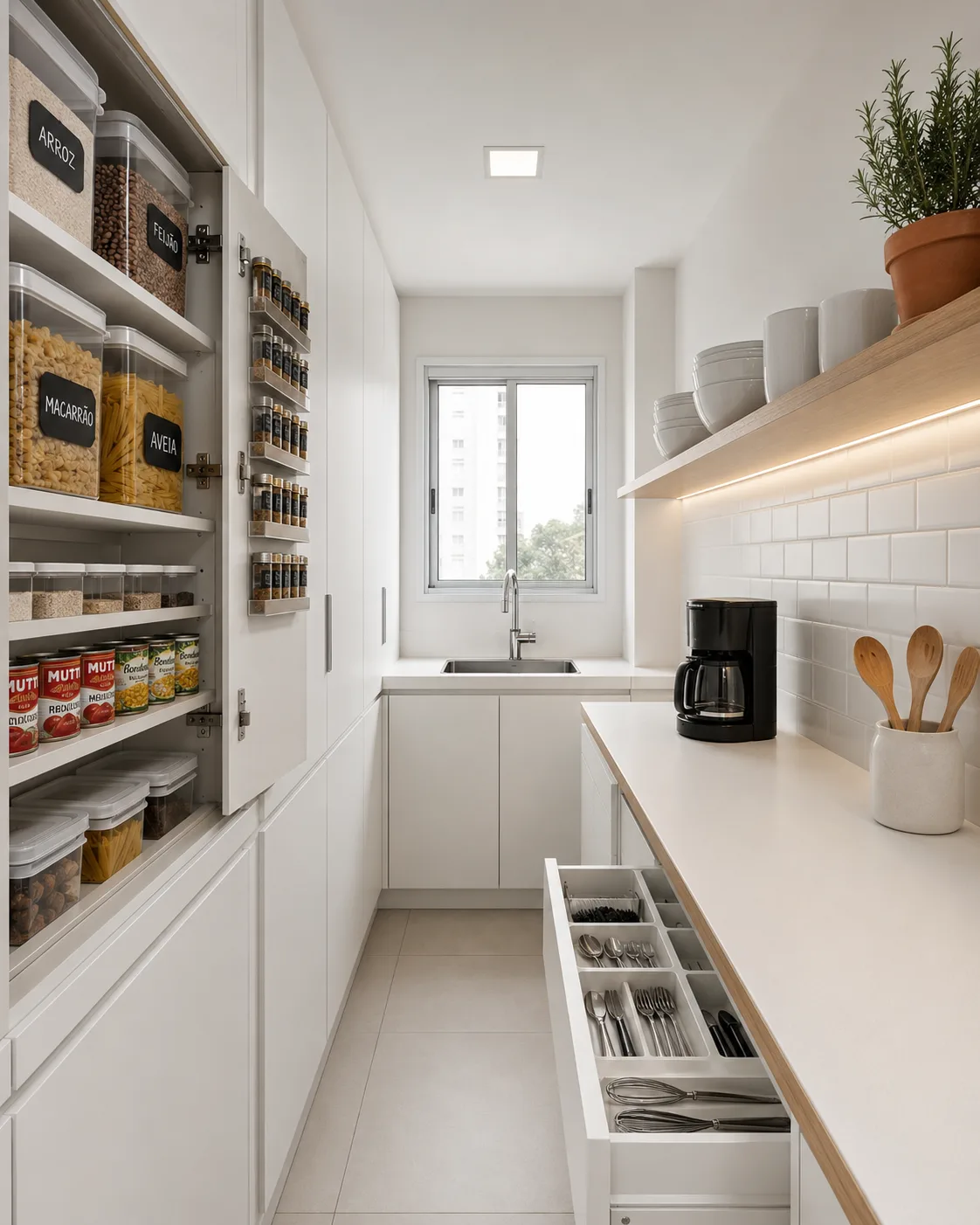
In small kitchens, there is no room for a generous pantry cabinet. The solution is to use every centimeter of height in the existing cabinets. Stackable containers, shelf organizers that double the capacity of each level, and the inside of cabinet doors (ideal for spices and condiments) are the resources that make the biggest difference.
One simple rule: nothing on the counter that is not used daily. A coffee maker and a spice rack are the only items that deserve permanent counter space. Everything else goes in the cabinet: accessible, but put away.
Utensils: strict selection
In compact kitchens, the quantity of utensils needs to match the space. One pot of each main size (small, medium, large), one frying pan, one baking dish. If the second frying pan is used three times a year, it does not justify the space it occupies all year round.
Drawers with dividers by category (cutlery, prep utensils, accessories) keep things organized with no effort, as long as what is inside them is only what you actually use.
Your apartment does not need more space. It needs a system that respects what you already have.
See home organization →The small bedroom: closet, bed, and work
In many São Paulo apartments, the bedroom functions as three rooms at once: bedroom, closet, and home office. Doing this without the result looking chaotic requires clear visual boundaries for each zone within the same room.
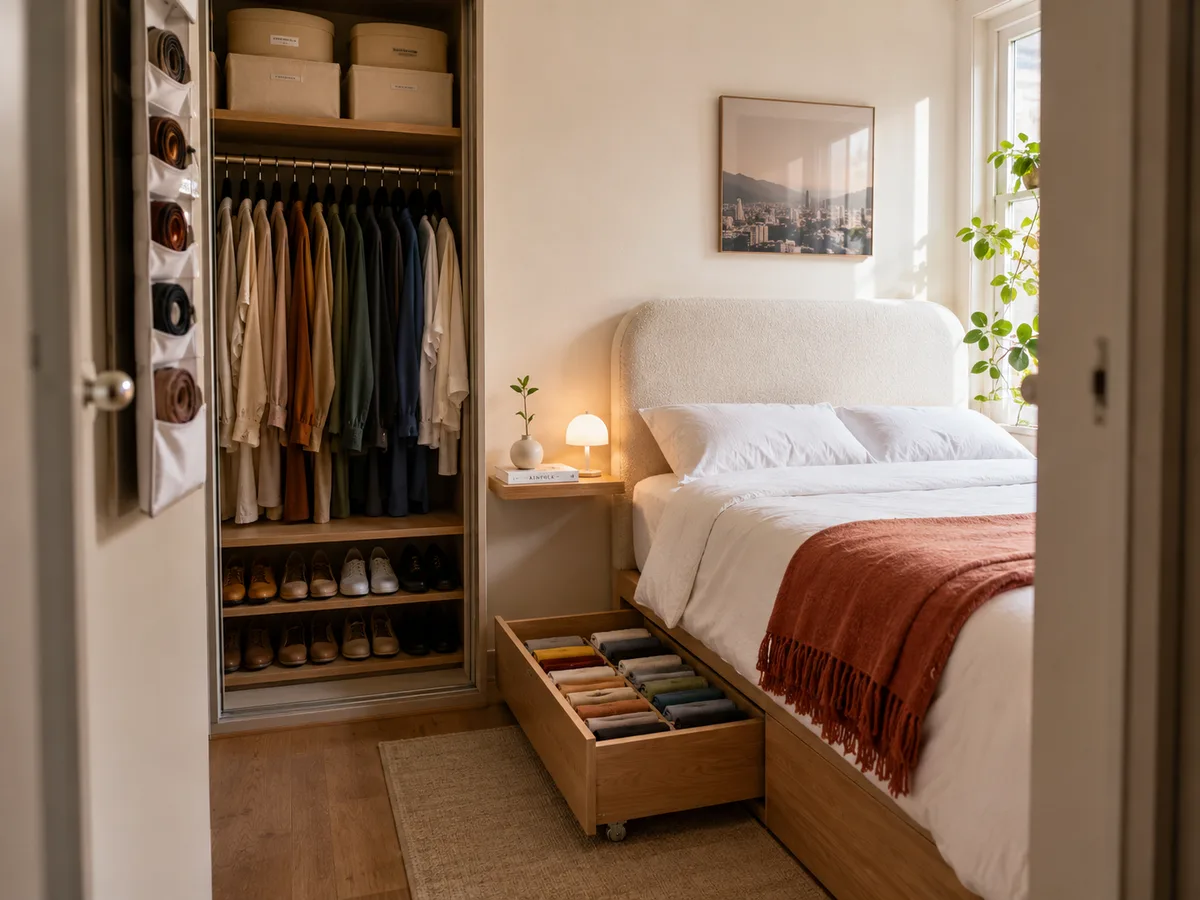
The wardrobe in compact apartments
Two-door wardrobes are the reality for most one-bedroom apartments in São Paulo. To make the most of the internal space:
- Organize by category and frequency: what you wear daily sits at eye level. What you rarely wear goes up high.
- Use uniform hangers: the visual difference between matching hangers and mismatched ones is huge. Slim velvet hangers take up less space than plastic ones and keep clothes from slipping off.
- Maximize the internal shelves: use drawer organizers inside the shelves for folded clothes. An 80cm shelf with dividers can hold socks, underwear, and t-shirts without them mixing together.
- Use the doors internally: a fabric shoe rack on the inside of the closet door holds 6 to 12 pairs without taking up any floor space.
Under the bed: the most underused space
In small apartments, the space under the bed is too valuable to sit empty or collect boxes with no system. With platform beds or beds with built-in drawers, that space handles extra bedding, off-season clothes, suitcases, and blankets without taking up a single extra cm² of the apartment.
Open-plan living room: living, dining, and home office
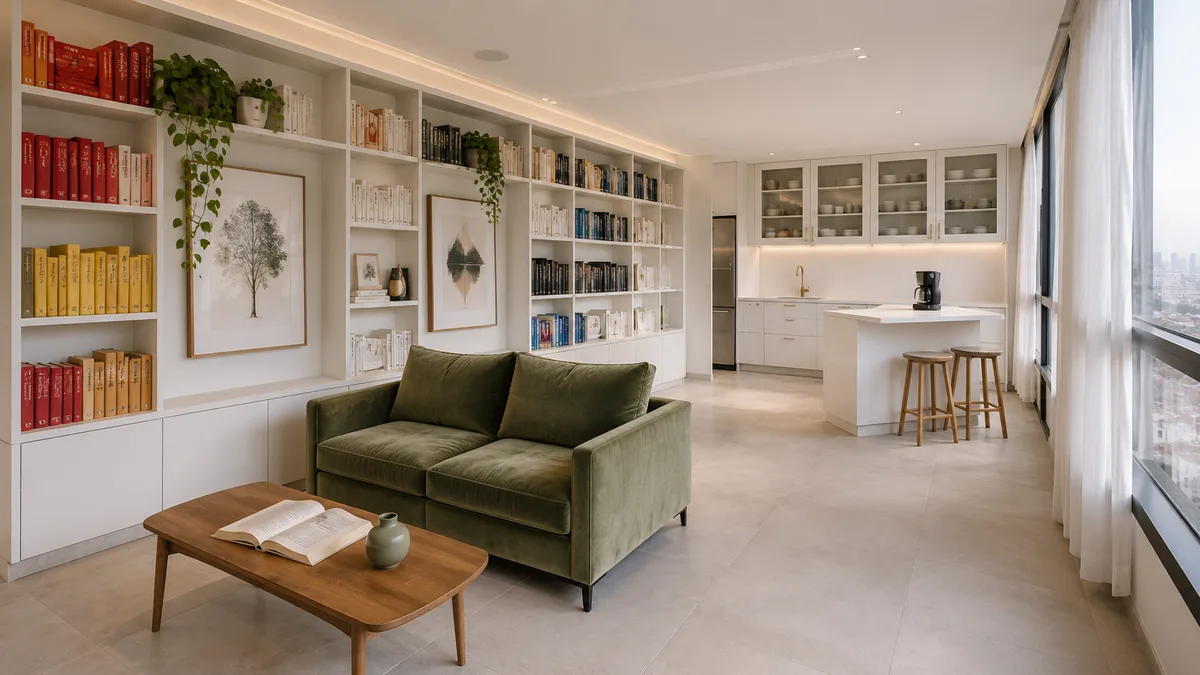
The open-plan living room is the most common layout in São Paulo's newer apartments: living room, dining area, and open kitchen in a single open space. The overlap of functions, with no defined zones, is what makes the space feel constantly messy.
Boundaries without walls
In open floor plans, zones are marked by furniture and rugs, not walls. A rug defines the living area. The table and chairs define the dining area. A console against the wall defines the home office, and when the chair is pushed in, the work space visually disappears from the living room.
A home office in a small living room
The most functional solution for a home office in a small living room is a dual-purpose piece of furniture: a dining table that doubles as a work desk, or a folding desk that closes flat against the wall when not in use. The goal is for the home office to disappear outside of work hours, keeping the living room visually clean.
Vertical use of space: the meter everyone forgets
São Paulo apartments average a ceiling height of 2.6m, and most people only use the space up to 1.8m. That extra meter and a half, in every room, is the biggest waste of space in compact apartments.
Vertical use works in every room:
- Kitchen: cabinets that go all the way to the ceiling eliminate the "dead space" above existing cabinets. If extending the cabinets is not possible, closed storage boxes on top of them hold seasonal items without cluttering the look.
- Living room: tall wall shelves hold books, decorative objects, and belongings, freeing up the TV stand and lower shelving for everyday items.
- Entryway: a hook panel running from the baseboard almost to the ceiling makes use of the vertical space in an area that is usually only used at hand height.
- Bathroom: a shelf above the toilet (with at least 15cm of clearance above the tank) holds extra towels, toiletries, and a reserve of toilet paper without taking up counter space.
What to buy (and what not to buy)
One of the most common mistakes when organizing a small apartment is jumping straight to shopping. Organizers, bins, boxes, shelves, and in the end, the space is still cluttered, just now with pretty organizers that also have no place to go.
What to buy, but only after decluttering
- Empty and declutter first. Only then measure and buy
- Slim velvet hangers to replace mismatched plastic ones
- Adjustable drawer dividers (fit to the size of the drawer)
- Uniform clear containers for the pantry (all the same model)
- Closed bins or boxes for high shelves (hides the clutter without losing the space)
- A door organizer for the inside of a bathroom or kitchen cabinet
What not to buy
- New furniture before using what you have: most storage problems get solved by reorganizing what already exists, not by buying another piece of furniture that will take up floor space.
- Organizers without measuring first: a bin that is 3cm too wide for the closet ends up in the trash or sitting outside the closet: useless.
- Products you "might use": in a small apartment, there is no room to stock items you might use someday. Only buy what you already know you use.
How to keep it organized day to day
In small apartments, maintaining the organization matters even more than in larger homes, because clutter becomes visible faster and spreads to every room more easily.
In practice, three habits make the difference:
- A 10-minute reset at the end of the day: every object that left its place during the day goes back before bed. In small apartments, this reset takes just a few minutes and keeps the space organized by morning.
- One thing in, one thing out: before any purchase, identify what will go to make room. The volume of belongings needs to match the space, always.
- Groceries put away immediately: when you get home with groceries, put everything in its place before doing anything else. In small kitchens, bags left on the counter for hours or days create a cascading effect of clutter.
Frequently asked questions about organizing a small apartment
How do I organize a small apartment without spending much?
The first step, and the most transformative one, costs nothing: decluttering. In smaller apartments, most of the problem is not a lack of space, but an excess of objects that should not be there. Before buying any organizer, empty each closet one at a time and let go of what you do not use, does not fit, and has no defined place. Then use the boxes and bins you already own before buying new ones.
Is it worth hiring a personal organizer for a small apartment?
Yes, especially for small apartments. In smaller spaces, every storage decision carries more weight. A personal organizer maps out the use of every centimeter: takes advantage of height, creates smart use zones in compact closets, sets up a galley kitchen so it actually works, and hands over systems the family can maintain on its own day to day.
How can I make a small apartment look bigger through organization?
Three main principles: (1) keep visible countertops and surfaces completely free of unnecessary objects, since a cluttered view makes a room feel smaller; (2) use vertical storage to the max, taking shelves up to the ceiling to make use of the room's full volume; (3) adopt neutral colors and uniform organizers that create visual continuity instead of fragmenting the space.
Which São Paulo neighborhoods have smaller apartments?
Compact apartments are more common in neighborhoods like Pinheiros, Vila Madalena, Itaim Bibi, Brooklin, Paraíso, Vila Mariana, and Bela Vista: central areas with high demand and smaller lots. In these neighborhoods, studios and apartments of 35 to 55m² are very common, which makes professional organization especially relevant.
How many hours does it take to professionally organize a 45m² apartment?
A 40 to 55m² apartment typically takes between 6 and 10 hours of service, depending on the volume of belongings and the number of rooms. Very compact studios (up to 30m²) with little volume can be finished in a single 4 to 6 hour session. The timeline covers every room: kitchen, bedroom, bathroom, and living room.
Professional organization for compact apartments in São Paulo
A specialist in small spaces: Silvana turns studios and 1 to 2 bedroom apartments into fully functional homes.
Talk to Silvana →
About the author
Silvana Santanna →Personal Organizer in São Paulo, specialized in residential move organization and functional organizing projects for homes, closets, kitchens, trousseaux and home offices. Creator of the Casa Pronta™ Method, with more than 100 projects completed across São Paulo and the greater metro area.
Related posts
Small Closet in a São Paulo Apartment: What Stays and What Goes
11 min · Read article →
How to Organize a Small Laundry Room in São Paulo: 4 Functional Zones
11 min · Read article →
Organizing a Rented Apartment: Solutions With No Drilling and No Cabinetry
12 min · Read article →
Ready to have your home organized
without lifting a finger?
Project assessment visit.