Organizing a Rented Apartment: Solutions With No Drilling and No Cabinetry
How to organize a rented apartment in São Paulo without drilling walls, without cabinetry work and without risking your deposit. A professional method for closets, kitchen, home office and a real routine.
Neste guia você verá:
What changes when the apartment is rented
A large share of people living in São Paulo are in a rented apartment, and most of them live with the same question: how do you organize a space with constraints you cannot change.
The most common mistake I see is confusing real constraints with imagined ones. Many people assume they cannot do absolutely anything in a rented apartment, and end up living with unusable closets and a disorganized kitchen for years. The real constraint is more specific: you cannot make permanent changes that alter the structure of the property. Anything reversible generally falls within what is possible.
The second mistake is trying to solve organization with decor. Buying a nice rug, framed art for the wall and a vase for the living room does not organize anything. Organization is about where things live in day-to-day use, not about how the apartment looks in a photo.
I have worked with rented apartments in São Paulo for years, and the pattern is always the same: closets with shelves at generic heights that do not fit the real contents, a kitchen with a standard cabinet that was never designed for the flow of someone who cooks, and a hallway or entryway with no organization point at all. All of it has a solution that requires no construction work.
Three situations I handled
These three cases share the same common thread: the person had resigned themselves to a space that did not work, without knowing there was a solution that required no construction work and put no deposit at risk.
The closet with shelves that served no purpose
A couple in Vila Mariana, a 55m² apartment, renting for 8 months. The bedroom closet had two shelves: one at 1.70m and another at 2.10m. Everyday clothes ended up on the floor because neither height was practical for folding and storing short pieces. They had bought baskets before the session, but with no system the baskets just became another pile.
They had concluded that this was simply how it was in a rental. Eight months living with that closet, and the bedroom floor had never once stayed clean.
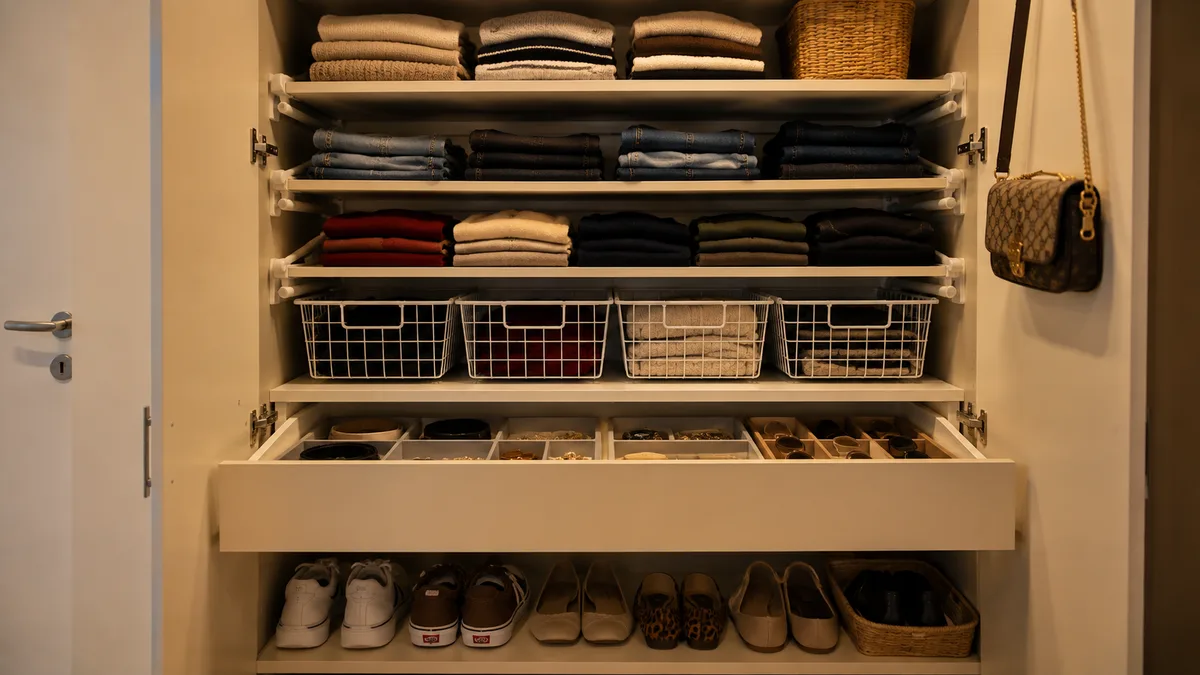
We emptied the closet completely. We added two tension shelves in the oversized gaps, with no screws. Adjustable drawer dividers separated underwear, socks and t-shirts by category in each drawer. Four weeks later, the floor was clean for the first time since they had moved in.
The takeaway: a tension shelf with no screws solves what a standard rental closet leaves unresolved, with no marks on the wall and no risk to the deposit.
The kitchen she had stopped using
Sometimes the sign that a space does not work is that the person stops using it before they even complain about it.
A professional in Brooklin, a 38m² apartment, a 2-year lease. A kitchen with two 60cm-deep cabinets and no drawer unit. Pots stacked, lids loose on top. She told me she had stopped cooking at home because every meal started with 5 minutes spent looking for the right pot.
She said it without drama, like someone who had already accepted it. But it sounded exhausting, that decision to order delivery every day because of a poorly resolved cabinet.
Two wire baskets with a front pull in each cabinet. A vertical lid organizer in the gap alongside. Installation took two hours, no screws, no damage to the property at all. Two weeks later she sent me a photo of the lunch she had cooked.
The takeaway: when the friction of accessing a space gets too high, people stop using the space. The needs do not go away.
The morning routine that took 15 extra minutes
The entryway never seems urgent. Until you calculate how many minutes a day disappear looking for something that got lost there.
A couple with a 4-year-old in Tatuapé, a 75m² apartment. An entryway with no organization point at all: the boy's backpack stayed on the floor, keys ended up on the kitchen counter, shoes scattered across the living room. Every morning meant a search for whatever had disappeared the night before.
The husband told me later that the search for the backpack or the keys had become the first conflict of the day, almost every morning. They thought it was disorganization. The real issue was the lack of a place for things to land when they walked in the door.
The lease allowed screws for a mirror, but no construction work. A 22cm-deep entryway console with a mirror, two side hooks and a drawer. Installation took two hours. No construction work, no cabinetry. A month later the husband messaged me saying the morning routine felt different.
The takeaway: an entryway with no anchor point turns every departure into a search for what went missing the night before. A 22cm-deep console solves it.
Existing closets: getting the most out of them with no cabinetry
The standard closet in a rented apartment in São Paulo usually comes with two or three fixed shelves at heights that do not serve any specific purpose. The first thing I do in any session is empty it completely and assess the real space.
Intermediate shelves with no screws
A tension shelf or stackable modular shelves add divisions where the original closet has oversized gaps. In a closet with a shelf at 80cm from the floor and another at 2m, for example, the middle gap becomes unusable for folded clothes. A tension shelf placed in the middle creates two usable spaces with no screws and no damage to the surface.
Baskets with a pull for deep closets
A 60cm-deep cabinet with no drawer unit is the most common problem in rented kitchens and laundry rooms. The no-construction solution is a wire or rigid plastic basket with a front pull. You stack two baskets per gap, and each one opens like an improvised drawer. The contents at the back stay accessible without having to pull everything out from the front.
Adjustable drawer dividers
A standard rental drawer is wide and undivided. An adjustable drawer divider fits any width with no screws. In a closet: it separates underwear, socks and accessories. In a kitchen: it separates cutlery without having to buy the cutlery drawer a cabinetmaker would have included in the project. In a bathroom: it separates cosmetics by type of use.
- A closet with shelves that are too high: use shelf risers or vertical organizers to create layers within the existing gap.
- A closet with a door that creaks or sticks: do not force it. Ask the landlord to repair it. Organizing a closet well when the door has a problem is frustrating, and you will stop using it.
- A closet with no interior lighting: a battery-powered adhesive LED light solves it with no electrical work at all.
- A closet with a warped or damp back panel: before organizing anything, flag it to the landlord. Moisture behind a closet can mean a leak, and organizing over it does not fix the problem.
A rented kitchen: how to organize with no renovation at all
The kitchen is the room where rental constraints show up the most. Standard cabinets with a single shelf, no dedicated drawer unit for cutlery, no vertical use of space, no room for countertop appliances. The full package of a space that was never designed with anyone in mind.
Vertical use of the countertop
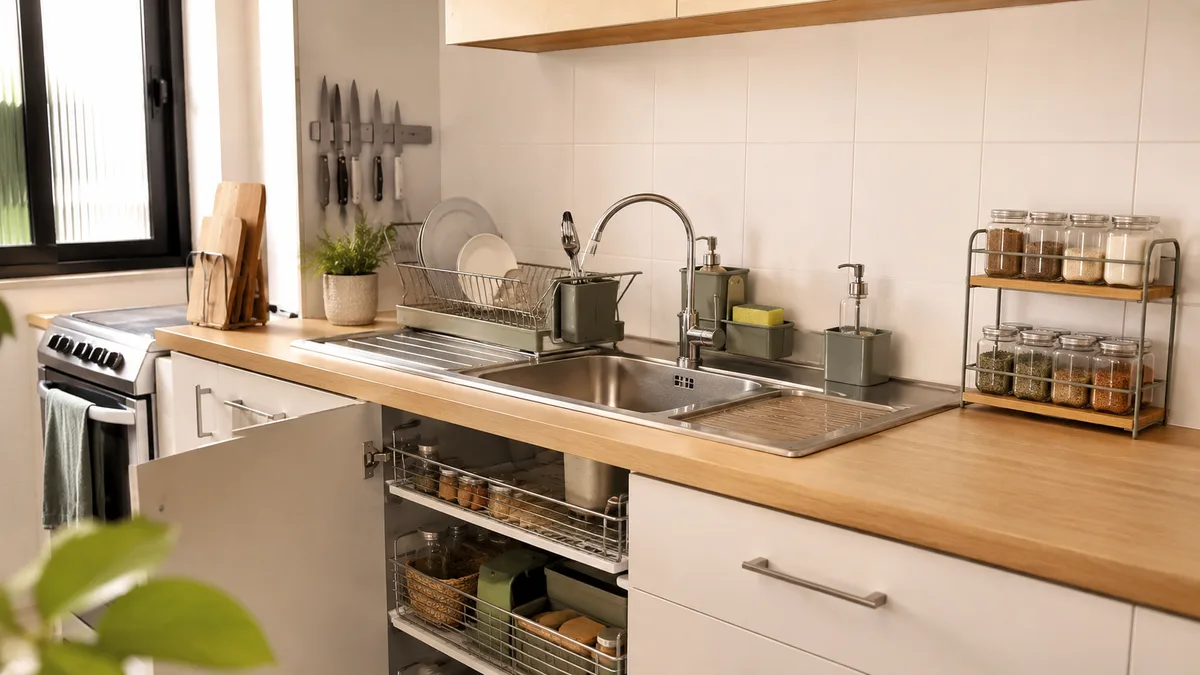
A rented kitchen's countertop is usually small. The way out is to go up: a vertical cutting board holder, a magnetic knife strip (high-strength adhesive on the side of the cabinet), a countertop or wall-mounted spice rack with adhesive. Every item that moves off the counter into a vertical position frees up horizontal space for prep.
Improvised drawer units inside cabinets
A 60cm-deep kitchen cabinet shelf with no drawer unit is the standard. Two stackable wire baskets with a front pull turn each gap into two easy-access drawers. For pots: a vertical lid organizer separates the pieces without an unstable stack. For pots and containers: a lazy susan inside the corner cabinet reclaims space that would otherwise go dead.
Sink and dish rack area
An old faucet with no side caddy is common in simpler rented apartments. A sink caddy that clips onto the edge (no screws) creates room for a sponge, dish soap and drying rack without taking up counter space. A foldable dish rack saves space when not in use.
A rented apartment has limits on construction work, but not on having a system.
See home organization →Walls, doors and hallways: reversible solutions that work
Before any wall solution, read the lease. Most leases in São Paulo allow holes for hanging art and mirrors, as long as they are patched before move-out. A total ban on screws is less common than people imagine.
Hooks and adhesive rails
A high-strength adhesive hook (Command or similar) holds up to 5kg per hook on a smooth surface. For a hallway or entryway: hooks for bags, umbrellas and coats with no screws. For a bathroom: an adhesive hook on the tile for a hand towel, hairdryer and flat iron. For a kitchen: an adhesive wall rail for utensils.
A note on removal: a removable adhesive hook needs to be pulled down along the tab, slowly, never straight out. Removing it the wrong way pulls off paint or tile. Always test the hook on a less visible surface before using it on the main wall.
The front door and bedroom doors
A bedroom door has huge potential for organization with no screws. An over-door organizer with slot-in hooks at the top creates room for shoes, bags or cleaning products on the inside of the door. In a small bathroom, an over-the-door organizer for the back of the door creates extra shelving with no floor space used.
Hallway and entryway
A rented apartment's hallway usually has no organization point at all. A narrow entryway console (20 to 25cm deep) with a mirror, drawer and side hooks solves both arrival and departure: keys, glasses, wallet, bag, umbrella. A freestanding piece of furniture, no fixing, no construction work. In an apartment where the hallway does not even fit that, a door hook on the inside of the front door solves the bare minimum.
Routine in a space that is not yours: staying organized without risking the deposit
Organizing a rented apartment has one extra layer: everything you do needs to be reversible. That changes the mindset around maintenance.
Use the space fully, but only with reversible solutions
Using the space fully does not mean making permanent changes. The rule is simple: any solution you install needs to be removable in less than a day of moving out, with no trace left behind.
Before installing anything, ask yourself: can I remove this in under 30 minutes? If the answer is no, it is probably not the right solution for a rented apartment.
Checklist before you leave the apartment
- Remove all adhesive hooks with the correct technique (pull the tab downward)
- Patch screw holes with filler and paint matching the same tone
- Check that no removable furniture piece left a mark on the floor
- Take down all over-door organizers before handing back the keys
- Photograph the state of the apartment before and after for documentation
A weekly maintenance routine that works in any apartment
Maintenance follows the same logic in any closet: every item has a fixed container, every container has a fixed spot. When a container gets too full, you discard before buying more. Consistency matters more than the quality of the closet itself.
In rented apartments with less space than you need, the one-in-one-out rule becomes even more important: for every new item that comes in, something equivalent goes out. It does not need to be rigid, but it needs to exist. Without that rule, any organization falls apart within a few months no matter how many baskets and dividers you bought.
Frequently asked questions about organizing a rented apartment
How do I organize a rented apartment without drilling the walls?
The most effective solutions are: pressure-mounted shelves (no screws), removable adhesive hooks for walls and tile, high-strength double-sided adhesive wall rails, and modular cabinets that stand freely with no fixing. For heavier items like mirrors, most rental agreements allow screw fixing as long as the holes are patched before move-out. Read the lease before assuming everything is forbidden.
Which organizers work best in a rented apartment?
The most versatile are: stackable baskets and bins with no fixing, which reorganize any existing shelf; adjustable drawer dividers that fit any width; over-door organizers with slot-in hooks (no screws); tension shelves for gaps between walls like bathroom niches; and open modular shelving units that stand on their own weight. Avoid products that promise permanent no-drill fixing: the adhesive often pulls off paint on removal.
Can I hire a personal organizer for a rented apartment?
Yes, and it makes particular sense when the apartment has poorly sized closets or a layout that complicates organization. The personal organizer works with what already exists: reorganizes the inside of closets, creates use zones within the available space, recommends which organizers solve the problem with no construction work, and sets up the complete system. The result is a functional apartment within the constraints of the lease.
How do I stay organized in an apartment with bad closets?
A bad closet in a rented apartment usually has two problems: too few shelves or shelves in the wrong spots, and excessive depth that wastes the back of the space. For too few shelves: add internal tension shelves or stackable baskets that create layers. For excessive depth: use baskets with a front pull on rails or organize into labeled boxes facing forward, always in a double row. Daily maintenance gets easier when every category has a fixed container, even if the closet itself is not ideal.

About the author
Silvana Santanna →Personal Organizer in São Paulo, specialized in residential move organization and functional organizing projects for homes, closets, kitchens, trousseaux and home offices. Creator of the Casa Pronta™ Method, with more than 100 projects completed across São Paulo and the greater metro area.
Ready to have your home organized
without lifting a finger?
Project assessment visit.