How to Organize a Medicine Cabinet: 6 Zones by Expiration and Use
Complete guide to organizing your medicine cabinet at home: categories, correct temperature, child safety, expiration tracking and safe disposal. Personal organizer in São Paulo.
Neste guia você verá:
Why is the medicine cabinet the most dangerous corner of the house?
I once organized the apartment of a couple in Moema who had a two-year-old daughter. Their medicine cabinet sat behind the bathroom mirror, right above the sink. They thought it was out of her reach because she could not get there standing on the floor. When we started the session, the mother mentioned in passing that, weeks earlier, she had found the toddler in the bathroom holding a box of pills. She had climbed onto the sink counter.
The child never got the box open. But she could have. And that is the pattern I see again and again in these sessions: the cabinet is technically out of reach, but the child finds a path the adult never anticipated.
The data confirms what I see in these sessions. There are 37 children and teenagers poisoned by medicine every day in Brazil, according to SINITOX. That figure has held since 1994, with medicine topping Fiocruz's ranking of toxic agents. In most cases, the medicine was in a cabinet considered out of reach, but without a lock, without organization by risk, and without periodic expiration checks.
The problem goes beyond child safety. A cabinet with no system creates two risks that go unnoticed: you cannot find what you need during an emergency because everything is mixed together, and you end up taking expired medicine without realizing it because no one checks regularly.
In the sessions I have run for years in São Paulo, the medicine cabinet tends to be the most neglected space in the house. Not because people are careless, but because no one teaches how to do it right. Everything ends up together: last year's pain reliever, an expired ointment, a 2019 prescription slip and loose pills with no label.
- No categories: medicine for ongoing treatment shares space with ointment, bandages and a thermometer. In an emergency, you waste time hunting for what you need.
- No expiration review: an expired tablet may have reduced effectiveness or, in some cases, breakdown products with a toxic effect.
- No physical protection: an accessible cabinet with no lock is a real risk with children aged one to four, the group responsible for 53% of medication poisoning accidents in the country.
The bathroom is not the place for medicine: where should you really keep it?
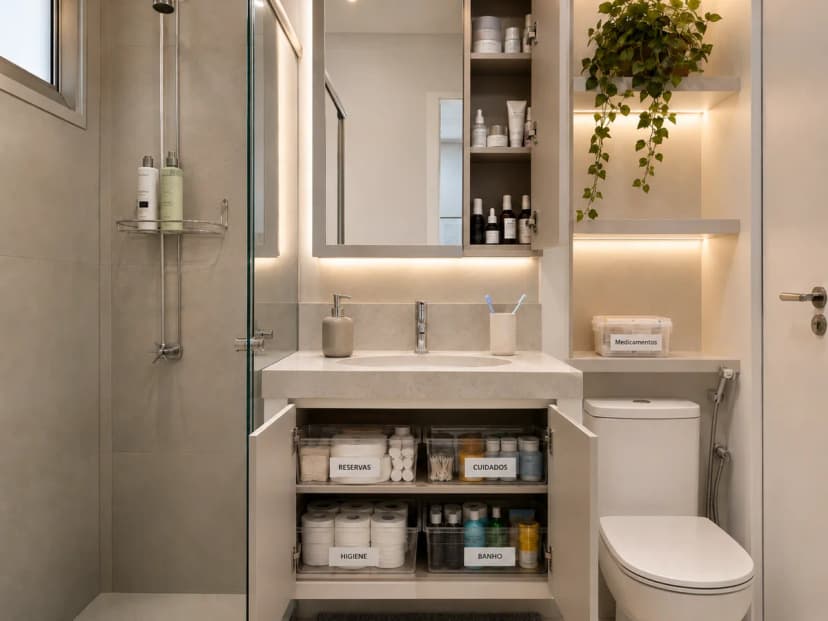
ANVISA recommends a temperature between 15°C and 30°C for medicine stored at room temperature. A bathroom in a São Paulo apartment can top 35°C in summer and swings with every shower. ANVISA's Resolution RE 01/2005 runs stability studies at 75% relative humidity, and bathrooms routinely exceed that. Heat and humidity degrade active ingredients before the expiration date ever arrives.
What happens when medicine sits in the bathroom for years
I worked with a client in Vila Mariana who had kept her medicine in the cabinet behind the bathroom mirror for more than ten years. She took an oral contraceptive daily. When we opened the cabinet to organize it, we noticed the pills had a slightly different color than normal and broke in half easily, along with visible moisture inside the blister pack.
She was surprised. She always bought from the same pharmacy, put it away right after opening the package, and thought she was doing everything right. The issue was the location. Her bathroom was small and she took long, hot showers every day. The steam that built up over those ten years had done its work slowly, without any warning sign.
We found 11 expired items in that cabinet and 3 with clear physical signs of degradation. None of them were medicine she remembered keeping. They were the ones at the back, behind everything else.
Even so, the mirrored cabinet above the sink remains the default spot for medicine in most homes. It makes sense out of habit, but not out of chemistry: heat and humidity do not spare an active ingredient just because the medicine is inside the house.
So where should you keep it?
The best location combines three traits: stable temperature below 30°C, low humidity and protection from direct light. In São Paulo, where summer easily pushes the thermometer up, that usually means a climate-controlled bedroom.
- An upper cabinet in an air-conditioned bedroom: the best option for most apartments. Controlled temperature, far from water and steam.
- A covered shelf in an interior hallway: works well if the hallway gets no direct sun and has natural ventilation.
- An upper kitchen cabinet, away from the stove and sink: a reasonable option if it is the only alternative, but requires care around cooking steam.
- Heat-sensitive medicine in the refrigerator: only the ones the package insert calls for (between 2°C and 8°C). Never in the door, where the temperature shifts every time it opens.
One note on self-medication: a 2024 ICTQ survey found that 86% of Brazilians self-medicate. With an organized cabinet, you at least do it safely, using medicine within its expiration date and stored under the right conditions.
How do you categorize medicine so you can find it in an emergency?
A father in Itaim called me after spending 12 minutes looking for dipyrone while his 7-year-old son cried with a high fever at 2 a.m. Their medicine cabinet was one of the kitchen cabinets, with everything piled together with no logic: vitamins next to ointments next to bandages next to pills whose names he did not recognize. The dipyrone was in there. He just could not find it in time.
He called me the next day. We ran the full checklist, sorted everything by category and labeled each section in plain English (in Portuguese, for his household). Three weeks later he messaged me: his son had a fever again, and this time he found the medicine in 20 seconds.
Emergency organization has no room for searching. When someone is unwell, you do not have time to open four boxes before finding the right one. The system needs to work in the dark, half asleep, under pressure.
The four categories that work
Sort everything into four groups before putting anything away:
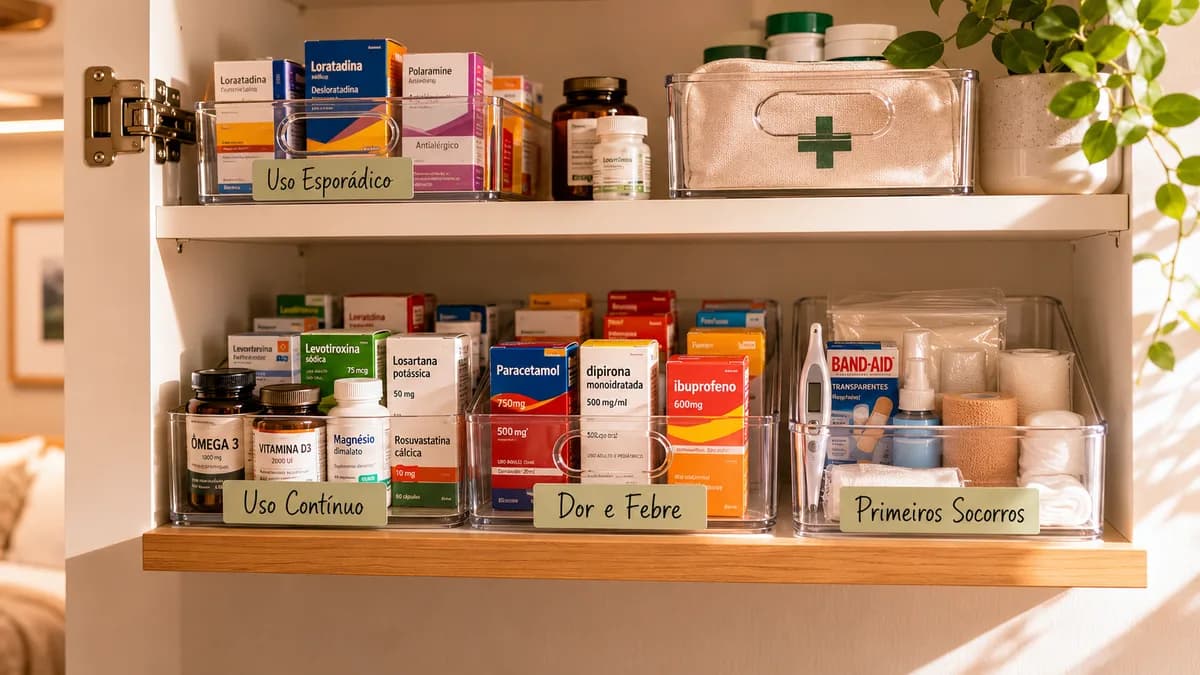
- Ongoing use: medicine taken daily or on a regular basis, usually prescribed by a doctor. Keep it in the most accessible spot in the cabinet, at the front and clearly labeled. Includes blood pressure, diabetes, thyroid and contraceptive medication.
- Frequent use: pain relievers, fever reducers, antihistamines, cold medicine, antacids. These are the ones you reach for with a headache, fever or general discomfort. Keep them accessible, in the central section of the cabinet.
- Occasional use: leftover pills from finished antibiotic courses, ointments, single-use eye drops, seasonal vitamins. Keep these in a separate section, reviewed every three months.
- First aid: bandages, adhesive tape, gauze, alcohol, antiseptic, thermometer, disposable gloves. These items go in a compartment separate from the medicine, clearly labeled.
How to set up the system inside the cabinet
Low organizer boxes or trays with dividers work better than stacking loose boxes. Each category gets its own tray or labeled section. Clear labels like "Pain and fever," "Ongoing use" and "First aid" are more practical than pharmacological categories no one memorizes.
In homes with elderly residents, it is worth paying extra attention to the cabinet's height and how accessible the ongoing-use medicine is. Medicine stored above shoulder height forces someone to grab a chair or stretch, a risk that adds to other environmental factors. How disorganization creates a fall risk for the elderly at home covers this in more detail.
- Empty everything out and check the expiration date of each item
- Sort into: ongoing use / frequent use / occasional use / first aid
- Dispose of expired items at a pharmacy collection point
- Identify loose pills or discard the ones with no label
- Label each section with a simple, visible name
- Photograph the finished setup for future reference
A medicine cabinet is part of complete home organization, including the safety review most homes still have not done.
See home organization →How do you keep medicine out of reach of children?
Height out of reach, a physical lock on the door, and the constant habit of closing the cabinet. Each of these measures alone leaves gaps. All three together create an effective barrier.
53% of medication poisoning accidents in Brazil involve children aged one to four, and medicine has led the ranking of toxic agents since 1994. Most of it happens at home.
Height
The medicine cabinet needs to sit at least 1.60 meters off the floor, with no chair, stool or nearby furniture a child could use to climb up. Children aged 3 to 5 already climb onto chairs, use drawers as steps and reach shelves that seemed safe. It is worth reviewing the cabinet's surroundings, not just its height.
Safety lock
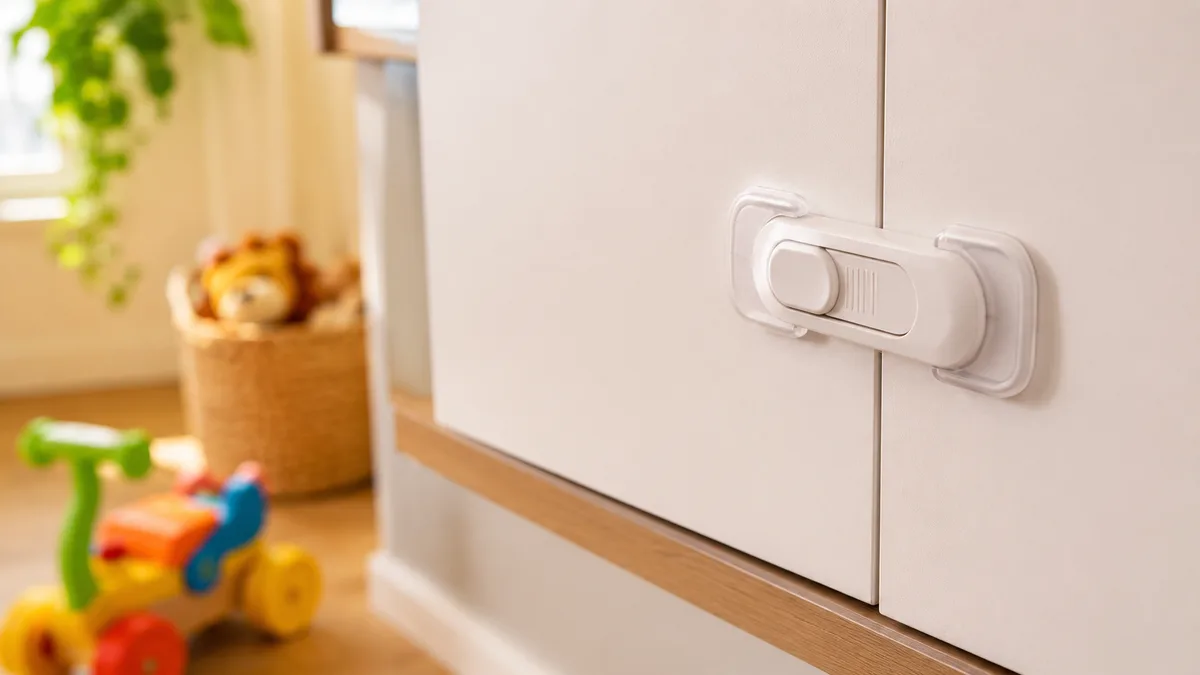
Child safety locks for cabinets are inexpensive, easy to install without drilling into wood in most models, and effective against children under 6. Some models latch the door from the inside, others are external and require adult-level pressure to open. Either type works. What matters is installing it before you need it.
The habit of closing it
A lock that is installed but left open is useless. Closing the cabinet every time you finish using it needs to become an automatic habit for every adult in the house, including frequent visitors like grandparents and babysitters. It is worth communicating the rule actively.
When and how should you safely dispose of expired medicine?
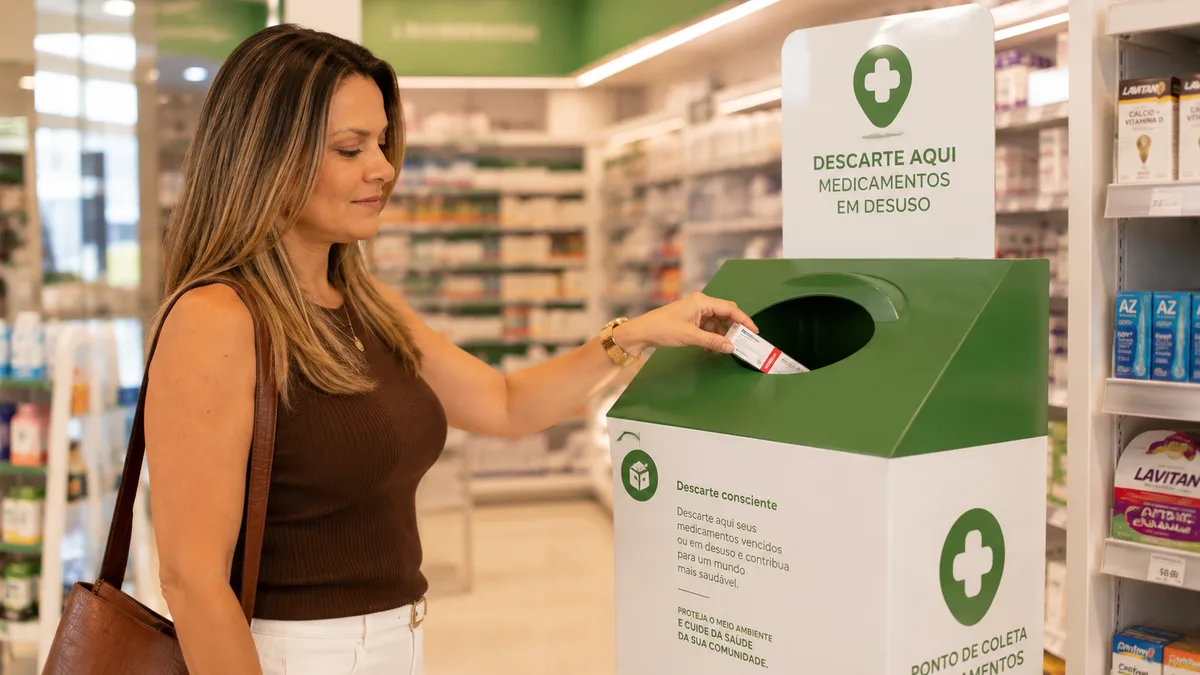
Expired medicine ends up in the regular trash in most Brazilian homes. The problem is that the active ingredients disposed of this way reach the soil and water and contaminate the ecosystem. The alternative is becoming more accessible: pharmacies are legally required to have a collection point, and São Paulo has hundreds of them.
What the law says
A 2020 federal ordinance regulated the disposal of household medicine and made it mandatory for drugstores and pharmacies to keep at least one collection point per 10,000 residents. São Paulo has been within the implementation deadline for years. Brazil has more than 4,000 collection points registered in the Logmed system.
How to find the nearest collection point
Go to logmed.org.br and search by postal code (CEP). Chains such as Drogasil, Ultrafarma and Pacheco have collection bins available at many locations across the city. Just bring the medicine in its original packaging or in a sealed plastic bag.
How often should you review the cabinet?
A quarterly review is the ideal rhythm for most families. Every three months, open the cabinet, check every expiration date, and take the expired items to a collection point. With this routine, the cabinet never accumulates years of unusable medicine. If the family relies on several ongoing medications, it may be worth switching to every two months.
- Never throw medicine in the regular trash or flush it down the toilet
- Find the nearest collection point at logmed.org.br
- Bring it in the original packaging or a sealed plastic bag
- Loose, unlabeled pills: better to discard them
- Put a quarterly review on the calendar as a standing reminder
Three situations I handled
In these three cases, the safety problem and the organization problem were the same thing. Solving one solved the other.
Fifteen ongoing medications with no system
A 55-year-old woman in Pinheiros, living alone. Hypertension, thyroid and osteoporosis: six daily medications, at different times. Plus eight more taken regularly but not daily: supplements, a seasonal antihistamine, eye drops, ointments. The medicine cabinet was in the bathroom. Everything together, with no separation by type or time of day.
She told me she had taken her blood pressure medicine twice on different days, thinking she had forgotten it. It scared her. She was not sure how many times that had happened. The cabinet was full, but no medicine had a fixed place.
First step: out of the bathroom. We moved the cabinet to a shelf in the air-conditioned bedroom. Then we organized it into four trays by time of day: morning, night, weekly, and as needed. Each ongoing medication got its schedule labeled right on the box. She reviews the cabinet monthly. The double dose has not happened again.
The lesson: ongoing medication with no organization by schedule relies on memory. For anyone with more than four daily medications, memory does not work as a system.
The medicine cabinet of three kids
This cabinet had grown along with the family.
A family in Santana, three children aged 5, 9 and 13. The medicine cabinet was in an upper kitchen cabinet, out of the children's reach. When we opened it to organize, we found: antibiotics from courses finished back in 2023, diaper rash cream from when the youngest was a baby, expired cough syrups, a broken glass thermometer at the back, prescription slips from doctors the kids no longer saw. All together, with no sorting.
The mother was surprised by what turned up. She thought it was reasonably organized. The cabinet was full of things no one would ever use again.
We disposed of 60% of the contents at the pharmacy collection point. What remained was reorganized into four clear categories, with plain labels. The mother photographed the result for future reference. A review was set on the calendar for three months out.
The lesson: a family cabinet with children builds up in phases. Each phase leaves residue behind. Without a quarterly sort, what was left over from 2021 sits next to what was bought this week.
The expired medicine found in the middle of another session
This situation came up inside a broader residential organization session. The medicine cabinet was not the focus of the day.
A couple in Brooklin, a 72m² apartment, booked a session to organize the kitchen and pantry. During the initial walkthrough, I opened the medicine cabinet to see what was inside: 23 items. We checked expiration dates in 10 minutes. Result: 7 expired, 3 of them more than two years past their date. Two unlabeled bottles neither of them could identify.
She said she had no idea there were so many expired items. No one had opened that cabinet to review it since they had moved into the apartment two years earlier. Only to grab what they needed at the time.
We disposed of the expired items and reorganized what was still within date into two categories: frequent use at the front, occasional use at the back. A 15-minute quarterly review was agreed on to keep it that way.
The lesson: a medicine cabinet with no quarterly review quietly accumulates expired items. No one opens it to check, only to grab what they need in the moment.
Frequently asked questions about medicine cabinet organization
Can I store medicine in the bathroom cabinet?
No. The bathroom is one of the worst places to store medicine. Temperature easily climbs above 30°C after a shower, and relative humidity often exceeds 75%, the limit set by ANVISA stability studies (Resolution RE 01/2005). Heat and humidity degrade active ingredients and change color, texture and effectiveness, even before the expiration date. Keep medicine in a dry, ventilated cabinet away from the stove and sink, preferably in a bedroom or kitchen.
What should I do with expired medicine in São Paulo?
Never throw expired medicine in the regular trash or flush it down the toilet. The active ingredients contaminate soil and water. The correct approach is to take it to a specialized collection point: pharmacies and drugstores are required, under a 2020 federal ordinance, to keep at least one collection point per 10,000 residents. To find the nearest one in São Paulo, go to logmed.org.br and search by postal code. Chains such as Drogasil, Ultrafarma and Pacheco already have collection bins available at many locations.
What is the correct temperature for storing medicine at home?
ANVISA recommends a range of 15°C to 30°C for medicine classified as room-temperature storage. For heat-sensitive medicine, the package insert calls for refrigeration between 2°C and 8°C. In São Paulo, where summer temperatures can top 35°C in rooms without air conditioning, a climate-controlled bedroom is the most suitable place to keep a home pharmacy. Never store medicine in the refrigerator door, where the temperature shifts every time it opens.
How do I keep medicine out of reach of young children?
Three measures combined eliminate the risk: store it somewhere physically out of reach (above 1.60m, with no nearby furniture a child could climb); install a child safety lock on the cabinet door; keep the cabinet closed by habit, not by chance. According to SINITOX, 53% of medication poisoning accidents involve children aged one to four, and medicine has been the leading toxic agent in Brazil since 1994. The combination of height, lock and the habit of closing the door works far better than any one of these on its own.

About the author
Silvana Santanna →Personal Organizer in São Paulo, specialized in residential move organization and functional organizing projects for homes, closets, kitchens, trousseaux and home offices. Creator of the Casa Pronta™ Method, with more than 100 projects completed across São Paulo and the greater metro area.
Ready to have your home organized
without lifting a finger?
Project assessment visit.