Falls at Home: How Disorganization Puts Older Adults at Risk
One in four older adults falls every year in Brazil, most of them at home. Learn how disorganization increases that risk and what to change in each room.
Neste guia você verá:
- 01Why do falls at home kill more than people think?
- 02Which rooms carry the most risk, and why?
- 03What disorganization does that the eye does not catch
- 04How to adapt each room to reduce the risk
- 05The difference between a "tidy" home and a safe home for an older adult
- 06Personal organizer for older adults in São Paulo
- 07Frequently asked questions
Why do falls at home kill more than people think?
The fall that kills an older adult rarely happens through carelessness. It happens in an environment that looks organized, where the danger stayed invisible for months until it became an emergency. In 2024, 13,385 older adults died in Brazil as a result of falls, according to data from Agência Brasil. That same year, there were more than 344 thousand emergency visits and hospitalizations. These are not just emergency room statistics. They are numbers that begin inside the home, in the hallway, in the bathroom, at the bedroom entrance, at 11 p.m.
According to Brazil's Ministry of Health, one in four older adults in Brazilian urban areas falls at least once a year. Among those over 80, that number rises to 40%, according to Brazil's National Institute of Traumatology and Orthopedics (INTO). Ninety percent of hip fractures in this age group result from falls, according to the Brazilian Society of Geriatrics and Gerontology (SBGG).
A hip fracture in an older adult is not just surgery. It is the start of a process that often includes a long hospital stay, immobility, hospital-acquired infection, thrombosis. Gerontologist Nubia Queiroz puts it well: falls represent a much more serious risk for older people because they can permanently compromise mobility. For many, the fall is the event that separates an independent life from a dependent one.
What few people realize is that most of these falls do not happen through negligence or carelessness. They happen because the environment was not designed for someone who is 70 years old, with worn joints and reduced night vision. The home that worked well at 40 hides traps that stay invisible until someone trips.
Which rooms carry the most risk, and why?
Bedrooms and bathrooms are where most falls among older adults happen. Emergency service data cited by Agência Brasil shows that falls in these two rooms rose from 16% to 23% of all emergency calls between January and May 2025. That is not a coincidence. It is risk built into the architecture.
Bedroom
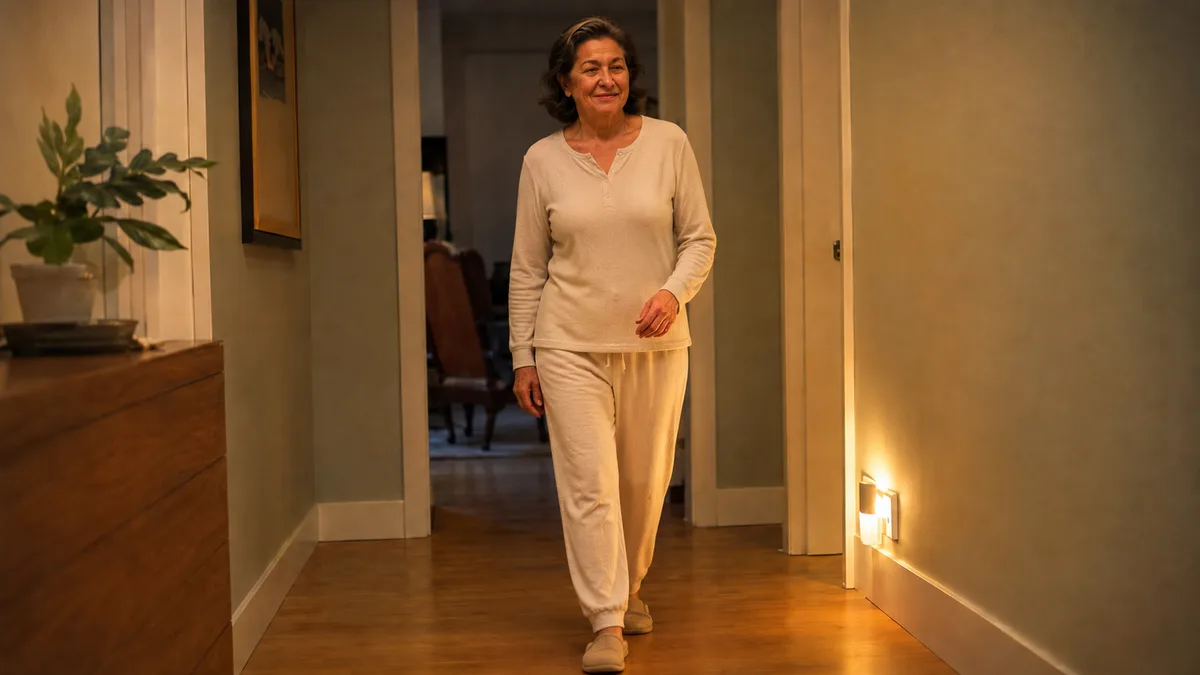
The bedroom carries the highest nighttime risk. The older adult wakes at 3 a.m. to go to the bathroom, does not turn on the light so as not to disturb whoever is sleeping nearby, and crosses a room that looks organized during the day. At night, with reduced vision and balance still half-asleep, any slipper out of place, a rug with a curled edge, or an extension cord crossing the floor becomes a real obstacle.
Other critical points in the bedroom: a cane or walker stored at the back of the closet "so it does not get in the way" (far away exactly when it is needed most), a bed too low to sit down and stand up from with stability, and a narrow side passage that forces the person to lean on furniture to move around.
Bathroom
In the bathroom, the risk is physical and immediate: a wet floor, a shower with no grab bar, a rubber bath mat that slides, an old aluminum shower track that collects soap and turns smooth and slippery. Using the toilet, stepping out of the shower: the transition from sitting to standing is the moment of greatest instability for someone with compromised joints or postural dizziness.
Hallway and living room
Narrow hallways with objects leaning against the walls and living rooms crowded with furniture reduce the effective width of circulation. In a home cluttered over decades, a hallway that measures 90 cm can end up functioning with only 60 cm of real passage. For an older adult who uses a cane, a walker, or simply needs to lean sideways for balance, that changes everything.
What disorganization does that the eye does not catch
Disorganization creates fall risk in two ways: through physical obstacles in circulation routes, and through the absence of accessible support points when the older adult needs them. Both are invisible to the people who live in the home, because the eyes of those who live there have stopped noticing what is out of place.
The cord had been there for two years. Nobody had tripped over it, until the night a 72 year old man went to the bathroom at 11 p.m.
I was called to organize a client's apartment in Jabaquara after her father-in-law fell in the hallway and lay on the floor for two hours until she found him in the morning. When I arrived, the space did not look messy. The rooms were tidy. But in the 80 cm hallway between the bedroom and the bathroom, there was a fan's extension cord crossing diagonally, a pair of rubber slippers that had fallen off the shoe rack, and a rug with a curled edge at the bathroom entrance. In daylight, none of that stood out. At 11 p.m., without glasses and half-asleep, any one of those three things was enough.
We made three changes in that hallway: we removed the rug, secured the cord to the wall with adhesive cable clips, and installed a motion-sensor light that turned on automatically. The man went fourteen months without a new fall. We did not buy anything expensive. We spent very little in total.
The imperfect part of the process: he refused to remove the living room rug, a thirty-year wedding gift. We compromised. The rug stayed, but with non-slip tape on all four edges. Sometimes organizing for an older adult means finding the line between what is necessary and what is possible.
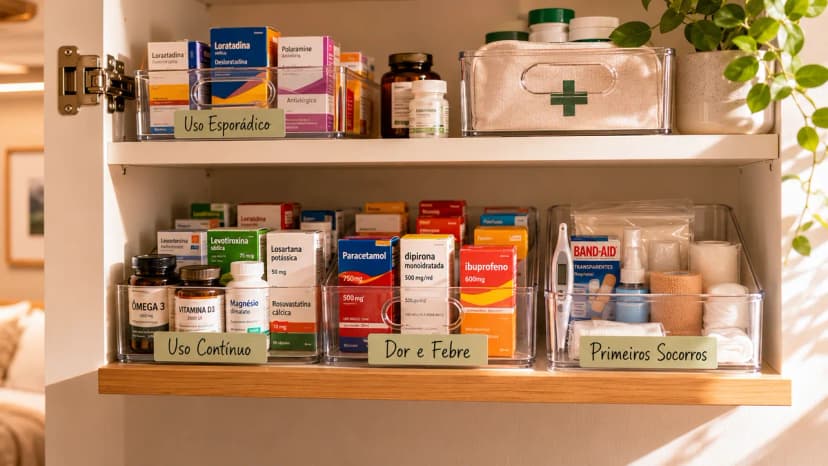
Beyond physical obstacles, disorganization creates a second kind of risk: frequently used items stored out of safe reach. When the morning medication sits on the second shelf of a cabinet, when the spare slippers sit at the top of the wardrobe, when the phone stays in the living room while the older adult is in the bedroom. The risk is not only on the floor. It is in the need to improvise to reach something that should already be at hand.
Does your home have an older adult living there or visiting often? A walkthrough of the space can identify risks before they turn into an emergency.
See home organization →How to adapt each room to reduce the risk
Adapting a home for an older adult does not require a renovation. It requires mapping the most used routes and removing whatever creates risk along them. The starting point is always the same: bedroom to bathroom, bedroom to kitchen, living room to kitchen. Along these three paths, the way through needs to be clear, well lit, and free of surprises on the floor.
Bedroom
- Automatic motion-sensor light: in the hallway between the bedroom and bathroom, triggered by a motion sensor. It costs very little and removes the risk of walking in the dark.
- Minimum side passage of 90 cm: the distance between the bed and the nearest piece of furniture needs to be enough to walk with a cane or walker without having to turn sideways.
- Cane or walker beside the bed: not in the closet, not in the corner of the living room. Beside the bed. Within reach before the first step.
- Proper bed height: a bed that is too low (less than 45 cm from floor to mattress) makes it harder to stand up and sit down with stability. If needed, bed risers are inexpensive and effective.
- Zero objects on the floor along nighttime routes: cords, slippers, magazines, bags. Anything that could be stepped on or tripped over comes out of the paths used at night.
The fall did not happen through carelessness. It happened from too much care about not taking up someone else's space.
In a family in Morumbi, a 78 year old mother had moved into her daughter's guest room. To "not get in the way," she kept her own daily items (the morning medication, a handkerchief, spare slippers) on the high shelves of the closet, leaving the lower ones for her daughter. When she needed something, she improvised: once she used a rolling office chair to reach a box.
We created a simple rule: everything the mother uses every day stays below her shoulder height. We reorganized the closet, put the medications in an organizer on the bathroom counter, and placed the spare slippers on the lowest shoe rack by the entrance. In the first month, she still put a few new items up high "out of habit." We did a review after 30 days. No relapse. The improvising stopped because the need to improvise disappeared.
Bathroom
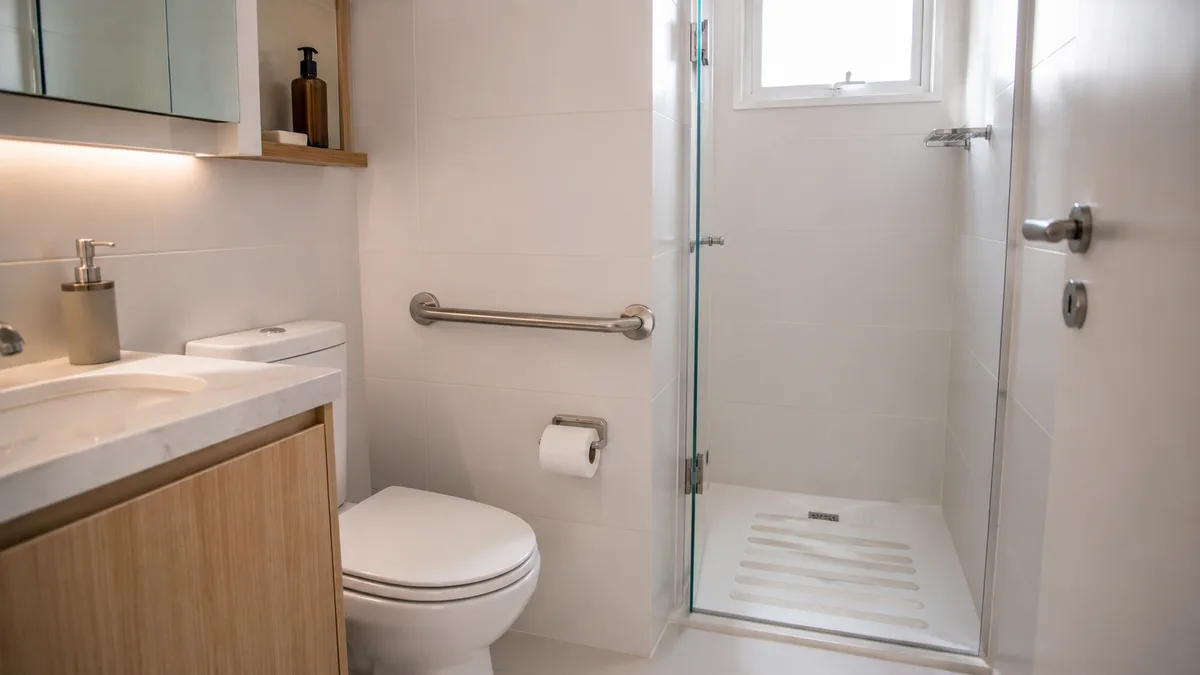
- Side grab bar beside the toilet: the sit-to-stand transition is the moment of greatest risk. The bar does not require construction work: there are models that attach with suction cups or screws without breaking tile.
- Non-slip strip inside the shower: safer than a loose bath mat, which can fold over and slide.
- Suction-cup rubber mat in the shower: if you prefer a mat, choose one with suction cups on the back, applied to a dry floor before use.
- Removal of the old aluminum shower track: shower tracks collect soap and turn slippery. Replacing them with a hinged door or a trackless shower removes that risk point.
- Night lighting: the same setup as the hallway: an automatic light that turns on without needing to find the switch in the dark.
Living room and hallways
- Circulation routes with at least 90 cm clear: measure it. Do not estimate. Remove whatever blocks it, even if only temporarily moved to another room.
- Cords on the wall, never on the floor: adhesive cable clips are cheap and solve this in 10 minutes.
- Rugs only with a non-slip backing: or remove them from the main routes. Overlapping rugs (one on top of another) are not allowed.
- Furniture without sharp edges along the routes: corner tables, glass shelving units, and sideboards with sharp corners are secondary risks. If the older adult trips, what happens right after the trip matters too.
What is the difference between a "tidy" home and a safe home for an older adult?
A tidy home has everything in a defined place. A safe home for an older adult has the right things in the right places for someone with limits on mobility, balance, and night vision. It is not the same thing. And the difference is usually invisible until it becomes an emergency.
Dona Vera's home was tidy. Every object had a place. The problem was that the place for everything created obstacles for someone who needed to move around with knee arthritis.
I was called by a family in Pinheiros after Dona Vera, 69, was diagnosed with knee arthritis and her doctor recommended adapting the home environment. The 22m² living room had three sofas, two coffee tables, a massive TV unit, and the path between the kitchen and the main sofa ran through a makeshift corridor between pieces of furniture. The bathroom had smooth porcelain tile, no grab bar. The shower had an old aluminum track that collected soap. Everything was tidy. And everything was poorly positioned for someone who needed safe circulation.
Her husband wanted to change everything at once. Dona Vera resisted, since every piece of furniture had a story. What we did was different from both of their plans: I mapped the three circulation routes she used most often (bedroom to bathroom, living room to bathroom, living room to kitchen) and removed only what stood along those routes. The secondary sofa went to the balcony. One of the overlapping rugs came out. The TV unit stayed, but we shifted it 40 cm to free up the side passage. We installed a non-slip strip in the shower and a temporary grab bar beside the toilet while the bathroom renovation was quoted.
Dona Vera kept the furniture she wanted. Her husband was satisfied because he did not have to start from zero. And the three routes that mattered stayed clear. Organizing for an older adult does not need to be sparse. It can be surgical: touch only what is in the way and leave the rest.
The imperfect part of the process: her husband wanted to renovate the bathroom before anything else. I convinced the family to install the temporary bar first, because "waiting for the renovation" meant another six months with no protection at all. The renovation came later, and with the temporary bar already tested, they knew exactly where to install the permanent one.
What separates a tidy home from a safe home for an older adult is a simple question: can the person who lives there go from the bedroom to the bathroom at 3 a.m., without turning on the light, without tripping over anything, and without needing to lean on a piece of furniture that could move? If the answer is no, or "probably not," there is work to do.
How does a personal organizer work on safety for an older adult in São Paulo?
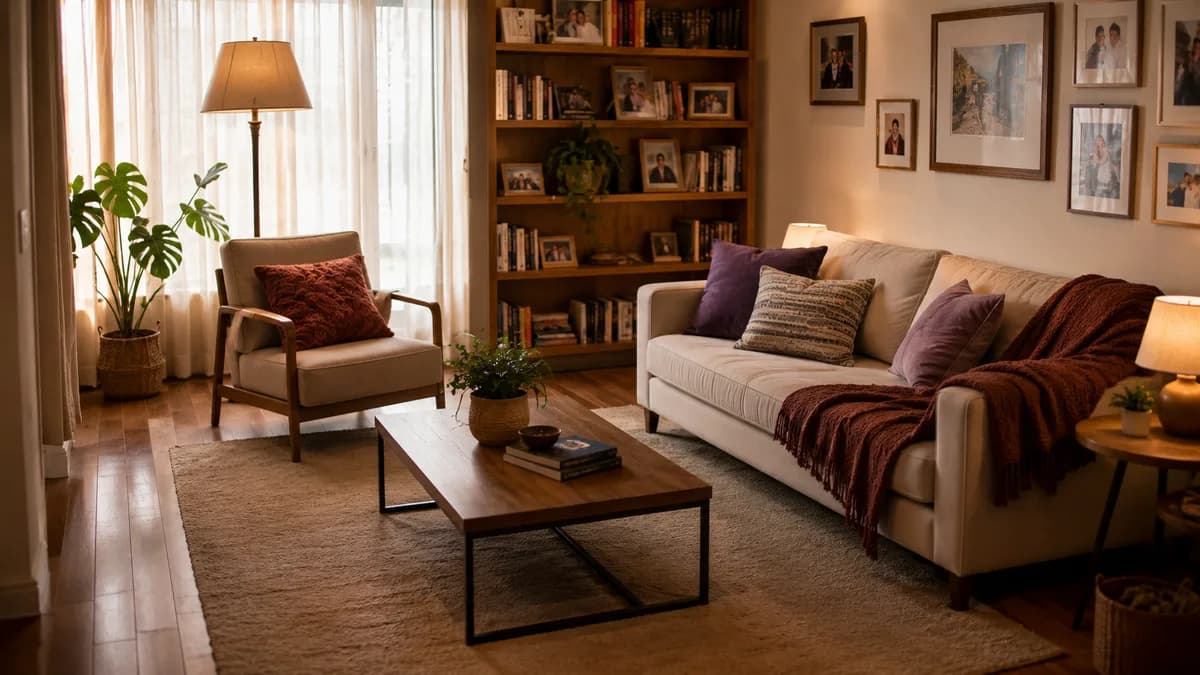
The work of a personal organizer specialized in homes with older adults goes beyond tidying up. It starts by mapping the routes the person walks alone and ends with a system the family and household staff can maintain. In São Paulo, where many older adults live in compact apartments or share a home with children and grandchildren, this focus on circulation, reach, and lighting changes day-to-day risk.
The service usually includes reorganizing the bedroom and bathroom by priority of use, setting a fixed, accessible spot for medications and daily items, and guiding whoever maintains the home afterward. When grab bars, shower adaptations, or a mobility assessment are called for, the personal organizer works alongside the doctor or occupational therapist, without replacing that evaluation.
See how the personal organizer in São Paulo runs the process and the home organization service, which includes adapting spaces for families with older adults.
Frequently asked questions about falls at home and organization for older adults
What are the main fall risks for older adults at home?
The main risks are environmental and tied to disorganization: loose or overlapping rugs, extension cords crossing walkways, poor lighting at night, objects scattered on the floor (slippers, toys, bags), furniture blocking circulation, and bathrooms without a grab bar. Bedrooms and bathrooms account for most accidents, especially at night, when the older adult gets up without turning on the light. A fall rarely has a single cause. It is always the combination of an unfavorable environment with a moment of reduced attention.
How can I organize a home to prevent falls in older adults?
Start by mapping the three most used routes: bedroom to bathroom, bedroom to kitchen, and living room to kitchen. Along these routes, the path needs to be clear: no loose rugs, cords, objects on the floor, or furniture narrowing circulation to less than 90 cm. Install motion-sensor night-lights in the hallway and bathroom. Keep every item the older adult uses daily below shoulder height, removing the need to reach up high or improvise with chairs and stools. A bathroom with a grab bar beside the toilet and inside the shower drastically reduces the risk of falling during use.
Are rugs dangerous for older adults at home?
A loose rug, one with curled edges, or one placed on a smooth surface is one of the most cited risk factors in home falls among older adults. That does not mean every rug needs to go. Rugs with a non-slip backing and edges secured (double-sided tape or non-slip tape on all four sides) in walkways outside the main circulation path carry much lower risk. The problem is a rug placed exactly where the older adult steps often, at the bedroom entrance, at the shower exit, alongside the bed, without proper fixing.
Does a fall at home always require medical attention for an older adult?
Yes, any fall in an older adult should be evaluated by a doctor, even when the person says they feel fine. Hip fractures and other internal injuries may not cause intense immediate pain in older adults with reduced sensitivity. Beyond that, the fall itself can be a symptom of an underlying clinical condition: postural hypotension, arrhythmia, a medication side effect, or a neurological episode. A doctor or geriatrician is who assesses whether there was an injury and whether there is a clinical cause to treat. This content covers environmental prevention, not post-fall care.

About the author
Silvana Santanna →Personal Organizer in São Paulo, specialized in residential move organization and functional organizing projects for homes, closets, kitchens, trousseaux and home offices. Creator of the Casa Pronta™ Method, with more than 100 projects completed across São Paulo and the greater metro area.
Ready to have your home organized
without lifting a finger?
Project assessment visit.