How to Keep Your Home Organized When You Work Full Time: the Three Rhythms That Hold the System
The maintenance routine I give clients who leave early and get home late, and why it is simpler than it sounds.
Neste guia você verá:
- 01How do you keep the house organized when you work full time?
- 02What is the last conversation that happens at every service?
- 03What are the three maintenance rhythms?
- 04The daily reset: the habit that holds everything together
- 05The weekly routine by room
- 06Monthly and seasonal maintenance
- 07How do you split tasks among household members?
- 08How do you get kids involved in maintenance?
- 09Why does the system fall apart, and how do you avoid it?
- 10The first 30 days: the critical period
- 11When is it worth calling the personal organizer back?
- 12Frequently asked questions
How do you keep the house organized when you work full time?
Someone who leaves the house at seven and gets back at eight in the evening loses the organization to build-up. Every day without putting things back leaves a residue, and a week of residue becomes the feeling of mess that discourages any attempt to start over.
So maintenance for someone who works full time fits into the ten minutes before bed, always the same ten minutes. The short, repeated rhythm holds the system better than the Saturday marathon. Building that system around the routine the home actually has is the work of the Casa Pronta™ Method, and that is why the service ends with the maintenance conversation.
One of the most common questions from people considering hiring a personal organizer is: how long does it last? The honest answer is that it depends, not on the service itself, but on the habits that come after.
What a personal organizer delivers is not a temporarily tidy home. It is a system: every object with a defined place, clear logic for where each category lives, and spaces designed to make maintenance easier instead of demanding it. The difference between a well-built system and an ordinary tidy-up is that in a system, putting something back is easier than leaving it out of place.
What is the last conversation that happens at every service?
At the end of every service, before leaving, I do the same thing with every client: a conversation about what was just built and how it holds up. Not because the system is fragile, but because a habit without understanding becomes an obligation, and obligations get abandoned.
What I explain in that conversation is simple: the organization you just received was designed for your actual pace of life, not for some imagined ideal routine. It works with little daily effort, as long as that little is consistent. Most clients who keep their home organized for years are not doing anything special: they just never abandon the daily reset.
The most common call I get in the first weeks after a service is not a compliment. It is a client thinking the system has failed.
A mother of two in an apartment in Brooklin called me three weeks after her service. The home was "going back to chaos." When I went to look, the organization was intact. The problem was the kitchen counter: Tuesday's grocery bags still sitting there, medicine her son had brought home from school on Friday, the husband's car keys with no fixed spot. In one hectic week, the counter had become the dumping ground for everything nobody had made a decision about yet. I talked to her about the reset. She had not managed to put it into practice; she got home exhausted and the idea of "organizing" felt huge. I suggested something smaller: 8 minutes, just the counter and the entryway, alongside the podcast she listened to before bed. Within two weeks the home was back to how the service had left it. The system was intact. It was the habit that had not taken hold yet.
What brings systems down, almost always, is not life itself: it is the buildup of days when the reset did not happen. One week without a reset is enough to create that feeling of mess that discourages any attempt to organize.
What are the three maintenance rhythms that hold the system together?
Efficient maintenance is not a single task list: it is an overlap of three rhythms with different frequencies, each with its own specific purpose:
- Daily rhythm (10 to 20 minutes): the basic reset that keeps the home livable every day, no matter what happened. These are the simplest and most critical habits: the ones that cannot slip.
- Weekly rhythm (30 to 45 minutes a day): deeper maintenance for each room, spread across the week. Includes cleaning and organizing tasks that do not need to happen daily.
- Monthly and seasonal rhythm (2 to 3 hours): reviews that happen once a month or once a season: pantry, clothing rotation, documents, clearing out what has piled up.
Each rhythm supports the next: the daily one keeps basic control, the weekly one prevents buildup, the monthly one avoids major reorganizations. Together, they eliminate the 6-hour "cleaning day" that wrecks the weekend.
The daily reset: the habit that holds everything together
If you implement just one habit after a professional service, make it this one: the daily reset. It is the practice of returning every object to its place at the end of the day, and it usually takes less than 15 minutes in a home with working systems.
How to do the daily reset
The reset works best when it has a fixed time (usually after dinner or before bed). With everyone home, each person is responsible for their own belongings and their own area. Shared spaces become a collective task.
- Pick up every object from surfaces in shared areas and return it to its defined place
- Kitchen counter clear: only the permanent items allowed stay out
- Dishes in the machine or drying, never left in the sink overnight
- Each family member responsible for their own belongings in shared areas
- Sofa and chairs: cushions in place, throws folded or in the defined basket
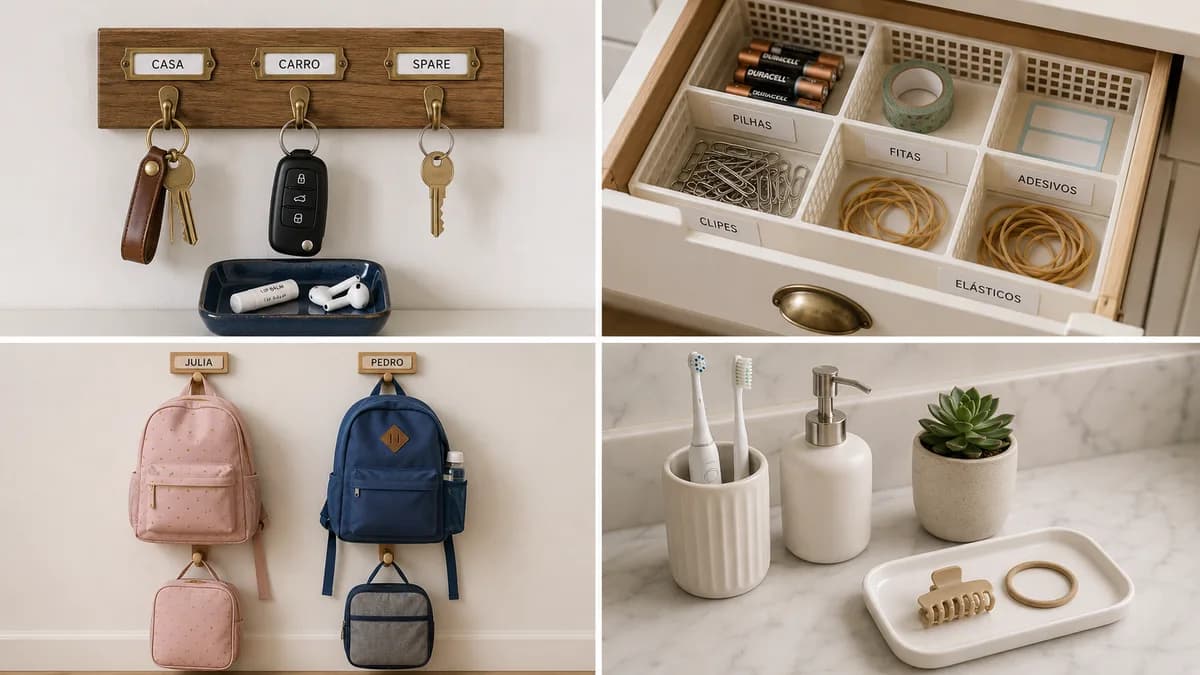
- Entryway: keys on the hook, bags and backpacks in their defined spots
- Items from the day (medicine, documents, mail) put away or discarded
The morning reset (5 minutes)
A complement to the evening reset: making the bed right after waking up, wiping down the bathroom counter after getting ready, checking that the kitchen is set for the day. A made bed and a clean kitchen in the morning change how the whole home feels, regardless of the state of the other rooms.
How to build the habit
In practice, the routine only works when it attaches to something the family already does every day. Tie the reset to a fixed moment: right after dinner, while listening to a podcast, before turning on the TV at night. After a few weeks of repetition, the reset stops feeling like a separate task.
A system that lasts is one built for your actual routine, not for a generic one.
See home organization →The weekly routine by room
The weekly routine spreads each room's tasks across the days instead of packing everything into the weekend. The principle: each day of the week has one main room, and that room's task rarely takes more than 30 to 45 minutes.
- Monday (Clothes): separate dirty laundry, run a load, fold what dried. Check the closet: put back anything out of place.
- Tuesday (Deep kitchen clean): beyond the daily basics, clean the stove and microwave, organize the pantry with first-in-first-out for the week's groceries.
- Wednesday (Bathrooms): sanitize the sink, toilet and shower stall. Restock soap, toilet paper, shampoo. Check medicine if needed.
- Thursday (Workspace): home office or study desk. Organize documents and mail from the week.
- Friday (Social areas): living room, dining room, entryway. Vacuum, wipe down surfaces, get the home ready for the weekend.
- Saturday or Sunday (Shopping and restocking): the week's groceries, put away immediately, restock cleaning supplies.
This breakdown is a suggestion: adapt it to your family's pace. What matters is that each room has a defined frequency, not that it falls on that exact day.
Monthly and seasonal maintenance
Once a month, set aside 2 to 3 hours for tasks that do not fit the weekly routine but prevent major reorganizations:
- Pantry inventory and discarding expired items
- Reviewing the medicine cabinet (expiration dates and quantity)
- Checking the storage room or service area
- Organizing the month's documents and mail
- Reviewing kids' toys (what can be donated)
Twice a year (start of the year and in July), do a seasonal review: rotating clothes by season, seasonal décor, reviewing items that can be discarded, and assessing whether the current system still works for the family's current pace.
In homes where an elderly person lives or visits regularly, the seasonal review also includes checking circulation routes: what disorganization does to fall risk for elderly people at home changes over time, as mobility changes too.

How do you split maintenance tasks among household members?
Splitting maintenance tasks is one of the topics that causes the most conflict, and almost always for an avoidable reason: the split was decided by one person and announced to the others, instead of being built together.
The alignment conversation
Before any task list, an honest conversation is needed about: who is available when, who hates which task specifically, what each person considers "organized" (standards can be very different), and what is non-negotiable for each person.
Splitting by life rhythm, not by room
The most effective split for couples is by rhythm, not by room. Whoever wakes up earlier handles the morning kitchen reset. Whoever gets home earlier starts dinner and does the afternoon reset. Whoever has more energy at night closes up the house with the evening reset.
For tasks both people avoid, a biweekly rotation works better than a permanent assignment, since it splits the burden without building up resentment.
How do you get kids involved in maintaining organization?
Kids who take part in home maintenance develop independence, a sense of responsibility, and an understanding of the effort that keeps the system running. Involvement needs to fit the age group: tasks that are impossible for a child's age create frustration, not engagement.
- Ages 3 to 5: putting toys in the right basket, putting dirty clothes in the hamper, placing their plate in the sink after a meal.
- Ages 6 to 9: making their own bed (not perfectly, but made), setting the table for dinner, folding simple clothes, picking up their own things from the living room.
- Ages 10 to 12: vacuuming their own room, washing and drying their own dishes, organizing their own backpack and school supplies, helping put away groceries.
- Age 13 and up: washing the family's dishes, cleaning their own bathroom, doing their own laundry.
What matters most is that the system be simple enough for the child to carry out without help, and that maintenance be treated as routine, not punishment.
Why does the system fall apart, and how do you avoid it?
When organization slips again, it is almost never a lack of discipline. In practice, the system tends to fall apart for three simple reasons: too much stuff came in, groceries were not put away the right way, or the home went too long without a review.
New items coming in
The professional system was built for a specific volume of belongings. When that volume grows without discarding anything, the defined spots stop being able to hold it all. The one-in-one-out rule helps: a T-shirt comes in, a T-shirt goes out; a book comes in, another can go to donation. It does not need to be rigid, but there needs to be an outflow.
An outbox in a visible spot works well. Everything leaving the home goes into it. When it fills up, the donation happens. The point is not to turn every discard decision into a big one.
Volume grows slowly. By the time someone notices the closet has jammed up again, months of purchases have already piled up with no corresponding discard.
For a couple I worked with in Vila Madalena, the closet went back to its old state in under 8 months. When the client called me for an adjustment session, I found 34 new winter pieces that had come in since the service, and none had gone out. The rods were jammed again, shelves stacked with boxes. The husband was frustrated: "we organized it and it all went down the drain." The system was correct. The volume had simply grown beyond what the service had planned for. We put an outbox at the closet door and set the one-in-one-out rule from then on. Within a month the closet was working again with no need for a full session.
Groceries with nowhere to go
Grocery bags on the counter "to put away later" are one of the fastest ways to break a system. When you get home with groceries, put everything away before moving on to another task: pantry items with new stock behind the old, cleaning products in their proper spot, refrigerated items straight into the fridge, and toiletries into the bathroom.
This process rarely takes more than 15 minutes, but it prevents an entire week of a full counter, an open package, and a duplicate product because nobody saw what was already there.
Lack of periodic review
Life changes, and the home changes with it. A new job, a child who has grown, a different school schedule, or a room that took on a new function can make the old system less practical. When the same object keeps ending up out of place, an area keeps collecting the same items, or a cabinet is always too full to close, it is a sign a review is due.
The fix is usually small: moving a category to a new spot, simplifying labels, cutting down volume, or creating a landing spot where the clutter tends to start. The mistake is waiting for the whole home to spiral before touching the system.
The first 30 days: the critical period
The month after a professional service is the most important period for locking in new habits. It is when old patterns try to creep back in, and the new ones are not yet automatic.
- Week 1: focus solely on the daily reset, do not skip a single day
- Week 2: add the rule of putting groceries away immediately when you get home
- Week 3: review the system, is anything not working the way you expected?
- Week 4: practice the one-in-one-out rule on your first significant purchase
- Day 30: assess which room is hardest to maintain. Why?
After 30 days with these habits, the system is built into the routine, and maintenance starts to require less conscious attention.

When is it worth calling the personal organizer back?
A maintenance session with a personal organizer is not a sign of failure: it is a smart part of the process. There are specific moments when revisiting the system with professional support is worth it:
- After major life changes: a new baby, a teenager who has grown and needs a new bedroom system, starting a home office, a family member moving in.
- Before a move: reviewing the system and discarding before packing, since it is far more efficient than organizing everything mixed together in the new home.
- After 12 to 18 months since the initial service: an adjustment session to clear out what has piled up, reviewing zones that have lost efficiency.
- When one specific room is out of control: sometimes a new room (office, storage, guest room) needs specific attention without redoing the whole home.
When a room changes function, the system needs to change with it. That adjustment rarely happens on its own.
A client in Itaim called me for maintenance 6 months after her initial service. When I walked in, the living room, kitchen and bedrooms looked like the first day. The problem was the office: a home office that had turned into storage once she changed companies and her new work routine called for a different kind of organization. Documents from two different projects mixed in the drawers, a chair covered in clothes "to fold later," a desk with three things open at once. She mentioned, a bit embarrassed, that she had let "just that one room" slip out of control. A 4-hour session in the office fixed it. The rest of the home was perfect, no other area needed adjustment. That is exactly what a one-off maintenance session is for.
When that kind of adjustment makes sense, you can request a quote for a maintenance session and explain which room has lost its logic in day-to-day life.
Frequently asked questions about keeping a home organized
How do you keep the house organized when you work full time?
With three rhythms at different frequencies. The 10-minute daily reset, always at the same time, puts every object back before the day leaves a residue. The weekly review handles one room at a time, in rotation. Monthly maintenance deals with what only shows up over the long run: discarding, seasonal swaps and adjusting the system to the routine the home actually has.
How long does organization by a personal organizer last?
A well-built professional system lasts indefinitely, as long as the basic maintenance habits are practiced. Most clients keep their organization for years after the service. What breaks organization down is not time, but new items coming in with no corresponding discard, and letting the daily reset lapse.
Does a home get messy again after the personal organizer leaves?
Not necessarily. That is exactly the point of the work. Professional organization creates systems with clear logic where every item has a defined place. When the place for each thing is obvious, putting it back takes less effort than leaving it out of place.
What are the most important habits for keeping a home organized?
Three habits do 80% of the work: (1) A 10 to 15 minute daily reset; (2) The one-in-one-out rule: for every new item that comes in, one goes out; (3) Putting groceries away immediately. With these three habits in place consistently, the system holds.
What should I do when the home starts getting disorganized again?
Find the breaking point: clutter almost always starts at one specific spot (a counter, a chair, a shelf) and spreads from there. Go back to the original system at that spot. Then assess whether the system still works for your current routine, since life changes can call for adjustments.
Is it worth having a maintenance session after the initial service?
Yes, especially after 3 to 6 months. A maintenance session adjusts the system to the family's real routine, resolves points that are not working, and clears out what has piled up. For homes going through constant change, an annual session is especially useful.
How should maintenance tasks be split with a partner?
The most effective split is by life rhythm, not by room. Whoever wakes up earlier handles the morning reset. Whoever gets home earlier does the afternoon reset. Whoever has more energy at night closes up the house. For tasks both people avoid, a biweekly rotation works better than a permanent assignment.
Maintenance session with Silvana: a quick adjustment without redoing everything
If the system is losing its logic, an adjustment visit resolves specific points before disorganization takes over.
Talk to Silvana →
About the author
Silvana Santanna →Personal Organizer in São Paulo, specialized in residential move organization and functional organizing projects for homes, closets, kitchens, trousseaux and home offices. Creator of the Casa Pronta™ Method, with more than 100 projects completed across São Paulo and the greater metro area.
Related posts

How to Prepare Your Home for a Personal Organizer: 5 Essential Steps
10 min · Read article →

What Does a Personal Organizer Do in São Paulo? Services and Process
10 min · Read article →

How to Let Go of Belongings Without Guilt: 5 Practical Questions to Decide
12 min · Read article →
Ready to have your home organized
without lifting a finger?
Project assessment visit.