What Does a Personal Organizer Do in São Paulo? Services and Process
Understand what a personal organizer really does, how the process works from start to finish, who should hire one, and what to expect from the service in São Paulo.
Neste guia você verá:
- 01What a personal organizer is (beyond the dictionary definition)
- 02What she does: in practice, step by step
- 03What she does NOT do (and why it matters)
- 04Personal organizer vs. house cleaner, housekeeper, and interior decorator
- 05Types of service: what a personal organizer organizes
- 06Who should hire one
- 07Does a personal organizer work alone or in a team?
- 08The Casa Pronta™ Method: how it works in practice
- 09Does the personal organizer bring the organizers, or do I buy them?
- 10How to choose the right personal organizer for you
Most people have a vague idea of what a personal organizer does: "she organizes things." But once you start thinking about hiring one, the questions pile up. Do I need to be home while she works? Will she judge the state of my house? Can she throw my things away? Does she also clean?
These questions make sense and deserve direct answers. The process I use with my clients in São Paulo has defined steps, and understanding each one changes what you should expect from the service.
What is a personal organizer, really?
A personal organizer is the professional who creates functional organization systems adapted to each client's real routine. She is not a house cleaner, an interior decorator, or a lifestyle consultant: she assesses how a space is used, builds a system that works for that specific family, and teaches how to maintain it. The result is a home that stays organized. The profession (known internationally as a professional organizer) is recognized by associations such as NAPO (National Association of Productivity and Organizing Professionals, USA) and ANPOP (National Association of Organization and Productivity Professionals, Brazil) as a productivity and well-being specialty. In Brazil, the occupation is officially registered with CBO under code 375130 (Organization Professional), a recognition obtained in 2022 through ANPOP.
A personal organizer is not a house cleaner. She is not an interior decorator. She is not a lifestyle consultant or a feng shui practitioner. She is a professional specialized in creating functional organization systems adapted to each client's real routine.
More specifically, a personal organizer:
- Assesses how a space is used versus how it should be used to work better;
- Creates organization systems built for the family's real routine, not for an Instagram photo;
- Implements those systems with the client's own belongings (she does not buy everything from scratch);
- Teaches how to keep the system running day to day.
The key word is system. Not just tidy: systematized. There is a huge difference between straightening up a space and building a system that keeps that space organized without constant effort.

What does a personal organizer do in practice, step by step?
The professional organization process has defined steps. Skipping any of them compromises the result.
Step 1: Briefing
Before touching anything, the personal organizer needs to understand how the family uses each space. Not the space itself: the routine. What time does everyone wake up? Who uses which bathroom? Where do the kids drop their backpack when they get home from school? What is causing the most frustration day to day? ("I can never find the documents," "the kitchen gets messy again right after tidying up.")
This briefing is where a good personal organizer stands apart from someone who simply "tidies up nicely." The system needs to be built for that family's real life, not for an imaginary family with ideal habits.
Step 2: Assessment
With an understanding of the routine, the personal organizer walks through every space with the client. The goal is not to judge the state of the house: it is to identify what works, what doesn't, what is in the wrong place, and what is creating bottlenecks. A poorly placed cabinet can generate clutter in three other rooms. An inconvenient storage system creates piles on the floor. The assessment reveals these connections.
Step 3: Action plan
Before execution begins, there is a plan: where each category of item will go, how the flow of each room will work, what needs to be bought. And crucially: what needs to be bought is defined after decluttering, never before. Buying organizers before knowing what will stay is the most common and most costly mistake people make.
Step 4: Execution
The physical work: taking everything out, categorizing, making discard decisions (with the client, or based on the briefing for projects where the client is not present), and putting everything back according to the plan. For moving projects, this means unpacking boxes, organizing room by room, and making the home function from day one.
Step 5: Handover and guidance
The service does not end when the last item is put in place. The handover includes a tour of the organized space, an explanation of how each system works, and maintenance guidance: what goes in which drawer, how the kids put away their own things, and what the criteria are for what goes in each cabinet.
- Detailed briefing on routine and pain points
- Assessment of every relevant space
- Action plan before execution
- Execution with categorization and decluttering
- Recommendation of organizers specific to the space
- Handover tour with an explanation of the systems
- Maintenance guide
In an 85 m² apartment in Perdizes, the client expected me to arrive and "tidy things up." During the briefing, I asked about her 7-year-old son's school routine. She said: "he drops his backpack and school stuff in the hallway every day, we keep tripping over it." The kids' wardrobe was in the master bedroom because "it fit better there."
The briefing revealed that the wardrobe was in the wrong place. We reorganized to put the kids' wardrobe near the entrance. Her son started putting away his own backpack the moment he got home. The client said: "I thought you were going to tidy the closet, not notice that the problem was where it was placed."
The takeaway: the service starts with understanding the routine. What looks like the problem from the outside is rarely where it actually lives.
What does a personal organizer NOT do?
Clarifying what is out of scope is just as important as describing what is in it, especially so expectations are correct from the start.
- She does not clean. Sweeping, mopping, scrubbing surfaces: that is the scope of a house cleaner. The two professions are complementary but distinct. Many clients have their home cleaned before the organization service, so the personal organizer works in a clean space. But these are two different professionals.
- She does not make discard decisions for you.The personal organizer presents criteria, makes the process easier, and asks the right questions, but the decision of what stays and what goes is always the client's. Nothing is discarded without approval.
- She does not decorate or design furniture. The organization work uses the existing space and furniture. For projects that involve new custom cabinetry or interior design, there is a separate consulting scope, but organization itself is independent of any renovation.
- She does not guarantee a permanent result without upkeep.The personal organizer builds the system and teaches you how to use it. But the system needs to be respected day to day. Upkeep is simple (much simpler than reorganizing everything from scratch), but it depends on the client's habits.
Personal organizer, house cleaner, housekeeper, and interior decorator: what is the difference?
A personal organizer creates functional organization systems adapted to each client's routine. The other professions work in completely different scopes, and while they can be complementary, they do not replace each other.
- Personal organizer vs. house cleaner: the cleaner removes dirt from surfaces (cleaning). The personal organizer creates systems that determine where each object belongs and why (organization). A house can be clean and disorganized at the same time. These are distinct services, usually sequential: cleaning first, organization after.
- Personal organizer vs. housekeeper: the housekeeper keeps the home tidy day to day, putting items back where they belong. The personal organizer creates those places. It is the difference between running a system and designing the system. Many clients hire a personal organizer to build the structure and then a housekeeper to maintain it.
- Personal organizer vs. interior designer/decorator: the decorator designs the aesthetics and layout of the space (colors, furniture, finishes). The personal organizer organizes what already exists in the space, regardless of any renovation or new furniture purchase. The services can be complementary: decorate first, organize after moving in.
- Personal organizer vs. productivity consultant: the productivity consultant focuses on work processes, time management, and digital workflow. The personal organizer focuses on the physical environment, creating spaces that support productivity. Some professionals work in both fields, but they are distinct specialties.
| Professional | What they do | When to hire |
|---|---|---|
| Personal organizer | Creates functional organization systems adapted to the family's routine | Moving, full reorganization, a specific room, post-renovation |
| House cleaner | Removes dirt from surfaces; handles routine household tasks | Periodic cleaning; before the organization service |
| Housekeeper | Keeps the home tidy day to day, putting items back where they belong | Daily upkeep once the organization system is already built |
| Interior designer | Designs the aesthetics and layout of the space: colors, furniture, finishes | Renovation, decorating, or choosing new furniture |
Types of service: what does a personal organizer organize?
The scope goes far beyond "tidying the closet." Each type of project has specific deliverables and adapts to the client's stage of life.
Moving organization
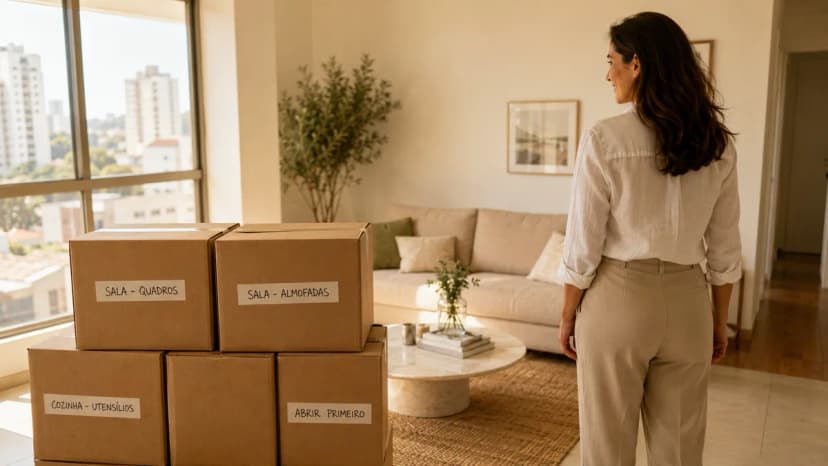
The most requested project: the personal organizer arrives on moving day (or shortly after) and organizes the entire home from scratch. It includes unpacking every box, categorizing belongings, deciding where each item goes based on the family's routine, and making the home function from day one. Nothing stays in a box waiting for "someday" to be opened.
- Receiving and unpacking boxes by room
- Defining functional zones (kitchen, bedroom, home office)
- Recommending organizers needed after seeing the real space
- A maintenance guide by room
Learn more: moving organization in São Paulo.
Full home organization
For anyone who has already been living in the home for months or years and wants to reorganize from scratch. The project covers every room, reviewing existing systems and creating new ones where needed. Result: the entire home working coherently.
- Full assessment of every room
- Reorganization room by room with a new category system
- Purchase recommendations (after decluttering)
- Handover tour and maintenance guide
Closet and wardrobe
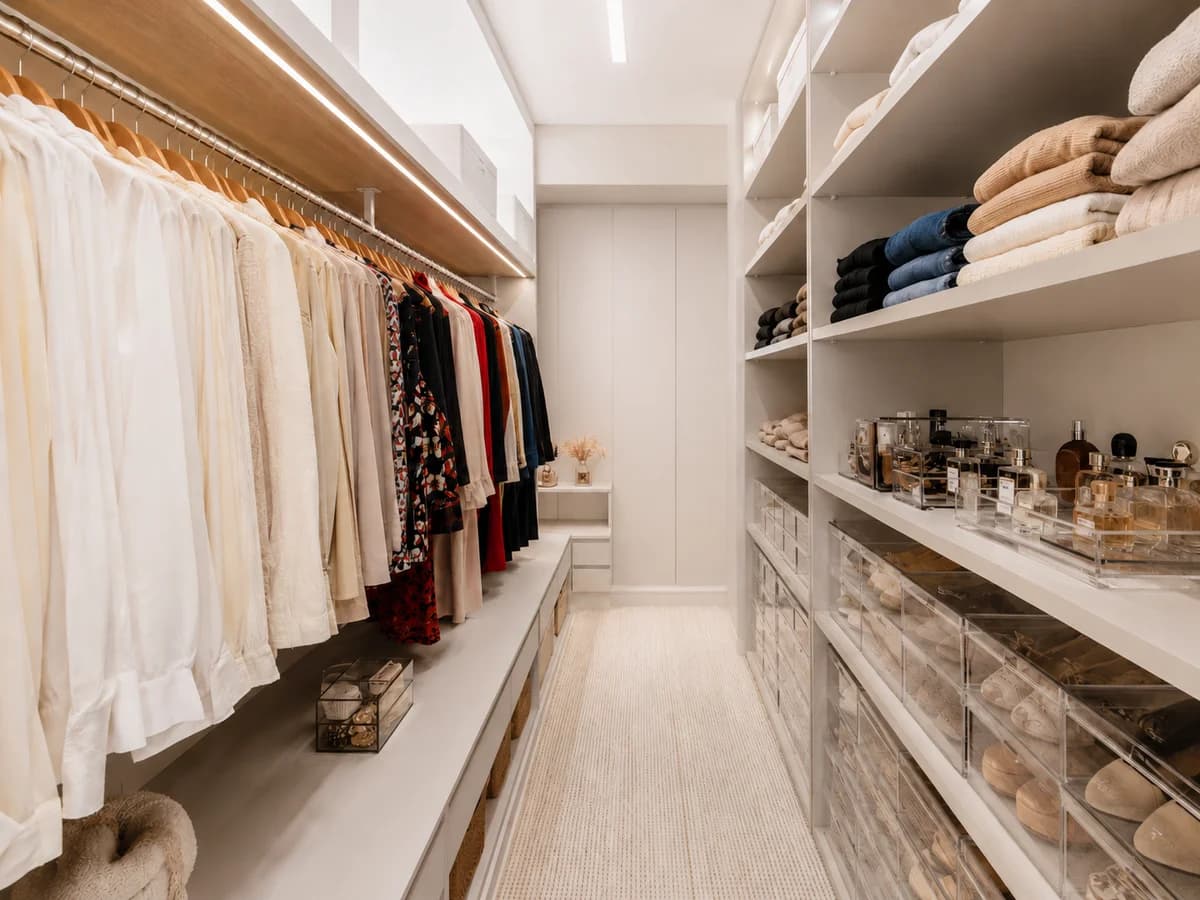
One of the rooms with the biggest impact on daily routine. The project includes emptying everything out, reviewing the wardrobe by season, categorizing by type of item and frequency of use, and setting up an organization system that lets you see everything you own and find any item in seconds.
- Full emptying and sorting of the wardrobe
- Organization by category, color, or use (based on the routine)
- Recommendation of dividers, boxes, and hangers suited to the space
See more: how to organize a closet in São Paulo.
Kitchen and pantry
A disorganized kitchen costs time and money: forgotten expired items, duplicate purchases, hard-to-reach utensils. The project reorganizes drawers, cabinets, and the pantry by frequency of use, with functional zones that make meal prep faster.
- Discarding expired items and unused utensils
- Creating zones by type of use (prep, storage, everyday items)
- Organizing the pantry with a stock rotation system
Read: functional kitchen organization in São Paulo.
Home office
Working from home requires a space that supports focus and workflow. The project organizes the desk, drawers, shelves, and documents so the work area is functional and does not spill into the rest of the home.
- Organizing the desk and work surfaces
- A filing system for physical documents
- Organizing cables, equipment, and office supplies
Learn more: how to organize a home office.
Nursery and baby trousseau
One of the moments with the greatest emotional weight: preparing the space for a baby's arrival. The project organizes the trousseau by category and size, sets up the nursery with everything within easy reach for the overnight routine, and creates a simple maintenance system for when the baby arrives.
- Organizing the trousseau by category (clothes, hygiene, feeding)
- Setting up the nursery with functional zones for changing, feeding, and sleeping
- A size-rotation system as the baby grows
Read: how to organize a baby trousseau in São Paulo.
Personal documents
Poorly organized documents cause hours lost searching for contracts, deeds, diplomas, and receipts. The project creates a physical filing system by category and priority, with a quick-access folder and a separate archive.
- Sorting and discarding expired or unnecessary documents
- A category system (finance, health, property, vehicles, personal)
- A quick-access folder for frequently used documents
See: how to organize personal documents at home.
Post-renovation organization
After a renovation, the home tends to accumulate debris, mixed-up items, and rooms with no clear function. The post-renovation project returns the home to functionality after the mess of construction, reorganizing everything with the new systems the renovation made possible.
- Post-renovation decluttering (removing accumulated unused items)
- Setting up new spaces (new cabinetry, closets, nooks)
- Creating an organization system adapted to the renovated layout
Who should hire a personal organizer?
A personal organizer is not for everyone, or every moment. The scenarios with the highest return on investment:
- Families moving or recently moved: the moment with the highest ROI. Instead of unpacking at random and spending months reorganizing, you move into the new home with everything already in the right place from day one.
- Anyone who tried to organize alone and it didn't last: if you have already organized and gone back to how things were, the problem is not a lack of effort. It is a lack of system. A personal organizer fixes the cause, not the symptom.
- Busy professionals: weeks of weekend reorganizing turn into days of professional work, depending on the project scope.
- Families expecting a baby: organizing the trousseau, preparing the nursery, and reorganizing the existing space to make room for the new arrival is one of the most common requests.
- Homes with years of accumulation: when the situation has gotten out of hand and it seems impossible to know where to start, a professional with method and no emotional attachment to the items makes all the difference.
- Anyone living in a small apartment: making the most of every square foot available is one of the specialties of professional organization.
- People with ADHD: for those with attention deficit, disorganization has a neurological basis. The approach needs to be different. Read: how personal organizing works for ADHD and what changes in practice.
If you are moving or planning to, it is worth understanding why this is the moment with the highest return, read: is it worth hiring a personal organizer for a move?
In a 220 m² house in Moema, the couple had tried to organize the office for three months of weekends. They never finished. When they called me, they said they no longer knew where to start.
We worked as a team: three people over two days. The entire home was organized, including the office that had sat untouched for months. On our way out, the client calculated it would have taken another six months doing it themselves on weekends.
The takeaway: when time is the scarce resource, method and a team compress months into days. Method and a team solve what isolated weekends cannot finish.
If after reading this you want to see how it would work in your own space, that is exactly what an in-person assessment is for.
See the home organization service →Does a personal organizer work alone or in a team?
It depends on the scope. For single rooms (closet, kitchen, home office), the service is usually handled individually. For larger projects, such as full moves or homes with more than two bedrooms, the work is done as a team, with two or three professionals working simultaneously in different rooms.
The practical difference is the timeline: a three-bedroom home that one person would take five days to organize can be ready in two days with a team. The briefing defines the scope, and the scope determines whether the project needs a team. See more about how the hiring process works in: how to hire a personal organizer in São Paulo.
- Single room (closet, kitchen, home office): individual service, 1 to 2 days, depending on volume and scope.
- Full apartment (2 to 3 bedrooms): individual or a pair, 3 to 5 days, depending on size and scope.
- Large home or high-volume move: a team of 2 to 3 people, compressed to 2 to 3 days of work.
How does the Casa Pronta™ Method work in practice?
After hundreds of projects across São Paulo and the greater metropolitan area, the process I use with my clients has specific traits that shape the result.
Function before aesthetics
The result of a well-executed project is a home that works for the family's real routine, not necessarily a home that looks like it came out of a magazine. Closets organized with matching boxes look nice, but the real measure of success is different: you find what you are looking for in under 10 seconds, the morning routine flows better, and the kids can put away their own belongings.
The briefing as the foundation of everything
No project starts without a deep understanding of how the family uses the space. Two 80 m² apartments with the same layout can need completely different systems depending on who lives there, how many people, their consumption habits, whether there are kids, pets, or work from home. The briefing is what ensures the system built will last, because it was made for that specific family.
A couple in Vila Madalena, in a 70 m² apartment, had just moved in. Three weeks later the kitchen still ran on improvisation. During the briefing, I asked who cooked. She: every day. He: rarely. The kitchen was set up for two cooks because it "seemed fairer." Her utensils sat on high shelves because the prime space had been split evenly.
We reorganized based on the real routine: her most-used utensils at hand height, his on an upper shelf. She said: "it's obvious now that you mention it."
The takeaway: two apartments with the same layout need different systems. The briefing is what ensures the system will work for that specific routine.
Team execution for larger projects
For moves or larger homes, the work is done as a team: multiple people working simultaneously in different rooms. This compresses execution time from weeks into days: a 3-bedroom home that you would spend months organizing on weekends is ready in an average of 3 to 5 days of professional work, depending on the size and scope of the project.
Support after handover
After handover, the client receives a maintenance guide specific to the project. In the following days, questions get answered: "where does this item go, I couldn't find a place for it?", "does it make sense to reorganize this drawer this way?" The system needs to work in real life, not just on handover day.
Does the personal organizer bring the organizers, or do I buy them?
You buy them, and the purchase happens after the organization, never before. The personal organizer tells you exactly what to buy: model, size, and quantity, based on the real space after decluttering and categorizing. Buying boxes and baskets before knowing what will stay is the most costly mistake people make when they try to organize on their own.
The standard process is: decluttering, categorizing, measuring the available space, and only then, the shopping list. In some projects, the professional can join the purchase in person or remotely. In others, she sends a detailed list with links and specifications for the client to buy on their own. What does not happen is arriving with standardized organizers without knowing the space. Learn more about what is included in the service in: how much does a personal organizer cost in São Paulo.
- Decluttering and categorizing always come before any purchase.
- The list of organizers is based on measurements of the real space, not estimates.
- Organizers are bought by the client, with precise guidance from the professional.
- A good result does not depend on expensive products: it depends on the system and on decluttering.
How to choose the right personal organizer for you
The professional organizing market has grown a lot in recent years, which is great, but it also means the options vary widely in quality and process. To understand the size and context of this market, read: an overview of the professional organizing market in Brazil. A few criteria to evaluate before hiring:
Warning signs
- Gives a quote with no visit or detailed conversation: it is impossible to know the real scope without seeing the space;
- Has no clear briefing process;
- Has no portfolio, client testimonials, or verifiable references;
- Does not provide a written scope of service: what is included, what is not, an estimated timeline;
- Makes promises about the outcome without understanding your routine.
Good signs
- A detailed briefing process before any execution;
- A clear scope of what is included in the service;
- An estimated timeline communicated up front;
- A portfolio with projects similar to yours (moving, closet, laundry room, depending on what you need);
- Clear communication about what you will need to decide during the process.
And beyond the objective criteria: trust your gut. You are going to let this person (and possibly a team) into your home, with access to your belongings, including personal items. Trust matters just as much as the technical process.
Learn more about Silvana Santanna's background, personal organizer in São Paulo with certification and specialization in residential moves.
If you are considering hiring, the natural next steps are understanding how much a personal organizer costs in São Paulo and what to evaluate before choosing the right professional. For a complete view of how a home organization project works (from briefing to handover), check out the home organization guide.
Frequently asked questions about personal organizer services
Do I need to be home while the personal organizer works?
Not necessarily. For the moving organization service (the most common one), we start with an initial briefing where we understand your preferences for where each item should go. After that, you can leave the keys and come back to a home that is already organized. Clients who prefer to be present are also welcome, but it is not required.
Will the personal organizer throw away my belongings without asking?
Never. Discarding items is always the client's decision. The personal organizer guides you, presents criteria, and makes the decision process easier, but the final word is always yours. Our role is to help you make better decisions with more clarity, not to decide for you.
How long does a personal organizer project take?
It depends on the scope. Full projects take on average 3 to 5 days, depending on the size and scope of the project. A single room such as a closet or kitchen takes on average 1 to 2 days, depending on volume and scope. The exact timeline is confirmed in the quote, after the briefing.
What is the difference between a personal organizer and a house cleaner?
They are completely different services. The cleaner cleans: removing dirt from surfaces. The personal organizer organizes: creating functional systems so the home works well. Some clients have their home cleaned before the organization service so the personal organizer works in a clean space, but they are distinct professionals with distinct scopes.
Can a personal organizer help me buy organizers?
Yes. Part of the service is recommending which organizers make sense for your space, after decluttering and defining the categories. We do a briefing of the space, measure the rooms, and recommend specific solutions. Some personal organizers also shop together with the client, or send a complete shopping list.
Is it worth hiring a personal organizer?
It depends on the moment and the problem. It is worth it when you have tried to organize on your own and the result did not last, when you are moving and want your home functional from day one, when time is scarce and weekends of reorganizing never move the needle, or when the clutter is having a real impact on your routine. The return is highest on moving projects and in situations of accumulation beyond what you can organize alone.
What is the difference between a personal organizer and a housekeeper?
The housekeeper handles routine household tasks: cleaning, laundry, basic tidying. The personal organizer creates organization systems adapted to the family's routine: defining where each item belongs, how spaces are categorized, and how the system is maintained. The housekeeper executes daily tasks. The personal organizer designs the system that the housekeeper (and the family) will use. They are complementary services, not substitutes.
Does a personal organizer work with the furniture I already have?
Yes. The organization service works with the existing space and furniture. You do not need to buy new furniture, renovate, or commission custom cabinetry to hire a personal organizer. Buying organizers (boxes, dividers, baskets) happens only after decluttering and only when there is a real need, never as a first step. The result depends on the method, not on new products.
How long does the result of a personal organizer last?
The result lasts as long as the system is respected. A system well designed for the family's real routine is easier to maintain than it seems: everything has a defined, logical place. Upkeep is simple (far simpler than reorganizing everything from scratch). What undermines durability is a system designed for a different routine than the real one, which is why the initial briefing is critical to the long-term result.
Does a personal organizer work in houses and apartments?
Yes. The service works in both houses and apartments, of any size. Small apartments (50 to 80 m²) often see the biggest gains because every square inch needs to work well. Larger houses require more project days and are usually handled by a team. The initial briefing defines the scope, timeline, and what is included in each case.
Does a personal organizer work alone or in a team?
It depends on the scope. For single rooms (closet, kitchen, home office), the service is usually handled individually. For larger projects, such as full moves or homes with more than two bedrooms, the work is done as a team, with two or three professionals working simultaneously in different rooms. Compressed timelines are one of the main advantages of team work: a three-bedroom home that one person would take five days to organize can be ready in two days with a team.
Want to see it in practice?
Project assessment with Silvana Santanna
Certified personal organizer in São Paulo. Tell me about your space and I will get back to you with a project assessment.
Talk to Silvana on WhatsAppServing São Paulo and the metro area

About the author
Silvana Santanna →Personal Organizer in São Paulo, specialized in residential move organization and functional organizing projects for homes, closets, kitchens, trousseaux and home offices. Creator of the Casa Pronta™ Method, with more than 100 projects completed across São Paulo and the greater metro area.
Related posts
When It Is Worth Hiring a Personal Organizer for Your Move (and When It Is Not)
10 min · Read article →

How to Hire a Personal Organizer in São Paulo (Without Regretting It)
9 min · Read article →
How to Keep Your Home Organized When You Work Full Time
14 min · Read article →
Ready to have your home organized
without lifting a finger?
Project assessment visit.