When It Is Worth Hiring a Personal Organizer for Your Move, and When It Is Not
Real situations where professional organization makes a difference, and when you can probably handle it on your own.
Neste guia você verá:
- 01When you can probably handle it on your own
- 02Which scenarios turn a move into chaos?
- 03Three moves I organized
- 04What actually happens without planning?
- 05What does the moving company do, and not do?
- 06What does a personal organizer do during a move?
- 07If you decide to hire: what to look for
- 08Frequently asked questions
Most people who consult me before a move start with the same question: "do I really need help, or can I handle this myself?" It is a good question, and the honest answer is that it depends on your situation.
This post helps you make that call. To plan your move step by step, see the 47-item moving checklist. If the move has already happened, the next step is the guide to organizing your home in the first 7 days.
Some moves you will probably handle fine on your own, without much drama. And some moves, without professional organization, end up as weeks of open boxes in the hallway, duplicate purchases, and a home that never quite works. The difference comes down to a few concrete factors, not how organized you are.
When can you organize the move yourself?
A move has a good chance of going well without professional help when the volume is small (a studio or one-bedroom apartment with few belongings), you have at least a week off available after the move, and there is no rigid deadline. With those three conditions, the process is manageable on your own.
A move done without professional help has a good chance of going well when:
- The volume is small: a studio or one-bedroom apartment with little accumulated stuff. Fewer belongings means fewer simultaneous decisions, which means less chaos.
- You have real time available: a full week off after the move, with no urgent pressure. An unhurried, organized move is workable: the problem is moves squeezed into the gap between one workday and the next.
- You have done this before with good results: if your last move resulted in a functional home within a week, you already have the internal method to repeat it.
- You are moving to a bigger space: more space means more room for error. Every item finds a spot, even a temporary one.
- You live alone or with one other adult: every additional resident (especially young children) multiplies the complexity.
If you fit that profile, you probably do not need professional help. The 47-item moving checklist and the first-7-days roadmap cover what you need.
Which scenarios turn a move into chaos?
In practice, across moving organization projects, I regularly see a few patterns that greatly increase the odds of a move becoming a prolonged problem:
Moving with young children
Kids get disoriented by the new environment, demand constant attention, and undo what you just set up. Trying to organize the new home with a 3 year old clinging to your leg is, in practice, impossible, and during those first two overwhelming days the whole family hits its limit. The home that should have been ready in two days takes two weeks.
Short timeline with a high volume
When the move needs to happen fast (key handover, end of a lease, the start of the school year) and the volume of belongings is large, something gives. Usually what gives is the organization: boxes get opened out of urgency, not logic, and items end up wherever there is space, not where they make sense. The result is a home that "works" but never truly comes together.
Moving from a large home into a smaller space
When the space shrinks, every storage decision matters much more. What used to fit spread across a 150m² house does not fit in an 80m² apartment, and without planning, you find that out the hard way: trying to close a closet door that will not shut anymore. In São Paulo, a city with over 11 million residents according to IBGE, downsizing is the most common scenario in residential moves.
Belongings accumulated over years
Families who stay many years in the same home accumulate a volume of belongings that stays invisible simply because it is familiar. Once everything becomes a box, the real scale shows up. Organizing that volume without a pre-move decluttering method means paying to transport things that have no place in the new home.
What actually happens without professional organization?
These are real patterns that show up in clients who tried to handle the move on their own before contacting me:
- The search for the toothbrush at 11pm on day one. You know you are in the new home. You know you have a toothbrush. You do not know which of the 40 bathroom boxes it is in.
- Duplicate purchases.A client bought a second can opener three weeks after moving because "hers had disappeared." It was in a still-sealed kitchen box, next to a pot she also thought she had lost.
- The box that sits in the bedroom for months. Boxes with no defined destination do not get opened. They get pushed into a corner. Three months later, you do not know what is inside and have no energy to find out.
- The kitchen that never quite works.Utensils were stored wherever there was room, not where it made sense. The flow logic was never established. Two years later, it is still the "temporary" kitchen no one ever truly reorganized.
Most people take 3 to 6 weeks to feel settled after a move. With professional organization, that happens on day one.

Three moves I organized
Every move has a different pattern of collapse. These three come up most often.
The move from 160m² to 85m² with no prior decluttering
A family from Mooca, a couple with two kids. They were leaving a 160m² home they had lived in for 11 years. The move happened on a Saturday. They called me the following Wednesday, paralyzed: 28 boxes stacked in the hallway, a kitchen with two complete sets of pots because each family member had packed separately with no coordination, and a hallway closet packed to the brim with items that had no place in the smaller apartment. Eight days after the move, no one knew where the air conditioner remote was. Every time they walked through the hallway, they felt the problem was growing.
We sorted through everything the next day: I discarded 35% of the volume. I organized the rest in a single day. "I did not believe it would get done in a day." The lesson from this case: moving from a larger space to a smaller one without decluttering first turns the day after into weeks of paralysis. The work that should have happened beforehand becomes an emergency afterward.
Six days to move, everything packed with no separation by room
A short timeline for a move carries a risk that the rush hides: packing in a hurry erases any system logic.
An architect from Brooklin, living alone with a 5 year old daughter who spends weekends with her. She received a 30 day notice that her lease was ending. She called me 4 days before the date, anxious, afraid she would not make it in time. The boxes had been packed overnight, with no separation by room: dishes with books, her daughter's clothes with documents, kitchen utensils with office supplies.
I mapped out the new apartment before the move happened. On delivery day, I directed each box to the right room while the movers were still in the home. The kitchen and her daughter's bedroom were ready on day one. She texted me at 11pm: "I slept with the house ready. I thought it would take two weeks." What this case showed: in a move with a short timeline, the step that saves the most time is mapping the new property (done before any box is opened).
A 4 month old baby, a 3 year old, day two of the move
No move with young children follows the plan the same way. The child does not understand that routine will come back. She just feels that the world changed.
A couple from Itaim Bibi, a 90m² apartment. They tried to organize on their own for the first two days. They messaged me at 10:30pm on day two, at their limit: their 3 year old disoriented by the new environment, the baby off routine, a spare diaper in one of the 14 bedroom boxes they had not yet managed to open. Their feeling was that the harder they tried, the more the chaos grew.
I came on the morning of day three. I started with the kids' bedroom. With the children's base set up, the couple could work on the other rooms without interruption. By the end of the day they had the bedroom, kitchen, and bathroom working. "It was the first night everyone slept." The lesson: in a move with young children, the kids' bedroom is not the last room to organize. It is the first.
What does the moving company do, and not do?
There is a common confusion about the role of each service. A moving company does one thing: transport your belongings safely from the old address to the new one. They carry, protect, and unload.
Where each closet will go, how to organize the inside of the kitchen, what should go or be left behind, what to open first: those decisions stay with you. The company delivers the boxes. Everything else needs a different kind of work.
The two services are complementary, not alternatives. You have probably already thought about hiring a moving company. The question is what happens after the truck drives off. To put together the full budget, see how much moving organization costs in São Paulo in 2026.
What does a personal organizer do during a move?
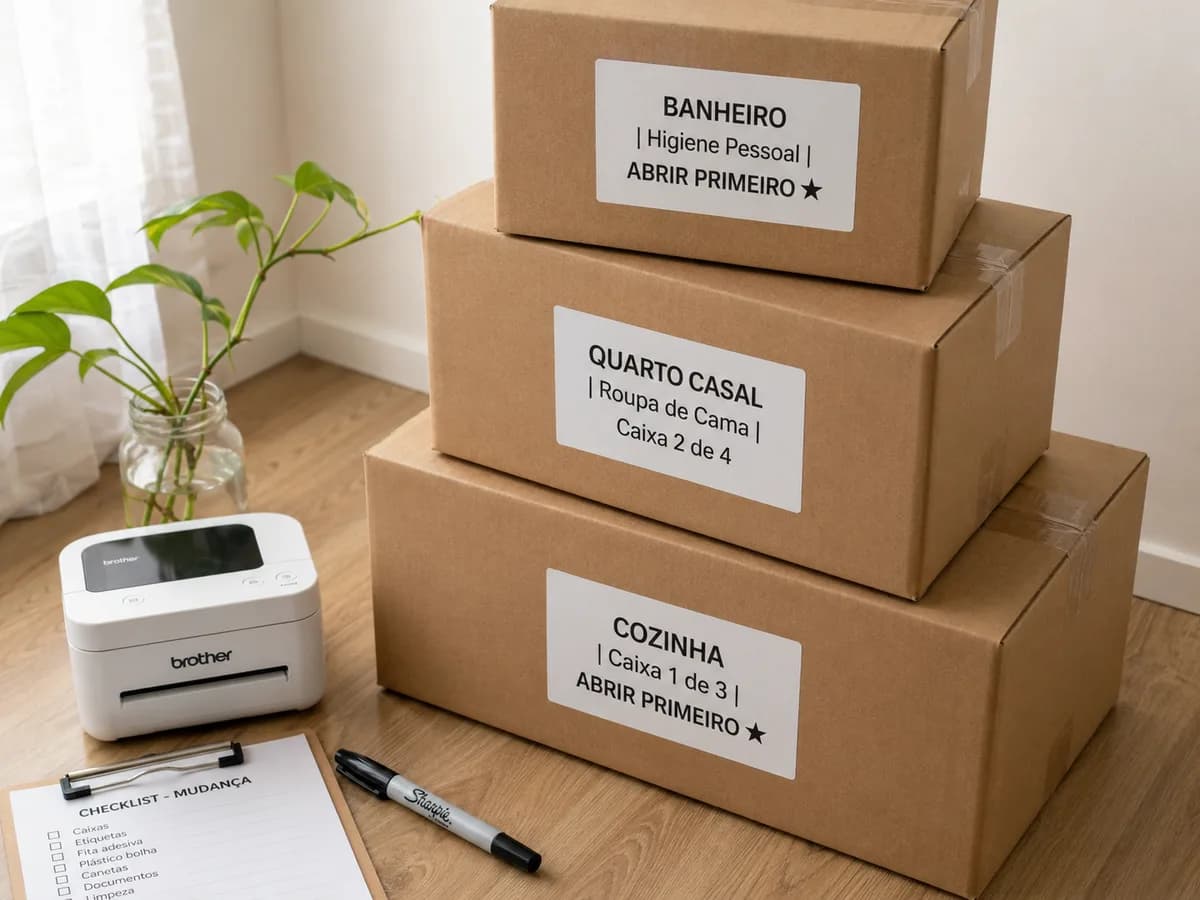
The work starts before moving day: with a technical visit to the new property to map out the spaces and plan where each category of belongings will go. On the day, I coordinate the arrival and direct each box to the right room while the crew is still in the home. By the end, every room is set up with a functional system from day one: closets organized, kitchen ready, bathrooms stocked. You do not need to search for anything.
If you decide to hire: what to look for
If you have identified that your move fits the scenarios where professional organization makes a real difference, the next step is finding the right professional. Look for someone who:
- Does a technical visit to the new property before the day, not just shows up to organize;
- Has a portfolio specific to residential moves, not just closet organization;
- Clearly explains what is and is not included in the service;
- Does a detailed briefing about your routine before starting anything.
- Has verified training: check the directory of ANPOP (Brazil's National Association of Organizing and Productivity Professionals) to find certified professionals.
The post how to hire a personal organizer in São Paulo (without regretting it) covers the right questions to ask and the warning signs worth knowing before you book any service. For moves in high-end properties with collections (wine, silverware, art) or 200m²+ projects, see what changes in organizing high-end properties.
Moving with a personal organizer starts before the truck arrives, and ends with a home that works.
See the Casa Pronta™ Method →To find out the specific price for your move, request a personal organizer quote.

Frequently asked questions
How far in advance of the move should I hire a personal organizer?
Ideally 2 to 4 weeks in advance. That window allows for a technical visit to the new property, mapping out the spaces, and guidance on packing by room. Hiring with less than a week's notice limits a lot of what can be planned before the day.
Do I need to be home for the entire moving organization service?
It is not required. With a complete briefing done beforehand, the personal organizer works independently: you can hand over the keys in the morning and come back to an organized home. Many clients spend the day handling other moving tasks while the service takes place.
What is the difference between a personal organizer and a moving company?
The moving company transports your belongings from point A to point B. The personal organizer handles everything that comes before and after: planning the rooms, deciding what should not go to the new home, packing by room, and fully organizing and setting up the spaces. The services are complementary.
Is it worth hiring for a move into a small apartment?
Especially so. In smaller apartments, every centimeter matters. The personal organizer defines what actually fits the space, avoiding unnecessary furniture purchases that will not fit, and sets up the rooms for maximum use from day one.
How much does it cost to hire a personal organizer for a move in São Paulo?
The price depends on the size of the property, the volume of belongings, the number of rooms, and the timeline. There is no fixed price: each project is quoted individually after a technical visit. What is consistent: the cost pays for itself through avoided purchases, time saved, and weeks of chaos eliminated.
Decided you need help?
Project assessment for your move
Tell me about the property, the timeline, and the rooms. I will get back to you with a personalized proposal, no pressure.
Request a moving quote on WhatsAppAssessment visit · Serving São Paulo and the region

About the author
Silvana Santanna →Personal Organizer in São Paulo, specialized in residential move organization and functional organizing projects for homes, closets, kitchens, trousseaux and home offices. Creator of the Casa Pronta™ Method, with more than 100 projects completed across São Paulo and the greater metro area.
Related posts

What Does a Personal Organizer Do in São Paulo? Services and Process
10 min · Read article →

How to Hire a Personal Organizer in São Paulo (Without Regretting It)
9 min · Read article →

Moving Checklist São Paulo: 47 Steps to Not Forget Anything
10 min · Read article →
Ready to have your home organized
without lifting a finger?
Project assessment visit.