Moving Organization Cost in São Paulo: what goes into the quote
What shapes the investment in moving organization in São Paulo: real volume, prioritized rooms, phases and the building window. Always a personalized quote.
Neste guia você verá:
Why is there no fixed price list for moving organization?
Two moves out of apartments with the same floor area, in the same neighborhood, can produce projects of very different sizes. One belongs to a couple who has lived there for two years. The other belongs to a family of eighteen years in the same place, with the grandmother's china, four boxes of documents and a storage unit in the garage nobody has opened since the last move. The floor plan is identical. The work is not.
That is why no serious organization quote closes over the phone, and why the math never starts with square meters.
The two videos I ask for before any math
For a move I always ask for two videos, and it is the comparison between them that defines the project.
- A video of the current property, with everything open: wardrobes, pantry, the laundry area cabinet, the closet drawer unit, the storage unit in the building. This is what shows the real volume that floor area hides
- A video of the new property, empty and with the built-ins open: this is what shows how much storage exists to receive that volume, and where it sits
Once both videos arrive, the conversation changes subject. It stops being "how much does it cost" and becomes "what has to be decided before the truck arrives." In most moves to a smaller property, that is where the most expensive item in the project shows up: the things that get packed, transported, paid for and then discarded on the other side.
What the freight delivers, and where it stops
A moving company and a personal organizer do different things, and the two are independent hires. The moving company packs, loads and unpacks. Unpacking means taking the item out of the box and placing it in the assigned room. It does not mean deciding where the plate goes on the shelf, creating a system for the pantry, setting up the closet by category, or getting the home office functional on day one.
A family in Vila Madalena called me at 7 pm on a Friday. The moving company had finished at 6 pm, the truck was gone, and 40 boxes were scattered across three bedrooms and the living room. Their kids, 6 and 8 years old, had no bed set up and did not know where to find their pajamas. The mother had a meeting at 8 am the next day. The freight had been carried out flawlessly, exactly as agreed. The problem is that transport and organization are two different services, and only one of them had been hired.
We arrived early the next morning. By 8 pm, the kitchen, the kids rooms, the bathrooms and the home office were all functioning. The family slept at home that night without having to dig through boxes.
What is included in moving organization
- Prior assessment of the new space: mapping the rooms, available storage points and fit for the volume of items before moving day
- Building a system room by room: kitchen, pantry, closet, bedrooms, home office and bathrooms with functional zones defined from day one
- Decisions on discarding and redistributing: items that do not fit in the new space need a destination before they come in, not after
- Setting up the systems: shelving by category, clothes organized by type, labeling closets and everyday-use boxes
- Guidance for maintenance: how to keep the system running after the service ends, without having to start from zero again in 3 months
The profession was officially recognized by the Brazilian Classification of Occupations (CBO) in 2022, which helped standardize scope and made proposals easier to compare. For the picture of the São Paulo market, I gathered the available numbers in residential moving in São Paulo: what the data shows.
The four blocks that shape the investment
Understanding each block does two things: it lets you compare proposals from different professionals without comparing things that are not comparable, and it shows where scope can be reduced without losing what matters.
1. Real volume and what will be discarded
A home accumulated over many years takes more time than a young couple's home. A kitchen with 200 utensils, a variety of spices, several dinnerware sets and appliances takes twice as long as a lean kitchen. Kids rooms with toys, books and clothes in different sizes add complexity. And every item that will not fit at the destination requires a decision, which takes time whether it happens before or after the truck.
2. Prioritized rooms and the order between them
What defines the scope is not only floor area: it is how many rooms will be organized and in what order. A move can prioritize the kitchen, bedrooms and bathrooms, leave the storage unit and the laundry area for a second phase, and still hand over a working routine on the first night. Moving with a baby flips everything: the child's room comes before any other, and the rest gets organized around it.
3. Which phases are part of the project
Moving organization is not one single service. There are three moments, and a project can include one, two or all three.
- Before: pre-move organization sorts and categorizes with everything still in the original place, when deciding costs less in time and in energy
- On the day: following the arrival, deciding which box opens first and setting up the essential rooms before nightfall
- After: post-move organization builds the definitive systems room by room, with the family's real routine already running in the new property
4. Timeline and date
When organization has to happen in two days because the family cannot live in chaos, that requires a locked date and often a larger team at the same address. End of month, beginning of month and the eve of a holiday are the most contested periods for moving in São Paulo, and dates like those leave far less room to maneuver than a flexible window mid-month.
What happens without a prior walkthrough
A couple moving from a 180 m² house to a 90 m² apartment hired me for organization, but without a prior walkthrough. On moving day, they discovered that 30% of the furniture did not fit in the new space. The custom closet from the previous home had three times the space available in the new apartment.
Work that should have taken 3 days took 5. Every discard decision had to happen with the items already inside the apartment, far slower than it would have been beforehand. The couple's bed sat in the hallway for two days while we reorganized the bedroom for the new space.
A prior walkthrough is not paperwork: it is what defines the real scope before closing the quote and prevents the project from changing size midway through.

Now that you know what goes into the quote, the next step is seeing how the moving service works from the inside.
See the moving service →Building logistics in São Paulo count too
This is the block that disappears from generic organization checklists, written for any city. A move in São Paulo is rarely a free-running operation: it is a scheduled one, with an hour to start and an hour to stop, in two buildings at the same time.
Most buildings require the move to be booked days in advance, release the service elevator only during certain hours and usually do not authorize Sundays or holidays. Many ask for elevator protection, notice to the building manager and, in newer buildings, a deposit or insurance. When origin and destination have different rules, whoever organizes the move has to fit both windows into the same day.
What usually compresses the working window
- Elevator booking in both buildings: the date only exists when both release it, and they do not always release the same shift
- Permitted weekday hours: a short window forces the work into priority blocks, starting with whatever has to be ready before nightfall
- Truck access: a narrow street, a loading spot and rush-hour traffic restrictions in parts of the city push the operation into a tighter slice of the day
- Front desk and inspection: checking items in and registering service providers consume real schedule time, not just paperwork
None of this is unforeseeable. It exists beforehand, it is written in the building rules, and it can be confirmed by phone with both building managers in one afternoon. What costs dearly is finding out on the day.
- Confirm the permitted moving hours with both building managers
- Book the service elevator at origin and destination for the same date
- Record both videos: the current property with cabinets open and the new one empty
- Define which rooms have to be working on the first night
- Ask for an organization quote by room scope, not by day rate
- Confirm with the personal organizer what supplies to buy before you go shopping
- Leave slack in the family plan for access and schedule surprises

When the investment pays for itself
An executive called me two months after moving. She had decided to organize on weekends, without hiring anyone. She went back to working in person three days after the move and had not been able to make progress since. When I arrived: 8 boxes still sealed in the guest room, a kitchen working at half capacity, a home office set up on the dining table.
We calculated it together: she had spent 22 weekends trying to organize. She always started, got tired and stopped before finishing a single room. The service took 2 days. In the end, she said she should have done it on day one.
People with flexible schedules, no young children, and a moderate volume move can organize with method and patience. For any other situation, the math tends to favor the professional service once you add up the time spent and the real toll it takes.
Situations where the investment clearly pays off
- Young children or a baby: routine and a safe environment need to be ready before any other room
- Work with no pause during the move: with no time to organize after hours, boxes stay open for weeks
- New property smaller than the previous one: you need to decide what comes in, what gets donated and what gets discarded before storing anything
- A person with a physical or health restriction: heavy organizing work should not be done by someone recovering from surgery or with limited mobility
- Moving from another state or country: with no local support network, every hour lost to organizing is a real productivity cost
There is also a situation few people consider: when the new property has more space than the previous one, but a completely different layout. Storing everything without a plan creates rooms that look full while nothing is in the right place. Months later you buy organizers to solve a problem that was about the system, not the space.

Three moving projects
These three cases show the full picture of a move: what the moving company does, what it does not do, and what stays unresolved when organization was not planned separately from freight.
The doctor who came from Recife without ever seeing the new apartment
A 32-year-old doctor, moving from Recife to Brooklin. A 55 m² apartment rented before she arrived, seen only through photos. The moving company carried out the transport over three days, and on the fourth day 47 boxes sat in the São Paulo apartment. She called me at 6 pm that same day: she still did not really know the apartment's layout, the kitchen did not even have the basics within reach, and her shift started at 7 am the next morning.
She was more afraid of working with no place to come back to than of setting up the home.
What had been missing was a prior mapping of the apartment before the boxes arrived. No one knew which box to open first, what needed to be accessible that night, which room to prioritize. We worked until midnight. Functional bedroom, basic kitchen, accessible bathroom. The next day she went to her shift.
The lesson: a move with no prior mapping of the destination arrives at the apartment with no plan. The freight fulfilled its contract. The organization needed a separate hire.
The move with a two-month-old baby
Some moves cannot wait for the home to get organized little by little.
A couple from Pinheiros with a 2-month-old baby. Moving from an 80 m² apartment to a 70 m² one in the same neighborhood. The freight was carried out on schedule. When the moving company left, the boxes were in the right rooms, but nothing was functional. The baby's room had a crib, but diapers, clothes and toiletries were spread across four different boxes that no one had had time to open.
The mother was on maternity leave, breastfeeding every two hours, trying to set up the home while the baby slept. She called me at 10 am after a night of the baby crying and searching for clothes in the wrong box. Her voice was at its limit.
During the service, the baby's room was the first room addressed. Three hours later it was functional: diapers, clothes, toiletries, all sorted by category and within an arm's reach. The couple slept that night without needing to search for anything.
The lesson: in a move with a baby, the child's room is the first organization priority. The cost of not having that solved on day one is measured in lost nights.
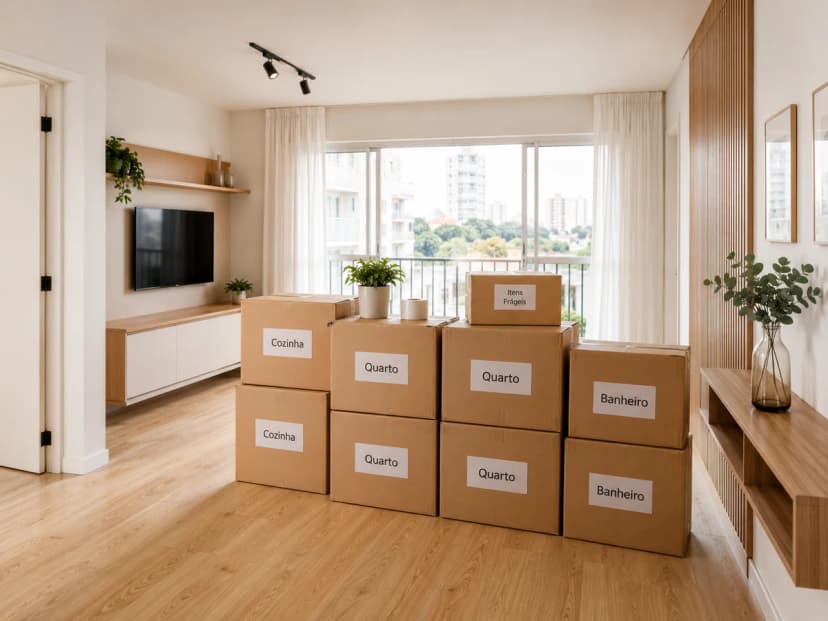
Moving to a smaller space seems simple until the furniture arrives and half of it does not fit.
The couple who moved to a smaller apartment without decluttering first
A couple from Perdizes, with no children, moving from a 95 m² apartment to a 65 m² one. The freight had been quoted and booked. What had not been planned was what would happen when 95 m² worth of furniture and belongings arrived in a 65 m² apartment.
On moving day, three pieces of living room furniture from the previous home did not fit in the new living room. A wardrobe from the old guest room had come along by mistake. Two bookshelves sat in the hallway for two days because no one knew where to put them.
She told me afterward that the toll of making all those decisions with the furniture already inside the new apartment had been the worst part of the move. Every decision had to happen on the fly, with the apartment full and no plan.
The lesson: moving to a smaller space needs decluttering before the freight. Deciding what goes with belongings already inside the new apartment costs more time and energy than doing it calmly a week ahead. That is exactly what the video of the new property anticipates.
Frequently asked questions about moving organization in São Paulo
Why is there no fixed price list for moving organization in São Paulo?
Because two moves with the same floor area can have completely different scopes. What shapes the investment is the real volume of items, how many rooms will be organized, which phases are part of the project (pre-move, moving day and post-move) and the working window both buildings allow. None of that shows up on a floor plan, so the quote is personalized and comes after the assessment.
Why does the personal organizer ask for a video before quoting a move?
For a move there are two videos: one of the current property, showing the wardrobes open, the pantry, the laundry area and the storage unit, and one of the new property, empty, with the built-ins open. The first shows the real volume, which floor area never reveals. The second shows how much storage exists to receive that volume. Comparing the two is what defines scope, timeline and what has to be decided before the truck arrives.
Is moving organization included in the moving company service?
No. The moving company handles transport, packing and unpacking of items. Unpacking means taking the item out of the box and leaving it in the assigned room, not deciding where each thing belongs, building functional systems room by room, or adapting the new property to the family routine. Moving organization is a service performed by a personal organizer, separate from transport, and the two are independent and complementary.
Do building moving rules affect the quote in São Paulo?
They do, more than most people expect. In São Paulo there are two sets of rules at once, the origin building and the destination one, each with its own service elevator booking, its own protection requirement and its own permitted hours. When the destination window is short or falls on a weekday morning, the work has to be reorganized into priority blocks, sometimes with a larger team, and that becomes part of the project scope.
Can I hire organization for only some rooms of the move?
You can, and in a large property it is usually the sensible call. You define what has to be working on the first night, generally the kitchen, the bathrooms and the bedrooms of whoever sleeps there, and the rest goes into a second phase. That reduces the initial scope without compromising the family routine. The storage unit, the laundry area and seasonal items are usually the best candidates to leave for later.

About the author
Silvana Santanna →Personal Organizer in São Paulo, specialized in residential move organization and functional organizing projects for homes, closets, kitchens, trousseaux and home offices. Creator of the Casa Pronta™ Method, with more than 100 projects completed across São Paulo and the greater metro area.

Ready to have your home organized
without lifting a finger?
Project assessment visit.