Family and Baby Organization Guide for São Paulo
By the child's phase, by the toy system, and by the routine the adults can actually keep afterwards. A home with children in the São Paulo apartment. By Silvana Santanna, certified personal organizer.
Neste guia você verá:
- 01Why does a home with children fall out of order faster?
- 02What to prepare before the baby arrives
- 03How to organize the children's room by phase
- 04How to organize toys without a storage unit
- 05How to share upkeep between the adults
- 06How the professional process works
- 07When hiring is worth it
- 08Posts by topic
- 09Frequently asked questions
Family organization is the system that keeps a home working while everything inside it changes size. Clothes that fit for two months, a toy that loses its appeal in weeks: in a home with children, the volume changes faster than the wardrobe can keep up.
This guide covers what organizing a family home in São Paulo involves: what to prepare before the baby arrives, how to set up the children's room by phase, how to solve the volume of toys, and how to share upkeep between the adults instead of letting it fall on one person.
Why does a home with children fall out of order faster?
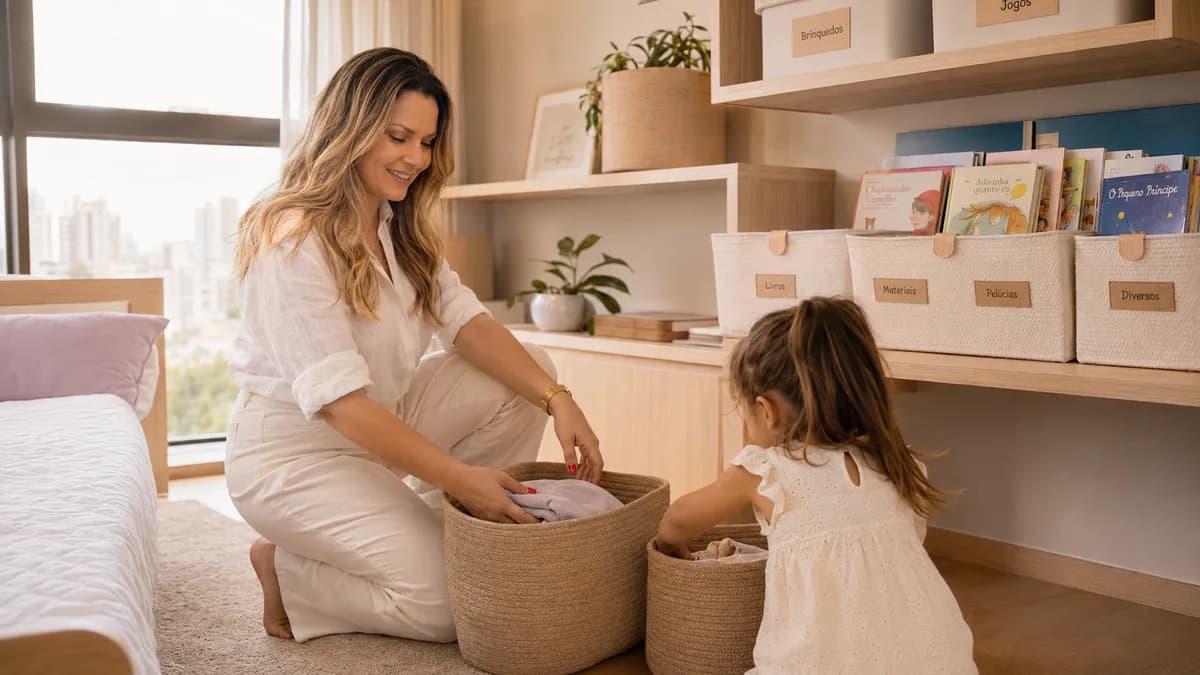
Because items come in and go out constantly, while the system was built for a fixed state. Clothing sizes change every two or three months, toys follow development, and school sends paper home every week. With no defined exit point, the home ends up storing three phases at once in the same wardrobe.
In a home with children, the resident changes size. An adult wardrobe crosses years with the same contents. A two-year-old's wardrobe is obsolete in a quarter. When the system has no exit for what became too small, every new arrival piles onto the last one.
The space constraint sharpens the effect. Between January and July 2023, 81.6% of the properties launched in São Paulo measured up to 45 square meters, according to Secovi-SP. A children's room in that kind of floor plan usually runs 8 to 10 square meters, split between crib or bed, wardrobe, and play area. There is no margin left for storing what no longer fits.
Overlapping phases pile up
The pattern that shows up most in projects: the same wardrobe holds newborn clothes, the current size, and clothes bought for a year from now. Three phases sharing one shelf, none of them within quick reach. The adult opens the drawer at seven in the morning and digs through pieces that no longer fit to find the one that does.
The load that lands on one adult
When the system lives only in one person's head, that person becomes the household search engine. According to IBGE, in 2022 women spent 21.3 hours a week on household chores and caring for people, against 11.7 hours for men. The gap of nearly 10 hours a week is not only about execution: it comes from knowing where everything lives, what ran out, and what needs to be bought.
What should you prepare before the baby arrives?
Prepare four areas, not just the nursery: the baby's room, the kitchen, the laundry, and a single point for documents. The nursery is usually the only one anyone remembers, but the first weeks of routine happen in the kitchen and the laundry, and that is where the lack of a system shows up first.
Preparing the home for a baby has two distinct blocks. The first is the layette itself: what to buy, in what quantity, and how to store it. That block is covered in the trousseau organization guide, which handles sorting the volume that arrives from the baby shower and the gift registry.
The second block is the home around the nursery, and it is the one usually left out. In the first weeks, the mother is up through the night with little margin to look for things. Every item out of place becomes one more decision in a day that already has few to spare.
- Kitchen: frozen meals in single portions, labeled with contents and date, at immediate-access height
- Laundry: a separate point for the baby's clothes, with its own detergent and a drying area defined before the birth
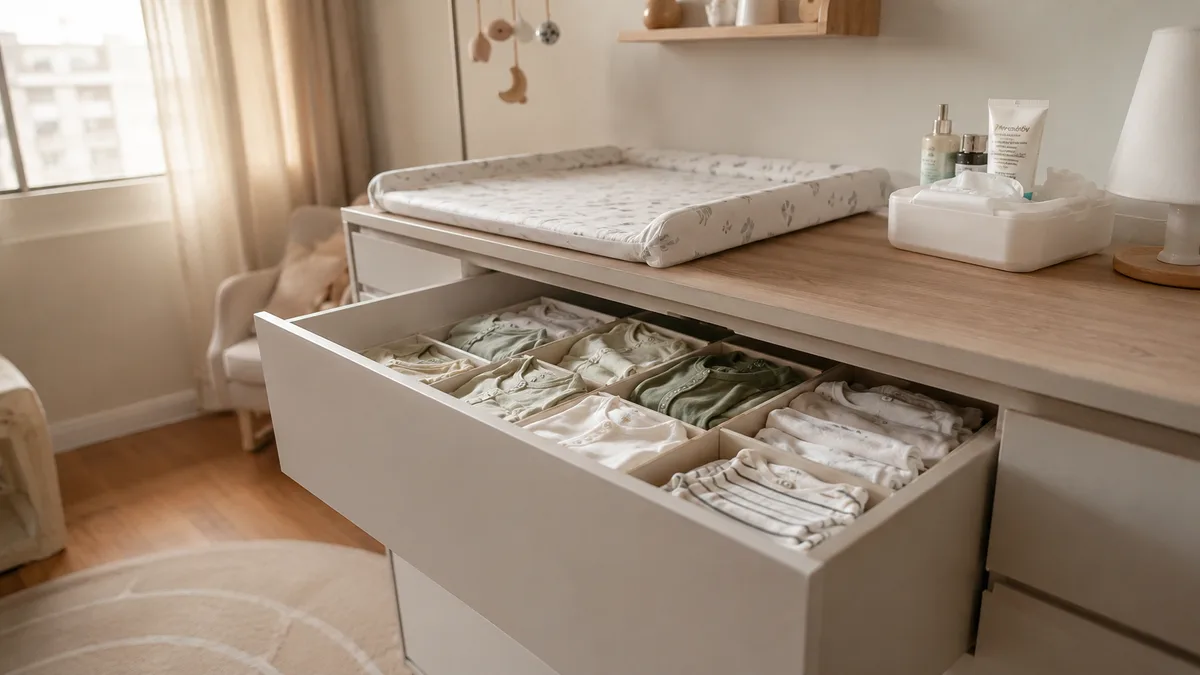
- Nursery: a complete changing station in one single spot, with diapers and clothes within reach of whoever is holding the baby
- Documents: one folder for the vaccination record, test results, prescriptions, and birth paperwork, always in the same place
- Circulation: a clear path between bedroom, bathroom, and kitchen, with no loose rug or furniture in the night-time route
When to do it
The third trimester is the real window. That is when the nursery is set up, the gifts arrive, and there is still physical energy for sorting decisions. After the birth the work is still possible, but it happens around the baby's routine, in shorter sessions and with the mother present for only part of them.
How do you organize the children's room by phase?
Divide the room by activity zone, not by type of object: sleeping, playing, dressing and, at school age, studying. What changes with each phase is who operates each zone. Up to age two, all of them belong to the adult. From three to six, the child takes over playing and part of dressing. At school age, she runs the whole room.
The most common mistake in a children's room is organizing it with adult logic and expecting the child to maintain it. Thin drawer dividers, heavy lidded boxes, and clothes folded in tall stacks work for someone with full motor coordination. For a four-year-old, each of those formats is a reason not to put anything away.
Zero to two: the room is run by the adult
In this phase the criterion is access speed for whoever is holding the child. The changing station concentrates everything in one spot. The wardrobe is organized by size, not by category: the size in use occupies immediate-access height, and the next sizes sit separately above or below, ready for the swap every two or three months. The play area is minimal, because a baby plays wherever the adult is.
Three to six: the child takes over what she can put away
Here the system changes owner. Whatever she uses on her own comes down to the band up to about 1.20 meters: the toys in the current rotation, books facing cover-out, one or two clothing drawers. Open baskets replace lidded boxes. A label with a drawing or a photo works where she cannot read yet. The upper shelves stay with the adult, for future sizes and toys outside the rotation.
Seven and up: the study zone comes in
School age adds a new and bulky flow: backpack, supplies, school paper, and printed work. The study zone needs an arrival point for the backpack, a fixed place for the week's materials, and one folder for whatever comes from school, reviewed on a defined interval. Without that exit point, school paper takes the desk, then the floor, then the whole room.
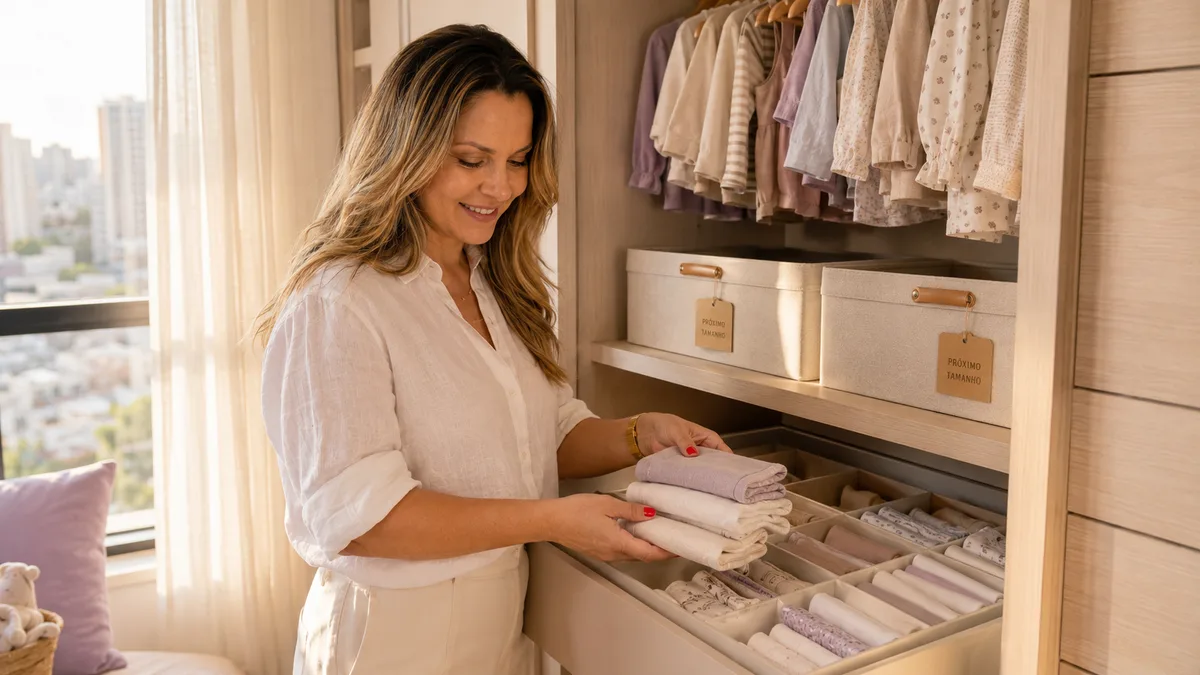
A children's room that will not close, or that unravels every week: the in-person diagnostic maps the real space before any decision.
Request an assessment →How do you organize toys without the room becoming a storage unit?
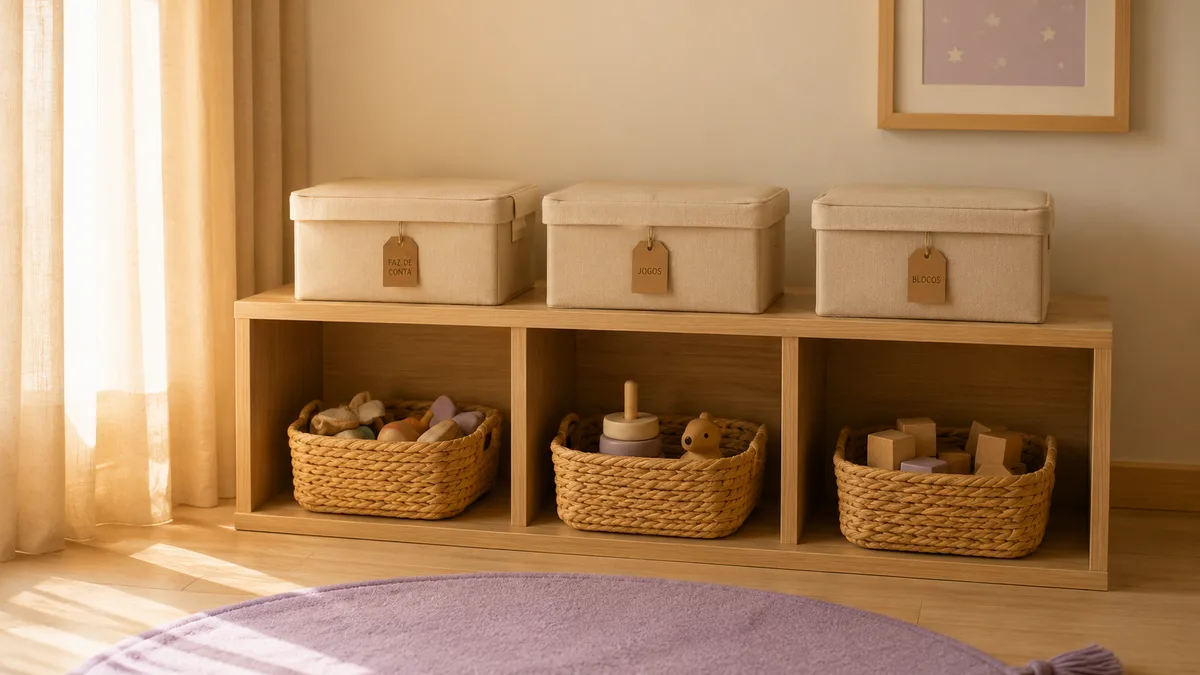
Keep a small batch accessible and store the rest in rotation, out of reach, swapping every two or three weeks. Fewer options available increases play time with each item. What stays accessible is split by category into open baskets, one per type, without mixing small pieces with large toys.
Toys are the item that comes in most and leaves least in a home with children. Birthdays, Christmas, gifts from grandparents, and party favors accumulate at a pace no shelf keeps up with. And the more toys within reach, the less time the child spends with each one.
How to set up the rotation
Sort every toy by category, pick a small and varied batch to stay accessible, and store the rest in closed boxes out of the child's reach. Every two or three weeks, swap the batch. A toy that comes back after a month in storage is greeted as a novelty, with nothing bought. And whatever was not missed across two consecutive rotations is the first candidate for donation.
The exit criterion
Every home with children needs a defined exit point, or the accumulation is simple arithmetic. Three objective criteria settle most of it: a toy for an age the child has outgrown, a toy that is broken or missing a piece that blocks its use, and a toy that was not asked for across two rotations. From age four the child takes part in the decision, choosing what goes to another child. A choice she made herself lowers the resistance at the next review.
How do you share upkeep between the adults in the home?
Move the system's information out of one person's head and into the home itself. Defined places, visible labels, and obvious categories let any adult put things away without asking where they go. As long as the answer depends on one person, sharing the work stays agreed on paper and concentrated in practice.
Shared upkeep rarely fails for lack of goodwill. It fails because putting things away requires knowing where. When that information lives in one person's memory, everyone asks before acting, and asking every time is more tiring than doing it alone. The result is exactly the concentration the IBGE figures show.
What makes a system operable by anyone in the home
- Categories named the way the family actually speaks, not the technical way
- A visible label at the storage point, with a drawing or photo where a child cannot read yet
- No item without an address: everything that enters the home gets a defined place before being used
- A short reset at the end of the day, ten to fifteen minutes, with the whole family returning what is out of place
- A review at every change of the child's phase, removing what no longer fits before anything new comes in
The reset a family can actually keep
A short daily reset is worth more than a long weekend overhaul. Ten minutes with everyone taking part returns the home to its starting state, and the child learns that putting away is part of playing. A whole weekend of tidying, done by one adult after everyone else went to bed, keeps the home organized and the division of labor exactly where it was.
How does the professional process work for families?
The process follows four stages in a required sequence: diagnostic, sorting, implementation, and maintenance. In a home with children, the difference is in the final stage: the system has to be handed over working for every resident, including the ones who cannot read yet.
- Diagnostic: an in-person visit to map the rooms, the age and autonomy of each child, the family's real routine, and the points where the current system fails every day
- Sorting: separation by phase and by real use, with a defined destination for what became too small, what broke, and what the child has outgrown
- Implementation: zones by activity, height calibrated by age, baskets and labels the child can operate, storage of future phases out of reach
- Maintenance: guidance on toy rotation, review pace by change of phase, and a daily reset the family can sustain without one adult carrying it
Family projects have a high output volume because overlapping phases are the rule, not the exception. Clothes three sizes back, toys for an age already passed, and school material from previous years usually take up a good share of the children's wardrobe. That released volume is what opens room for the system to work.
How long it takes
A children's room on its own is usually finished in a day. Full preparation of the home for a baby, covering nursery, kitchen, laundry, and documents, averages one to two days. Whole-home projects with two or more children are scheduled in stages, room by room, to respect the children's routine. The diagnostic defines the schedule before the work starts.
When is hiring worth it, and when can you do it yourself?
Some situations are solved with rigorous sorting and a free weekend. Others show a clear sign that the system is not calibrated for the child's current phase, and repeating the same approach does not change the result.
You will probably handle it yourself when
- The room has enough space for what exists and the problem is only the internal order of the wardrobes
- Sorting what became too small is easy and there is no emotional resistance to the stored pieces
- There is an adult with continuous time available and shared upkeep already works in practice
It is worth calling a professional when
- The children's room has been reorganized more than once and went back to the same state within weeks
- The wardrobe holds three phases of clothing at once and the morning starts by hunting for what fits
- The volume of toys takes over the living room, the bedroom, and the circulation, with no defined exit criterion
- The baby is due soon and setting up the nursery is not moving forward
- Upkeep falls on one adult and the agreed split does not hold in the real week
- Someone in the home needs a predictable routine, as with children and adults with ADHD
None of these signs is a personal failure. They indicate that the home is being run by a system built for a phase that has already passed. A home with children that works has a defined place for each item, height calibrated for whoever puts things away, and an exit point for everything that comes in.
Posts by family and baby organization topic
Each post goes deeper into one topic from this guide, with method, real project examples, and practical guidance for each phase.
Frequently asked questions about family and baby organization in São Paulo
How do you organize a home with a small child without it falling apart the next day?
The system has to be operable by the child, not only by the adult. That means storing what she uses on her own at her eye level, using open baskets instead of lidded boxes, and labeling with a drawing or photo where she cannot read yet. Once the child can return an item to its place without help, the mess stops depending on an available adult. The practical rule: whatever the child cannot put away alone goes back to the adult every single day.
How many toys should be accessible at once?
Research from the University of Toledo with children aged 18 to 30 months found that, with four toys available instead of sixteen, a child plays roughly twice as long with each item and in more creative ways. In practice this becomes a rotation system: a small batch stays accessible and the rest is stored out of reach, swapped every two or three weeks. The room stops looking like a storage unit and the child concentrates more.
What is the difference between organizing a baby layette and organizing a home with the child already living in it?
The layette is an intake problem: a high volume arrives in a few weeks, from the baby shower and the gift registry, and the decision is what to keep. The home with the child inside is a flow problem: toys, clothes that get too small every two or three months, school supplies, and routine items come in and go out constantly. The first calls for sorting. The second calls for a system with defined entry and exit points, reviewed at every change of phase.
How do you organize a small children's room in a São Paulo apartment?
Split the room into zones by activity, not by type of object: sleeping, playing, dressing and, from school age on, studying. Each zone holds only what belongs to that activity. In a room of 8 to 10 square meters, height solves what floor area cannot: the child owns the band up to about 1.20 meters, and the adult uses the upper shelves for future sizes and toys in rotation.
How do you share household upkeep between the adults in the family?
Sharing breaks down when one person holds every decision about where things live. According to IBGE, in 2022 women spent 21.3 hours a week on household chores and caring for people, against 11.7 hours for men. A system with defined, labeled places moves that information out of one head and into the home itself: whoever puts things away does not need to ask where they go. That is what makes sharing work in practice, not just on paper.
How often should the organization be reviewed with small children at home?
At every change of phase, not on a fixed calendar. In the first two years, clothing sizes change every two or three months and the type of toy follows motor development, so reviews are short and frequent. After age three, the pace drops to two or three reviews a year, usually at the change of season and at the start of the school year. Each review removes what became too small before anything new comes in.
Is it better to hire a personal organizer before or after the baby is born?
Before, whenever there is time. The third trimester concentrates setting up the nursery, the arrival of gifts, and preparing the kitchen and laundry for the newborn routine, and it is the last window in which the mother still has energy for sorting decisions. After the birth it still works, but the work happens around the baby's routine, in shorter sessions. In either case, the in-person diagnostic defines the schedule.

About the author
Silvana Santanna →Personal Organizer in São Paulo, specialized in residential move organization and functional organizing projects for homes, closets, kitchens, trousseaux and home offices. Creator of the Casa Pronta™ Method, with more than 100 projects completed across São Paulo and the greater metro area.
A home with children that works
without depending on one adult.
A diagnostic visit to map the rooms and each child's phase before any decision.