How to Organize a Playroom and Kids Bedroom: A Guide by Age Group
Organize a playroom and kids bedroom with systems by age group (0 to 10 years), toy rotation, closet zones, study area and backpack, with a routine the child can maintain.
Neste guia você verá:
- 01Toys are only 30% of the challenge
- 02Why toy organization always collapses
- 03The decluttering nobody manages to do (with the kid nearby)
- 04How to categorize toys by type of use
- 05Storage systems by age group
- 06Toy rotation: less mess, more engagement
- 07Playroom: when there is a dedicated space
- 08The room beyond the toys
- 09Zone 1: kids closet
- 10Zone 2: study desk and school supplies
- 11Zone 3: books and reading
- 12Zone 4: backpack and daily routine
- 13How to teach a child to keep the room organized
Toys are only 30% of the challenge
When we think about organizing a child's room, toys are the first thing that comes to mind. But toys represent, at most, 30% of the organizational challenge of a kids bedroom.
What really creates day-to-day chaos is the other 70%: clothes the child outgrows too fast to wear, school supplies that pile up during the year, books that show up as gifts at every birthday, the backpack that ends up on the floor every afternoon. Each of these categories needs its own system. And each system needs to be suited to the age group, simple enough for the child to maintain, and able to grow with them.
During residential organization visits, the kids bedroom is often the space where adults try to impose an adult organization system on a child, and grow frustrated when the room falls back into chaos within 48 hours. The shift in perspective is the first step: organize for the child, not for the adults who walk through the door.
Why toy organization always collapses
Before setting up any new system, understand why the previous one did not work. It is almost always the same combination:
1. The volume keeps growing
Birthdays, Christmas, a visit from grandparents, a trip: toys keep arriving. Even if you organize perfectly in January, by July there is twice the volume for the same space. A system with no regular decluttering collapses from accumulation, not from a flawed method.
2. The system requires adult memory, not child independence
If the child cannot put things away alone (because the bins are too high, the labels are text they cannot read, or the categories are too complex), the adult ends up doing it. And the adult gets tired. The system needs to be simple enough for the child to operate on their own.
3. The categories do not match how the child thinks about toys
Organizing by brand ("Lego box," "Barbie box") seems logical to an adult. For the child, the logic is different: "I want to build something," "I want to play pretend," "I want to play a game." Systems that mirror how the child thinks are more intuitive, and therefore more sustainable.
The decluttering nobody manages to do (with the kid nearby)
Before any storage system, volume needs to come down. And here lies one of the biggest practical challenges: decluttering toys is emotionally difficult for adults, and nearly impossible with the child present.
Toys carry memories and affection. The car grandpa gave, the doll from the first trip, the building set the child loved two years ago: getting rid of them feels like ingratitude or abandonment. And when you try to declutter with the child there, whatever toy you touch instantly becomes their all-time favorite, even if they have not touched it in months.
The strategy that works
For children under 4-5 years old: do the first round of decluttering without them present. They will not miss what is not visible. The rule is clear: if it is broken beyond repair, it goes in the trash. If it is in good condition but unused, it goes to donation.
For children over 4-5 years old: involve them, but with the right framing. It is not "throwing away." It is "finding a new owner for a toy that is waiting." Concrete and positive. Many children get genuinely excited once they understand another child will get to enjoy what they once did.
The three categories of toy decluttering
- Broken or incomplete: trash, no guilt. A puzzle with missing pieces will not get put together. A car with no wheel will not get played with. Keeping unusable items takes up space and creates frustration when the child tries to use them.
- Good condition, unused: donation. Charities, toy resale groups, mom WhatsApp groups: there is always a destination for toys in good shape. The honest test: has the child played with this in the last 3 months?
- Loved and used: stays. But it stays in the system, with a defined place.
Watch out for the "toy museum" trap: items kept for the parents' nostalgia, not because the child uses them. The teddy bear you loved as a kid can go into a memory box, but it does not need to take up today's child's play space.
How to categorize toys by type of use
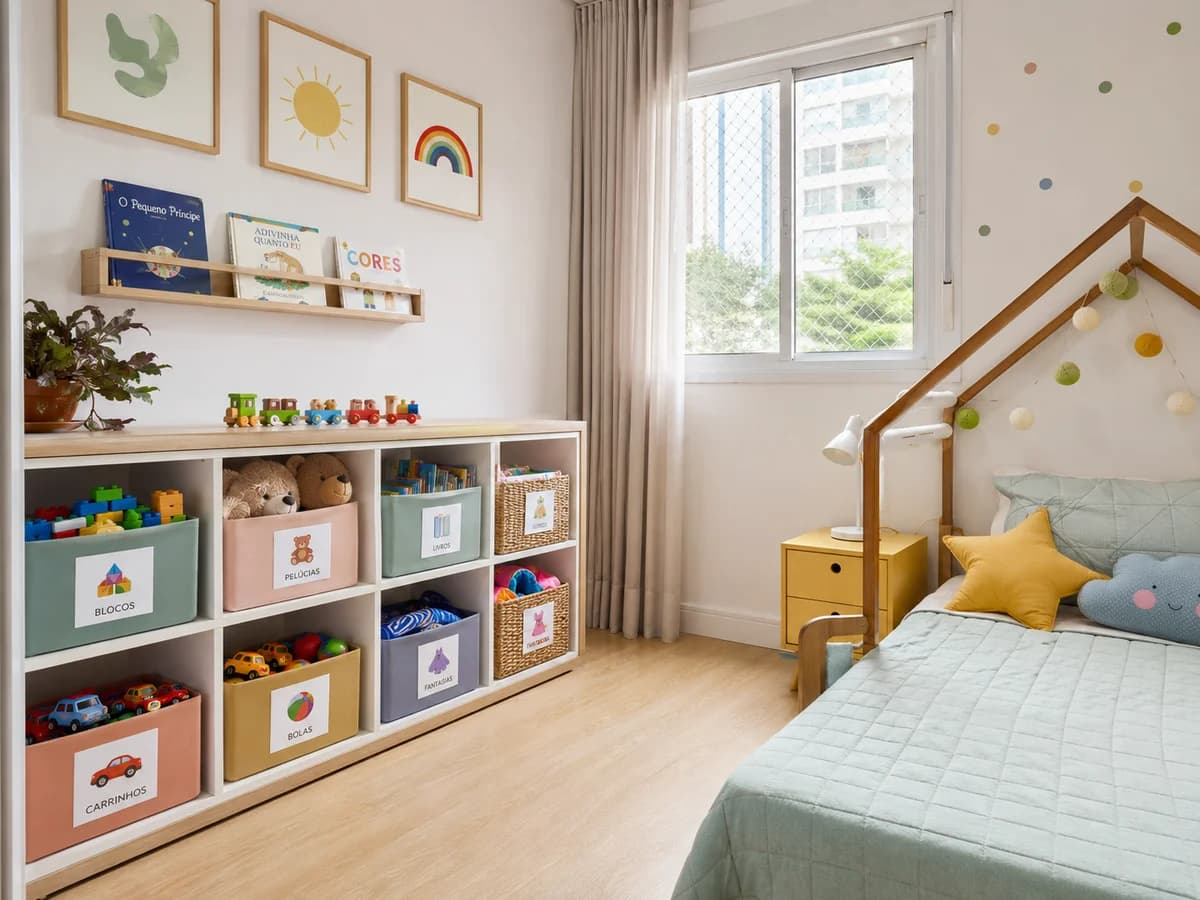
Categorizing by type of use (not by brand, not by set) is the key to an intuitive system. The child does not think "I want my Lego." They think "I want to build." When storage reflects that thinking, putting things away feels natural.
The categories that work
- Building: Lego, wooden blocks, Duplo, interlocking pieces, construction sets. All together: the brand does not matter, the type of play does.
- Games and puzzles: board games, card decks, puzzles. Stored in their original boxes or in zip bags inside a labeled bin.
- Characters and pretend play: dolls, action figures, cars, smaller stuffed animals, miniatures. Pretend play is the type of activity: the category makes sense to the child.
- Movement and physical activity: balls, jump ropes, hula hoops, skates. These toys belong near the exit: the hallway, balcony or leisure area. They do not belong mixed in with indoor toys.
- Children's books: not toys. They belong with the books, on an accessible shelf, not in a toy bin. Mixing books with toys does a disservice to both.
- Art and expression: play dough, paints, markers, paper, glue. This category deserves its own space, ideally near a table and away from the rug. It is also the category that needs the most supervision when putting away, because the pieces are smaller and scatter easily.
A category you can add if relevant: water and beach toys: floats, shovels, buckets. These are better kept in a utility area or garage, not in the bedroom.
Storage systems by age group
The same system that works for a 7-year-old fails completely for a 2-year-old. Age group determines how complex the system can be and who is responsible for maintaining it.
0-3 years: the adult maintains the system
At this age, the goal of the system is not the child's independence: it is the adult's speed. Use open bins (no lid), low ones (at the child's height or on the floor), in a small number (3 to 4 categories at most). Label with a photo of the contents, not text. The child cannot read yet, but recognizes images. The adult does the putting away at the end of the day, and the photo helps put things in the right bin fast.
Strictly limit the volume available per rotation (see the rotation section below). With fewer toys visible, putting away is quick, and the child engages more.
3-7 years: transition to independence
At this age, the child can take part in putting things away with guidance. Use bins with a photo and text (this reinforces reading), low shelves they can reach without an adult, and introduce the rule "one toy comes back before the next one comes out." Do not use stacked boxes: children do not stack them back, and the system collapses by the second box.
The put-away routine (before dinner, before bath time) starts to take shape here. Not as punishment, but as part of the day's sequence, just like brushing teeth.
7 years or older: their own system and responsibility
From age 7, the child can manage their own system with minimal supervision. More granular categories, drawer and shelf storage at varying heights become possible. Introduce the idea of a "project in progress": a Lego set being built can stay on a dedicated surface without needing to be put away halfway through.
The room belongs to the child, and responsibility for the system is progressively theirs. Your role is to create the system and teach the logic, not to maintain it for them.
- Boxes and bins at a height the child can reach, not on a shelf that requires a step stool
- Visual identification with a photo (for younger children) or photo plus text
- Number of categories suited to the age group (maximum 4 for under 3, up to 6-8 for older children)
- No lids that require strength or motor coordination to open and close
- A "project in progress" space for children over 7
- Art supplies in a separate, protected spot (away from the rug and upholstery)
Four attempts at organizing in two years. By the third one, the problem is rarely the method.
In a 72m² apartment in Perdizes, the mother had tried to organize her 5-year-old son's room four times in two years. No attempt lasted more than three weeks. When I arrived, there were three large baskets with lids, sorted by brand: Lego, Playmobil, Duplo. She told me she felt she did not have enough discipline to keep the system going. I asked her son to put a toy away. He tried to open the lid with one hand, could not, set the toy on the floor, opened it with both hands, put it away and closed it with effort. It took eighteen seconds to put away one piece. We replaced the baskets with four open bins, no lids, organized by type of play: building, pretend play, games and art. We taped a photo to the front of each bin. On the third day, the son put things away on his own while the mother was in the kitchen. Four months later, he still does it alone. At 5 years old, a child cannot open a full basket with one hand. They drop the toy on the floor. The mother's discipline was fine all along. The basket was wrong.
Toy rotation: less mess, more engagement
Toy rotation is probably the most effective tool for reducing mess and increasing the quality of play time, and the least known among parents.
The principle comes from a simple observation: the more toys available at once, the lower the engagement with each one. The child jumps from toy to toy, none hold attention for long, and the result is the whole room turned upside down in 10 minutes. When there are fewer options, the child plays more deeply: explores more, invents more, sustains attention longer.
How to implement rotation
Split the total volume of toys into 3 or 4 sets of similar size. Only one set stays available in the room at a time. The others stay stored in labeled boxes in a tall closet, pantry or utility room.
Every 2 to 4 weeks, make the swap: put away the current set, bring out the next. To the child, it feels like getting "new" toys: because they have already forgotten the ones coming back. Engagement renews, mess decreases, and you did not need to buy anything.
One important detail: favorite, daily-use toys (the sleep bear, the car that never leaves their hand) stay out of the rotation. Rotation is for the general volume, not for items with a strong emotional bond.
Playroom: when there is a dedicated space
Having a playroom (a room dedicated exclusively to toys) solves a real problem: toys stay contained in one space and the rest of the house breathes.
But the playroom has a classic trap: without planning, it turns into storage. Everything without a place elsewhere in the house ends up in the playroom. The result is a chaotic room where nobody can play with anything anymore.
Zoning the playroom
A functional playroom has at least two distinct zones:
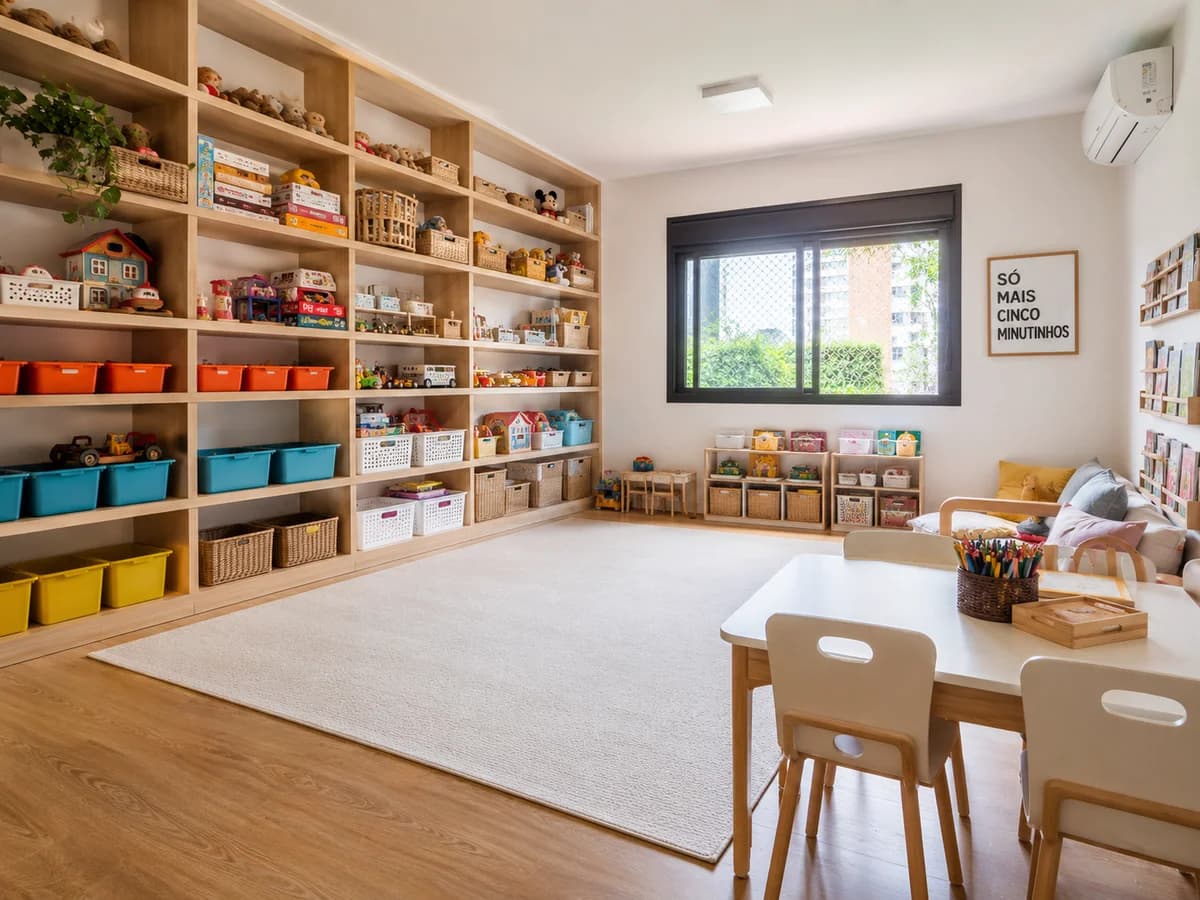
- Active play zone: open floor space for movement: large blocks, cars, floor games, pretend play with room to move. This zone needs empty space, not more toys.
- Calm play zone: a low table for puzzles, art, board games. Clean surface, materials organized within reach.
- Storage wall: shelves and labeled bins, at the child's height. This is where the organization lives, not scattered across the floor.
The playroom rule
Toys from the playroom stay in the playroom. This needs to be established and maintained from the start. When toys migrate to the living room, bedroom, kitchen, the system collapses and the playroom turns into storage.
Apply visual labels visible from the child's height on every bin and shelf. The child needs to be able to identify where each thing goes without having to ask an adult. This creates independence and reduces the friction of putting things away.
When a playroom stops working, the first purchase that comes to mind is another organizer. The problem is usually the floor that disappeared.
In a 110m² apartment in Pinheiros, the couple had set aside a 9m² room as a playroom for their two children, ages 4 and 7. Six months after setting it up, neither child wanted to play there. They told me they had invested heavily in the shelving and felt the money had gone to waste. When I walked into the room, I understood why the kids avoided it: four shelving units lined every wall, leaving less than 2m² of open floor in the center. Playing with cars or pretend play needs floor space. There was no floor. The kids had migrated to the living room. We removed two shelving units, reorganized storage onto a single wall and opened up 5m² in the center. Three weeks later, the kids spent whole afternoons in the playroom. The mother said she had never seen the two of them play together for that long in the same space. The mistake was spreading storage across every wall without leaving room to play. With fewer shelves, a real playroom emerged.
A kids bedroom organized by the children themselves starts when the system is built for them, not for an adult.
See home organization →The room beyond the toys
Toys have their own system, but a kids bedroom is not just about toys. Clothes, school supplies, books, the backpack and everyday items also need a defined place so the child can maintain organization day to day.
Age group determines who the real user of the organization system is, and therefore how the system should be designed for each zone of the room.
0 to 3 years: organization for the parents
Babies and very young children do not maintain organization. The user of the system is the adult caregiver. The focus is accessibility for the adult: diapers at hip height during changes, clothes at the adult's eye level, hygiene items within immediate reach during bath time. Use photo labels on bins (not text) to communicate the contents visually.
4 to 6 years: transition and participation
The child starts taking part in organizing, but still needs very simple systems. Practical rules for this phase:
- Low hooks (60 to 90 cm / 24 to 35 inches from the floor) for backpack and towel
- Labels with a drawing and a word (the child learns letters by associating them with the image)
- One open toy basket at a time (they take out another only after putting the first one away)
- A tidy-up ritual with music: a fixed-length "cleanup song" builds habit without negotiation
- One category per basket, no mixing: the child learns to categorize through play
7 to 10 years: independence with a system
The child can keep the room organized independently, as long as the system is clear. Text labels are enough. School organization gains relevance at this stage: the backpack, school materials and study space need their own system.
The child can and should choose aspects of the system: the color of the baskets, the label design, the layout of items on the desk. Autonomy in creating the system builds commitment to maintaining it.
11 years and up: the child's territory
The transition to adolescence requires a shift in the adult's role: from organizer to consultant. The room becomes a space of privacy. Imposing systems at this stage creates resistance. The conversation is about what works and what does not, not about what is right or wrong.
The practical focus: systems that reduce morning conflict (backpack ready the night before, uniform set aside, materials in place) matter more than an aesthetically perfect room.
Zone 1: kids closet
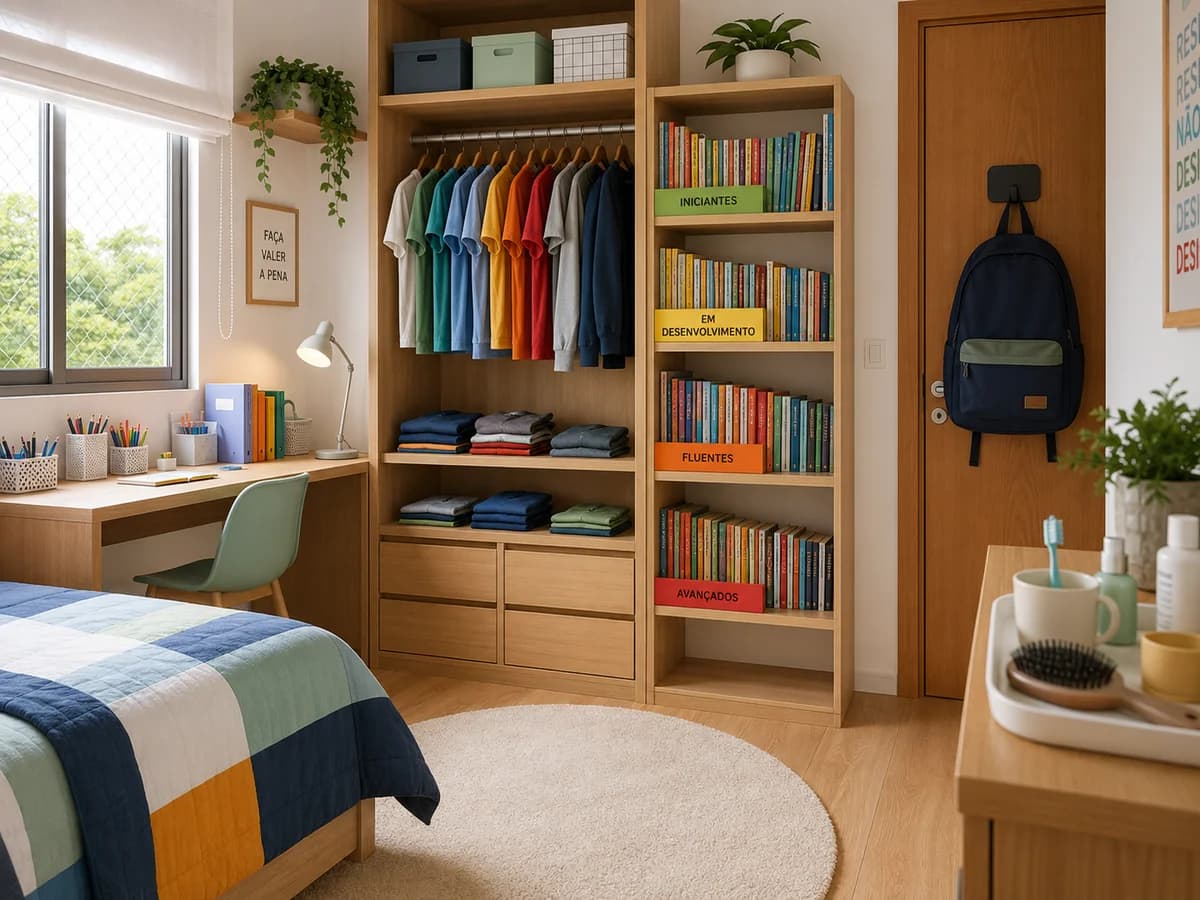
The kids closet has two users with different needs: the adult who washes and puts away the clothes, and the child who takes them out to get dressed. A well-designed system serves both.
Division by access height
- Child's height: everyday clothes: t-shirts, shorts, pants, pajamas, socks. What the child wears every day should be within their reach, without needing to ask an adult for help.
- Adult's height: special-occasion clothes, next season's clothes and the next size up in reserve.
Photo labels for ages 4 to 6
Tape a photo of the contents to the front of the drawer or shelf. A 4-year-old cannot read yet, but recognizes images. When a photo of a t-shirt is on the t-shirt drawer, the child knows where to put it away, without needing to ask an adult.
Review frequency
- 0 to 6 years: review every 3 months. Children grow fast: wrong-size clothes are wasted money and wasted space.
- 7 years and up: a review every six months is enough.
The single-size closet rule
Only current-size clothes stay in the closet. Next-size clothes go in a labeled box ("Size 8, next winter") under the bed or on top of the wardrobe. This cuts the volume of clothes in the active space in half.
Seasonality in São Paulo
São Paulo winters are mild: heavy clothes are needed for only a few weeks. Store thick coats and jackets out of active reach during the long summer. They take up disproportionate space relative to how often they are used.
Zone 2: study desk and school supplies
The study desk is the child's workspace. Like any workspace, it works better when it is set up for what needs to get done, not for storing everything that has no other place.
What stays on the desk
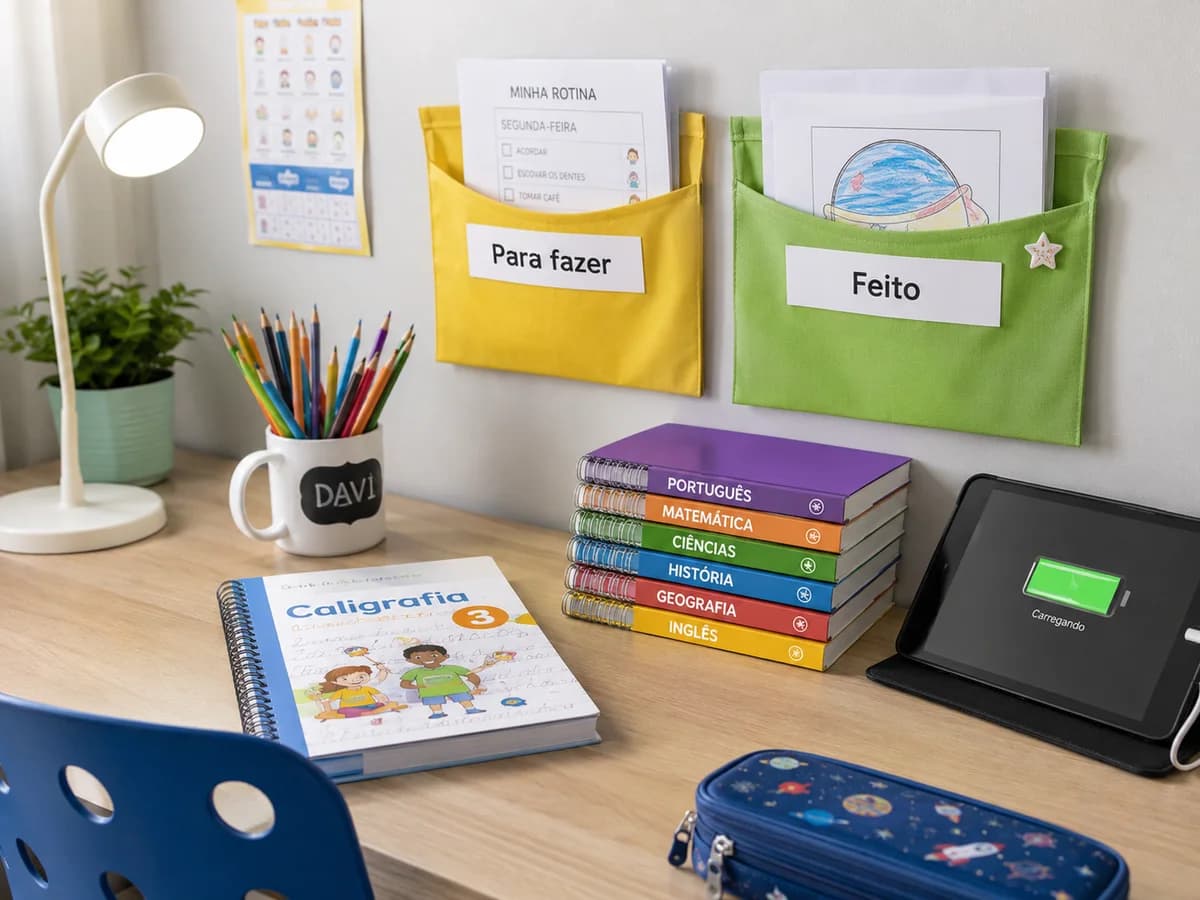
Only what is used daily for schoolwork: pens and pencils in a vertical pencil holder (not in a drawer: children lose what they cannot see), eraser, sharpener and ruler in a fixed, visible spot. Scissors in their own holder. Current-year notebooks on the shelf next to the desk, not stacked on the surface.
A system for school papers
Create two spots for papers: To do (homework, reminders, unread notices) and Done (turned-in assignments, read notices). Use a wall-mounted hanging folder or a desktop document holder. Papers with no defined destination turn into a pile, and the pile turns into an invisible dead archive.
The "clean desk before bed" ritual
Everything goes back in place before bedtime. Notebooks on the shelf, pens in the holder, papers in the right folder. A child who wakes up to a clean desk starts the day differently than one who has to clean the desk before starting their homework.
Art supplies
Paints, markers, glue and art paper stay in a drawer or basket separate from the main school supplies, not mixed in. Children waste time looking for a marker among notebooks. Separating by use (school / art) solves this.
Zone 3: books and reading
Books pile up naturally: every birthday, every Christmas, every visit from grandma brings at least one. Within a few years, a child can have dozens of books they no longer read, mixed in with the ones they love and reread.
Active shelf vs. reserve
Do not display every book at once. Abundance creates choice paralysis: when there are 40 books on the shelf, none of them feel special. Here is how the system works:
- Active shelf: 10 to 15 books in rotation, at the child's height. These are the books available to read right now.
- Reserve: the rest of the books in a basket or box, swapped monthly or whenever the child asks. Rotation creates novelty without needing new books.
Organizing by level for older children
For children age 7 and up, organizing by reading level makes more sense than by size or color: easy readers (beginning readers), chapter books, reference and research books. The child finds what they need for the moment.
The put-it-back ritual
A book that has been read goes back in place before picking up the next one. This simple habit, taught from age 4, prevents 15 books scattered across the room by the end of the day.
Annual review with the child
At the end of the year, review the books together. The child chooses which ones to keep (special, frequently reread) and which can be donated to the school library or a community project. Taking part in the decision teaches discernment and prevents silent buildup year after year.
Zone 4: backpack and daily routine
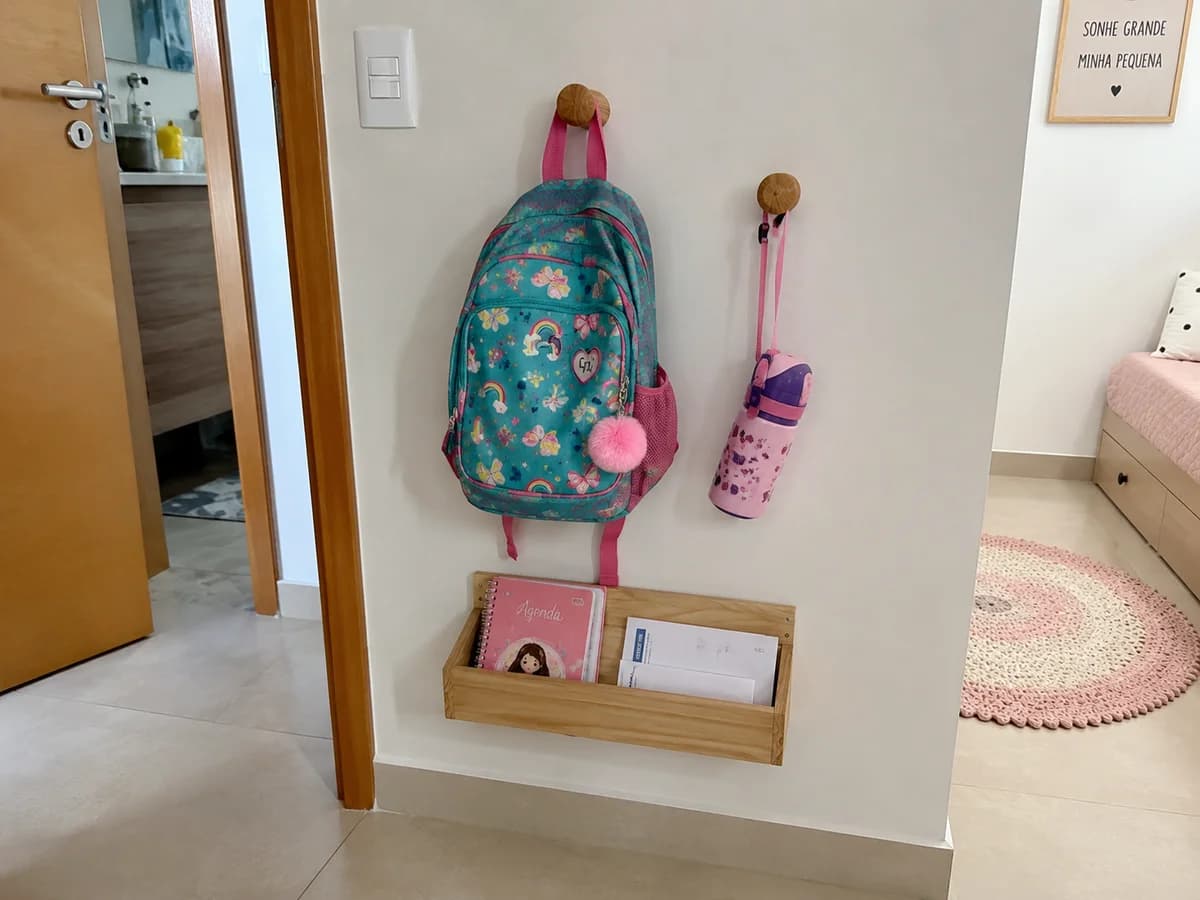
The backpack is the object that concentrates the most chaos in a kids bedroom, and the one that most impacts the morning routine. A backpack with no defined zone ends up on the floor, on the chair, on the bed, with its contents scattered around it.
A fixed zone for the backpack
The backpack has one place. Just one. A wall hook at the child's height, a specific corner of the room, or a low shelf: whatever is most accessible for the child on their own. What matters is that it is always the same spot.
The arriving-home ritual
As soon as they get home from school, the sequence is always the same:
- Lunch box to the kitchen (to be washed)
- Papers and notices to the "To do" folder at the study desk
- Dirty clothes to the hamper
- Backpack back on the hook
Five minutes upon arrival eliminate 20 minutes of searching in the morning. The arriving-home ritual is the most impactful habit a family can build for kids bedroom organization.
Preparing the night before
Lunch box: hygiene and routine
The lunch box goes to the kitchen as soon as the child gets home, and gets washed before bedtime. A lunch box left in the backpack overnight builds up bacteria and odor, and the next morning the family is dealing with the previous night's problem on top of the chaos of the day starting.
How to teach a child to keep the room organized
The biggest mistake is creating a flawless system only the adult understands. Organizing for kids needs to be taught as a routine, not enforced as a scolding. Instead of "clean up this room right now," it works better to say: "let's put things away together before bath time."
A simple ritual
Putting things away works better when it is linked to a predictable moment: before dinner, before bath time or before bed. For toys, the rule "one comes back before the next one comes out" keeps the whole room from turning into a search field within half an hour.
Autonomy by age
- 3 to 4 years: putting toys in an open basket and hanging the backpack on the hook.
- 5 to 6 years: dirty clothes in the hamper, backpack in place and helping make the bed.
- 7 to 10 years: a weekly checklist, a clean study desk and a backpack packed at night.
- 11 years and up: greater responsibility for the space, with the adult as support.
Involving the child
When the child chooses the color of the baskets, the label or where their favorite books go, the system stops feeling like something imposed on them. Take a photo of the organized room and use it as a visual reference. The question stops being "did you tidy up properly?" and becomes "does it look like the photo?"
- Dirty clothes in the hamper
- Backpack unpacked and lunch box washed
- School supplies back in place
- Books that were read back on the active shelf
- One toy put away before taking out another
- Bed made in the morning, even if imperfect
A child's resistance to tidying their room can just be a phase. When it lasts for months and the system has already been redone three times, the system is probably the problem.
In a 85m² apartment in Vila Mariana, an 8-year-old girl had a room her parents had redone three times. Each time, the chaos returned within two weeks. The mother described the situation to me with exhaustion: her daughter said she hated tidying her room and refused any help. When I looked at the system, I saw the problem: the labels were in English to look aesthetically nice, the main boxes sat on top of a wardrobe she could not reach without a step stool, and the parents had set everything up without her present. We redid everything with her. She chose the colors of the baskets, we made the labels together in Portuguese with her own drawings, and we moved everything to where she could reach standing up. Within six weeks, she kept the room organized without her parents asking even once. She had been operating a system that was never hers.
If the room has already gone through several organization attempts and always returns to the same point, it may be worth requesting a professional assessment to redesign the system with the child's routine in mind. For the picture by phase, from the nursery to school age, and how to share the upkeep between the adults, see the family and baby organization guide.
Frequently asked questions about kids bedroom organization
How do you organize toys for young children (0-3 years)?
For ages 0-3, use low open bins and few categories. The child cannot maintain complex systems, so the goal is for the adult to put things away quickly. Limit the number of toys available at a time with rotation: store part of the toys and swap them every 2-3 weeks.
How do I get my child to help put toys away?
The most effective rule is "one toy comes back before you take out another." For young children, use bins with a photo of the contents: they can identify where to put things away without knowing how to read. Make putting away part of a routine (before dinner, before bath time), not a punishment.
How many toys is too many?
If the child can't see all the toys available without digging through everything, there are too many toys. A rotation system is the best solution: it keeps the same total volume but reduces what's available at a time. Children play more creatively with fewer visible options.
What should you do with toys your child no longer uses?
Involve the child in the process of finding "toys that are waiting for a new owner." Framing matters: it is not "throwing away," it is "giving to a child who will play with it a lot." For children over 4-5 years old, this works well. For younger children, handle the discarding without involving them directly.
At what age can a child keep their room organized on their own?
With the right system, children aged 4 to 5 can already handle simple tasks: putting toys in a basket, hanging the backpack on a hook, putting dirty clothes in the hamper. From age 7 to 8, with a clear system of zones and labels, a child can keep the whole room organized independently. What determines success is not the child's willingness: it is how simple the system is.
How do you organize a small kids bedroom?
In small kids bedrooms, use multifunctional furniture (a bed with drawers, a folding desk), wall hooks instead of chairs, a single open toy basket at a time with a rotation system, and wall shelves for books and items. Vertical space is your greatest ally. Also reduce the total number of active items: toy rotation means having fewer toys available at once, not fewer toys overall.
How do you get a child to want to keep their room organized?
Never use organizing as punishment. Build it as a ritual: 'let's tidy up together before bath time' creates a habit without resistance. Take a photo of the room when it's organized and use it as a visual reference. Let the child choose the color of the baskets, the label design and the layout of items on the desk: autonomy creates a sense of ownership, and whoever feels the system is theirs takes care of it.
What should you do with school supplies that piled up by the end of the year?
At the end of the school year, do a review with the child: choose together which projects have special sentimental value (limit it to one small box per school year), donate materials in good condition to a school or community library, and recycle the rest. Having the child take part in the decision teaches discernment and prevents silent buildup year after year.

About the author
Silvana Santanna →Personal Organizer in São Paulo, specialized in residential move organization and functional organizing projects for homes, closets, kitchens, trousseaux and home offices. Creator of the Casa Pronta™ Method, with more than 100 projects completed across São Paulo and the greater metro area.
Related posts
How to Let Go of Belongings Without Guilt: 5 Practical Questions to Decide
12 min · Read article →
Organizing Your Home After Moving: 7 Days in São Paulo
11 min · Read article →
How to Organize a Closet for Good: 4 Zones That Stay Tidy for Weeks
12 min · Read article →
Ready to have your home organized
without lifting a finger?
Project assessment visit.