Organizing Your Home After a Move in São Paulo: The First 7 Days
A day-by-day roadmap for the first 7 days after a move in São Paulo: the service elevator window, the order of the rooms and the leftover box.
Neste guia você verá:
- 01In São Paulo, the 7 days start at the front desk
- 02Before the first box: walkthrough and elevator briefing
- 03Unpacking when everything came in at once
- 04Day 1: survival, with the elevator already released
- 05Days 2 and 3: kitchen and bathroom carry the week
- 06Days 4 and 5: bedrooms and the developer closet
- 07Days 6 and 7: living room, home office and leftover box
- 08When to hire a personal organizer in São Paulo
The truck is gone, the boxes are stacked floor to ceiling, and the question is where to begin. Begin with Day 1 survival, bed, bathroom and a minimal kitchen, and follow the order above through to the leftover box on Day 7. What changes in São Paulo is the starting point: when the move is into an apartment building, the roadmap does not begin at the first box, it begins when you book the unloading window.
That constraint explains much of the chaos that follows. The window is short and usually falls on a weekday, the crew works against the clock, and everything comes in at once. If nobody said where each box should go, it lands wherever it fits, usually the hallway and the living room. And the decisions you make, or put off, over the next 7 days will shape how this home functions for months.
This post picks up where others leave off. To plan before the move happens, see the 47-item moving checklist. To decide whether hiring professional help is worth it, read professional moving organization in São Paulo.
After following dozens of moves in São Paulo, I learned that the difference between a home that comes together quickly and one that takes months is not its size, or the volume of belongings. It is having a clear roadmap for the first days, and how seriously that roadmap takes the building's logistics. This is that roadmap.
In São Paulo, the 7 days start at the front desk
In an apartment building, a move is not your event: it is the condominium's event. The bylaws and internal regulations define the day allowed, the start and end times, the mandatory protection of the service elevator and what the front desk requires from the crew. Most São Paulo buildings ask for scheduling in advance and do not allow a move on just any day.
That has three practical consequences, and none of them show up in generic roadmaps. First: the unloading happens all at once, inside the window, so there is no option to bring the rest tomorrow. Second: once the window closes, hauling a piece of furniture or a large box up again becomes a scheduling problem, not an effort problem. Third: whatever comes in with no destination stays where the crew left it, and that is how the living room becomes a storage area on Day 1.
Add the habit window to that. In a home you have lived in for years, organizing means fighting old habits. In a new home you are building habits from scratch: the drawer that will become "the junk drawer" has not been named yet, the corner of the living room where things pile up does not exist yet. That window closes fast. The bag you threw in the hallway on Day 1 because there was nowhere to hang it will still be there on Day 30, because you have already gotten used to it sitting there.
The chaos of the first days of a move tends to become the permanent chaos.
In a 95-square-meter apartment in Higienópolis, a couple called me after already living in the property for 3 months. They told me they still had not "finished organizing." When I arrived, I understood why: they had put furniture wherever the moving company left it, opened boxes wherever they happened to be, and every decision improvised on the first day was still in place months later. The wife told me she felt like a guest in her own apartment, as if she were staying in someone else's home. When this couple moved to a larger property two years later, we worked together before the furniture arrived. We did a planning walkthrough of the new floor plan, decided where every item would go, and briefed the moving company to place each box directly in the correct room. The home was functional by the first weekend. Three months later, no temporary item had turned permanent. That window to build habits from scratch closes fast. The first 7 days become the system. The other 365 just repeat it.
Before the first box: walkthrough and elevator briefing
The step almost nobody takes, and the one that saves the most time later, is a planning walkthrough of the new home before the furniture arrives. If you already missed that window, you can still do it before opening the first box. It pays off even more when the property was just delivered: see how to organize a brand-new home from scratch.
The idea is simple: walk through the home with a notebook or your phone and decide, before anything arrives, where each type of item will go. That sounds obvious, but most people make these decisions in the heat of the moment, holding an item with no view of the whole.
Without that planning, the classic scenario unfolds: the crew drops everything in the hallway because nobody gave clear instructions, and since the window is short, they will not ask twice. Then you open boxes in the wrong place, carry unnecessary weight around the apartment and lose hours relocating things that could have gone straight to their final spot.
- Confirm with building management the day and hours allowed for the move, the elevator protection and what the front desk requires from the crew
- Confirm whether there is a moving fee or deposit, and who inspects the common areas before and after
- Agree with the moving company on where the truck will park: loading zones and truck circulation limits set the arrival time across much of the city
- Decide where the main kitchen storage goes (pots, pantry items, appliances)
- Define where bed linens and towels go (linen closet, bedroom, hallway?)
- Establish which side of the bed belongs to whom, and where each person’s belongings go
- Plan where the children’s items go (their own room, playroom, shared closet?)
- Identify the home office space, even if it is just a corner of the living room
- Map out where recycling, cleaning supplies and frequently used items will live
- Decide in advance what goes to the basement storage unit, and what must not go there
- Brief the crew: each box goes straight to the right room, not the hallway
This 30-to-40-minute planning session saves days of rework. And when a personal organizer is coordinating the move, the briefing happens before the truck leaves the previous property, with someone receiving box after box at the destination.
Unpacking when everything came in at once
If the unloading was concentrated and the boxes ended up stacked in the living room, the first task is not to open anything. It is to redistribute: carry each box to its destination room before opening the first one. It feels like lost time and it is the opposite: opening a box in the wrong place forces you to carry the contents later, item by item.
After that, the basic rule is to open boxes by room, not by curiosity. Before opening the next one, empty and put away the previous one completely. Most people open three at once and end the day with everything mixed together and nothing in its place.
The unpacking sequence, by priority
- 1st. Survival items: bed linens, towels, basic bathroom items, coffee maker or kettle. These are the boxes to identify and set aside before the move even happens, and ideally they travel in the car, not the truck.
- 2nd. Functional kitchen: pots, cutlery, enough plates for the family, basic pantry staples. Do not unpack every kitchen item at once, prioritize what you use daily.
- 3rd. Clothes and closet: empty the suitcases and clothing boxes before moving on to other rooms. Living out of a suitcase for days erodes the feeling of "I have arrived home."
- 4th. Living room and secondary spaces: leave this for last. The living room feels urgent because it is the most visible, but it does not affect your daily routine as much as the kitchen or the bedroom.
- Boxes redistributed by room before opening any of them
- One box at a time, fully emptied before opening the next
- Survival items set aside and accessible from Day 1
- Kitchen unpacked before the living room and decorative spaces
- Leftover box opened and resolved by Day 7, with nothing left for later
Opening every box on the first day seems efficient. Three days later, nothing is in its place.
In a 110-square-meter apartment in Moema, a couple with a 6-year-old daughter opened every box on the first day to "get ahead." Three days later, they called me in a panic: the home had items scattered across every room, their daughter cried every night because she could not find her toys, and nobody knew where anyone's pajamas had ended up. The mother told me she felt like the family was falling apart. We reorganized: the daughter's room first, then the couple's bed and a functional kitchen. Within two days, she stopped crying at bedtime. The logic of the apartment came back. A child in a new home without a set-up room becomes disoriented, and her anxiety spreads to the whole family. Prioritizing her room on Day 1 stabilizes everything else.
Day 1: survival, with the elevator already released
The goal of Day 1 is not to organize the home. It is to make sure you sleep well in it and wake up without wanting to cry. And there is a building detail that changes the plan: once the moving window closes, the service elevator belongs to the other residents again. Whatever is missing that day gets solved on foot, on the street, not with another trip from the truck.
Three things need to work before you go to sleep. Only three:
1. The beds
Find the bed linen boxes before anything else. Set up the beds, add pillows and comforters. With children, start with their room: a disoriented child in a new home needs a safe territory, and the set-up bedroom is that territory.
2. A basic bathroom
Find the bathroom box. Set out soap, shampoo, bath towel, toilet paper and toothpaste. Nothing else. The mirror can wait, the drawers can wait until tomorrow. What needs to work is tonight's shower and tomorrow morning's routine.
3. A minimal kitchen
You do not need to organize the kitchen today. You need to be able to make tomorrow's coffee and tonight's dinner, or to be clear that you are ordering food, which on Day 1 is a perfectly smart decision. Find the coffee maker or kettle, one pot, enough plates, cutlery and cups. The rest is for the coming days.
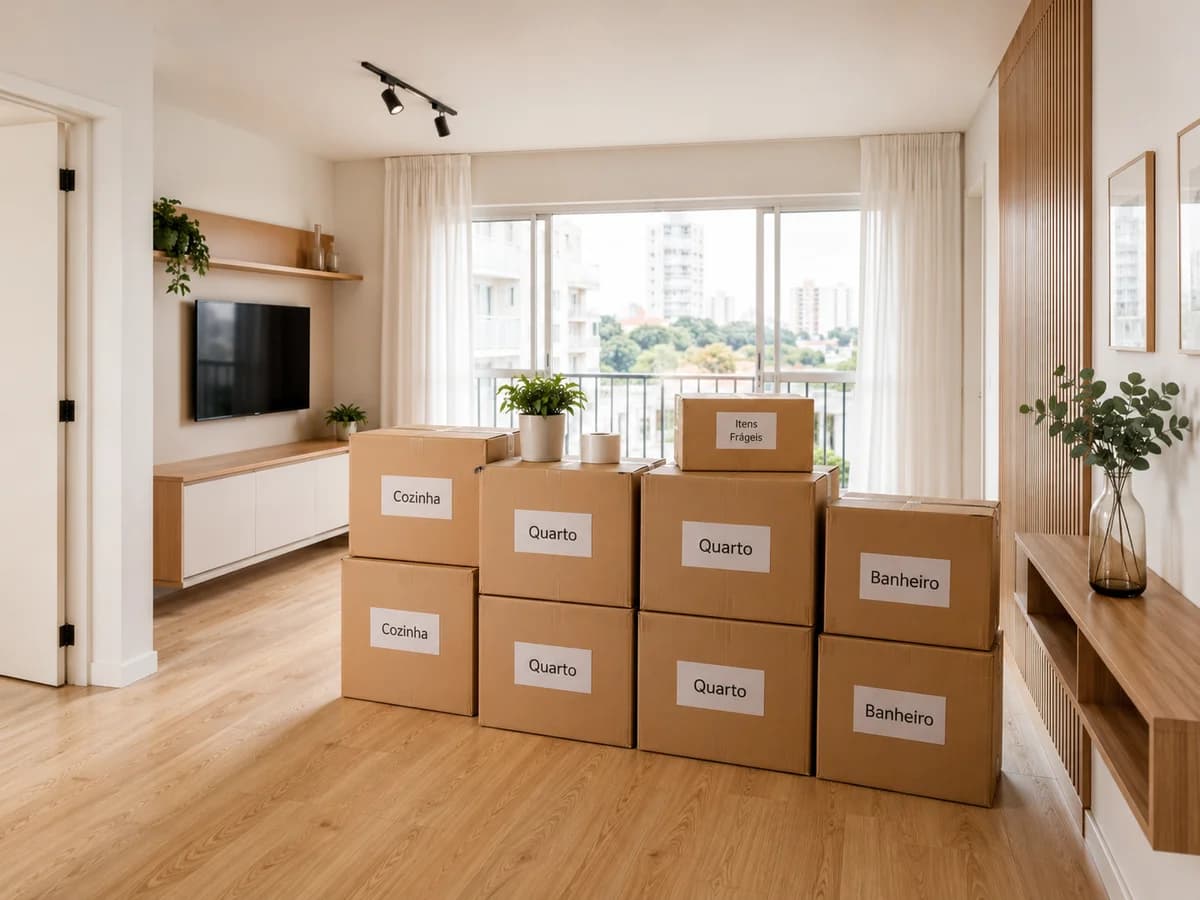
Everything that is not the bed, the basic bathroom or the minimal kitchen stays closed on Day 1. Do not open random boxes. Do not try to get ahead on the living room while the bedroom has no bed. Full focus on the three priorities, and tomorrow you start fresh with energy.
Days 2 and 3: kitchen and bathroom carry the week
As long as the kitchen is not organized, the whole home feels like a construction site. You cannot cook a meal, delivery packaging piles up and the family routine falls apart. In São Paulo, where delivery solves the problem a little too easily, this is where a move stalls without anyone noticing: two weeks of eating out and the kitchen is still in boxes.
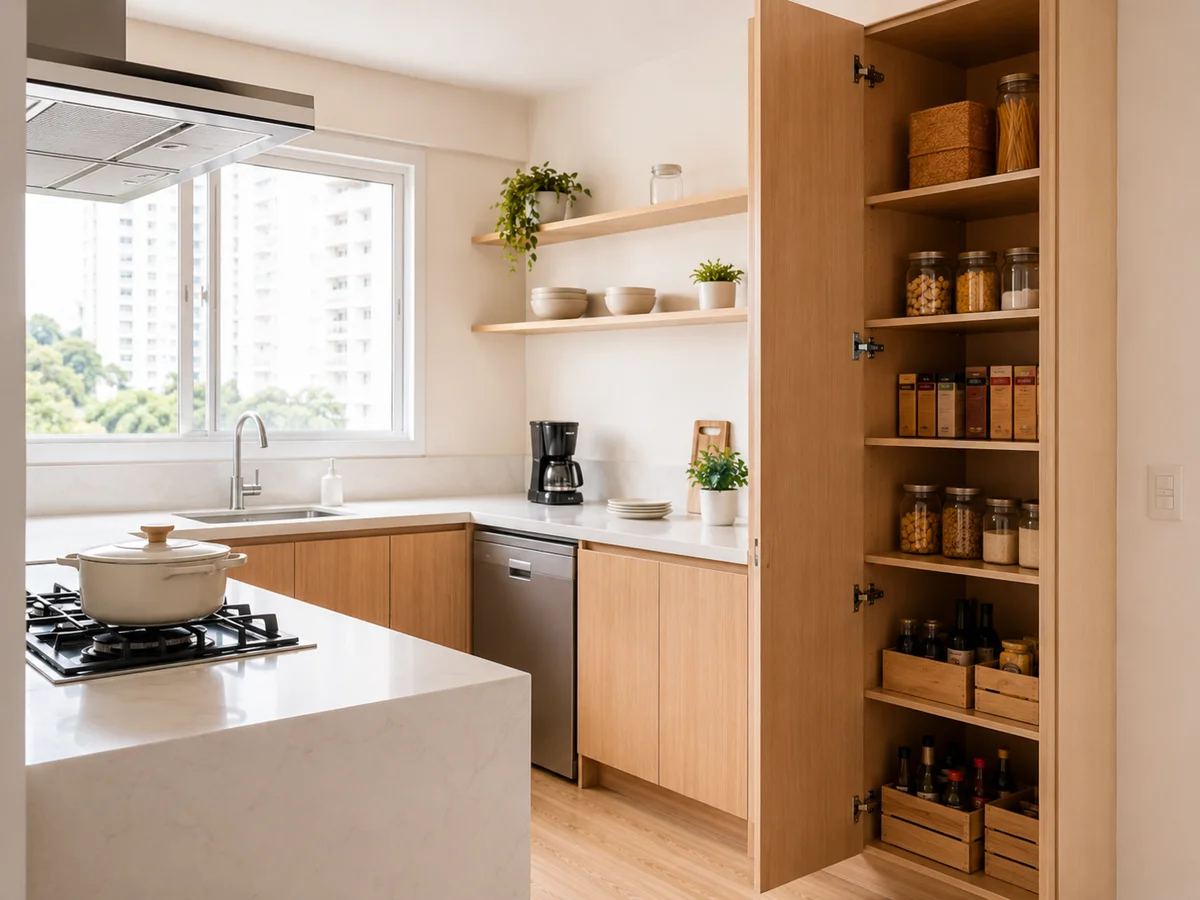
Organize by zones, not by box. Whatever box you open, distribute its items straight into the right zone, with nothing left for later.
Kitchen zones
- Prep zone: knives, cutting board, pots and pans near the stove and sink. The territory of whoever cooks.
- Breakfast zone: coffee maker, kettle, mugs, cereal and bread together, somewhere easy to reach, with no need to open several cabinets before 8am.
- Pantry and staples: grouped by category (grains, canned goods, spices, snacks). In an apartment with no pantry, pick one entire cabinet and accept that it is the pantry.
- Appliances: the daily ones stay on the counter, the weekly or monthly ones go in an accessible cabinet, never taking up counter space.
The built-in laundry area
In a recent São Paulo floor plan, the laundry area is a stretch of the kitchen. The washing machine, cleaning products, broom and pantry compete for the same cabinet, and that competition is settled now, not later: decide what goes up high (rare use), what stays within arm's reach (daily use) and what cannot share a shelf with food.
For the detail of how to lay out each zone, see the guide to functional kitchen organization in São Paulo.
A complete bathroom
On Days 2 and 3, the bathroom moves past survival mode and starts working for real. Separate personal care items by person when the bathroom is shared, place cleaning products somewhere accessible and apart from personal items, and install the towel bar, paper holder and basic fixtures, which is the kind of task that needs a drill and therefore gets postponed for months.
Days 4 and 5: bedrooms and the developer closet
Living out of a suitcase is psychologically exhausting. Pulling clothes from a suitcase every morning, digging for a pair of socks among open bags, not knowing where you hung your coat: it creates a constant feeling that you have not really arrived.
Days 4 and 5 are for getting clothes out of suitcases and boxes for good. And here comes the most common surprise of São Paulo moves: the closet in the new home is smaller than the wardrobe in the old one. Developer-built closets tend to come in standard sizes with little depth, and anyone arriving from custom cabinetry loses space without noticing until everything has to go in.
Closet and wardrobe
Before putting away a single piece, decide the logic: by type (pants with pants, shirts with shirts), by color, or by frequency of use. Pick one and apply it from the start, because changing later is far more work. The complete guide is in how to organize your closet in São Paulo.
If the volume does not fit, the decluttering happens now, with the clothes in your hands, not later once everything is stacked on a shelf. Cramming things in to decide later is the same as postponing forever.
Children's bedrooms as a priority
With children, their bedroom deserves special attention at this stage. Kids adapt better when they have their own set-up, familiar space as soon as possible. Set up the bed, organize toys and personal items so the child can find what is theirs on their own.
- Everyday clothes hung or folded in the wardrobe, out of the suitcase
- Extra bed linens in the linen closet
- Shoes in the shoe rack or a defined spot (not the hallway)
- Accessories and bedside items in place
- Child’s bedroom with toys and personal items within reach
- Each person with a clearly defined space in the shared closet
- Decluttering decided with the clothes in hand, before cramming anything in
Three wardrobes becoming one. Without splitting it up in advance, both partners spend weeks hunting for clothes.
In a 120-square-meter apartment in Brooklin, a couple came from a larger home and arrived at the new property with the volume of three wardrobes for a smaller closet. They spent the first week living out of an open suitcase. The client told me she woke up in a bad mood every day because she spent 15 minutes hunting for something to wear to work, not knowing where anything was, unable to separate what was hers from her husband's. When we organized the closet, we started with the split: each person with their own side, categories kept separate. Then we let go of what did not fit, about 30% of the total volume. Within three days, she messaged me saying it had been her first stress-free morning since the move. A shared closet without a per-person split creates friction every morning. Doing that split in the first week prevents the friction before it becomes a habit.
Days 6 and 7: living room, home office and the leftover box
We reach the most dangerous days of the move: the ones where the leftover boxes tend to pile up in a corner of the living room for now. That "for now" has a track record of lasting months.
The living room is the last room to be organized because it is the first one visitors see. The temptation is to set it up so the place looks ready while everything else is still in boxes. Resist, and do the opposite: functional spaces before aesthetic ones.
Living room
Place the furniture in its final position, or as close to it as possible. Moving the sofa and the shelving unit after everything is put away is unnecessary work, and in an apartment it means dragging furniture across flooring that is still under warranty. Set up lighting, position the TV and organize the frequently used items: remotes, chargers, books you reach for often.
Home office
If you work from home, even from a corner of the dining table, set up the workspace on Days 6 and 7. A laptop balanced on boxes feels temporary and usually lasts weeks, and by the following Monday the move is no longer an excuse. The step by step is in how to organize a home office.
The leftover box and the basement storage unit
Almost every move ends with a leftover box: the last one, holding the items with no obvious place, the charger for an old device, the decor piece you are not sure will stay, the spare extension cord. Open it and make final decisions: every item gets a place, goes to donation, or goes in the trash. Close the empty box.
In a building, that box has a ready-made hiding place: the basement storage unit. That is where it sits for years, next to the suitcase nobody uses and the furniture that did not fit. The rule that prevents it is simple: nothing goes into storage without a content label and a date, and nothing goes in merely because it has not been decided.
When to hire a personal organizer in São Paulo
Not every move needs professional support, but some clearly benefit from it. Assess your case:
- The moving window fell on a weekday and both adults in the household work. Someone has to be in the home receiving box after box, and that someone will not be you at 10am on a Tuesday.
- You have moved before and know the organizing dragged on for months. If the previous experience was chaotic, the pattern repeats without a change in approach.
- You have young children and managing the move and the kids at the same time is humanly difficult. A personal organizer takes over the organizing while you take care of them.
- The volume is large: 3 bedrooms or more, or years of accumulated belongings. Complexity multiplies the time required.
- You want to use the move to build better systems, rather than replicate what you had before.
With an experienced personal organizer and team, a 2 to 3 bedroom apartment is fully organized in 3 to 5 days on average, depending on size and scope. Beds made, kitchen running, closets set up, bathrooms organized: everything ready by the time you arrive at the new home.
A home organized on your own takes weeks. With a professional team, the project is finished in 3 to 5 days on average, depending on scope. A new home running on the timeline set at the assessment.
See the post-move personal organizer service →Frequently asked questions about post-move organization
Where do I start organizing after a move?
Start with survival: the bed made, a basic bathroom and a minimal kitchen. Those three points secure the first night and the first morning. Only then come the complete kitchen and bathroom on Days 2 and 3, bedrooms and closet on Days 4 and 5, and the living room, home office and leftover box on Days 6 and 7. Order matters more than speed: starting with the living room, the most visible room, multiplies the chaos in the rooms that carry your routine.
How does a São Paulo building moving window work?
Every building sets its own rule in its bylaws and internal regulations, and most São Paulo condominiums require scheduling in advance, restrict moves to weekdays and concentrate the unloading into a single time window, with mandatory protection of the service elevator. Confirm with building management before locking the date with the moving company: the day allowed, the start and end times, the documents required from the crew, and whether there is a fee or deposit. Since the unloading happens all at once, what decides the next 7 days is where each box is set down inside the home.
How long does it take to organize a home after moving?
It depends on the size of the property and the volume of belongings. A home organized on your own takes 1 to 2 weeks, usually stretched out because the work only advances at night and on weekends. With a personal organizer and team, the same project is finished in 3 to 5 days on average, depending on size and scope, because the process is planned and carried out without interruption. The exact timeline is estimated during the project assessment.
Do I need to be home during post-move organization?
Not necessarily. With a professional personal organizer, you do an initial briefing about your preferences and let the team work, which resolves the most common conflict in São Paulo: the moving window falls on a weekday and both adults in the household work. Many clients arrive at the new home to find everything already in place: beds made, kitchen running, bathroom organized.
How do I unpack moving boxes in an organized way?
Unpack one box at a time, by room, following the priority order: survival items first (bed, bathroom, minimal kitchen), then the complete kitchen, then closet and clothes, and the living room and decorative spaces last. If the unloading was concentrated and the boxes ended up stacked in the living room, the first task is not to open anything: it is to redistribute the boxes by room.
What should I do with the leftover box and the building storage unit?
The leftover box is the last one, holding items with no obvious place: the charger for an old device, the undecided decor piece, the spare extension cord. Open it by Day 7 and give every item a destination: a defined spot, donation or disposal. In a building there is a ready-made hiding place for it, the basement storage unit, and that is where the box tends to sit for years. The rule is simple: nothing goes into storage without a content label and a date.
Every box opened without a plan is one more decision in an already stressful moment. Arriving with everything already in place changes the entire experience of the move.
See the post-move personal organizer service →An organized move on the estimated timeline, without weeks of open boxes
Silvana and her team receive the unloading, handle the unpacking and deliver everything in place: bed made, kitchen running, home ready to live in.
Request an Assessment →
About the author
Silvana Santanna →Personal Organizer in São Paulo, specialized in residential move organization and functional organizing projects for homes, closets, kitchens, trousseaux and home offices. Creator of the Casa Pronta™ Method, with more than 100 projects completed across São Paulo and the greater metro area.
Related posts

Moving Checklist São Paulo: 47 Steps to Not Forget Anything
10 min · Read article →
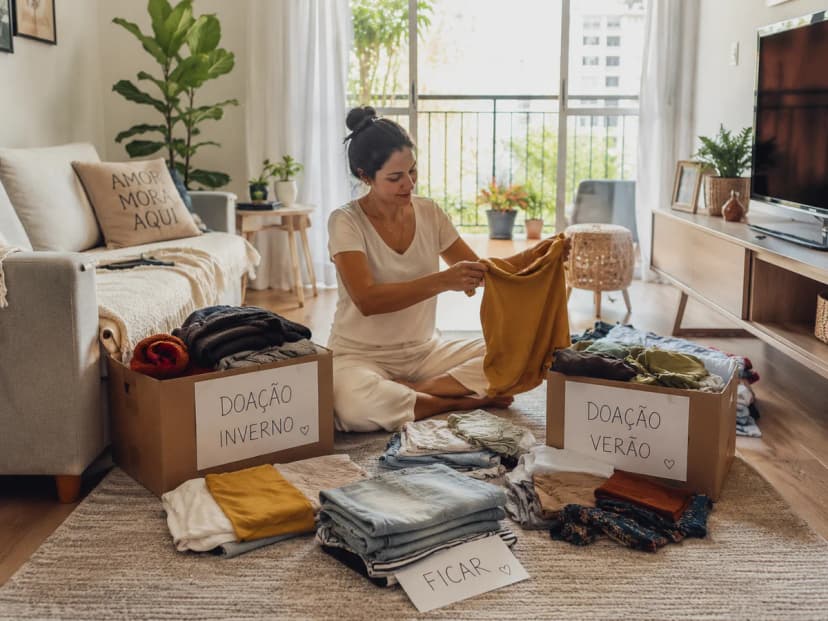
How to Let Go of Belongings Without Guilt: 5 Practical Questions to Decide
12 min · Read article →
How to Organize Your Home for Guests Without the Last-Minute Rush
11 min · Read article →
Ready to have your home organized
without lifting a finger?
Project assessment visit.