How to Organize Your Home for Guests Without the Last-Minute Rush
How to get your home ready for guests without panicking: a permanent room-by-room system, the 20-minute protocol, and a checklist for special occasions. Personal organizer SP.
Neste guia você verá:
Why you panic when someone says they are coming over
The message arrives: "can I stop by in a bit?" And suddenly you are running around the house throwing things into the closet and washing dishes in a hurry. This happens to almost everyone, and the reason is not that you are disorganized.
The problem is that the home does not have a permanent system. Every visit requires starting from scratch, because rooms go back to "everyday use" state right after the last cleaning. And everyday use, without a system, means a gradual buildup of things out of place that you stop noticing over time.
Guests do not notice the same things you do. You are used to the stack of mail on the kitchen counter, the backpack on the living room chair, the charger cord coiled up on the coffee table. Guests notice. Not because they are judging you, but because they are seeing it for the first time.
I have clients who tell me they turn down invitations to have people over because the home is "a mess." And when I see the home, it is not a mess: it is in use. The difference between a home in use and a home ready to welcome guests is smaller than it seems. It depends on a few adjustments in the right spots.
Three situations I have worked with
The situations that come up most in my sessions do not involve messy homes. They involve homes in normal use, without a system for the moment someone shows up.
The "can I stop by?" message that became a system
I worked with a couple in Vila Madalena, a 68m² apartment, no kids. She called me after an episode that left her embarrassed: her mother texted at 6pm saying she was stopping by to drop off a gift and would only stay half an hour. What followed was 25 minutes of rushing through the two main rooms: a week's worth of mail piled on the kitchen counter, two coats thrown over the living room chair, a bathroom with their daily products spread across the sink. By the time her mother arrived, she was still holding a dish towel.
The home was not messy. It had no fixed places. A small basket with a guest bathroom kit, a hook by the entrance for coats, and a 10-minute reset before bed. Four weeks later her mother came back unannounced. She did not even get up from the sofa to rush around. What this case taught me: pre-visit panic almost always has a solution in three adjustments, not a deep clean.
The lawyer who stopped having guests over for eight months
Sometimes the problem is not the apartment. It is the embarrassment of showing a space that seems not to work.
I worked with a lawyer in Itaim Bibi, 39m², living alone for three years. She had stopped inviting friends over because the home "was never ready," and that feeling was starting to really affect her social life. When I came to see it, the problem was specific: a home office integrated into the living room with no visual boundary, work papers scattered across the dining table, and a bathroom with every daily item on display.
We reorganized the home office with a visual boundary within the living room, created a separate guest bathroom kit apart from her own items, and set the dining table as a zero zone: no work papers allowed to land there. Six weeks later she hosted a dinner for four people. It was the first time in almost a year. What this case showed: when someone stops having guests over, it is almost always a room without a system for receiving people, not a lack of desire.
The Sunday lunch that started on Friday
A question I ask in every family session: how far ahead do you start getting the home ready for guests? The answer reveals whether a system exists or not.
A family in Tatuapé, a couple with two kids, 8 and 11 years old. Sunday lunch with the grandparents every week, but the prep started on Friday night: a full house cleaning, sorting through toys, washing guest towels that sat unused in storage. They arrived on Sunday already exhausted before the guests even showed up. Sunday had turned into a source of stress instead of rest.
The hallway bathroom became guest-only, with a fixed kit and the door kept closed during the week. We added a large bin in the living room to contain the toys before lunches. Saturday cleaning dropped from three hours to one. "We stopped arriving exhausted on Sunday before the guests even got there." The takeaway: when prep starts more than 24 hours ahead, the problem is not the visit. It is the absence of a fixed system.
The permanent system: the rooms that stay ready all the time
The permanent system defines a baseline state for each room that you can get back to in 5 to 10 minutes, even after a chaotic day. The baseline is functional.
Living and dining room
The living room baseline includes: cushions in place, surfaces without loose objects piling up, and a clean floor. It does not need to be spotless. It needs to be functional and free of visual clutter.
The things that break the living room baseline are always the same: remote controls out of place, cups and glasses left over from the afternoon, magazines open on the table, a bag dropped on a chair. For each of these items, the system requires a fixed landing spot. Not a drawer tucked behind a cabinet, an easily accessible spot where the item naturally ends up.
Nightly reset: 10 minutes before bed
The routine that changes a family's relationship with the home the most is the nightly reset of the living room and kitchen. Ten minutes before bed, each adult in the home walks through the living room and kitchen putting every item back in place. Dishes go in the dishwasher or drying rack, remote controls back in place, surfaces cleared. The next morning, the home is at baseline.
With the reset in place, any visit only requires the 15 to 20 minute adjustment I describe further down. Without the reset, days of items out of place pile up and getting ready for guests turns into heavy work.
Bathroom, kitchen and entryway: the three points every guest notices
If you only have time to prepare three rooms, prepare these three, in this order.
1. Guest bathroom
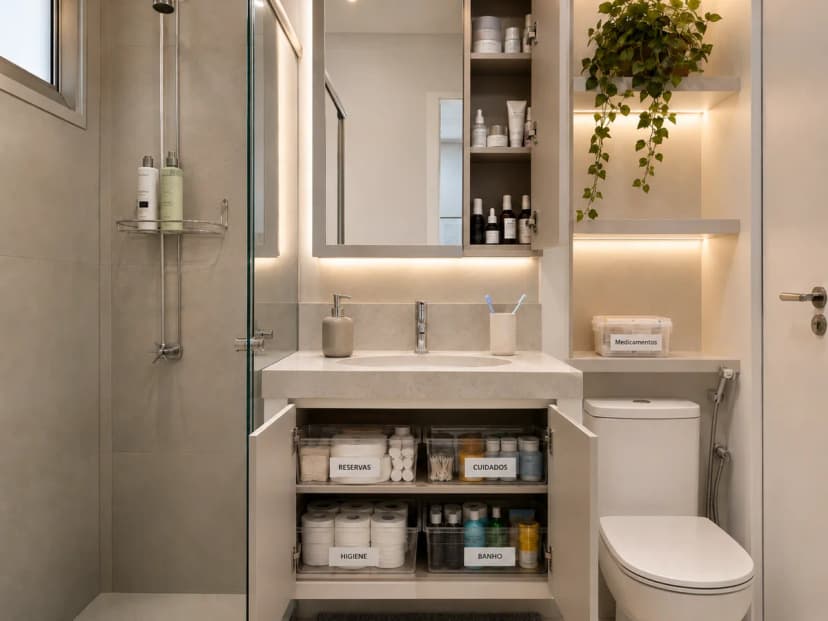
The bathroom is the only room where a guest is alone. It is also the room where people notice details most, because they are standing still, without the distraction of conversation. A bathroom with a clean sink, a clean folded hand towel, available toilet paper and a floor free of misplaced items makes a much better impression than a spotless living room with a neglected bathroom.
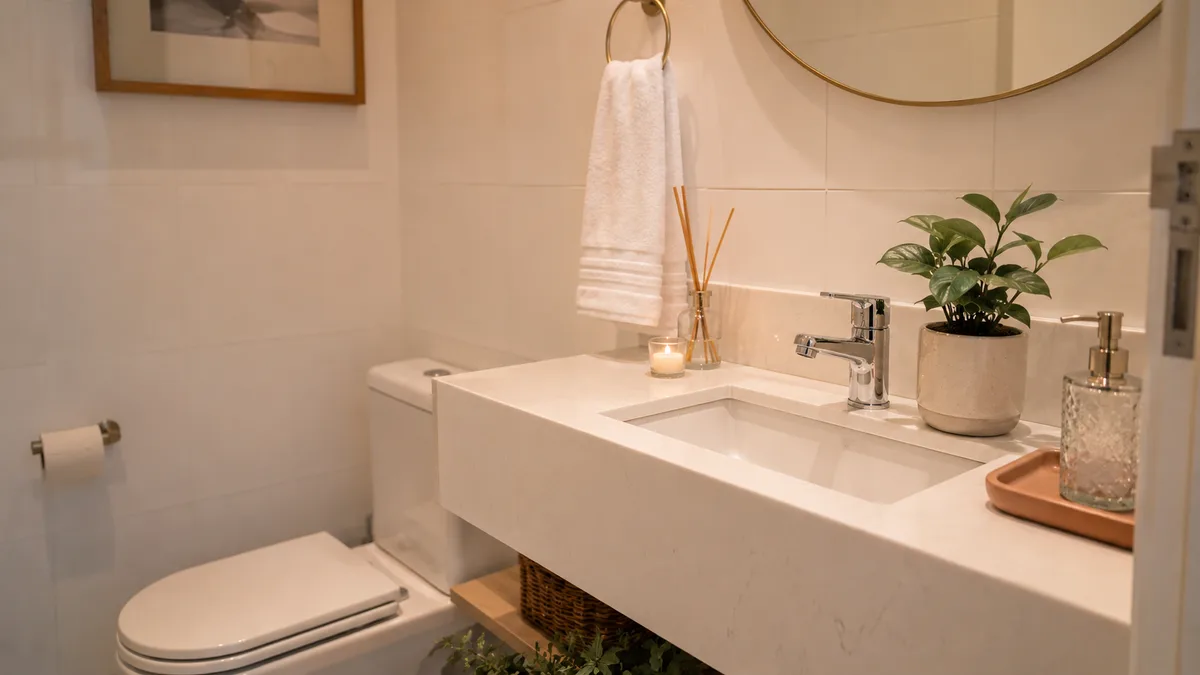
Keep a specific guest soap in the bathroom (not the family's everyday soap, showing signs of use), hand towels reserved for this purpose, and an air freshener. These three items take 2 minutes to set up if they are kept separate in an accessible spot.
2. Entryway and hallway
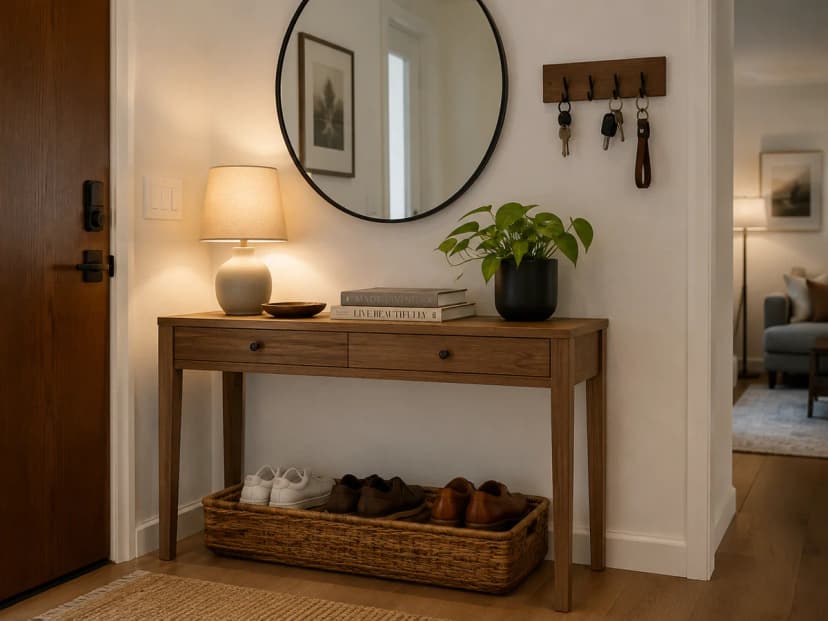
The entryway is the first impression. A hallway with shoes scattered around, a backpack on the floor and a coat on the doorknob communicates a lack of system before a guest even steps into the living room. Five minutes of tidying the entryway completely changes the initial perception.
Ideally, have a fixed organizing point at the entryway: a hook for coats, a shoe rack or designated shoe area, a small surface for keys and a wallet. When these items have a fixed place, the entryway stays tidy naturally, without needing special attention before each visit.
3. Visible kitchen
In apartments with a kitchen integrated into the living room, the kitchen is part of the social space. A clean counter and a sink free of accumulated dishes are the minimum. You do not need to put everything away in the cabinets. You need the visible surfaces to be clean and free of clutter.
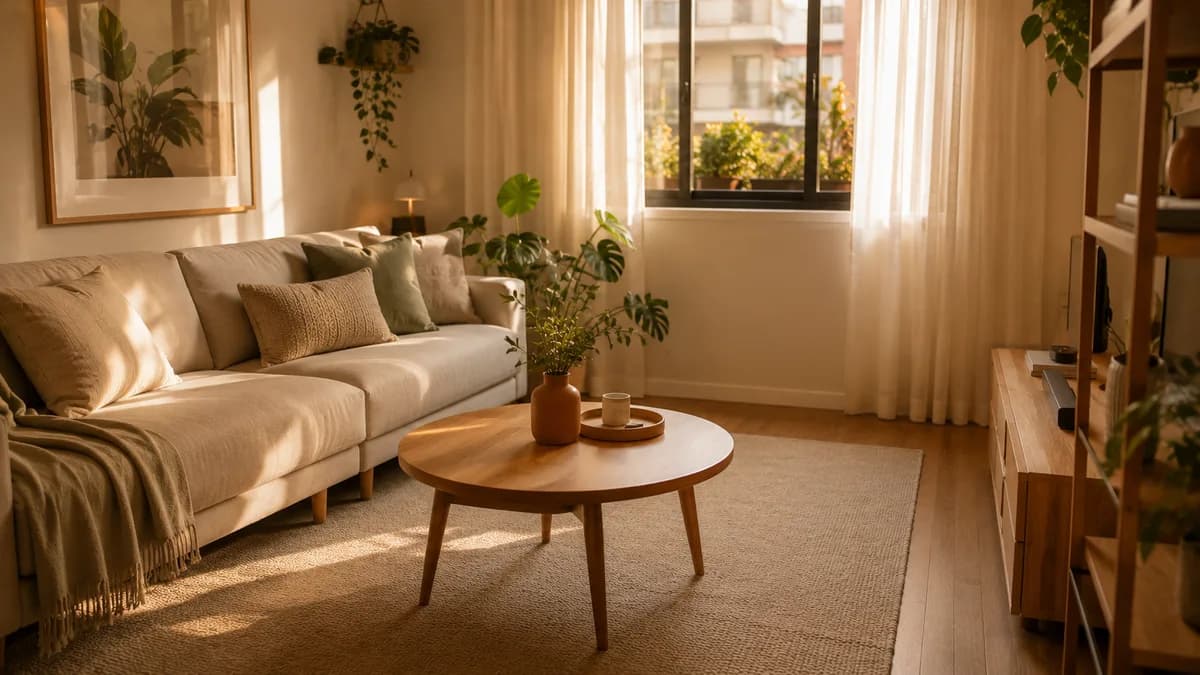
A home that welcomes guests without the rush has a system, not a heroic last-minute routine.
See residential organization →The 20-minute protocol: what to do when notice is short
Guests just texted that they arrive in 20 minutes. Take a breath. With a basic system in place, 20 minutes are enough. Without a system, they are not, but you can still cover the essentials.
- Minutes 1-3: Entryway. Shoes in place, coat on the hook, floor clear
- Minutes 4-8: Living room. Surfaces, cushions, misplaced items back in place
- Minutes 9-13: Guest bathroom. Sink, hand towel, toilet paper, air freshener
- Minutes 14-17: Kitchen. Clean counter, sink free of visible dishes
- Minutes 18-20: Candle or diffuser, home temperature, lighting
What not to do with 20 minutes
Bedroom, home office and laundry room stay behind closed doors. Vacuum the living room floor only if unavoidable, and only if the vacuum can be put away in under two minutes. Kitchen cabinets stay as they are. Bed linens stay as they are, if guests are not going into the bedroom. With 20 minutes, the focus is the bathroom, living room and entryway.
One thing I make a point of telling my clients: guests came to see you. The home is context. A home in use, with personality, is far more welcoming than a home that feels staged. What needs to be in order are the signs of neglect, and only those.
Before special occasions: what to do the day before
Christmas, a birthday, Sunday family lunch, a baby shower: occasions with more people require different preparation. With two days' notice, the prep is easy. With just the day before, it becomes a priority checklist.
With two days' notice
- Deep clean the bathrooms: including the floor, shower and mirror.
- Sort through the living room: remove items that do not belong there and return them to their proper rooms.
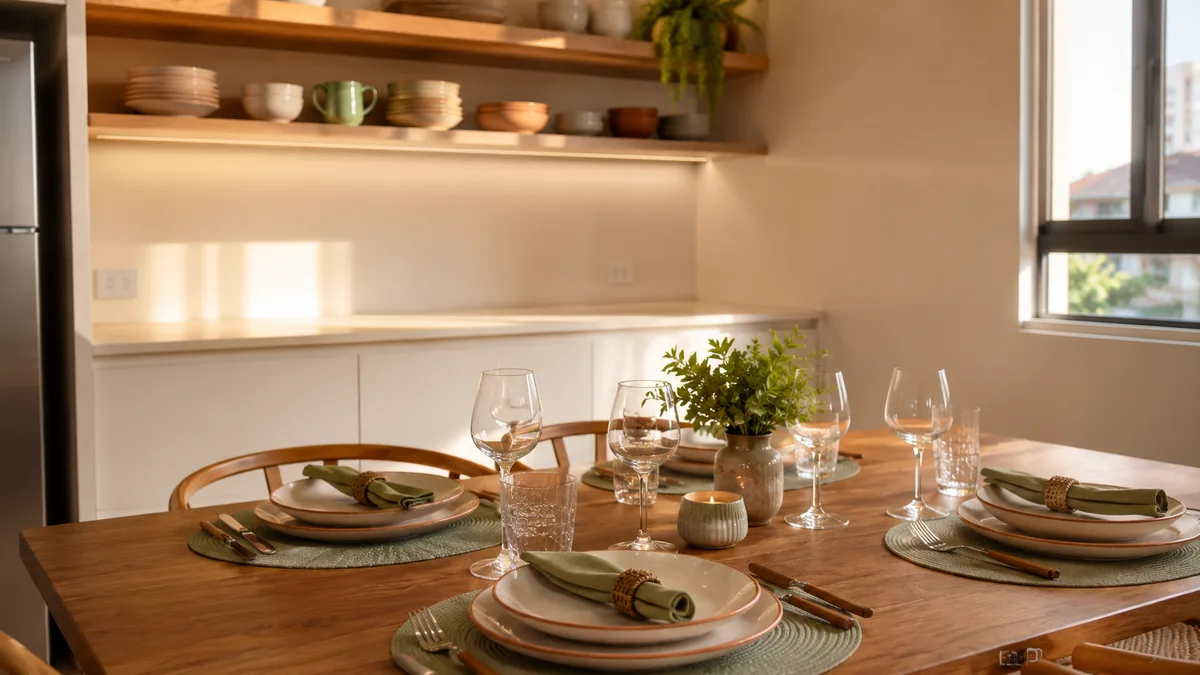
- Dining or buffet table: plan the table layout and check that the tablecloth, dishes and cutlery are ready.
- Entryway: check for any shoes, bags or objects that have piled up and need to be relocated.
The day before
- Kitchen: clear space for the next day's cooking, dishes put away.
- Guest bathrooms: guest towels in place, backup soap checked, air freshener refilled.
- Living room: final adjustment of cushions and surfaces.
- Lighting: check every light bulb in the rooms that will be used. A burnt-out bulb the day before lunch is the kind of detail that causes unnecessary stress.
On the day of the event
Set aside 30 minutes before guests arrive for the final touches: flowers or a table arrangement if you like, home temperature, music if you want it, checking that there is ice and cold drinks. These details make a difference in how much care is perceived, and none of them take more than half an hour if everything else was prepared the day before.
Frequently asked questions about organizing your home for guests
How do you organize a home quickly for guests?
With 20 minutes available, the priority is: entryway (30 seconds of adjustment), living room (put away anything out of place, arrange cushions and visible surfaces), guest bathroom (clean the sink, swap the hand towel, check toilet paper and soap), and kitchen (clear the counter, put away dishes from the sink). Bedroom doors stay closed. The goal is for guests to feel welcome, not for the home to look flawless.
Which rooms should you prioritize when guests give short notice?
The bathroom first, always. It is the only room in the home where a guest is alone and notices details. Then the living room, because that is where the conversation happens. Last, the entryway and kitchen if guests are staying for a meal. Bedrooms, home office and laundry room stay behind closed doors. No guest needs to see those rooms during a casual social visit.
How do you keep a home always ready for guests?
The daily maintenance that works has three parts: a living room and kitchen reset before bed (10 minutes), a bathroom cleaned once a week with a 2-minute daily touch-up, and an entryway that stays clear. With these three habits, any surprise visit only requires a 5 to 10 minute adjustment, no panic. A permanent system is easier to maintain than deep cleaning before every visit.
What is the difference between organizing for guests and organizing for daily use?
Organizing for daily use is about functionality: every item has a fixed place, the flow of daily life makes sense, upkeep is simple. Organizing to receive guests is about perception: visible surfaces are clean, social spaces look good, the guest bathroom is prepared. When the daily system works well, getting ready for guests is basically a quick 15 to 20 minute checklist, not a three-hour cleaning session.

About the author
Silvana Santanna →Personal Organizer in São Paulo, specialized in residential move organization and functional organizing projects for homes, closets, kitchens, trousseaux and home offices. Creator of the Casa Pronta™ Method, with more than 100 projects completed across São Paulo and the greater metro area.
Ready to have your home organized
without lifting a finger?
Project assessment visit.