What Your Entryway Reveals About Your Home Routine
The entryway holds everything that comes in and goes out every day. When it falls apart, the problem is usually not aesthetic: it's the absence of an arrival and departure system.
Neste guia você verá:
When I arrive to organize a home, the entryway usually tells me a lot before I even see the rest of the place. If keys, bags, shoes, mail, backpacks, groceries and things that are "just there for now" are already piling up, the problem is almost never the entryway itself. It's the lack of a clear arrival and departure system.
The entryway holds everything that crosses the door every day. That's why it becomes a summary of the household routine: who leaves early, who comes home loaded down, who gets a lot of deliveries, who has kids, pets or school backpacks moving through. Organizing this spot changes the look of the space less than you'd think, and the daily friction far more than you'd expect.
Why the entryway sets the tone for the whole house
In the field, the entryway is one of the clearest points of spillover in a home. When the entrance has no rule, it pulls clutter into the living room, the dining table and even the bedrooms, because objects come in without finding a destination right away.
The entryway also sets the emotional tone of coming home. Opening the door to an organized space, even if the rest of the house is imperfect, changes how it feels to walk in. And the tone of leaving matters just as much: an entryway where you find your keys, grab the right bag and walk out in 30 seconds is a different experience from one where you search for 5 minutes before rushing out.
In a 72m² apartment in Pinheiros, the couple had a 90 cm entry corridor, plenty of space for a system. But nothing had a defined spot. The backpack sat on the floor because there was no hook, the keys went missing because they landed on whatever surface was nearby, and the coat ended up on the living room chair because arriving and putting it away at the same time felt like one step too many. The husband estimated he searched for his keys three times a week, about 15 minutes each time.
We installed a dedicated hook for the apartment key, another for the backpack, and an open bin for sneakers. It all fit within the 90 cm. The following week, not a single key went missing.
The takeaway: any entryway works once every item that arrives has a fixed destination. The 90 cm had been enough from the start.
Diagnosis: what actually comes through your door
Before buying anything for the entryway, do an honest diagnosis of everything that comes through your door daily. For a week, note down (or photograph) what piles up in the entryway with no defined spot. In most homes, it's always the same categories:
- Keys: for the car, the home, the mailbox, spare keys for the whole family;
- Bags and backpacks: for work, the gym, school;
- Coats, jackets and umbrellas;
- Shoes and sneakers: the ones worn that day and the ones you'll "put away later";
- Mail, magazines, deliveries arriving by courier;
- Kids' belongings: snacks, school supplies, activity gear;
- Pet belongings: collar, leash, dirty paws.
The entryway system needs a spot for each of these categories that shows up in your home. It doesn't need to solve for everything that exists, just for what comes in and out with real frequency in your routine.
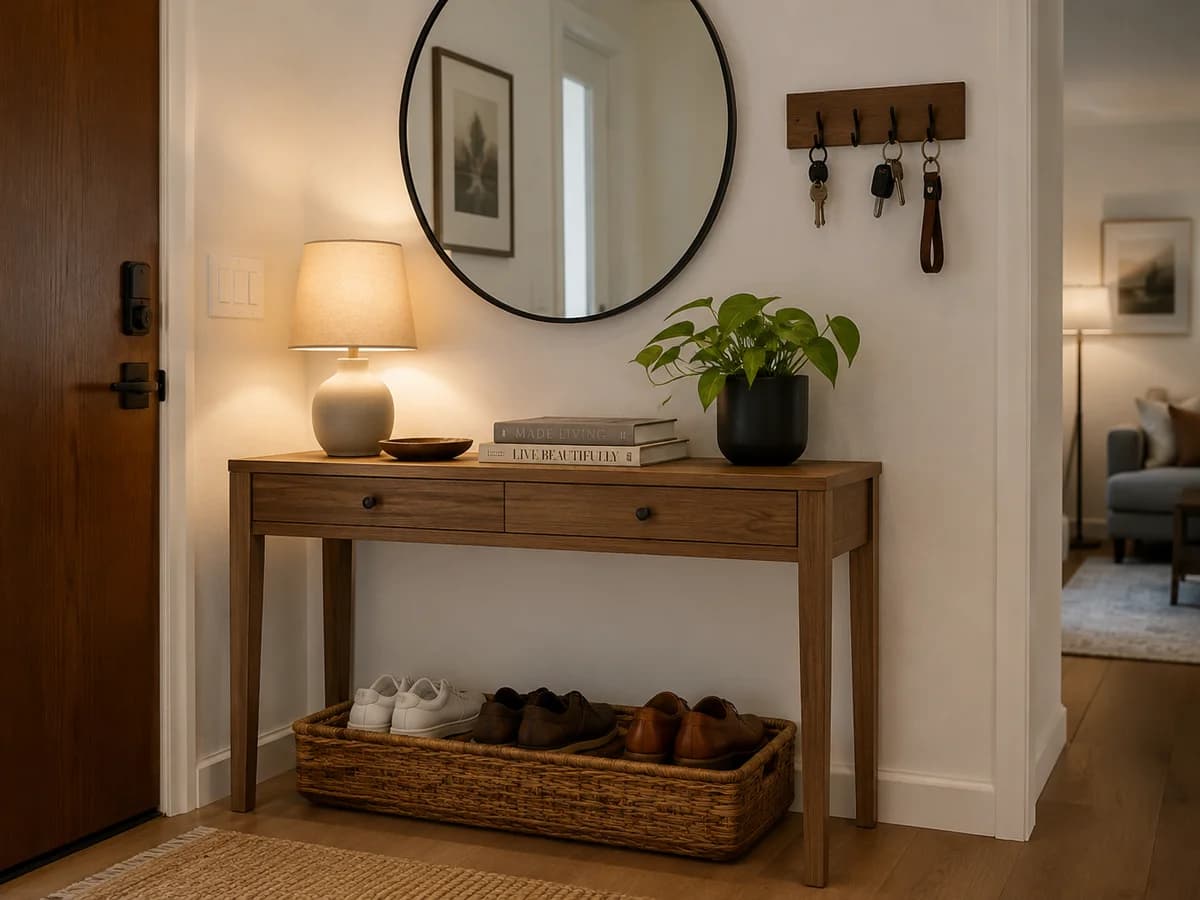
The 3 zones of a functional entryway
A well-organized entryway has three distinct zones, each with a specific function. The size of the space determines how each zone is implemented, not whether it exists.
This layout avoids a very common mistake: treating the entryway only as a pretty spot in the house. The entryway works when it absorbs routine, not when it depends on everyone remembering to be perfectly tidy all the time.
Zone 1: Arrival
The first meter from the door. This is where you take off items the moment you arrive: shoes, coat, umbrella. This zone needs fast resolution: the effort to put something away has to be zero. An open shoe rack, an accessible hook, a bin for umbrellas. If putting something away requires opening a door, bending down or searching, the item ends up on the floor.
Zone 2: Routine
The fixed reference point: where keys, glasses, your wallet and anything you need to find instantly every day live. A dedicated hook for keys (not a bowl where keys get mixed up with everything else), and a small surface for pocket items. The rule is simple: if you have to search for it, the system has failed. The location of these items never changes, day to day.
Zone 3: Departure
What you need to remember to take on your way out: work bags, backpacks, packages to mail, returns, belongings that made their way to the bedroom and need to come back. A dedicated hook or bin for "what leaves tomorrow" eliminates forgetting things and the last-minute scramble before you walk out.
In Moema, in a 180m² home, the entryway had space to spare: a console table, a mirror, hooks on the wall. Even so, it kept piling up. The console table had three months of mail stacked on it. Buried in the pile was an overdue condo fee bill that only surfaced when the bank blocked the automatic payment. The hooks were there, but bags ended up on the floor because none of the hooks was specifically for anything.
We organized the three zones: arrival with a fixed spot for shoes and coats, routine with a dedicated hook for keys, and a departure bin for whatever needed to leave the next day. The console table got a mail-sorting routine every Monday. Since then, not a single bill has gone overdue.
The takeaway: a large entryway without defined zones piles up more than a small entryway with a system. Every surface without a defined function becomes a dumping spot.
Solutions by space size
Very small entryway (up to 80 cm)
- Hook panel on the wall: 3 to 5 hooks in a row, handles bags, coats and backpacks without using any floor space;
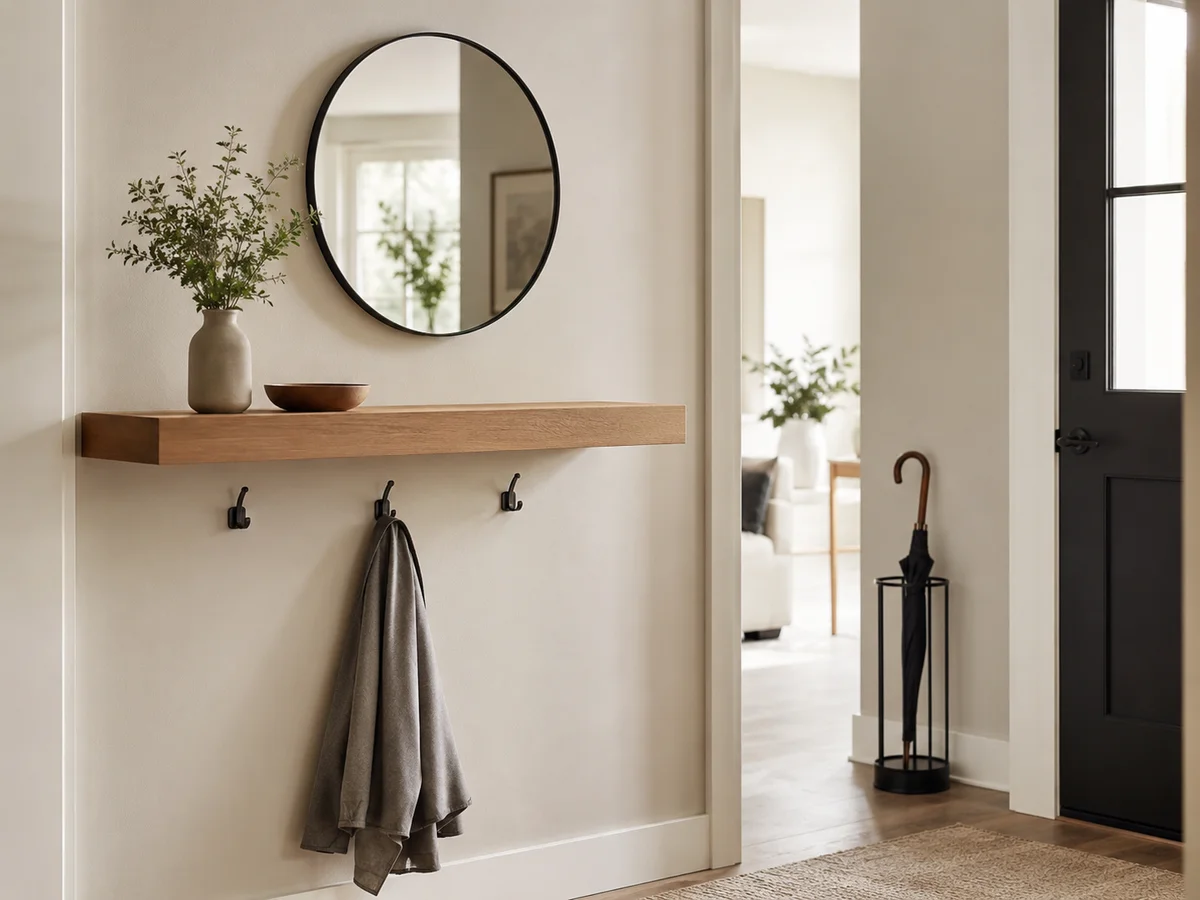
- Floating shelf with 2 hooks underneath: keys plus a surface for pocket items, all within 20 cm of depth;
- Narrow wall-mounted shoe rack (10 to 15 cm deep) or a low bin for the day's shoes, not the whole collection;
- A wall mirror without a wide frame: visually opens up the space and serves a practical function too.
Medium entryway (80 cm to 150 cm)
- Narrow console table (25 to 35 cm deep) with a drawer or bin underneath for shoes;
- Hook panel above the console for coats and bags;
- Mirror to the side or above the console;
- A dedicated bin for umbrellas with a water-collecting tray.
Large entryway (over 150 cm)
- Entryway cabinet with a door: handles the whole arrival zone and keeps the look clean;
- Bench with a shoe compartment underneath: lets you sit down to put on and take off shoes;
- A mix of open hooks (daily use) and a closed cabinet (less frequent items);
- A surface for mail and incoming items with a sorting bin.
Homes with frequent deliveries
If your home regularly receives groceries, pharmacy orders and packages, set aside a landing spot for immediate sorting. It can be a narrow console table or a pass-through bin. What doesn't work is letting bags and boxes sit in the entryway until someone "deals with it later."
For those who leave early
For anyone in a rush in the mornings, the entryway needs to shorten the path. Bag ready, backpack in the same spot, keys always on the same hook and the day's shoes within reach. If your morning starts with searching for something, the problem almost always lives in the entrance system.
Entryways with kids and pets
With kids
The system needs to work at their height and ability. Hooks at a child's height (70 to 90 cm from the floor, depending on age) so they can put away their own backpack and coat when they arrive. An open bin on the floor for sneakers: no latch, no drawer, no effort. Labels with images for kids who can't read yet.
Limit what goes in the entryway: this week's backpack, the day's coat, sneakers in current use. Last week's belongings, extracurricular activity gear and the heavier coat stay in the bedroom. The entryway isn't a storage room for everything that belongs to your child.
In an 85m² apartment in Vila Prudente, the family had two children, ages 5 and 8, and an entryway with hooks on the wall. The kids would arrive and drop everything on the floor: backpacks, sneakers, coats. The mother picked everything up every night before bed. When I mapped out the space, the hooks were 1.70 m off the floor. The 5-year-old couldn't reach anywhere near them.
We installed two hooks at 80 cm, an open bin on the floor for the kids' sneakers, and photo labels on their compartments. Within two weeks, both children were putting away their own backpack and coat when they arrived. The nightly cleanup round was over.
The takeaway: a system only works if the child can use it without help. A hook at the wrong height has the same effect as no hook at all.
With pets
Pets create specific needs at the entrance: collar, leash, treat pouches for walks, and, on rainy days, dirty paws. A pet station in the entryway solves all of it: a hook for collar and leash, a small bin for walk accessories, and an absorbent, washable mat near the door for rainy days. If the pet wears a coat for walks (common in São Paulo), a dedicated hook for it completes the system.
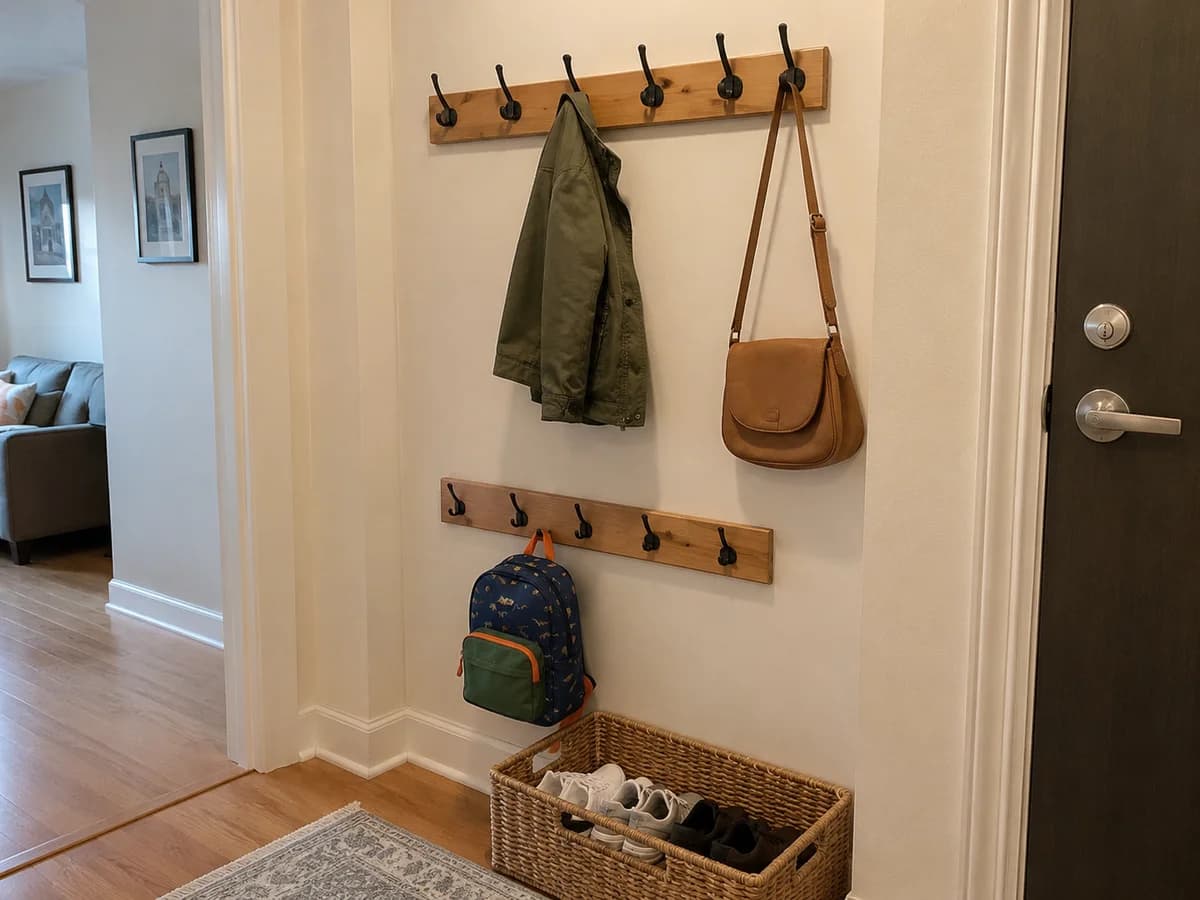
The entryway reveals your household routine. Once it's solved, the rest tends to follow.
See home organization services →The 5-second rule
This is the most useful measure for judging whether your entryway system works: any item that arrives should be put away in under 5 seconds. If putting the keys away takes longer than that, they end up on the console table. If putting the coat away requires opening a closet, pushing other coats aside and finding an empty hanger, it ends up on a chair.
Apply this rule to whatever items keep ending up out of place. If a properly designed system doesn't let you put something away in 5 seconds, the system is wrong, not your habits. The fix is to redesign the system, not to try harder to be disciplined.
- Keys: a dedicated, empty hook exactly where you walk in. Under 2 seconds;
- Coat: a hook in the entry corridor, not behind the bedroom door. Under 3 seconds;
- Shoes: an open bin on the floor, no lid. Under 2 seconds;
- Bag: a hook at the right height. Under 3 seconds.
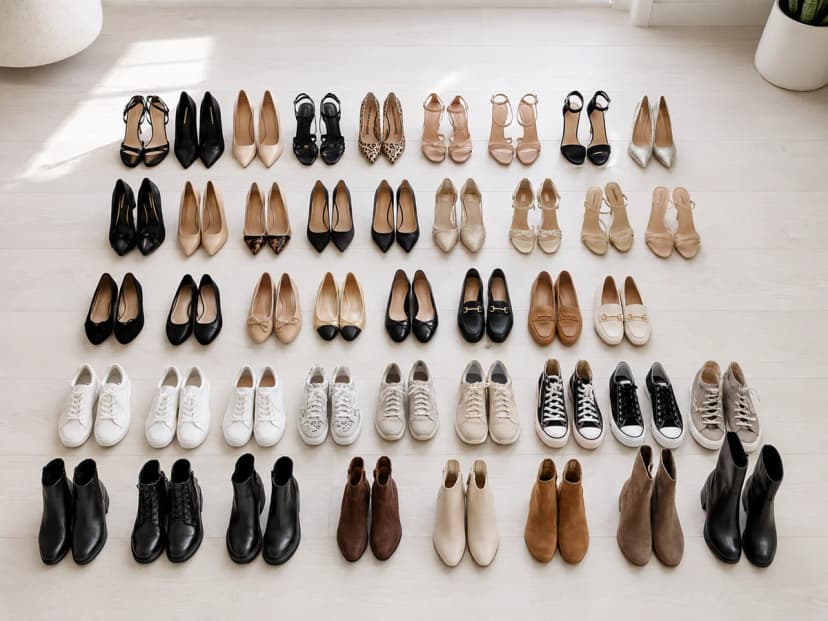
If your biggest entryway challenge is too many shoes moving between the entryway, bedroom and hallway, the post how to organize shoes in the entryway, wardrobe and closet goes deeper into that part of the system.
Daily maintenance in 2 minutes
A well-built entryway doesn't need weekly cleaning. It needs the system to be respected in daily use. Real maintenance is minimal:
- Keys always on the same hook, not on the console table, not in the coat pocket
- The day's shoes in the bin, not in the middle of the entryway
- Bag and backpack on the hook when you arrive, not on the floor or a chair
- Mail sorted: only what still needs handling stays in the entryway
- Once a week: clear out anything that migrated into the entryway without belonging there
- Once a month: check whether the entryway still handles what comes through the door, adjust the system if your routine has changed
When the entrance has already become a permanent clutter spot and nothing stays in place for long, it's worth requesting a quote for a professional assessment. Sometimes the solution isn't buying another piece of furniture, it's redesigning the logic of how the household arrives home.
Frequently asked questions about entryway organization
How do you organize a very small entryway (less than 1 meter)?
In spaces of up to 1 meter, prioritize the wall. A hook panel (3 to 5 hooks in a horizontal row) handles bags, coats and backpacks without using any floor space. A small mirror with a built-in shelf becomes the spot for keys and glasses. A narrow wall-mounted shoe rack or a 10 cm raised platform keeps shoes from spreading across the floor. Less than 30 cm of depth is enough for the entryway to work.
Where should you keep umbrellas in the entryway?
Umbrellas create three problems at the entrance: they wet the floor when damp, disappear when dry, and take up space when not in use. The ideal solution is an umbrella stand with a water-collecting tray placed beside the door. Indoors: in the corner closest to the door, never in the middle of the entryway. If space is very tight, a hook on the side wall (for a folded umbrella hung up) uses zero floor space.
How do you keep an entryway organized with young children?
The system needs to work at their height. Hooks at a child's height (80 cm from the floor) so they can put away their own backpack and coat when they arrive. An open bin at floor level for shoes: latches are barriers for young children. Labels with images, not just text, on their compartments. Limit what goes in the entryway: this week's backpack, coat and sneakers, not every belonging they own.
Do you need a console table in the entryway?
Not necessarily. A console table works well when there is space: it serves as a landing spot for bags, mail and keys. But in small entryways, a narrow console (maximum 30 cm deep) does the same job with half the space. For very small spaces, a floating shelf on the wall with 2 to 3 hooks underneath solves it without any furniture on the floor.

About the author
Silvana Santanna →Personal Organizer in São Paulo, specialized in residential move organization and functional organizing projects for homes, closets, kitchens, trousseaux and home offices. Creator of the Casa Pronta™ Method, with more than 100 projects completed across São Paulo and the greater metro area.
Ready to have your home organized
without lifting a finger?
Project assessment visit.