How to Organize Personal Documents at Home: A Complete System With Legal Retention Periods
Complete guide to organizing personal documents at home: categories, Brazilian legal retention periods, a physical system, digitizing with 3-2-1 backup, and an emergency folder.
Neste guia você verá:
The document drawer exists in practically every Brazilian home. Inside it: receipts from 2015, paid bills with no date on them, contracts nobody is sure are still valid, and birth certificates mixed in with appliance manuals. The mess is not a lack of effort, it is a lack of system.
You will learn what to keep, for how long, in what format, and how to find any document in under two minutes when you need it.
Why most attempts fail
Because organizing documents without knowing what can be discarded leads to keeping everything. Without clear disposal criteria and defined places for each type of document, any new piece of paper that arrives goes into the "I'll sort it later" pile, and the drawer returns to its original state within months.
Organizing documents sounds simple. Until you sit down with the pile. The trouble starts when you have to decide what stays and what goes. Without clear criteria, everything feels important. Keeping everything feels safer than discarding something you might need later.
The result is always the same: an organized system that lasts until the next document with no clear destination shows up. Three months later, the drawer is back where it started.
The fix is not more discipline, it is having a system with defined places for each type of document and clear criteria for disposal. When a document arrives, you know exactly where it goes. When its retention period ends, you know exactly what can leave.
In a 100m² apartment in Brooklin, a client had tried to organize her documents three times over the previous two years. Each attempt lasted two months. The office drawer held 11 years of paid bills, because she never knew what she could safely discard. Keeping everything felt more prudent than throwing away something she might need.
Before touching a single piece of paper, we defined the categories and the legal retention periods. With clear criteria in hand, she discarded 80% of what she had been keeping. The double drawer became a single accordion folder.
The takeaway: document organization breaks down when there is no disposal criteria. Without knowing what can go, everything stays, and the drawer returns to its original state within months.
The 5 document categories
Five categories cover 95% of the documents in any home: Personal and family (ID, certificates, diplomas), Property and vehicle (deed, property tax, vehicle registration), Financial and tax (tax returns, statements, loans), Health (insurance, exams, prescriptions) and Contracts and warranties (lease, appliances, terminations). Each category becomes a labeled folder or section.
Before touching any folder, define the categories. The entire system will be built on top of them. For most households, five categories cover everything:
1. Personal and family documents
- ID, tax ID, passport, voter registration, work card;
- Birth, marriage and death certificates;
- Diplomas, certificates, school transcripts;
- Each family member's documents in separate subfolders.
2. Property and vehicle
- Property deed, purchase and sale agreement, property registration;
- Property tax (IPTU) records from the last 5 years;
- Property and vehicle insurance policies;
- Vehicle transfer document, registration certificate, service history;
- Vehicle tax (IPVA) records from the last 5 years.
3. Financial and tax
- Income tax returns from the last 5 years;
- Proof of loan and financing payments;
- Relevant bank statements (financing, loans);
- Receipts for high-value goods (TV, computer, appliances).
4. Health
- Health insurance card and vaccination record;
- Recent medical exams and reports;
- Prescriptions for ongoing medication;
- History of hospital stays and surgeries.
5. Contracts and warranties
- Lease agreements, service contracts, subscriptions;
- Appliance and electronics warranties (with the receipt attached);
- Employment contracts and termination paperwork.
How long to keep them: Brazilian legal retention periods
General rule: keep financial documents (bills, tax returns, paid accounts, closed contracts) for 5 years. Keep birth and marriage certificates, property deeds and diplomas permanently (even if digitized), since the original carries legal value. When in doubt, the 5-year rule covers most situations under Brazilian civil law.
This is the point that turns an organizing attempt into a real system. With retention periods defined, disposal stops being a difficult decision and becomes an automatic consequence of the system.
Documents to keep forever
- Birth, marriage and death certificates;
- Property deed and registry office records;
- Diplomas and school transcripts;
- Work card (even an old one);
- Passport (even expired, as a travel history record).
5 years
- Income tax returns and proof of income;
- Paid electricity, water, gas and condominium fee bills;
- Paid property tax (IPTU) and vehicle tax (IPVA);
- Bank statements and proof of debt payment;
- Service contracts (after they end).
Contract term + 5 years
- Financing and loan contracts;
- Lease agreements;
- Insurance policies (after expiration).
Until the warranty expires
- Receipts for appliances and electronics;
- Warranty terms and user manuals.
In Santana, in an 80m² home, a lease agreement from three years earlier had to be produced for a dispute with the property management company. The document was mixed into a bag with paperwork from two previous jobs. It took two hours to find. It turned up torn.
The dispute was resolved, but the frustration stuck. We set up archive boxes by year for financial documents and a separate folder for active contracts, with each document's location written on a sheet in front. Today, any paper comes out in two minutes.
The takeaway: you do not notice the lack of a document system until you urgently need a specific paper. When that happens, two hours of searching through a bag of papers have already ruined the day.
Employment and social security documents
There is one category of documents everyone ignores while employed: work-related ones. Pay stubs pile up or get tossed without ceremony. The FGTS (severance fund) statement sits dormant in the app. Awareness usually kicks in after a layoff, a dispute, or when the INSS (Brazil's social security agency) asks for proof of contributions.
- Work card (physical or digital CTPS): permanent retention;
- Pay stubs: 5 years after each employment relationship ends (Brazilian Constitution, Article 7, XXIX);
- Termination paperwork (TRCT) and settlement documents: at least 5 years;
- FGTS statements: 5 years after the employment relationship ends (Superior Labor Court, Precedent 362). Also check the Caixa app anytime;
- INSS contributions: 10 years (Law 8,212/1991, Article 45). The full history is in the CNIS, accessible through Gov.br.
A 41-year-old client, a senior analyst in Pinheiros, reached out two days after being let go from a job she had held for 8 years. She needed to check her FGTS deposits and had no statements at home. Her pay stubs had gone in the trash over the years because they seemed unnecessary.
Before her access to her corporate email was revoked, we combed through the inbox and recovered 4 years of digital pay stubs. The 4 years before that were physical copies already discarded. Through the Caixa app, she identified two months of missing FGTS deposits from 2022. With the partial documentation, she was able to file a dispute. We could not recover the first 4 years.
The takeaway: employment documents seem unnecessary while the job is stable. The problem is that the moment you need them is exactly the hardest one: a layoff, a dispute, an INSS discrepancy. Keep them while access is still easy.
MEI (Brazilian micro-entrepreneurs) and freelancers
- Monthly DAS payment slip (MEI tax guide): 5 years;
- DASN (MEI's simplified annual return): 5 years;
- Paper invoices: 5 years. NF-e XML files: 11 years since Ajuste SINIEF No. 2/2025 (April 2025);
- Proof of INSS contributions as a self-employed worker: 10 years (Law 8,212/1991, Article 45).
Summary table: retention periods by document type
Reference based on the Procon-SP guidance on document retention and disposal (Federal Law No. 12,007/2009) and Brazilian labor and tax legislation.
| Document | Suggested retention |
|---|---|
| ID, tax ID, passport, certificates, diplomas, work card | Permanent |
| Deed, registration, property purchase and sale agreement | Permanent |
| Receipts for durable goods (appliances, electronics) | While you own the item |
| Income tax return and proof of income | 5 years |
| Paid water, electricity, gas, condominium fee and phone bills | 5 years |
| Paid property tax (IPTU) and vehicle tax (IPVA) | 5 years |
| Bank statements and proof of financing payment | 5 years |
| School tuition receipts | 5 years |
| Closed contracts (lease, services, insurance) | 5 years after closing |
| Rent payment receipts as a tenant | 3 years after the lease ends |
| Financing and loan contracts | Contract term + 5 years |
| Pay stubs and termination paperwork (TRCT) | 5 years after the job ends |
| INSS and social security contributions | 10 years |
| MEI's monthly DAS and DASN | 5 years |
| Relevant imaging exams and medical reports | Long term (recommended: permanent) |
| Condominium fees for a former resident (after selling or moving out) | 10 years |
Retention periods based on current Brazilian legislation. For specific legal, tax or labor situations, consult a professional.
Physical system: folder, file and safe
The physical setup works in three layers, each with a specific role:
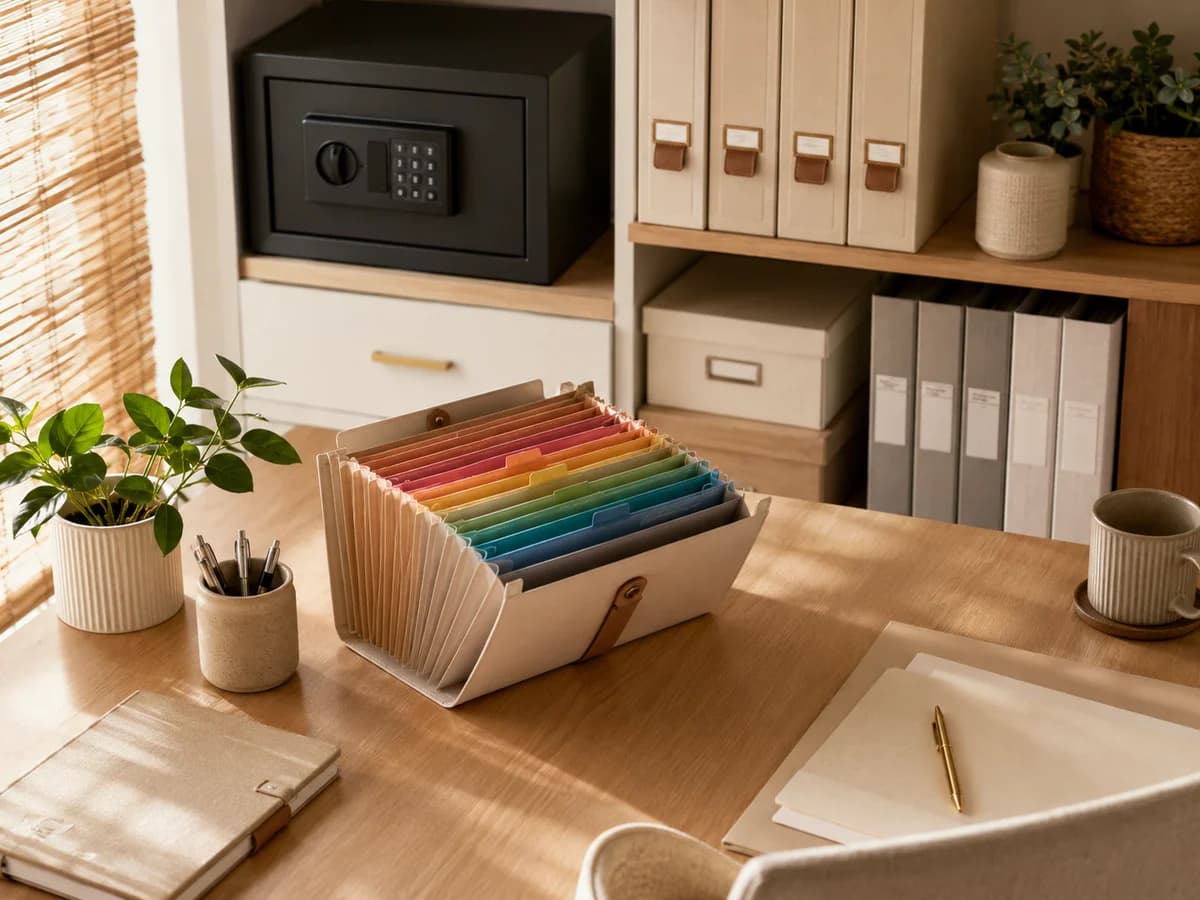
Layer 1: Frequent use, accordion folder for daily needs
For documents accessed often (health insurance card, car documents, warranties in use), a labeled accordion folder with dividers keeps everything within reach without taking up archive space. It stays in an easy-to-reach drawer.
Layer 2: Annual archive, hanging folders or archive boxes
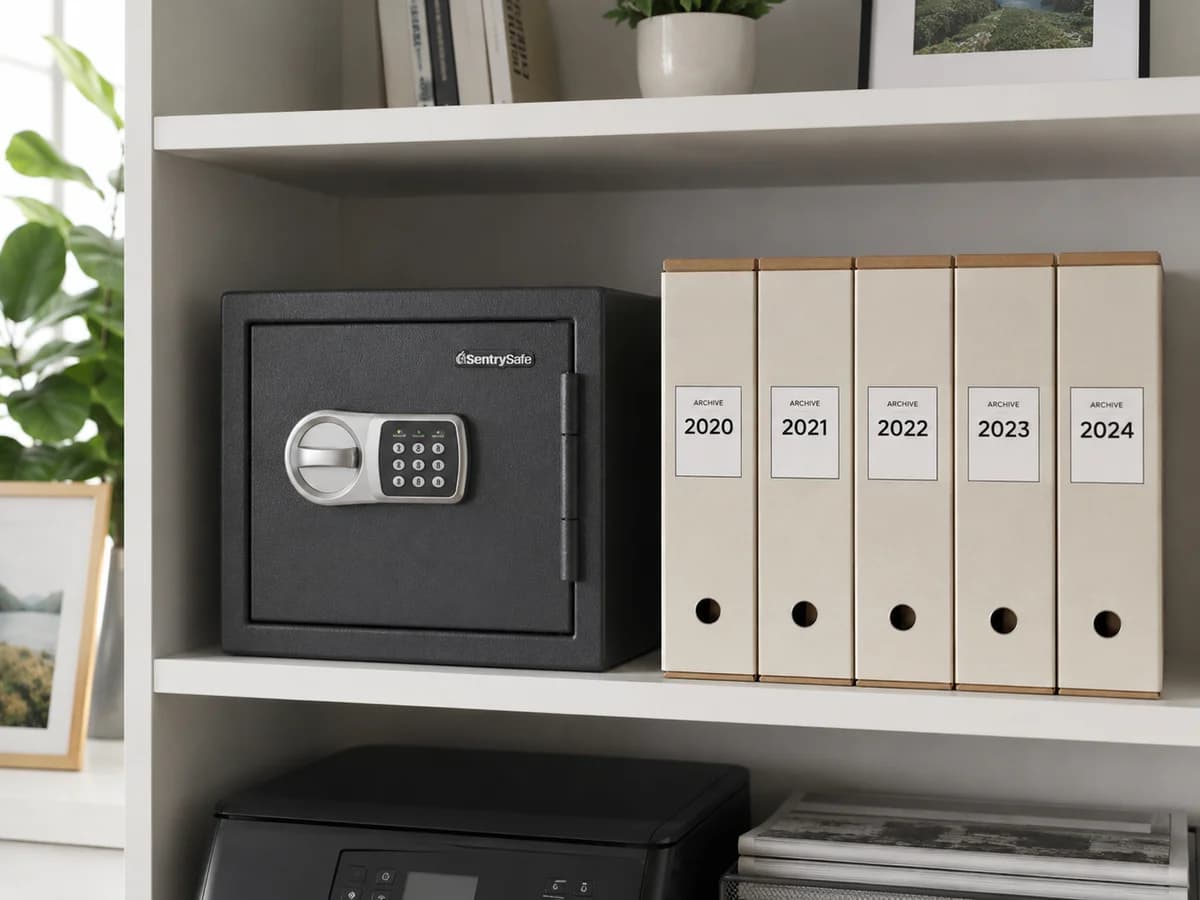
For documents that need to be kept but are not consulted often: tax returns from the last 5 years, paid bills, old contracts. Each year gets its own labeled folder or box. At the start of each year, you review what can be discarded and move the previous archive to disposal or long-term storage.
Layer 3: Permanent documents, safe or reinforced folder
Property deeds, original certificates, passports and irreplaceable documents need extra protection. A small safe (roughly $30 to $80 at a hardware store) protects against fire and theft. Alternatively, a reinforced folder kept somewhere less obvious than the office drawer already raises the security level significantly.
- Accordion folder for frequently used documents
- Archive boxes by year for financial documents
- Folders by category with visible labels
- Safe or reinforced folder for permanent documents
- Each family member with their own subfolder inside "Personal Documents"
Digitizing and 3-2-1 backup
Digitizing documents is not a substitute for the physical archive, it is an extra layer of security. A flooded apartment, a fire or a burglary can wipe out years of physical files in minutes. Going digital ensures you recover at least the information.
What to digitize
- All permanent documents (certificates, deed, long contracts);
- Income tax returns from the last 5 years;
- Important medical exams and reports;
- Receipts for high-value goods.
The 3-2-1 system
The rule IT professionals use for critical data: 3 copies of the file, in 2 different formats, with 1 copy off-site.
- Copy 1: a folder on your computer or an external hard drive at home;
- Copy 2: Google Drive, iCloud or Dropbox (cloud storage accessible from your phone);
- Copy 3: a USB drive kept somewhere else, like your parents' house, your office, or a bank safe deposit box.
For scanning, the Adobe Scan app or the iPhone's own Notes app produce PDFs of sufficient quality for proof purposes. Organize your digital folders with the same structure as the physical ones: one folder per category, subfolders by year. A photo archive follows the same logic and is usually the larger volume in the house: photo and memory organizing sorts the boxes of printed photos alongside the digital ones.
The emergency folder (that no one keeps, but should)
The emergency folder is probably the most important element of this system, and the most overlooked. It is a specific, immediately accessible folder that gathers copies of essential documents for critical situations: an accident, hospitalization, the death of a family member, a natural disaster.
It is not locked away. It is not hidden. It stays somewhere every member of the family knows about.
What goes in the emergency folder
- Copies of ID, tax ID and passport for every family member;
- Copy of the marriage certificate;
- Health insurance number and contact info for everyone;
- Life and property insurance policy (number and insurer contact);
- Emergency contacts: lawyer, trusted doctor, close relatives;
- Branch and account numbers for the main bank accounts;
- Simplified asset inventory (properties, vehicles, investments (just the details, not the values));
- Location of the safe and where the original documents are kept.
At an appointment in Ipiranga, in a 130m² home, the husband was rushed to the hospital. The wife needed to produce the health insurance policy to authorize a procedure. She spent 40 minutes searching and did not find it in time. She missed the window for prior authorization and paid for the procedure out of pocket.
The policy was at home. No one knew where.
We put together an emergency folder with a copy of each policy, insurer contact numbers, and the location of the original documents written down. We keep it in the kitchen drawer. The whole family knows it is there.
The takeaway: the emergency folder exists for whoever needs to act when you cannot help. Anyone in the family can find what they need without depending on you to locate it.
Organized documents solve what digitizing only postpones: finding the physical copy when you need it.
See home organization services →Upkeep: how to prevent future buildup
The document system breaks down for one reason: when a new document arrives, there is no ritual for processing it. It goes into the "I'll organize it later" pile, and the pile grows.
The document inbox
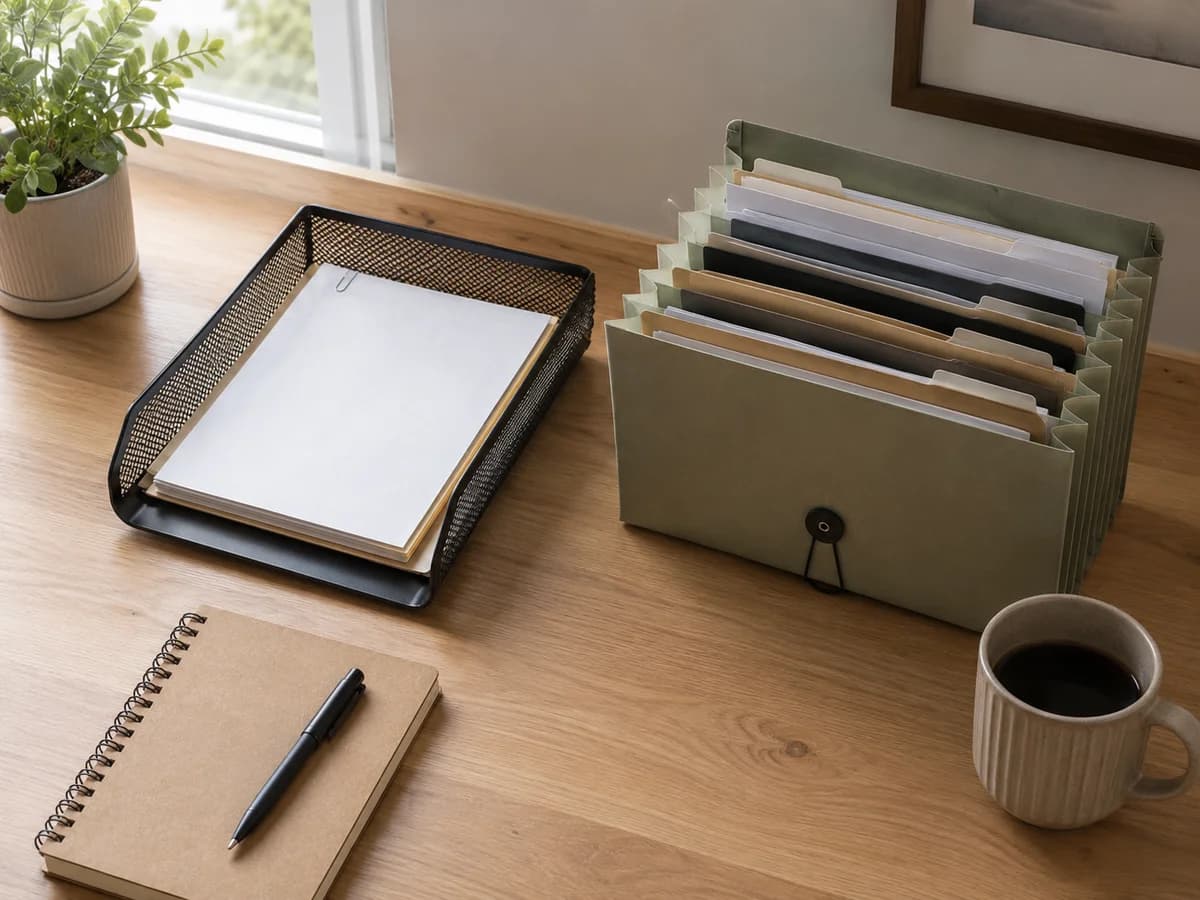
Create a single entry point: a small box, tray or slot where every incoming document gets dropped. Mail, receipts, contracts, exams, all of it goes there. Once a week, in 10 minutes, you empty the box: file what stays, discard what is not needed, and digitize what matters.
Year-end ritual
Once a year (January or December), review the entire archive. Check what has passed its retention period and can be discarded. Move documents from the current archive to the historical one. Update the emergency folder. The annual ritual takes 30 minutes and keeps the system running indefinitely.
- Single inbox for incoming documents
- Weekly processing of the inbox (10 minutes)
- Emergency folder updated annually
- Full archive review once a year
- Digital backup updated every six months
How to dispose of documents safely
Discarding a document once its retention period ends does not mean tossing it in the regular trash. A tax ID, signature and bank details left intact on a piece of paper in the garbage are enough material for identity fraud. According to the 2025 Identity and Fraud Report by Serasa Experian, 16.3% of Brazilians had documents stolen or lost in 2024.
- Never discard documents with an intact tax ID, bank details or signature in the regular trash;
- Tear into small pieces so the name and tax ID never end up on the same fragment;
- A home paper shredder (roughly $15 to $40) handles larger volumes for good;
- Paid bills without complete bank details can be discarded normally once the retention period ends;
- Digitize before discarding any document with sensitive data.
Frequently asked questions about document organization
How long should I keep paid bills?
Electricity, water, gas and condominium fee bills: keep for at least 5 years (the statute of limitations for improper collection claims in Brazil). Loan and financing installment slips: keep for the contract term plus 5 years. Proof of property tax (IPTU) and vehicle tax (IPVA) payment: 5 years. When in doubt, the general rule of thumb is 5 years for financial documents.
Can I throw away old documents once they are scanned?
It depends on the document. Bills and payment receipts: yes, a digital copy is equivalent to the physical one for proof purposes. Property documents (deed, registration): NEVER discard the original, even with a digital copy, since the original has irreplaceable legal value. Physically signed contracts: keep the original up to 5 years after expiration. Personal documents (ID, tax ID): keep the originals, the digital copy is a backup, not a replacement.
What is the difference between an accordion folder and a hanging file?
Accordion folder: ideal for frequent access, fits on a desk or in a drawer, and has built-in dividers. Great for the current month or quarter. Hanging file: for larger volume, takes up more space but allows easy retrieval through labeled tabs. Ideal for annual archives. For most homes, combining both works best: an accordion folder for daily use and a hanging file for documents that need to stay accessible but are not used weekly.
What should go in the emergency folder?
The emergency folder should hold copies of: ID and tax ID for every family member, birth and marriage certificates, passports, life and property insurance policies, contact info for a trusted lawyer or accountant, bank account and branch numbers, emergency contacts, and a simplified asset inventory. This folder stays in an easy-to-reach spot, not locked in a safe, and gets updated once a year.
How long should I keep pay stubs?
Keep pay stubs for at least 5 years after each employment relationship ends (Brazilian Constitution, Article 7, XXIX). For retirement purposes, the CNIS centralizes your INSS contribution history and can be checked through the Gov.br portal. Even so, keep physical or digital pay stubs for 5 years, since the CNIS does not automatically flag its own entry errors, and those are exactly the errors that surface at retirement time. Pay stubs older than 5 years after the job ended: digitize them if you still have them, but there is no obligation to keep the physical copy.
Do I need to keep receipts from everyday purchases?
No. Receipts from the supermarket, pharmacy, clothing stores and everyday purchases with no warranty do not need to be kept. Worth keeping: receipts for appliances, electronics and furniture for as long as the warranty lasts (or longer, for high-value items), items with extended warranty for the contracted period, and goods that can be insured or declared on your tax return. According to Procon-SP, receipts for durable goods should be kept for as long as the product is in use. The practical rule: if the product has no active warranty and does not appear on your tax return, the receipt can be discarded.
Complete home organization: documents, kitchen, closet and more
Silvana builds systems that hold up with ease, with every space following clear logic and a defined place for each item.

About the author
Silvana Santanna →Personal Organizer in São Paulo, specialized in residential move organization and functional organizing projects for homes, closets, kitchens, trousseaux and home offices. Creator of the Casa Pronta™ Method, with more than 100 projects completed across São Paulo and the greater metro area.


Ready to have your home organized
without lifting a finger?
Project assessment visit.