The Professional Organizing Market in Brazil: Data and Overview
Origin of the profession, CBO 375130 recognition, the role of ANPOP, growing demand, and what sets the Brazilian sector apart from international markets. Data with verifiable sources.
Neste guia você verá:
- 01What is the professional organizing market
- 02When did the personal organizer profession emerge?
- 03How the profession arrived and grew in Brazil
- 04What is ANPOP and what role does it play in the sector?
- 05What does CBO 375130 mean?
- 06How many professionals are there in Brazil today?
- 07Why is demand for personal organizers growing in Brazil?
- 08Comparison with the international market
- 09What sets a professional organizing project apart
- 10Frequently asked questions about the market
The professional organizing market grew in Brazil over the course of a decade, more quietly than most new professions. Smaller housing, busier routines, and the popularization of the subject through media: three phenomena that added up and, starting in 2022, gained formal backing with the federal government's recognition of the occupation.
This article gathers the verifiable data about the sector: origin, association structure, and market numbers. Where reliable data exists, it is sourced. Where only estimates exist, that is stated clearly.
What is the professional organizing market?
Professional organizing is the set of specialized services that involve assessing spaces, creating storage and categorization systems, and implementing routines that keep environments functional. The profession serves individuals in homes, freelance professionals in home offices, companies in offices, and transition situations such as residential moves.
The predominant profile of Brazilian clientele, according to ANPOP data and market observations, converges with the international profile: women between 35 and 54 years old, from social classes A and B, with little time available to manage household organization. In the American market, where data is more robust, 72% of clients fit this demographic profile, according to a WorldMetrics (2026) report.
When did the personal organizer profession emerge?
The profession formally emerged in the United States in 1983, when a group of women already working as professional organizers began meeting informally in Los Angeles. In 1985, the group formalized the association that, a year later, would take the name NAPO: National Association of Professional Organizers, known today as the National Association of Productivity and Organizing Professionals (NAPO).
NAPO today has approximately 3,500 members in the US. Internationally, national associations connect through the IFPOA (International Federation of Professional Organizing Associations), of which the Brazilian ANPOP is a member.
How the profession arrived and grew in Brazil
In Brazil, professional organizing as a structured service gained visibility throughout the 2010s. The international popularization of the subject, including the success of Marie Kondo's KonMari method, opened space for Brazilian professionals with public portfolios, such as Micaela Góes and Priscila Saboia, to become references.
Institutionalization followed a clear sequence: in 2013, the first Encontro de Personal Organizers (EPO) brought together 41 professionals in São Paulo. In 2014, ANPOP was born. In 2022, the profession received its CBO code. At each stage, the reach of the sector grew: more trained professionals, more visibility, and more clients who came to know the service existed.
Apartments launched in São Paulo also got smaller. According to a survey by Secovi-SP (Top Imobiliário), 75% of units launched in the capital had up to 45m² of usable area, out of a total of 73,249 units. Less space with the same volume of belongings creates real demand for professionals who know how to make every square meter work. The numbers behind this appear in detail in the analysis on moving in São Paulo read through the data.
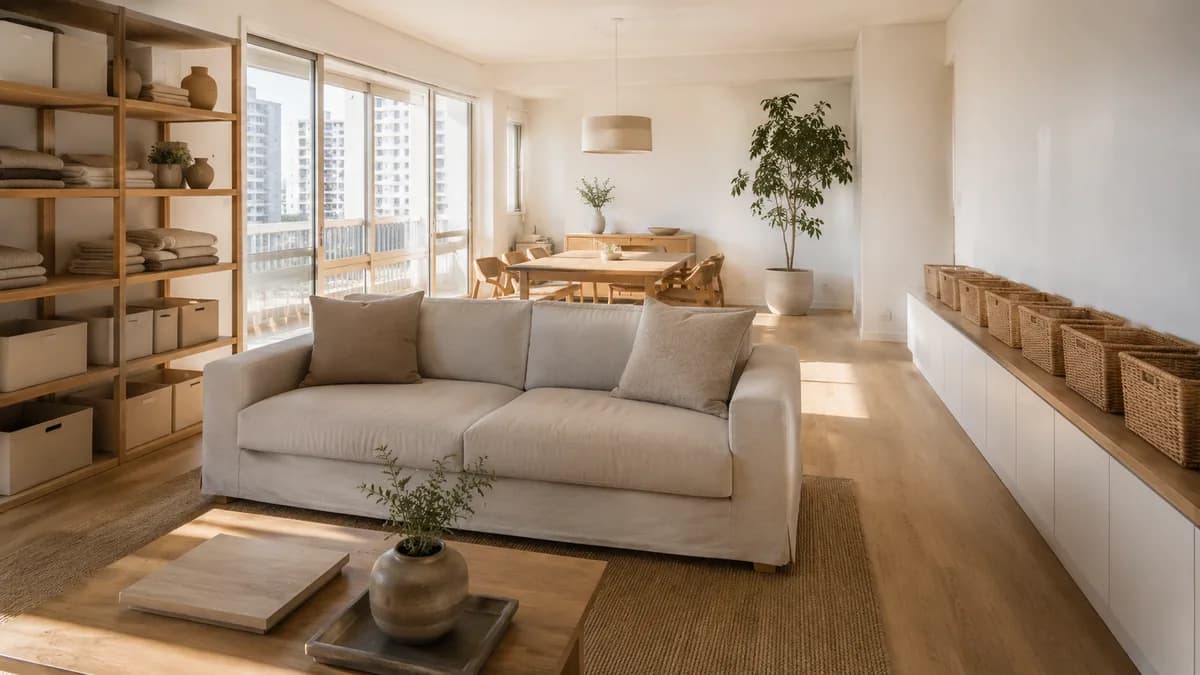
In a 62m² apartment in Pinheiros, the client had spent two years trying to find a system that worked for the kitchen. The space was objectively small: six cabinets, a linear counter, no island. She had bought organizing boxes, watched videos, tried three different setups.
The problem was not the size. It was that two adults with completely different routines were sharing the same kitchen with no separation of use zones. He woke up at 5am and needed coffee immediately. She would not touch the stove before 10am, but used the counter for creative work in the afternoons.
We reorganized based on three zones: morning (his, right counter), prep (hers, left counter), and stock (upper shelves, shared). She said she went the entire week without needing to ask him to move anything.
The lesson: in small spaces, the problem is rarely the amount of stuff. It is the absence of a logic of use that defines where each thing belongs.
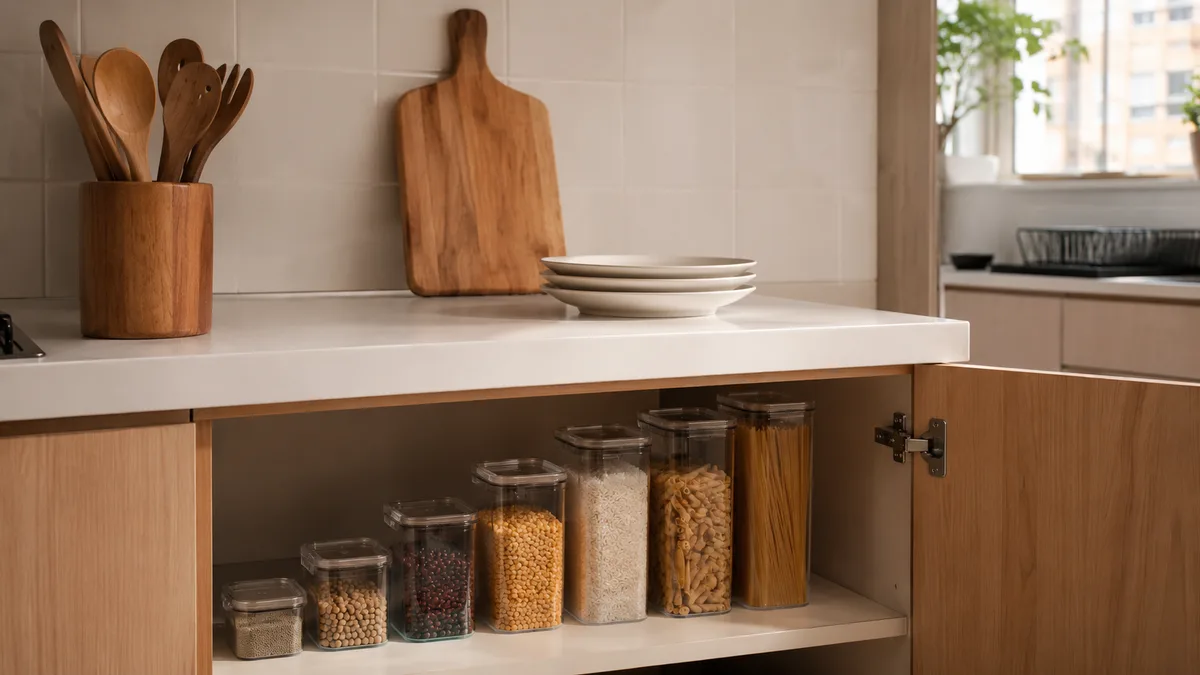
Knowing the profession has a method and a standard is one thing. Seeing it applied in your own home, with a diagnosis before any box is bought, is another.
See the service →What is ANPOP and what role does it play in the sector?
ANPOP (National Association of Organizing and Productivity Professionals) is the sector's main representative body in Brazil. It was founded on February 13, 2014, and publicly launched on March 11 of the same year, during the 1st International Conference of Professional Organizers in São Paulo, which brought together more than 350 people.
The association has gone through five management terms since 2014. In 2024, it welcomed its fifth board, chaired by Ana Alarcon. ANPOP maintains a public directory of member professionals, a code of ethics for the sector, and hosts training and networking events, including Imersão ANPOP, described as the largest organizing event in Brazil.
- Founded on February 13, 2014, in São Paulo
- Responsible for the request to recognize the occupation in the CBO (filed in March 2020)
- Member of IFPOA (International Federation of Professional Organizing Associations)
- Co-founder of World Organizing Day (May 20), alongside other international associations
- Maintains a public directory of member professionals for client reference
- Sets recommended training standards: a minimum of 40 hours for in-person and online courses
ANPOP membership is not required by law to practice the profession, but it serves as a reference for commitment to professional standards. When hiring a personal organizer, checking whether she is a member or follows ANPOP's ethical standards is a legitimate evaluation criterion.
What does CBO 375130 mean?
CBO code 375130 officially classifies the occupation of "Organization professional (personal organizer)" in the Brazilian Classification of Occupations, maintained by the Ministry of Labor and Employment. Its inclusion in the CBO was published in February 2022, following a request filed by ANPOP in March 2020 and approved by the Brazilian Committee of Occupations of the Ministry of Economy in March 2021.
CBO recognition has a defined scope:
- What it means: the occupation formally exists. The professional can reference the CBO code in documents, contracts, and resumes. The sector has official representation in the country's occupation statistics.
- What it does not mean: recognition in the CBO is not regulation. There is no mandatory training, professional board, professional registration, or minimum wage defined by law. ANPOP notes that "recognizing is different from regulating": regulation would require specific legislation from the National Congress.
- Recognized synonyms in the CBO: "organizing consultant" and "professional organizer" appear as equivalent occupations under the same code.
How many professionals are there in Brazil today?
There is no updated official census. Available data comes from sources with different methodologies and reference dates, and needs to be read with that caveat in mind.
| Data point | Value | Source |
|---|---|---|
| Estimated professionals in Brazil | ~2,000 | Pequenas Empresas Grandes Negócios |
| ANPOP members (2019) | ~300 | Revista Empreende (2019) |
| Geographic concentration | SP and RJ lead | Revista Empreende |
| First national gathering of POs | 41 participants (2013) | ANPOP, Quem Somos |
| 1st International Conference (2014) | 350+ participants | ANPOP, Quem Somos |
The 2019 data does not reflect post-pandemic growth, when demand for residential organizing increased alongside remote work and more time spent at home. The real number of practitioners in 2025 to 2026 is probably higher, but there is no published national survey with that update.
Why is demand for personal organizers growing in Brazil?
Growing demand is rooted in three reinforcing phenomena:
1. Smaller apartments in São Paulo
According to a survey by Secovi-SP (Top Imobiliário), 75% of units launched in the city of São Paulo had up to 45m² of usable area, out of a total of 73,249 units. Less space with the same volume of belongings creates objective demand for professionals who specialize in maximizing the use of every square meter.
2. Busier routines
The rise of two-income families working long hours reduces the time available for household organization. According to the American market client profile research (WorldMetrics, 2026), 60% of clients are dual-income families, and 45% of the post-pandemic market came from people who started working from home and noticed the dysfunction of their own spaces.
3. Expansion into the middle class
Until the mid-2010s, the service was seen as something for extremely high-income clients. The popularization of organizing as a digital content topic changed that perception. The middle class began to see professional organizing as an investment in productivity, and the market responded with more professionals and smaller-scope projects focused on specific rooms.
In a 48m² apartment in Brooklin, the couple had moved in four months earlier and were still living with boxes in the second bedroom. It was not a lack of time: it was paralysis in the face of a space that seemed to have no solution. "It doesn't all fit," was what they said at the start of the project.
The assessment revealed that it did fit, and comfortably. The problem was that they had brought the mental organizing system from their previous apartment, which had twice the space. The solution started with decluttering: 40% of what was in the boxes went to donation. The rest fit in the apartment with room to spare in the cabinets.
The lesson: living in smaller spaces does not require fewer belongings. It requires more precise systems. The difference between fitting and not fitting is usually the absence of criteria, not the absence of space.
How does the Brazilian market compare to the international market?
The American professional organizing market is the most documented in the world. In 2023, it was valued at US$ 1.2 billion, with a projected US$ 2.1 billion by 2028 at an annual growth rate of 9%, according to a WorldMetrics (2026) report. The global market was estimated at US$ 2.5 billion in 2022, projected to reach US$ 4.5 billion by 2032 (a CAGR of 7.5%).
American NAPO had 4,200 members in 2023, growing 12% a year in membership. By comparison, the Brazilian ANPOP had about 300 members in 2019, with significant growth since then, but without published updated numbers.
| Indicator | US (2023) | Brazil (available data) |
|---|---|---|
| Market size | US$ 1.2 billion | No published data |
| National association members | NAPO: 4,200 (2023) | ANPOP: ~300 (2019) |
| Certified professionals | 5,000+ (2023) | ~2,000 total estimate |
| Official recognition | NAPO: 1985 (founding) | CBO: February 2022 |
| Predominant client profile | Women 35-54, 72% | Women, classes A/B (no official data) |
Brazil is at an earlier stage of maturity. Markets like this have more pent-up demand and less saturation on the supply side. The main gap in the Brazilian sector is the absence of a national census: without it, most estimates about active professionals and revenue depend on isolated observations, not systematic surveys.
What sets a professional organizing project apart?
More supply means more variation in quality. A few objective criteria separate serious professional projects from improvised ones.
A structured process before any execution
Professional projects start with a briefing: understanding the client's actual routine, not just the space. Two 80m² apartments with the same layout need different systems depending on who lives there. Professionals who send a quote without seeing the space or discussing the routine have no way to estimate real scope.
Decluttering before buying organizers
The most common mistake people make when organizing on their own is buying boxes and baskets before knowing what will stay. Serious professionals decide on purchases after decluttering and categorizing, using the actual measurements of the available space. The system needs to fit the space that exists, not the space imagined before starting.
A training standard with a defined minimum course load
ANPOP recommends a minimum course load of 40 hours for professional organizing training, covering residential and corporate organizing, ethics, pricing, and client service. Training is not required by law, but it signals that the professional invested in a structured learning process beyond just "liking to organize."
A sector code of ethics
ANPOP maintains a code of ethics for members, which includes confidentiality about the client's space and belongings, respect for the client's autonomy in deciding what to discard, and commitment to the declared scope. Hiring a professional with a code of ethics is a basic guarantee that personal items, documents, and belongings will not be shared or discarded without authorization.
A client in Perdizes arrived at the project with a distrust she admitted openly in the first conversation: she had hired someone before, with no certification or references, who emptied three closets in one Saturday and left. Within two weeks the room had returned to chaos. Worse: she could no longer find even the documents that had been organized before.
The problem was not the low price she paid. It was the absence of process: nobody asked how she used the space, and the system that was imposed had nothing to do with her routine. We started over from scratch, with a briefing, categorization by actual use, and a one-page maintenance guide. She resisted decluttering an entire drawer of old cables, and that was fine: they went into a labeled box she would review in six months.
The lesson: certification is not a vanity badge. It is the difference between someone who applies a method and someone who just moves your things around. Cutting corners usually ends up costing twice.
Frequently asked questions about the professional organizing market
Is personal organizing a recognized profession in Brazil?
Yes. Since February 2022, the occupation of "Organization professional (personal organizer)" has been registered in the Brazilian Classification of Occupations (CBO) under code 375130. The recognition was obtained through ANPOP (National Association of Organizing and Productivity Professionals), which filed the request in March 2020. Recognition in the CBO is not the same as regulation: it formalizes the existence of the occupation, but does not impose mandatory training or professional registration requirements.
What is ANPOP and what role does it play in the organizing market in Brazil?
ANPOP (National Association of Organizing and Productivity Professionals) is the main Brazilian association in the sector, founded on February 13, 2014, in São Paulo. Its central role includes representing professionals before public authorities (it was ANPOP that secured CBO code 375130), setting ethical standards for the sector, offering a directory of certified professionals, and hosting industry events, including Imersão ANPOP, described as the largest organizing event in Brazil.
How many personal organizers are there in Brazil?
There is no official census. The most cited estimate, published by the Pequenas Empresas Grandes Negócios portal, points to about 2,000 professionals in the country, concentrated in the states of São Paulo and Rio de Janeiro. ANPOP had approximately 300 members in 2019. The total number of practitioners, including professionals without association membership, is likely higher than association records suggest.
When did the personal organizer profession emerge?
The profession emerged in the United States in 1983, when a group of women working as professional organizers began meeting informally in Los Angeles. In 1985, the group formalized the association that would become NAPO (National Association of Productivity and Organizing Professionals). In Brazil, the profession gained visibility starting in the 2010s and received official CBO recognition in February 2022, driven by ANPOP, founded in 2014.
Why is demand for personal organizers growing in Brazil?
Three converging factors drove demand: smaller and smaller apartments (75% of units launched in the capital had up to 45m², out of 73,249 units, according to Secovi-SP), busier routines with less time for household organization, and greater awareness of how a physical environment affects productivity and well-being. The service also moved from a narrow high-income audience to the middle class, which began to see professional organizing as an investment.
What is the difference between a certified and a non-certified personal organizer?
The profession is not regulated in Brazil: anyone can call themselves a personal organizer without training. Certified professionals have completed programs with a minimum recommended course load of 40 hours from ANPOP, covering residential and corporate organizing, client service, ethics, and pricing. Certification is not required by law, but it signals a commitment to professional standards. When hiring, it is worth checking portfolio, references, and whether the professional follows a code of ethics.
Want to see it in practice?
Project assessment with Silvana Organizer
Certified personal organizer in São Paulo, with more than 100 projects completed and 6 years of experience. Tell me about your space and I will get back to you with a project assessment.
Request an Assessment via WhatsAppServing São Paulo and the region

About the author
Silvana Santanna →Personal Organizer in São Paulo, specialized in residential move organization and functional organizing projects for homes, closets, kitchens, trousseaux and home offices. Creator of the Casa Pronta™ Method, with more than 100 projects completed across São Paulo and the greater metro area.
Related posts
What Does a Personal Organizer Do in São Paulo? Services and Process
10 min · Read article →
How to Hire a Personal Organizer in São Paulo (Without Regretting It)
9 min · Read article →

How Much Does a Personal Organizer Cost in São Paulo? What Sets the Price
9 min · Read article →
Ready to have your home organized
without lifting a finger?
Project assessment visit.