How to Prepare Your Home to Receive a Personal Organizer: What to Do (and Avoid)
Learn what to do before the personal organizer arrives: the mistake of buying organizers too early, what to leave as is, how to communicate your priorities, and what to expect from the process. Complete guide.
Neste guia você verá:
In the years I have worked as a personal organizer in São Paulo, I have noticed that clients who arrive more prepared for the session get results up to 40% better, not because they organize more, but because they make better use of the time we spend together. And preparing well does not mean what most people imagine.
Most people believe that preparing their home to receive a personal organizer means tidying everything up beforehand, buying those beautiful boxes they saw on Pinterest, and making the space look "presentable." In practice, those three instincts are exactly the opposite of what helps, and one of them can be a literally costly mistake.
What follows is what I personally explain to every client before the first session: what to do, what to avoid, how to communicate priorities, and what to expect at each stage.
The mistake almost every client makes
There is a pattern that repeats with striking frequency: the client books the session, gets excited, and heads straight to the store to buy organizers. Clear bins, wicker baskets, drawer dividers, label makers. All very pretty. All very premature.
The problem is structural. The decluttering phase, which always happens before any organizing, radically changes the dimensions of the space. Once everything comes out of a closet, what no longer serves a purpose is discarded, and only the essentials remain, the volume of items drops significantly. The measurements you need change. The right approach changes along with them.
On top of that, the personal organizer may recommend a solution completely different from what you imagined: open storage instead of closed, vertical storage instead of horizontal, niches you had not even noticed existed. Buying ahead of time means assuming you know the solution before the problem has even been mapped out.
The most common outcome is also the most frustrating: expensive organizers that do not fit, do not click into place, or simply do not make sense for the system that gets designed.
This pattern repeats so often that I have started mentioning it in the very first conversation: do not buy anything yet.
One client showed up for her session with close to eight hundred reais in organizing boxes bought the week before. She had researched thoroughly, picked out beautiful products, and measured the closet from the outside. Her apartment closet in Jardins was so full the drawers would not close. The decluttering phase alone took nearly three hours. By the time we were done, more than half of what had been in the closet was gone. What remained needed three boxes, not the twelve she had bought, and in a completely different size. The frustrating part was realizing she had assumed the solution before mapping out the problem. We returned what could be returned and bought only what was actually needed, in the right measurements. She ended up spending less than before. The closet worked. The lesson: decluttering reveals how much space truly exists. Only then can you know what to buy.
Save your enthusiasm for after the diagnostic session. At that point, you will know exactly what to buy, in what size, in what quantity, and where to find the best value. Often, the organizer herself will point you to where to buy, or can source the materials for you.
Why you should not tidy up before the organizer arrives
Because the personal organizer needs to see the space as it truly is day to day: open drawers, cluttered surfaces, real habits. Tidying up beforehand hides the diagnosis. The system she designs needs to be calibrated to real behavior, not to a tidied-up version of a single day.
This is the guidance that surprises clients the most, because it goes against instinct: do not tidy up, do not reorganize, do not give the spaces a quick touch-up before the session.
The reason is technical. The personal organizer needs to see the space in its natural state: how the drawers really look day to day, how surfaces really accumulate clutter, where items really end up by the end of the day. If you "organize" before she arrives, she sees a temporary, unreal version of the problem.
It is not possible to diagnose what is not working if the problem has been hidden for a few hours. The system the organizer builds needs to be calibrated to your real behavior, not to the behavior you show when you know someone is coming to visit.
- If you always leave clothes draped over the back of a chair, the organizer needs to know that to design a solution that actually works with that habit.
- If a certain drawer is always overflowing, she needs to understand why: too many items, the wrong size, or a flawed storage logic.
- If the kitchen counter always accumulates clutter, the solution is not to clear the counter: it is understanding what keeps landing there and creating a proper spot for each item.
What you CAN and should do before the session is covered in the next section. But there is an important distinction: basic tidiness is different from reorganizing.
Take dirty dishes to the sink, take out full trash bags, leave the bathroom in a minimally usable condition. That is tidiness. Reorganizing drawers, stacking things "neatly" in corners, or hiding the clutter inside cabinets: that gets in the way of the diagnosis.
The instinct to "at least tidy things up a bit" before the visit has a cost that most people do not realize: it hides the diagnosis.
One client in Perdizes spent the morning tidying up the kitchen before I arrived. She organized the drawers, stacked the boxes, wiped down the counters. When I arrived, the kitchen looked functional. When we started working and undid what she had done, we found the real state: one drawer with three versions of the same utensil, another with cleaning products mixed in with spices, a third with items she had been searching for for weeks. The tidying had hidden what I needed to see. The system we built used the kitchen's real behavior as its foundation. She found the scissors she thought she had lost.

What to do the week before
Now that you know what not to do, here is what actually helps. The ideal preparation happens the week before the session, and it is entirely mental, not physical.
Reflect on what bothers you the most
Write down, on paper or on your phone, which spaces cause the most frustration in your daily life. Not the ones that look the messiest, but the ones that actually hurt your routine. Ask yourself: where do you waste time looking for something every week? What stresses you out when you walk into a room? Which space do you avoid using because it is impractical?
This list will guide the priorities conversation with the organizer and make sure the session's time is invested where it makes the biggest impact on your daily life.
Identify your non-negotiables
Every client has items they will not get rid of under any circumstance, like sentimental objects, inherited pieces, hobby equipment, or specific work tools. You do not need to justify anything. Just know what those items are before the session.
A good personal organizer will fully respect your non-negotiables. Her role is not to decide what you should keep: it is to help you organize what you have chosen to keep as functionally as possible.
Think about your real lifestyle
Not your ideal lifestyle, your real one. Do you actually hang up your clothes when you get home, or do they end up on the chair? Do you cook every day or once a week? Do the kids do homework at the desk or on the bed? Do you use the dining table for meals, or has it become a workspace?
The more honest you are about your real habits, the more accurate and lasting the system will be. Systems that ignore the resident's real behavior last days, not months.
Clear space in your schedule
Being present is essential, and being present with energy matters too. An organizing session is mentally and physically tiring. You will make hundreds of micro-decisions throughout the day: keep or toss? here or there? do I use this, or do I just think I will? Do not schedule other commitments on the same day.
In particular, keep the afternoon and evening free. Ending a long session with another commitment right after is exhausting, and it cuts the process short right when you were gaining momentum.
- List the 3 spaces that hurt your daily routine the most
- Identify items you will not compromise on (sentimental, professional, hobby)
- Think about your real habits in using each space, not the ideal ones
- Block off the whole day on your calendar, with no other commitments
- Let your family know about the session and ask for their cooperation that day
- Write down questions you want to ask the personal organizer
Preparations on the day of the visit
With the week of reflection done, the day of the session has a few practical preparations that make a real difference in how the work goes.
Kids and pets
If possible, arrange for young children and pets to be elsewhere during the session, or at least for most of it. Constant interruptions fragment the flow of decisions and make the process significantly slower. It is not a requirement, but it is one of the tips that most improves how the session goes when it is followed.
Food and hydration
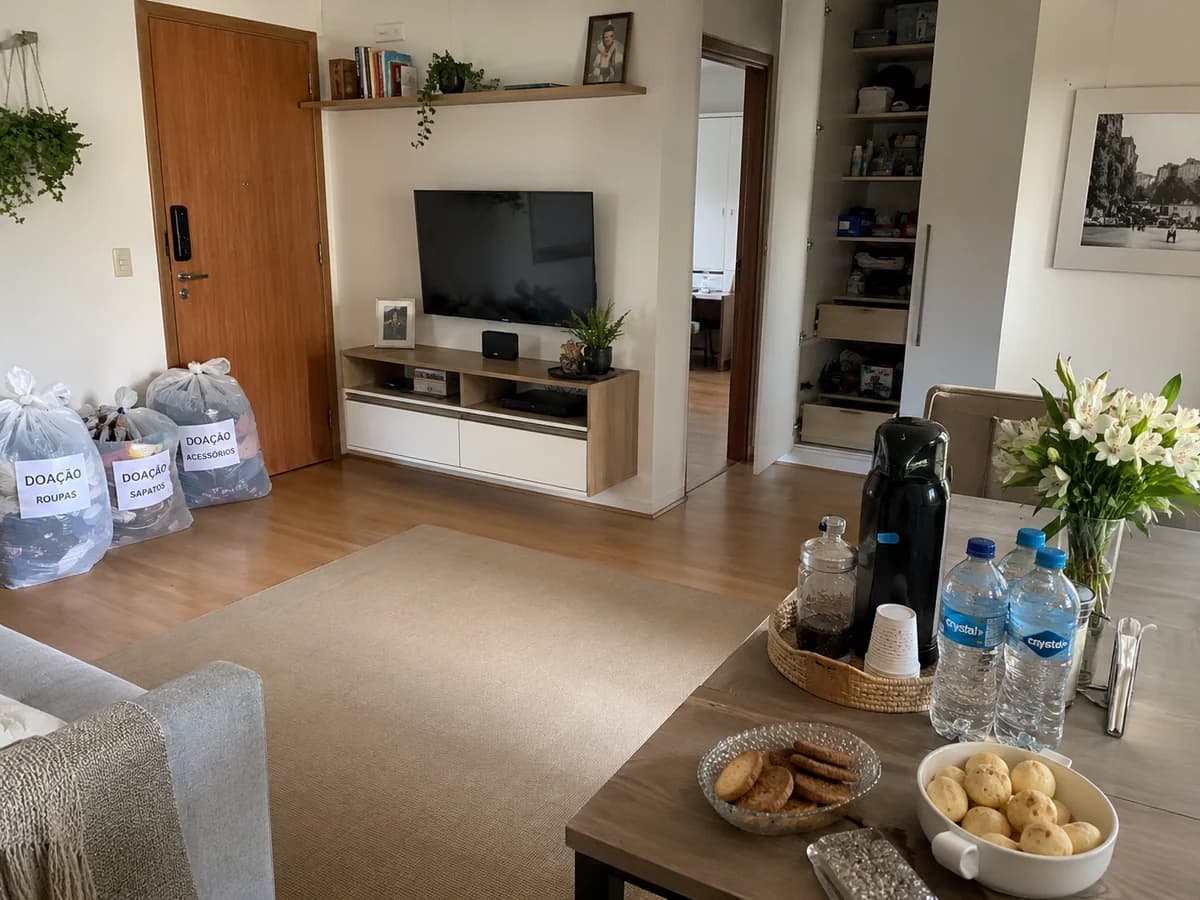
Have water, coffee, and a snack on hand. A full session lasts between 4 and 8 hours and is physically demanding: there is a lot of moving around, crouching, lifting boxes, and making decisions. The organizer will appreciate the hospitality, and you will be glad to have something to eat by mid-afternoon.
Materials for donations
Set aside large bags or boxes in advance for the different destinations of discarded items: donation, disposal, and resale. Leaving the session with bags already full and labeled feels extremely satisfying and turns the decision to let go into something concrete and final.
A temporary sorting area
Leave a neutral space available (the living room floor, the bed, a large table) where items can be spread out temporarily during sorting. In any professional organizing process, everything comes out before it goes back in. Having this staging area available is essential for the method to work.
Documents, jewelry, and valuables
Before the session, set aside personal documents, jewelry, cash, and any paper carrying banking data, and keep that category somewhere only you can reach. It is the same care you would take with anyone spending a full working day inside your home. Doing it beforehand also spares you from deciding in a hurry, in the middle of sorting, what to do with a folder of documents that surfaced at the back of a cabinet.
If the project involves silverware, watches, or family heirlooms, agree with the professional on a photographic inventory before any piece moves. It is also worth confirming how paper will be discarded: an old bank statement leaves your home with your name and address printed on it, and the correct destination is shredding, not the building bin. If you have not hired anyone yet, see what needs to be in writing before the first session in the hiring guide.
Comfortable clothes
Wear clothes you can move around in. You will crouch, reach for high shelves, move boxes, and sit on the floor. This is not the day for your favorite outfit.
How to communicate your priorities
Start with the space that hurts your daily routine the most, not the one that looks the messiest. Be honest about what has not worked in previous attempts and what your real habits are. This conversation at the start of the session is what separates a generic result from a personalized system that lasts.
The priorities conversation at the start of the session is one of the most important moments of the entire process. Clear communication here ensures the time and energy are invested where they will bring the most results to your life.
Start with what hurts your routine the most
The space that looks the messiest is not always the most urgent one. If what is wrecking your mornings is the closet (even if the living room looks worse to a visitor), start with the closet. Tell the organizer what is actually costing you time and energy in your real daily life, not what will look better in photos.
The logic is simple: you will notice the impact of the organizing much faster when the space that gets organized is the one you use intensely every day. That quick win also gives you the motivation to keep going through the following rooms.
Be honest about what is not working
"I have tried organizing this drawer three times, and in two weeks it is a mess again." That sentence is gold for a personal organizer. It tells her that the current system does not match your real behavior, and that something different needs to be designed, not the same method repeated with more little boxes.
Do not hide past frustrated attempts. They are valuable data that help calibrate the solution. An experienced organizer will not judge you for having tried and failed to keep it up; she will use that information to build something that works this time.
Share your constraints
Be transparent about practical limitations that will shape the solutions:
- Budget for materials: if there is a limit on what you can spend on organizers, say so. The organizer can prioritize the investments that make the biggest difference.
- Structural constraints: a rented apartment where you cannot drill into walls, for example, rules out some solutions and opens up others.
- Physical constraints: back or knee pain means the highest shelves should not be the main storage for items you use daily.
- Time available for upkeep: how much time per week can you dedicate to maintaining the system? That number defines how much complexity the system can have.
What to expect during the process
Knowing what is going to happen reduces anxiety and helps you trust the process even when it feels chaotic, and at some point, it will feel chaotic.
It gets worse before it gets better
When everything comes out of a closet or drawer before going back in reorganized, the room ends up temporarily worse than when you started. Piles of clothes on the floor, items spread across the bed, open boxes everywhere. This is completely normal: it is the necessary chaos of reorganizing.
Trust the process. The organizer knows exactly what stage things are at and where it is all heading. That temporary chaos is proof that the real work is being done.
Decision fatigue is real
In the first few hours, decisions are easy: that one clearly goes, this one clearly stays. By the third or fourth hour, deciding on any random item can feel disproportionately exhausting. This has a name: decision fatigue. It is a documented psychological phenomenon and completely expected.
The organizer knows this moment well and will adjust the pace of the session accordingly. She is not there to decide for you, but she is there to ask the right questions that help you decide faster: "Have you used this in the last 12 months?", "If you had to buy it again, would you?", "If you keep this, can you say exactly where it is and what it is for?"
The hardest moment of any session is not the decluttering itself. It is seeing the room look worse than when you started.
During a bedroom session in Moema, the husband looked at the room in the third hour and said he wanted to stop. Clothes spread across the entire bed, drawers open, boxes on the floor, the wardrobe completely empty. It looked like more chaos than before we started. We paused and looked at what had already come out: two donation bags, one box for disposal, items that had been in the wrong place for years. The chaos was proof that the work was being done. Two hours later, the wardrobe was better organized than at any point since the couple had moved into that apartment. The husband said the bedroom had never worked like this before.
The personal organizer's role
Be clear with yourself about what the organizer does and does not do. She does not discard anything without your decision. She does not judge what you choose to keep. She will not renovate your apartment or do construction work. What she does is design systems, explain the logic behind each choice, and teach you how to maintain it before she leaves.
It is a partnership, not a service that happens while you watch. Your active participation is what makes the difference between a generic result and a personalized system that lasts.
What you will discover
Almost every client is surprised by three things by the end of a session: things they thought were lost turning up (documents, objects, accessories that "vanished" months ago), duplicates they did not know they had (how many raincoats can fit in one apartment?), and much more space than they believed existed. That is, consistently, the most satisfying moment of the process.

After the session: the first 14 days
The session is over. The space is transformed. And now comes the part that determines whether the result lasts weeks or years: the first 14 days living with the new system.
Photograph everything
Right after the session, photograph every organized space. These photos are your reference: when you are not sure where something goes, the photo shows exactly where it was when the system was working. It is simple and works far better than trying to remember.
The system will feel strange at first
For a week or two, you will hesitate before putting something away. "Where does this go again?" You will open the wrong drawer out of habit before remembering the new logic. That is completely normal: you are undoing habits built over years. Give the new system at least 21 days before judging whether it is working.
Put items back consciously
Every time you use something and put it back in its designated spot, you reinforce the new habit. The first week is the hardest and the most important. Resist the urge to "leave it here for now and put it away later." "Later" is where systems start to slip.
If something is not working, speak up
No system is perfect on the first try. If a solution is not making sense for how you actually use the space, or if you notice you keep leaving items in the wrong place, or a space feels impractical, reach out to the organizer. Adjustments are a normal part of the process, not a sign of failure. A good professional wants to know what is not working so she can refine it.
Follow-up session
Many organizers offer a follow-up session 2 to 4 weeks after the main session for fine-tuning and checking how well the system is being maintained. If that option was not mentioned, ask about it when booking: it can be the difference between a good result and a system that truly sticks.
Preparation is what separates a productive session from one that will need a follow-up. Post-session support makes sure the system works with your real routine.
See the residential service →Frequently asked questions
Do I need to be home during the entire personal organizer session?
Yes, the client being present is essential. The personal organizer will make hundreds of decisions WITH you (keep, donate, or discard each item). Sessions without the client present result in generic systems that do not match real behavior and do not hold up long term. Your active involvement in the process is what guarantees a personalized system.
How long does a professional organizing session last?
It depends on the space and its current condition: a single room takes 4 to 6 hours; a full apartment may require 2 to 3 full sessions; a move covering every room usually takes 3 to 5 sessions. The personal organizer will estimate the duration after the diagnostic visit, once she has a clear view of the volume and complexity of the work.
What happens to items being discarded during the session?
Discarded items have three possible destinations. Donation: items in good working condition go to nonprofits, thrift shops, or neighbors. Proper disposal: broken, expired, or damaged items go to the correct trash stream (including selective disposal where applicable). Resale: items in good condition with resale value can go to online marketplaces or local resale groups. Have labeled bags or boxes ready for each category before the session starts: it speeds up the decision process considerably.
How do I keep the organization going after the session?
The personal organizer will explain the logic behind each system before leaving. Understanding WHY each item belongs where it does makes upkeep natural and intuitive: you do not have to memorize anything, just understand it. After 21 days of conscious use, the new system becomes habit. If any part is not working, reach out to the organizer. Adjustments are a completely normal part of the process and do not represent failure; no system is perfect on the first try.
Moving organization has different logistics from a residential session: it is not just about boxes. Learn how the service works.
See the moving service →Ready to get started?
Schedule your assessment visit with Silvana
The quote is personalized and pressure-free. Describe your property and timeline and get a quote over WhatsApp.
Talk to Silvana on WhatsAppServing São Paulo and surrounding areas

About the author
Silvana Santanna →Personal Organizer in São Paulo, specialized in residential move organization and functional organizing projects for homes, closets, kitchens, trousseaux and home offices. Creator of the Casa Pronta™ Method, with more than 100 projects completed across São Paulo and the greater metro area.


Ready to have your home organized
without lifting a finger?
Project assessment visit.