How to Store Winter Clothes Without Ruining Them
What nobody tells you about storing coats, knitwear and duvets in São Paulo: the wrong packaging ruins more garments than moths do.
Neste guia você verá:
- 01Why stored clothes spoil in São Paulo
- 02What to do with a garment before packing it
- 03What must never go in a vacuum bag
- 04Non-woven fabric, box or plastic: what to use
- 05How to fold without setting a permanent crease
- 06Where to store inside an apartment
- 07How to unpack for the next season
- 08Frequently asked questions
The vacuum bag is the item I most often ask people to take out of the wardrobe at the turn of the season. It solves the space and creates two larger problems: it flattens the fibre that keeps the garment warm and it seals in the moisture the piece carried out of the bedroom. In a dry city that goes unnoticed. In São Paulo it does not.
Why stored clothes spoil in São Paulo
Because the city air stays humid all year and a closed wardrobe adds mild warmth and no ventilation to that. No garment spoils on its own inside a box: it spoils because it met moisture, moderate heat and organic residue in the same place, with no moving air to interrupt the process.
The figure surprises people who live here. According to the climate bulletin from the IAG/USP weather station, the monthly mean relative humidity in São Paulo across the 1991 to 2020 normal ranges from 76.6% in August to 82.1% in March. The driest month of the year in the city still reads above 76%.
That matters because there is a known risk band. The Institute of Biomedical Sciences at USP describes humidity between 70% and 90% over a few days as favourable to spore germination and mycelium development, and temperatures between 20°C and 30°C as favourable to many species. The same text lists textile lint among the substrates where fungus settles, and points to poor ventilation as a factor that builds up moisture indoors.
There is a second front, which is moths. The larvae feed on animal fibre, so wool, cashmere, silk and leather are the target, while pure polyester passes almost untouched. They look for garments stored dirty, dark and undisturbed. Those three conditions come together in the box nobody opens between September and April.
What to do with a garment before packing it
Every garment goes into the box clean and completely dry, including the one worn once that looks untouched. Residue from sweat, perfume and skin oil is invisible in September and turns into an oxidised yellow stain by April, past the point of easy removal. It is also what attracts moths.
Before deciding how to wash, read the label. It is not there as a courtesy from the brand. Information on care treatment for textile products is mandatory in Brazil and must follow the NM ISO 3758:2013 standard, under the technical regulation of Inmetro Ordinance 118 of 2021, published by Inmetro. The tub symbol, the crossed triangle and the circle with a letter inside tell you, in order, whether the piece takes water, whether it takes bleach and which solvent the cleaner should use.
- Wash everything, including the coat worn twice all season
- Dry completely, with attention to cuffs, collars and linings, which hold water
- Never store wool carrying perfume residue, because it stays in the fibre
- Check loose buttons, hems and old moth damage before closing the box
- Let the garment rest outside the wardrobe for a few hours after ironing, so the steam leaves
The most frequent mistake I see at this stage involves duvets and blankets. The piece comes out of the machine feeling dry on the outside and still holds moisture in the core of the filling. Storing it in that state schedules the mold in advance. With a thick piece, press the centre with your hand and feel whether it is cold, because cold there almost always means damp.
What must never go in a vacuum bag
Wool, cashmere, chunky knits, goose down and leather never go in a vacuum bag. Those pieces keep you warm because they trap air inside the structure of the fibre, and prolonged compression destroys that structure. What comes back out of the box is a thinner garment, with a set crease and less capacity to warm than it had before.
Cotton and synthetics are a different story. They handle compression well, return to shape after a few hours on a hanger and lose no function. If space is tight and the vacuum bag has to come into play, those are the pieces for it.
A client in a 140m² apartment in Higienópolis learned this the expensive way. At the end of one winter she packed four wool coats and a down duvet into vacuum bags, all sealed on the same day, to free up the overhead cabinet. The following April, when she opened them, the down never came back to volume and one of the coats carried a deep crease across the shoulder. She was angry with herself, because it was the coat she travelled in.
We recovered part of it. The duvet returned to roughly seventy per cent of its volume after hours in the dryer on cool air with clean tennis balls inside, and the wool coat went to a specialist cleaner and still kept the mark on the shoulder. The lesson holds for any wardrobe: vacuum bags are a tool for synthetics and cotton, not for a piece that depends on loft to work.
It is worth saying what happened next, because real life does not end at a rule obeyed. The following year she went back to vacuum bags, this time only for synthetic pieces and cotton bed linen, because space was still short. It worked. Organization that ignores the limits of the home does not survive a second season.
A good garment stored badly costs more than the wardrobe itself. A residential project decides where each fibre spends the season out of use.
See the service →Non-woven fabric, box or plastic: what to use
The container has to block dust and let air through. Non-woven fabric and cotton do both. Sealed plastic does only the first and holds in the moisture already in the garment, adding condensation whenever the room temperature swings between day and night.
What to use for each type of piece
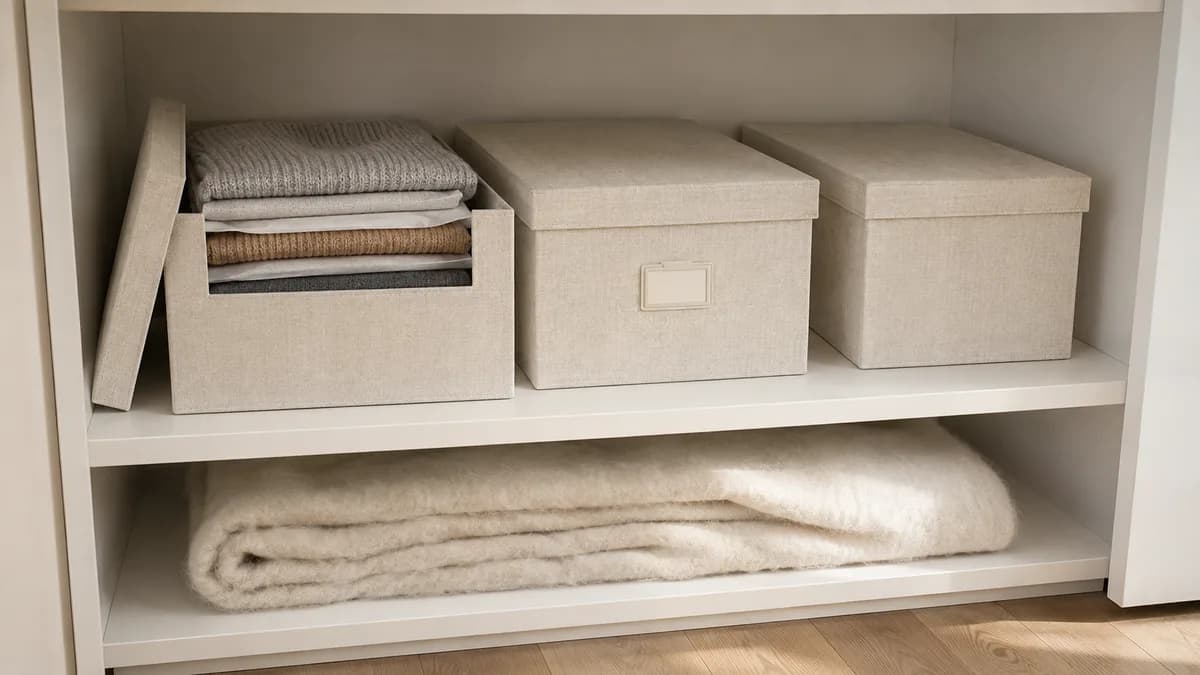
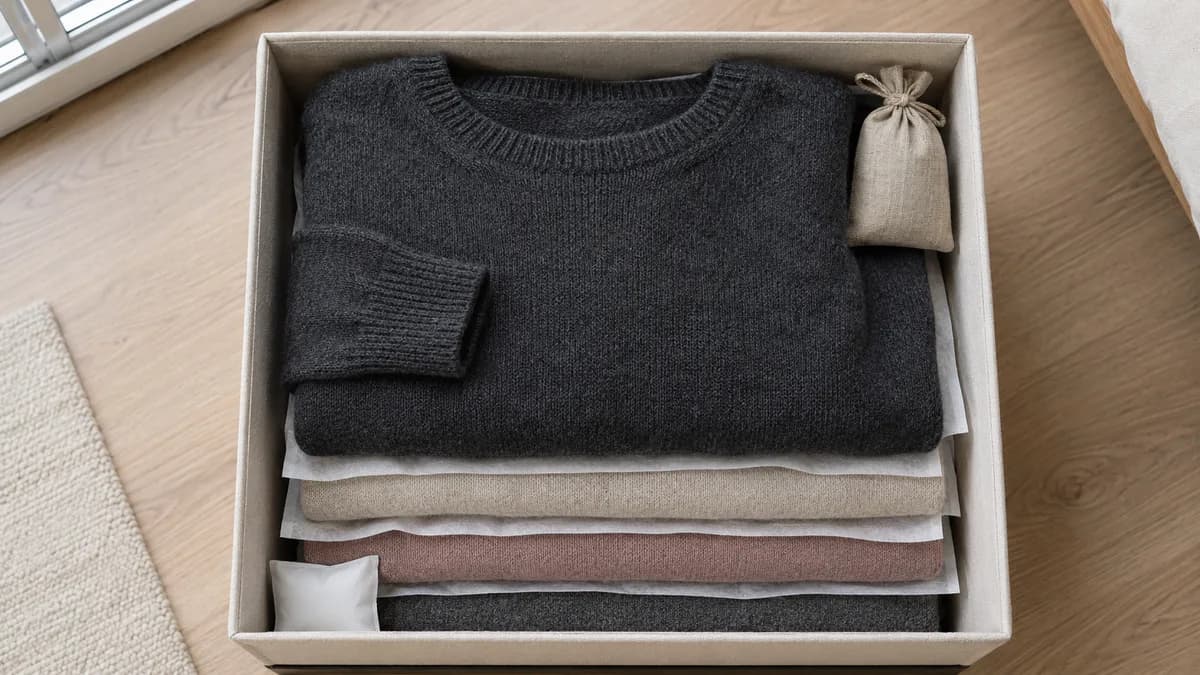
- Wool, cashmere and knitwear: folded, wrapped in non-woven fabric or cotton, inside a rigid box with a lid. Never hung for months, because the weight of the garment itself deforms the shoulder.
- Structured coats and overcoats: hung on a wide-shouldered hanger, protected by a breathable garment bag, with space between one piece and the next.
- Leather and suede: hung, away from heat sources and direct light, always in a breathable cover. Sealed plastic is the fastest route to surface mold.
- Duvets and blankets: a large box, no compression, the volume left loose. Wide folds instead of tight ones wherever it fits.
- Boots: upright, with acid-free paper or fabric filling the shaft so it does not crease, and never stacked on top of each other.
On repellents, mothballs handle the moths and leave an odour that soaks into the fibre and follows the garment into the next season. In an apartment wardrobe I prefer lavender or cedar sachets, replaced once a season, alongside silica gel to hold down the moisture. Cedar fades over time and works again after a light sanding of the surface.
A client in a 92m² apartment in Moema had a habit of sealing everything in heavy plastic bags with wide tape, and her bedroom faced south, with no direct sun at any hour. In May she opened the bags and smelled the problem before she saw it: two silk shirts with yellow staining at the collar and a smell of mold on almost everything. She was embarrassed, because she had stored it all clean and believed she was doing the right thing.
She was doing the right thing until the last step. Professional cleaning recovered most of it and one shirt was lost. We swapped the system for a lined rigid box, non-woven fabric between the pieces and one silica sachet per box. The takeaway is short: sealed plastic traps inside the box the moisture the garment already carried in there.
She would not give up plastic for her leather boots, because she was afraid of dust. Rather than push, we agreed on plastic pierced in several places with silica inside the box. It fell short of ideal and solved the real problem, which was the mold. A good part of organizing work is that negotiation.
How to fold without setting a permanent crease
A permanent mark comes from three factors together: folding always at the same point, weight on top and a long stretch of time. Six months untouched is enough for the crease to become fibre memory, above all in wool and silk. The way out is folding differently and spreading the weight across the pieces.
- Fold into three wide sections rather than four tight ones, cutting the number of creases
- Place acid-free paper or fabric at the fold line of silk and fine wool
- Stack four to five pieces per column at most, heaviest at the bottom
- Alternate the fold direction against the previous season when a piece repeats
- Leave slack in the box, because a garment pressed by the box wall also marks
Heavy knitwear left on a hanger is another classic. The shoulder stretches, the piece grows two drooping points and no wash brings the shape back. Knits and jersey stay folded, always. The split between what stays on a hanger and what stays on a shelf is covered in the guide on how to organize a closet.
Where to store inside an apartment
Choose the driest point in the home, even when the emptiest one is elsewhere. Before settling on the zone, put your hand on the wall and feel whether it is cold or damp. Laundry areas, shower walls and external walls facing south concentrate the damp in a São Paulo building.
- Overhead hallway or internal wardrobe cabinets: usually the driest zone in the apartment, away from external walls and plumbing.
- Top of the bedroom wardrobe: a good option, as long as the wardrobe does not back onto a bathroom wall.
- Under the bed: works with the box lifted off the floor and in a room that gets ventilation. In a bedroom shut all day, it is the worst zone in the home.
- Building storage unit: demands extra care, because many sit in the basement, with no window and humidity above the rest of the building.
When the wardrobe is short and no dry zone is left over, the problem stops being the season and becomes capacity. In that case seasonal rotation has to come with a review of the whole system, along the lines of the method described in how to organize a small wardrobe.
A couple in a 68m² apartment in Pinheiros had no overhead cabinet and decided to store the boxes under the divan bed, pushed against the wall that backed onto the laundry area. There was slight damp there that nobody had noticed, because the skirting was intact and the paint was not blistering. By April three boxes had mold and one duvet was lost.
The bigger frustration was not the duvet. It was finding out the problem had been visible the whole time to anyone who knew how to look. We moved the boxes to the overhead hallway cabinet and adopted a simple test before settling on any new zone: leave a sheet of plain paper against the wall for 48 hours and check whether it comes away wavy or cold. Choosing where to store means reading the wall before measuring the space.
They decided not to replace the duvet that year and got through the following winter with what was left. It was a practical call, made with the budget tight after the bathroom works, and it held.

How to unpack for the next season
Opening has a method of its own and almost nobody applies it. Open the boxes two to three weeks before you need the clothes, not on the first cold day. A garment stored for months needs time on a hanger for the crease to relax and the wardrobe smell to leave, and rushing this stage usually ends in an unnecessary wash.
- Hang everything in a ventilated room for 24 to 48 hours before wearing it
- Check collars, cuffs and underarms for staining that appeared during storage
- Steam rather than iron wool, so the crease releases without flattening the fibre
- Separate what went unworn last season and decide on letting go now, garment in hand
- Record what went into each box on the outside, to avoid opening all of them next year
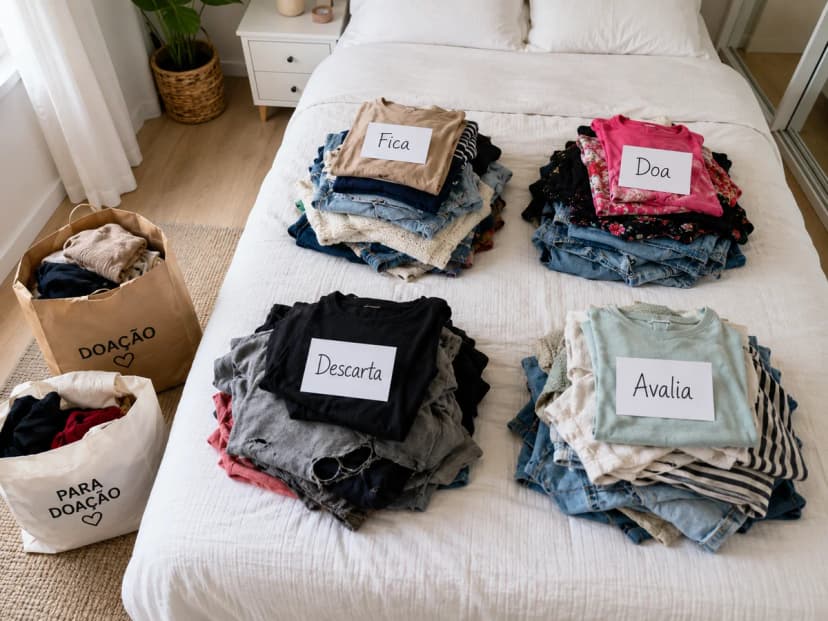
Unpacking is also the best moment to decide what leaves circulation, with the garment in hand and a fresh memory of the winter you spent without wearing it. If that part tends to stall, the route is in how to let go without pressure.
The tag on the outside of the box looks like a detail and it is what holds the system up. Without it, the family opens five boxes to find one scarf and puts everything back any which way, undoing in an afternoon the care of a whole season.
Storing well returns the garment intact for the next season. In a city that spends the year above 76% humidity, the result of a system that works is a quiet one: no new stains, no strange smell and the coat with the same volume it had last year. Something will end up out of place regardless, because a routine is not a showroom, and the difference is that the damage stops happening unnoticed.
Frequently asked questions about storing winter clothes in São Paulo
Can winter clothes be stored in vacuum bags?
It depends on the fibre. Cotton and synthetic pieces handle compression well and return to shape after a few hours on a hanger. Wool, cashmere, chunky knits, goose down and any leather item should never go in a vacuum bag: prolonged compression breaks down the structure of the fibre, flattens the loft that makes the piece warm and sets creases that never come out. In São Paulo there is a second problem, because the sealed bag traps whatever moisture the garment absorbed before it was packed away.
Do winter clothes need washing before storage?
Yes, including the pieces that look clean. Invisible residue from sweat, perfume, skin oil and food splashes is exactly what feeds moths and fungus inside a box that stays shut for six months. The stain nobody can see in September comes out yellow in April, already oxidised and far harder to remove. Before washing, check the care symbol on the label, which is mandatory under Brazilian regulation and states the correct treatment for that fibre.
What is the best container for storing winter clothes in an apartment?
A rigid box with a lid, lined with cotton or non-woven fabric, with each garment wrapped in non-woven fabric rather than plastic. Non-woven fabric keeps dust out and still lets air move through, which is decisive in a humid city. A sealed plastic bag does the opposite: it holds in the moisture already inside and creates condensation when the temperature swings. For leather the plastic is worse still, because it stops the fibre breathing and encourages surface mold.
Where should winter storage boxes go in a small apartment?
Choosing the spot starts with reading the wall, before any calculation of free space. Avoid every zone against a laundry wall, a shower wall or an external wall facing south, which are the first places damp shows up in a São Paulo building. Overhead hallway cabinets and the top of an internal wardrobe are usually the driest areas. Under the bed only works with the box lifted off the floor, and never in a room that stays shut all day.
Would you rather have a professional?
Closets and seasonal storage organized by a professional in São Paulo
Silvana organizes closets, wardrobes and every room in São Paulo. A system built around your family's routine. Project assessment.
Request an assessment on WhatsAppServing São Paulo and region

About the author
Silvana Santanna →Personal Organizer in São Paulo, specialized in residential move organization and functional organizing projects for homes, closets, kitchens, trousseaux and home offices. Creator of the Casa Pronta™ Method, with more than 100 projects completed across São Paulo and the greater metro area.
Ready to have your home organized
without lifting a finger?
Project assessment visit.