How to Organize the Fridge: Temperature Zones and Leftovers
How to organize fridge and freezer with a professional method: temperature zones, what never belongs in the door, a leftover system and containers.
Neste guia você verá:
- 01Why does an overpacked fridge spoil food early?
- 02How do the temperature zones inside a fridge work?
- 03What should never sit in the fridge door?
- 04How do you organize a freezer without losing what is at the back?
- 05How do you build a leftover system the family actually uses?
- 06Which containers to use, and how to fix the lid chaos?
- 07How do you keep the fridge in 10 minutes a week?
Why does an overpacked fridge spoil food early?
Because a shelf packed to the back wall blocks the path of the air. The FDA is blunt about it: avoid overpacking the fridge, because cold air must circulate around refrigerated foods to keep them properly chilled. A shelf loaded wall to wall blocks the vent, and whole regions of the appliance start working above the safe temperature.
That is the part nobody mentions. A disorganized fridge costs food. Opening the door and failing to find the cheese is the visible symptom; poor preservation is the expensive part, and it happens quietly. Brazilian families throw out 128 kilos of food a year, according to research by Embrapa. A good share of it passed through the fridge before reaching the bin.
In client work, the same set of causes shows up almost every time:
- Storing by space instead of temperature: the container goes wherever it fits. Since the regions of a fridge chill differently, food ends up in the wrong zone and spoils before the printed date.
- The blind back: anything touching the back wall disappears from sight and blocks the vent. That is where forgotten leftovers live, along with the sauce jar opened three weeks ago.
- Leftovers with no identity: a closed opaque container, no label, no date. Nobody opens it, nobody eats it, everybody throws it out on the weekend.
- Market bags stored as they arrived: a knotted plastic bag inside the crisper traps moisture and speeds up rotting. The greens wilt in two days and the market takes the blame.
None of this is solved by buying a bigger fridge. If your whole kitchen needs a system rather than just the fridge, the kitchen organization method by zones shows how the spaces talk to each other.
How do the temperature zones inside a fridge work?
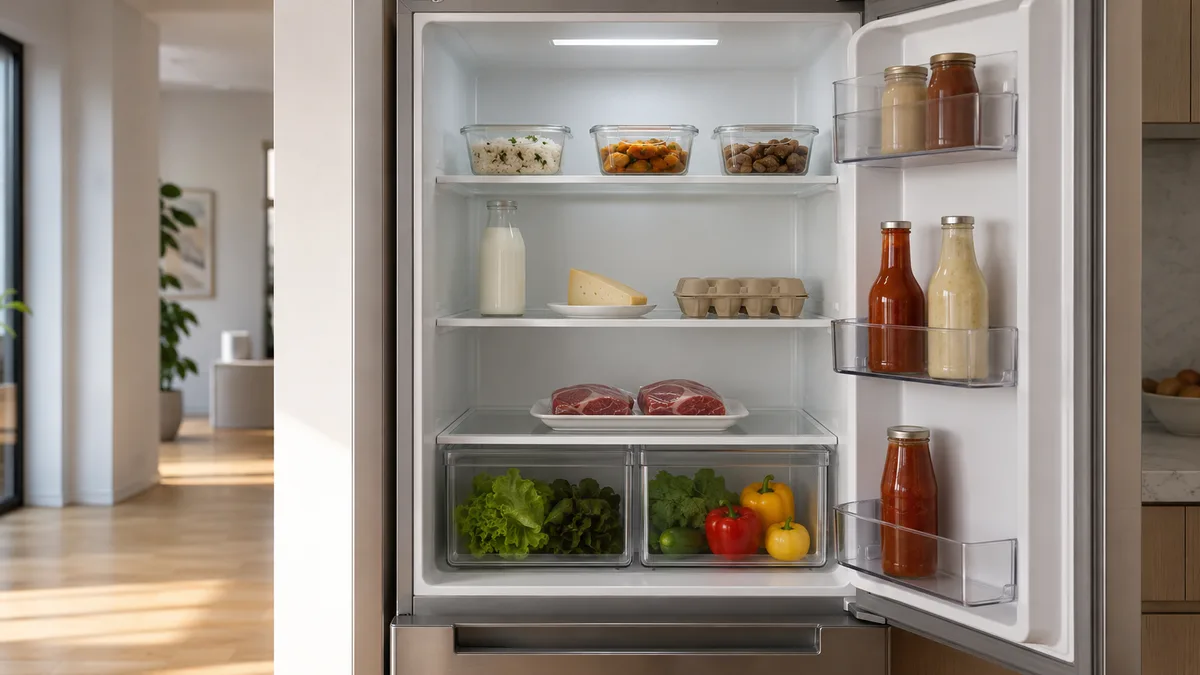
A fridge does not chill evenly. Cold air enters through a vent at the back and falls, which creates regions of different temperature inside the same appliance. Organizing by zones means putting each food in the range it tolerates. The FDA reference is to keep the appliance at 4 degrees Celsius or below, and the freezer near 18 below zero.
Top shelf: the steady zone
This is the region with the most constant temperature and the most visible one when you open the door. Ready-to-eat food belongs here: last night's leftovers, lunch remains, opened cold cuts, yoghurts, anything that will not be cooked before being eaten. Putting ready-to-eat above raw also has a practical safety reason: nothing dripping from raw food lands on cooked food.
Middle shelf: dairy and daily use
Milk, cheese, butter, eggs and whatever the family reaches for several times a day. Many people are surprised to see eggs off the door, but that is exactly where they should be, in their original carton, protected from swings. The middle shelf combines steady temperature with easy access, which makes it the everyday zone.
Bottom shelf: meat and fish
The shelf closest to the drawers is usually the coldest in the appliance. Meat, poultry and fish belong there, always in a closed container or on a plate that will catch any liquid. This is also the thawing zone. Anvisa advises that thawing be done under refrigeration, below 5 degrees Celsius, or in the microwave when the food goes straight to cooking. Thawing on the kitchen counter is the most common habit on the list and the riskiest.
Drawers: vegetables, greens and fruit
The crispers hold more moisture and exist for produce. The rule that changes the outcome is taking everything out of the plastic market bag. A leaf stored inside a knotted bag sweats, soaks and rots in two days. Wash it, dry it well, store it in a container or a perforated bag with a paper towel at the bottom to absorb the excess moisture.
She called the repair technician twice. There was nothing wrong with the fridge.
In a 60-square-meter apartment in Vila Mariana, a client who lives with her teenage daughter was convinced the appliance was faulty. Milk turned before the printed date, lettuce wilted in two days, and she had already paid for two service visits that found nothing. When we opened the fridge, the back was taken up by a large glass baking dish pressed against the wall, right in front of the vent. The shelves were loaded wall to wall. I put a standalone thermometer on the middle shelf: 9 degrees Celsius, more than double what it should read.
We emptied everything, pulled the containers about three fingers away from the back wall and removed the dish. Within 24 hours the thermometer read 4 degrees. The milk stopped turning the following week.
The baking dish had belonged to her grandmother and, in her words, "only fit there". That was the hard part of the conversation. She agreed to move the piece to the cabinet above, and complained about it for a good three weeks. Then she stopped complaining, because she stopped throwing food out.
The lesson: a fridge that seems faulty is often just blocked. Before calling for service, it is worth measuring the real temperature with a standalone thermometer and clearing the space in front of the vent.
The kitchen is the room that gives back the most time once it gets a system built around the routine of whoever cooks there.
See home organization →What should never sit in the fridge door?
Milk, eggs, yoghurt and meat. The door is the region that swings the most in temperature, because it takes in room air every time the appliance is opened. In a busy house that happens dozens of times a day. The door works well for stable items: bottled sauces, jams, preserves, oil, water and soft drinks.
The moulded egg tray built into the door is probably the most self-contradicting accessory ever fitted to an appliance. It puts the food most sensitive to thermal swing at the point of greatest thermal swing in the machine. Eggs are stored in their original cardboard carton, on a shelf, and the carton also protects them from absorbing odours.
The mother was certain the supermarket was selling old eggs.
In a family of four in Perdizes, with two small children, the door was home to the milk, the eggs and the children's yoghurts. Over two months, three cartons of eggs smelled off before the printed date and one yoghurt pot swelled. The mother had already decided to change supermarket. We counted together how many times the door opened on a Saturday afternoon with the children home: 26 times in four hours.
Milk and eggs moved up to the middle shelf, the eggs back in their original carton. The door kept sauces, jam, oil and water. They stopped losing eggs, and the yoghurt started lasting to its printed date.
The six-year-old kept storing her chocolate milk in the door, because it was the only spot she could reach on her own. It stayed there. Sealed UHT chocolate milk handles the swing fine, and a system a child can use alone is worth more than a perfect system she ignores.
The lesson: before blaming the supplier for a date, it is worth looking at where the food was stored. Sensitive food in the unstable zone spoils before the printed date, and the date is not at fault.
How do you organize a freezer without losing what is at the back?
With identification and single portions. A freezer rarely fails for lack of space. It fails because nobody knows what is inside the containers. Freezing in one large dish makes it worse: thawing means committing to the whole meal, so nobody thaws it, and the container ages at the back of the drawer.
A simple label solves most of it
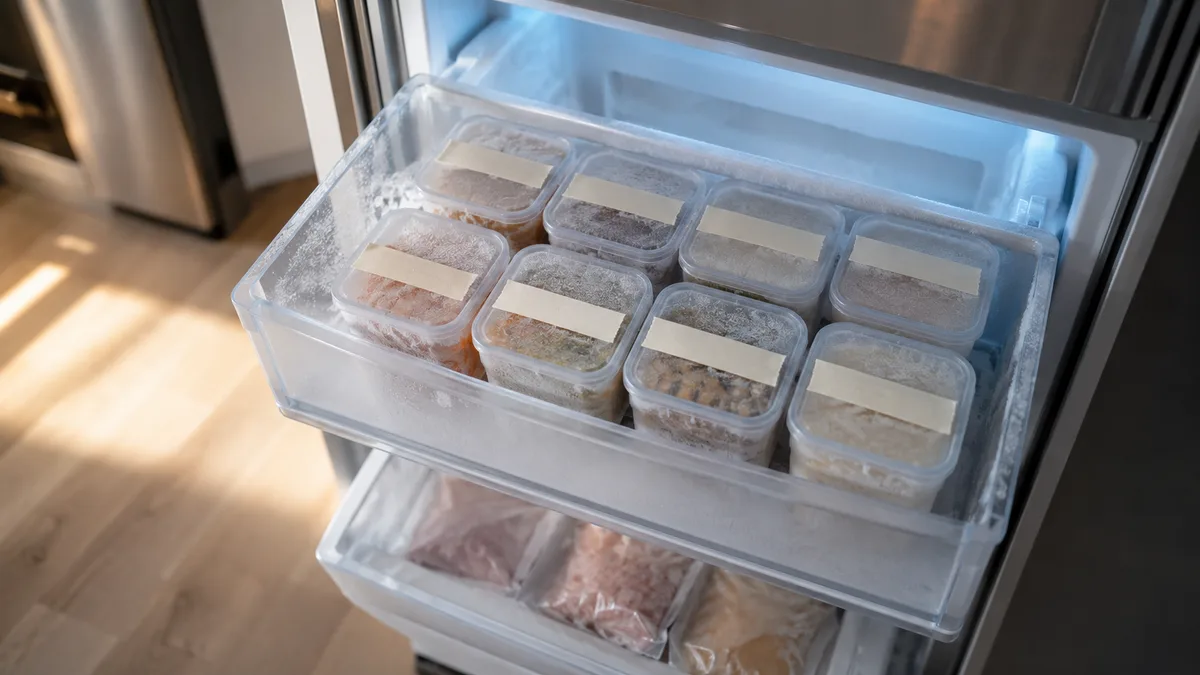
Masking tape and a permanent marker are enough. Write the name of the dish and the date it was frozen, in that order, and stick it on the lid and on the side. On the lid you read it when you open the top drawer. On the side you read it when containers are stacked upright. A label only on the lid disappears the moment someone stacks the container flat.
Single portions instead of one big dish
Freeze in the portion you will eat at once. One container per person, or one per meal. Thawing then stops being a family decision and becomes a decision for whoever came home hungry. Food that thaws easily is food that gets eaten.
Zones in the freezer too
- Top drawer or shelf: the rotation zone. Anything that needs eating in the next two weeks lives here, at eye level.
- Middle: raw protein in portions, wrapped individually and laid flat to take up less volume.
- Back or bottom drawer: long-term stock such as fruit pulp, stocks and bread. Review it every two months so nothing fossilizes there.
On Sunday nights they were doing archaeology in the freezer.
A couple in Pinheiros cooked on Sundays for the whole week. Both work outside the home and the idea was sound. The problem was the storage: identical white containers, opaque, with no labels at all, stacked across three drawers of an upright freezer. At dinner time they would thaw a container blind and find out what was in it once it had gone liquid. When we took inventory, nearly half of what was in there was discarded because nobody could say what it was or when it had been made.
We adopted masking tape with name and date, freezing in single portions, and the top drawer reserved for whatever had to go first. Two months later, almost nothing had gone in the bin for lack of identification.
In January they travelled, dropped the labelling and went back to anonymous containers. We had to start over. The fix that stuck was moving the masking tape out of the drawer and onto the fridge door, in plain sight. A system that requires fetching the materials tends to die in the first busy week.
The lesson: a freezer fails at identification long before it runs out of space. And the labelling material has to sit where the person stands at the moment of storing, not in a drawer in another room.
How do you build a leftover system the family actually uses?
By giving leftovers a fixed, visible address. A leftover that enters the fridge without a defined spot vanishes behind the juice bottle and resurfaces when it is past eating. The system has three parts: a fixed zone on the top shelf, a clear container and the date written on it.
The week zone
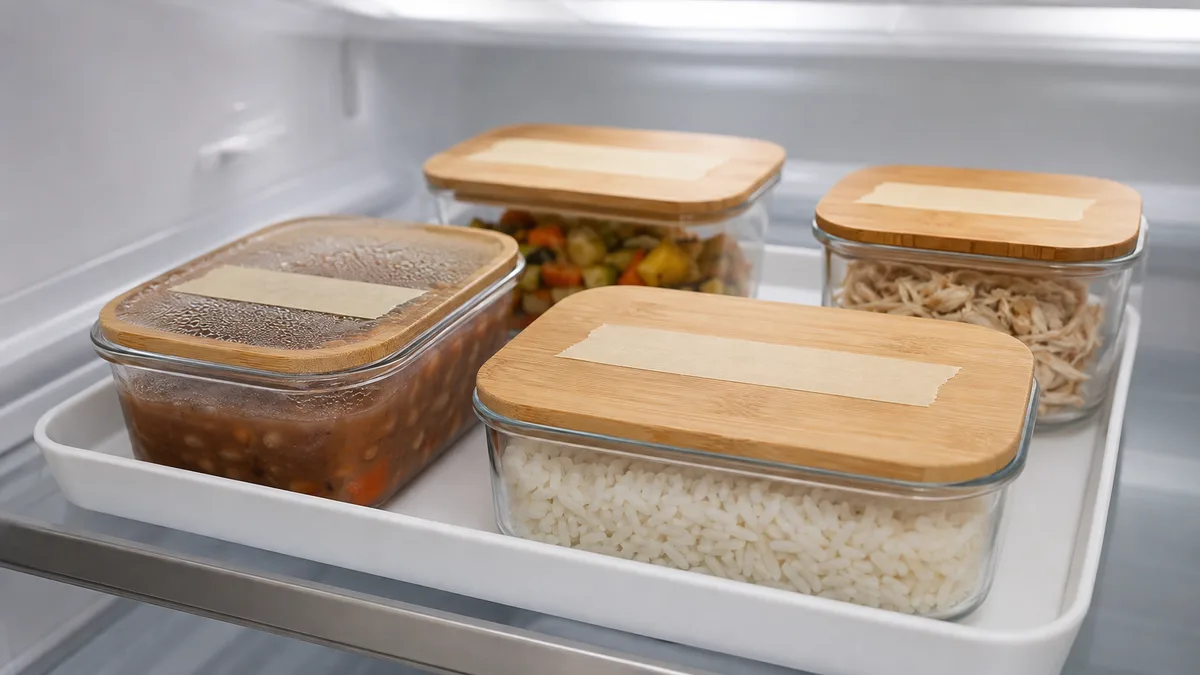
Set aside part of the top shelf, preferably at the front, and call it the week zone. Everything that has to be eaten in the next few days lives there. A shallow tray marks the area and lets you pull the whole set out at once to see what is in it. Whoever opens the fridge hungry looks there first.
The real deadline for a leftover
The Brazilian sanitary standard applied to food service works with a five-day limit for prepared food held below 5 degrees Celsius. At home, where the door opens constantly and the temperature swings more, the practical criterion I use with clients is more conservative: three days in the fridge, and whatever goes past that moves to the freezer on the third day, not the fifth.
There is also a rule that comes before the fridge. Anvisa advises against leaving cooked food more than two hours at room temperature, and the FDA uses the same two-hour limit for perishables in general. The pot that spends the afternoon on a switched-off stove waiting for someone to put it away already starts storage at a disadvantage.
- Store the leftover within 2 hours of cooking
- Use a clear container, so you can see the contents without opening it
- Write the preparation date, not an estimated expiry
- Reserve a fixed zone on the top shelf for the week
- On the third day, freeze whatever has not been eaten
- Pull the week tray out before writing the shopping list
Which containers to use, and how to fix the lid chaos?
Clear, stackable containers from a single family. Transparency removes the curiosity opening that warms the contents. A stackable shape uses the height of the shelf. And keeping one single line of containers solves the problem that eats the most time in a kitchen: hunting for the matching lid.
Glass or plastic
Glass does not absorb odours or stain with tomato sauce, moves from freezer to microwave when it is tempered, and lasts for years. It weighs more and it breaks, which matters if children fetch their own food.
Rigid food-grade plastic is light, resistant and safer in a child's hand. It stains over time and can hold smells if it goes away sealed while still damp. It works in the freezer as long as the container is rated for low temperature, since ordinary plastic cracks in the cold.
The lid problem
The container cabinet turns to chaos because a house accumulates lids from different lines over the years. The fix has two steps and takes under an hour. First, gather every container and every lid on the table and match them one by one. A lid with no container and a container with no lid leave the house, no exceptions and no promise that the other half will turn up. Then store the containers stacked and the lids upright inside a vertical organizer or a shallow box, separated by size.
A lid stored flat inside its own container looks organized and is not: it fills the whole interior volume and forces you to dismantle the entire stack to reach a container in the middle.
How do you keep the fridge in 10 minutes a week?
With one fixed pass before the weekly shop. The right moment is the day before the market or the farmers market, because the review turns into the shopping list on its own. Ten minutes a week prevent the three-hour deep clean nobody wants to do on a Saturday.
- Pull the week tray and decide: eat today, freeze or discard
- Check the dates on leftovers and on anything opened in the door
- Wipe fresh spills with a damp cloth before they harden
- Check whether any container is touching the back wall
- Note what is running out while you look, not afterwards
- Gather the greens that need using in the next two days
The quarterly review
Every three months, take everything out, wash the shelves and drawers with a damp cloth and diluted vinegar, and review the whole freezer. Use the chance to measure the temperature with a standalone thermometer, because a dried-out door gasket is the most common silent cause of an appliance that chills badly. If the gasket cannot hold a sheet of paper in place with the door closed, it needs replacing.
After some years organizing kitchens in São Paulo, the conclusion I carry is less pretty than the fridge photos on social media. Those shelves with matching containers and fruit in rows do not survive a Wednesday with a child at home and a meeting running late. The fridge that works has containers from different brands, has yesterday's leftovers at the front and has empty space on purpose. What it does not have is food hidden at the back waiting for cleaning day to be discovered. That is the standard that holds, and it is the only one worth chasing.
Frequently asked questions about fridge and freezer organization
What is the correct temperature for a fridge and a freezer?
The FDA recommends keeping the refrigerator at 40 degrees Fahrenheit or below, which is roughly 4 degrees Celsius, and the freezer at 0 degrees Fahrenheit, roughly 18 degrees below zero Celsius. Anvisa, the Brazilian health authority, advises that perishable food be refrigerated preferably below 5 degrees Celsius. The catch is that almost no domestic fridge shows its real temperature: the dial reads 1 to 5, which is power, not degrees. A standalone fridge thermometer costs very little and is the only way to know whether the appliance delivers what it promises.
Why should milk and eggs not be stored in the fridge door?
The door is the most unstable part of the fridge because it takes in room air every time someone opens the appliance. In a house with children the door opens dozens of times a day and the temperature there swings constantly. Milk, eggs, yoghurt and meat are among the foods that tolerate that swing worst. The door works well for stable items: bottled sauces, jams, oils, preserves and water. Perishables belong on the inner shelves, where the temperature holds steady.
How long can leftovers stay in the fridge?
The Brazilian sanitary standard applied to food service works with a five-day limit for prepared food held below 5 degrees Celsius. At home the practical criterion is shorter: eat it within three days and freeze whatever is left after that. Anvisa also advises against leaving cooked food more than two hours at room temperature before refrigerating it. Writing the preparation date on the container settles the question without relying on memory or on smell.
Does an overpacked fridge spoil food faster?
Yes, and it sits in the official FDA guidance: cold air must circulate around refrigerated foods to keep them properly chilled. When shelves are packed wall to wall, the airflow from the vent at the back of the appliance gets blocked and whole regions of the fridge run above the safe temperature. The appliance looks like it is working because the motor is running, but food sitting in front of the obstruction spoils early. Empty space inside a fridge serves a preservation purpose.
Would you rather have a professional?
Kitchens and fridges organized by a professional in São Paulo
Silvana organizes kitchens, pantries and every room in São Paulo. A system built around your family's routine. Project assessment.
Request an assessment on WhatsAppServing São Paulo and region

About the author
Silvana Santanna →Personal Organizer in São Paulo, specialized in residential move organization and functional organizing projects for homes, closets, kitchens, trousseaux and home offices. Creator of the Casa Pronta™ Method, with more than 100 projects completed across São Paulo and the greater metro area.
Ready to have your home organized
without lifting a finger?
Project assessment visit.