How to Organize a Beach House on the São Paulo Coast
How to organize a beach house that sits closed for weeks: protect linen from humidity and salt air, build an arrival kit and close the house mold-free.
Neste guia você verá:
- 01Why does a beach house fall apart faster?
- 02How do you prepare a house to stay closed for weeks?
- 03How do you protect linen from humidity and salt air?
- 04How do you build an arrival kit?
- 05How do you organize a kitchen used in bursts?
- 06What goes on the departure checklist?
- 07What changes when the house is also a holiday rental?
- 08Is a personal organizer worth it for a beach house?
Why does a beach house fall apart faster than your city home?
A beach house does not get messy from use. It gets messy from being left alone. Your city home is reset every single day by the people living in it. The coastal house sits locked for weeks, with still air and humidity working on its own inside the wardrobes. What you find when you come back has another name: deterioration.
And it is a common problem. The 2022 Census counted 6,672,912 occasional-use dwellings in Brazil, 7.4% of every home in the country and 70.7% more than in 2010. The Southeast holds 2.7 million of them. A large share belongs to São Paulo families who spend the year in the capital and drive down to the coast on a handful of weekends.
Four specific conditions explain why it degrades so quickly:
- Constant humidity and still air: the US Environmental Protection Agency recommends keeping indoor relative humidity below 60 percent and drying any wet material within 24 to 48 hours to avoid mold. On the coast, with the house locked, both conditions break at the same time. You can check the average for the nearest weather station in the INMET climate normals.
- Salt air: airborne salt speeds up corrosion on hinges, wardrobe rails, cast iron pans, scissors, the grill and any metal piece left exposed. Salt in contact with metal does not dirty it, it corrodes it. And it corrodes with the house empty, with nobody there to notice.
- Use in bursts: nobody keeps a maintenance routine in a house that sees people three days a month. The system has to work without anyone feeding it during the weeks of absence.
- A rotating cast: guests, extended family, your children's friends, the caretaker, the cleaner. Each person puts things away differently. With no labels and no obvious home for each item, the system dissolves within one season.
None of these four is solved with more storage. All of them are solved with method. The underlying logic is the same one in the residential organization guide, adapted for a property that spends most of its time alone.

How do you prepare a beach house to stay closed for weeks?
Preparing the house for absence means letting air move and fabric breathe. Internal doors open, wardrobes ajar, nothing wet left indoors, no metal exposed to salt air and no fabric trapped in plastic. A closed house still needs to ventilate on the inside, even when it is locked on the outside.
The most frequent mistake I see in coastal homes is the exact opposite. People seal everything believing they are protecting it. They shut the wardrobes, wrap cushions in plastic, cover the sofa with a tarp. The result is a greenhouse. The moisture already held in the fabric has nowhere to go and turns into a stain.
What stays open and what stays closed
- Open: bedroom and bathroom doors, wardrobe doors unlatched by a few centimetres, empty drawers, the fridge switched off with its door propped, the washing machine lid.
- Closed: everything metal, inside a wardrobe with a silica dehumidifier. Cast iron pans, good knives, tools, garden shears.
- Covered with fabric, never with plastic: sofas and mattresses. An old sheet or a cotton cover keeps dust off and still lets air through. Plastic traps vapour.
If someone can open the house once a month, one hour with the windows open does more than any product you can buy. And the best moment is mid-afternoon, when the temperature rises and relative humidity drops.
How do you protect bed linen, towels and bedding from humidity and salt air?
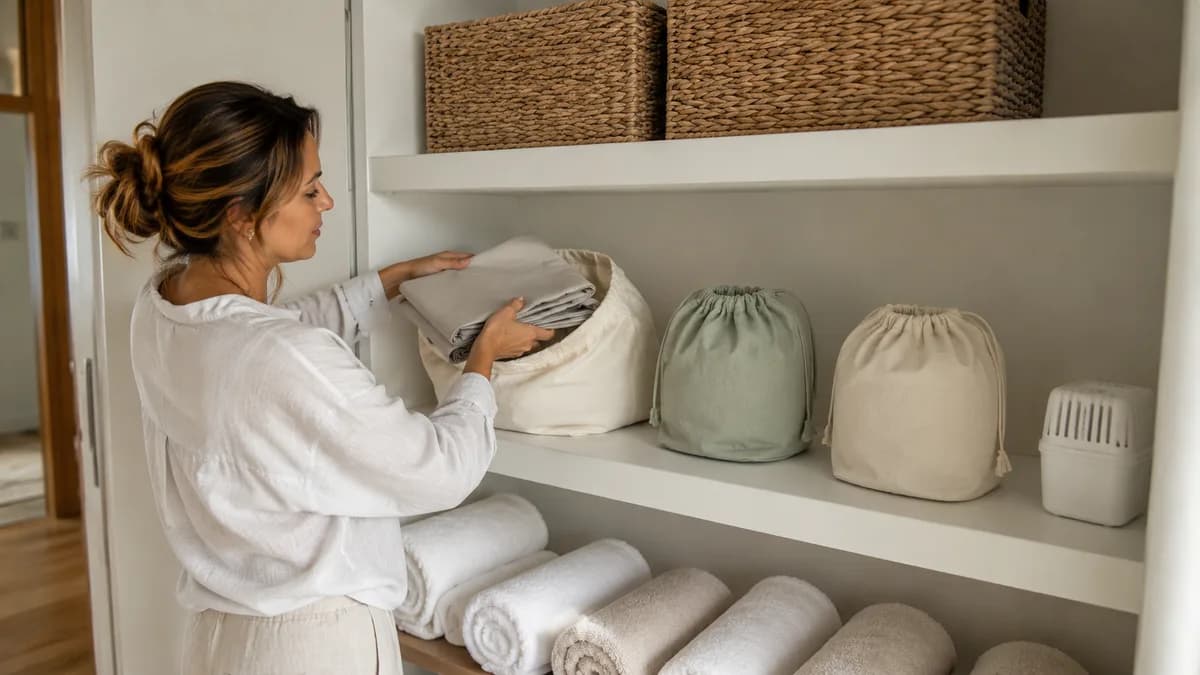
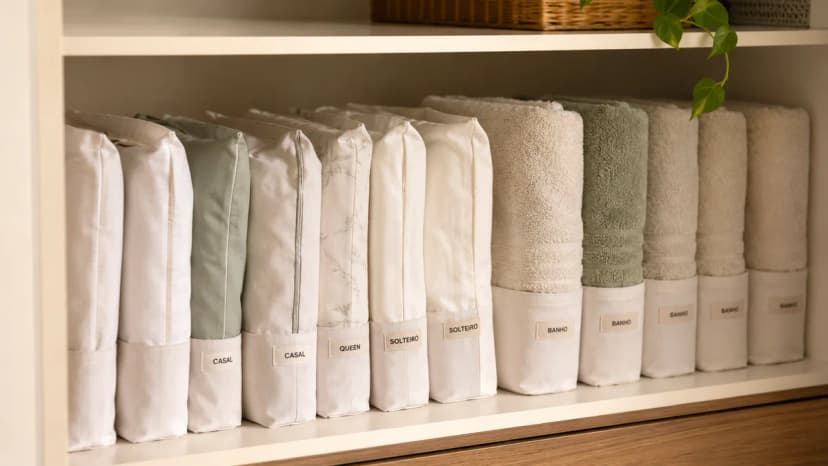
Fabric stored on the coast needs three things: to be completely dry when you put it away, to sit in something that breathes, and to have silica nearby. Cotton bags, clean pillowcases and fibre boxes all work. A sealed vacuum bag only works if the piece went in dry, which rarely happens in a beach house.
That detail is what solved the most stubborn case I handled in Riviera de São Lourenço.
The family had a beachfront apartment in Bertioga and used the house one weekend a month, plus the whole of January. They would arrive on Friday close to ten at night, tired from the drive with two teenagers, and the first thing they did was open every window because of the smell. Then came the worse part: pulling the bed linen out of the wardrobe, catching that stale smell and putting everything in the washing machine before anyone could sleep. The first night was always lost. The mother used to say she arrived at the beach more tired than she had left São Paulo.
The entire set of linen was sitting inside sealed plastic bags in the hallway wardrobe. She was certain that counted as protection and pushed back when I suggested taking it out. She only changed her mind when we opened a linen sheet set that had been in there for eight months and found yellowish stains from sealed-in moisture. We moved everything into cotton bags, added silica dehumidifiers on the shelves and set aside one labelled set per bed for the first night.
On the next trip, arriving took twenty minutes. Beds made, no washing machine, no smell.
The lesson: sealed plastic on the coast does not protect fabric. It traps the moisture already in the fibre and turns the wardrobe into a damp chamber. For folding and storage in more depth, the post on how to organize bed, table and bath linen covers the full-set system.
An organized second home gives the family the whole weekend back, instead of spending the first night putting the house in order.
See home organization →How do you build an arrival kit that solves the first two hours?
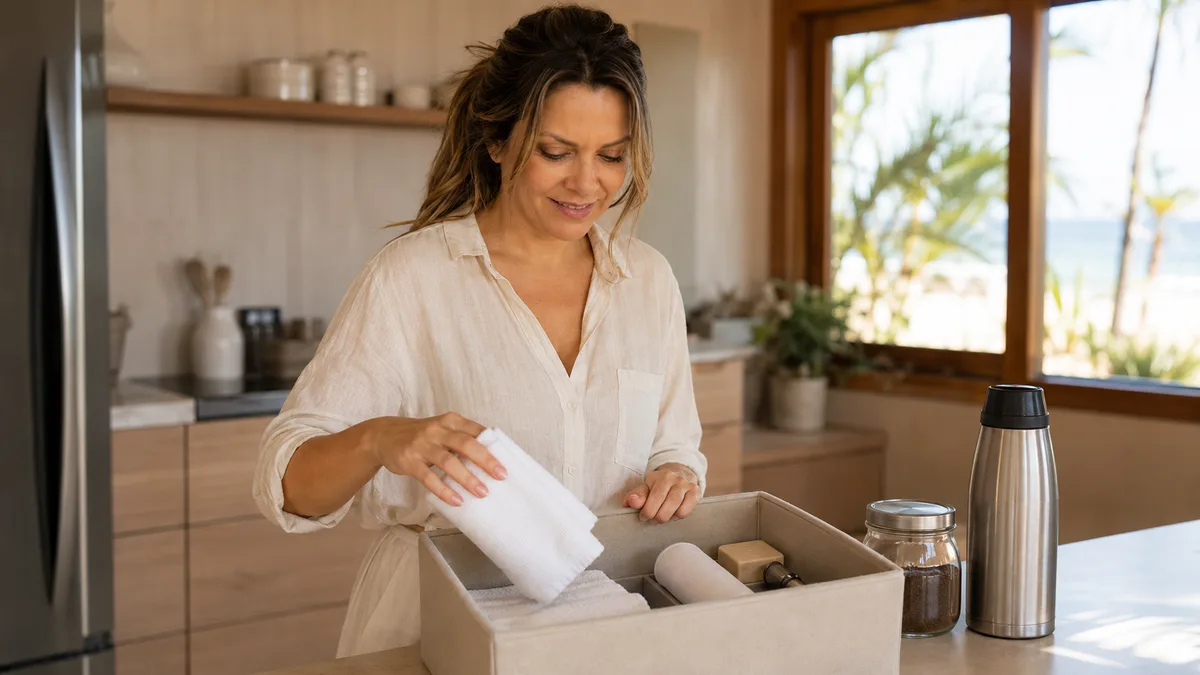
The arrival kit is a single box, stored in the wardrobe nearest the front door, holding everything the family needs in the first two hours. It exists so that nobody has to hunt for anything while the car is still loaded, a child is hungry and the luggage is sitting in the middle of the living room.
What goes in the box:
- One sealed set of bed linen per bed, reserved for the first night
- Two clean bath towels per family member
- Floor cloth, bin bags and a quick cleaning kit
- Toilet paper, soap and the bathroom basics
- Coffee, filters, sugar and bottled water
- Torch, batteries and a candle for power cuts
- Spare insect repellent and sunscreen
One rule keeps the kit alive: whoever takes something out replaces it before leaving. Without that rule, the kit disappears by the third season. It is the same reasoning behind preparing a house before guests arrive, which I cover in how to organize your home for guests.
The transition zone between the beach and the house
After the arrival kit, the second point that decides whether the house holds up during the season sits at the front door. A beach house takes in wet people, sandy feet and sunscreen in hand several times a day. With no defined place for that, sand travels all the way to the bedroom and the damp towel ends up on the bed.
The transition zone takes little space and solves both. It needs four elements: a deep basket for everything that came back with sand, hooks high enough for a towel to dry fully open, a shelf or tray for sunglasses, sunscreen and keys, and a natural fibre mat that catches sand before the indoor floor. If the house has an outdoor shower, that is the first item in the sequence.
The rule that sustains the zone works better when it is said out loud on arrival and not repeated afterwards: nothing wet goes past the door. With teenagers and children in the house, that sentence needs agreeing once per season. After that, the basket and the hook do the work themselves, because they sit in the path and nobody has to go out of their way to use them.
How do you organize a kitchen used in bursts without waste?
A beach house kitchen stocks little and stocks well. Only long-life non-perishables go in, in glass or rigid plastic with a proper seal, in small quantities. Anything fresh travels with the family. A badly calibrated cupboard on the coast becomes a pantry of expired food and an insect hotel.
The permanent stock
- Stays in the house: coffee, salt, sugar, olive oil, pasta, tomato sauce, tuna, dried herbs. Enough for one weekend, not for a month.
- Travels back and forth: bread, milk, cold cuts, fruit, meat, anything that spoils with the house switched off.
- Never left open: flour, grains and biscuits. Original packaging in a closed house is an invitation to pests.
Cast iron pans, knives and metal tools deserve separate treatment. Store everything in a closed, dry cupboard with silica inside, and wipe a film of oil over the iron pieces before closing the house. It is the same care taken on board, where salt air is even more aggressive, as I explain on the yacht organization page.
What goes on the departure checklist before you lock up?
The departure checklist decides what state the house will be in next time. It takes thirty to forty minutes and covers four fronts: perishable food, standing water, damp fabric and exposed metal. It is the most thankless hour of the trip and the most decisive one.
A single-storey house in São Sebastião showed me that in the most expensive way possible.
The couple was retired, had inherited the house three hundred metres from the sea and used it only from December to February. Every summer the arrival was the same scene: rusted cast iron pans, a jammed hinge on the hallway wardrobe, mold inside the blender jug and a fridge with a smell that would not come out, not even with bicarbonate. She was embarrassed to host her grandchildren in those conditions and talked about the house as if it were falling apart because of her.
We built a departure checklist, printed and laminated, hanging on the inside of the kitchen door. Fridge switched off with the door propped open, all metal moved into a cupboard with silica, sofas covered with cotton instead of the plastic they had been using, drains sealed and no appliance stored with water inside.
The following summer: no rusted pans and no smell in the fridge. Even so, they forgot the blender with water in the jug, and it came back with mold. That was what made the couple stop trusting memory and start ticking the checklist item by item, with a pen, before leaving.
The lesson: what ruins a beach house is not the use, it is the way it is left. And a checklist held in your head fails exactly when the family is rushing out to beat the traffic.
- Empty the fridge, switch it off and prop the door open
- Check every appliance with a reservoir: blender, coffee machine, iron
- Move metal into a closed cupboard with silica
- Cover sofas and mattresses with fabric, never with plastic
- Seal the drains and shut off the water valve
- Leave internal doors and wardrobes ajar
- Restock the arrival kit for the next trip
- Take the rubbish out and check that no fabric was left damp
What changes when the beach house is also a holiday rental?
A rented house is organized by owner, not by category. What belongs to the family goes in a wardrobe that locks. What belongs to the guest sits in open storage with a visible inventory. Without that split, every changeover turns into half a day of work and the owner never knows what is missing until she arrives.
That was the case in a house in Guarujá I worked on last year. The owner rented it out in the gaps when the family was not using it, and every changeover was a military operation: hide what was personal, lay out what was for guests, count towels, discover a missing piece. The main wardrobe had her own clothes mixed in with the rental linen. She said the house felt invaded without being able to explain quite why.
We did three things. A main wardrobe with a lock, for everything belonging to the family. Guest linen in a colour clearly distinct from the personal set. And a photographed inventory, taped to the inside of the linen cupboard door, with the exact count of what should be on each shelf.
The changeover between guests dropped from half a day to around an hour, and the caretaker started checking it on her own, without a phone call. The owner hated the distinct linen colour at first, said it gave the house a hotel look. She kept it anyway, because pieces stopped going missing.
The lesson: in a shared property, the boundary matters more than the label. As long as what belongs to the family and what belongs to the guest share a shelf, no system survives a second season.
Is hiring a personal organizer worth it for a beach house?
It is worth it when the house already has a history of loss: stained linen, rusted metal, repeat purchases of things that already exist in some cupboard. Organizing this kind of property works as preventive maintenance: it builds a system that has to run on its own during the weeks when nobody is there.
After years organizing second homes on the São Paulo coast, the difference I see between the house that holds up and the house that degrades has nothing to do with square metres or how much was spent on the interior. It comes down to whether someone organized it with the absence in mind. A house organized only for the pretty weekend is back to chaos within two seasons.
One point that tends to surprise people: organizing a beach house pays off more at the end of the season than at the start. Working in March, with the house still full of summer, lets you see what was genuinely used and what sat untouched the entire time. Organizing in December is guesswork.
None of this will make the house perfect. Sand will keep coming in, a towel will keep hanging crooked on the line and someone will keep putting the spoon in the wrong drawer. What changes is the time between arriving and actually using the house, and what you find when you open the door after five weeks away. The house does not end up immaculate. It ends up ready, which is what matters when you pull in at ten at night with a full car.
Frequently asked questions about organizing a beach house
How do I prevent mold in a beach house that stays closed?
Mold takes hold when relative humidity goes above 60% and the air stops moving. Before you leave, keep the bedroom doors open so air circulates through the whole house, leave wardrobe doors ajar, remove anything wet or damp before locking up and never store fabric inside a sealed plastic bag. If someone can open the house once a month, one hour with the windows open in the middle of the afternoon already changes the outcome. Silica dehumidifiers inside the wardrobes help, but they need replacing every two or three weeks to keep working.
What should stay in the beach house all year round?
Anything bulky, cheap to duplicate and annoying to carry stays in the house: bed and bath linen, basic kitchen tools, spare sunscreen, beach umbrella, mats, cleaning products and a small stock of non-perishables. Only three things travel back and forth with the family: what spoils, what has sentimental value and what attracts unwanted visitors, meaning electronics, jewellery, documents and fresh food. That split cuts half the luggage and shortens the gap between arriving and actually using the house.
How do I organize a small beach house with no built-in storage?
In a small house, the loose item is the enemy. Concentrate storage in closed stackable boxes with a visible label, one per function: beach, bed and bath, cleaning, kitchen. Use height with a high shelf in the hallway and in the bathroom, which is almost always where wall space is left over. Flat boxes with spare linen fit under the beds. Avoid raw MDF furniture on the coast, because it swells with humidity. Choose rigid plastic, synthetic fibre and treated wood instead.
Is a second set of linen worth it in a beach house?
It is, and it is the investment that removes the most friction on arrival. Without linen of its own, every trip starts with a large suitcase and ends with double laundry back home. The practical count is two sets per bed and three towels per family member, plus one spare set for guests. Keep one set per bed sealed in a cotton bag, reserved for the first night only. Arriving to a made bed with no stale smell changes the whole weekend.
Would you rather have a professional do it?
Second homes organized by a professional
Silvana Santanna organizes beach houses and homes in São Paulo and along the coast. A system built for a property used in bursts. Project assessment.
Request an assessment on WhatsAppServing São Paulo and the coast

About the author
Silvana Santanna →Personal Organizer in São Paulo, specialized in residential move organization and functional organizing projects for homes, closets, kitchens, trousseaux and home offices. Creator of the Casa Pronta™ Method, with more than 100 projects completed across São Paulo and the greater metro area.
Ready to have your home organized
without lifting a finger?
Project assessment visit.