How to Organize a Gourmet Kitchen in São Paulo: The Complete System
How to organize a gourmet kitchen in São Paulo: zoning by use station, center island, professional cookware, formal china, wine cellar, butler pantry, and coordination with household staff. Personal organizer.
Neste guia você verá:
- 01Why do gourmet kitchens end up cluttered even with all that space?
- 02Zoning by use station: the logic that structures everything
- 03Center island and work counters
- 04How do you organize appliances and large equipment?
- 05Professional cookware and specialty utensils
- 06A system for knives, boards and professional utensils
- 07China, crystal and family heirlooms
- 08Butler pantry: when it exists and how to integrate it
- 09Gourmet pantry and home wine cellar
- 10Getting the kitchen ready to host guests
- 11Coordinating with the cook or household staff
- 12Maintaining the system over time
- 13Frequently asked questions
Why do gourmet kitchens end up cluttered even with all that space?
A gourmet kitchen gets messier than a small kitchen. It sounds backwards, but that is what shows up in sessions across São Paulo: ample space gives permission to accumulate without urgency. With more counter, more cabinets and more drawers, the natural tendency is to fill everything with no criteria for frequency of use. The result is an expensive, well-equipped kitchen that, in practice, is hard to use day to day.
There is another layer to the problem: gourmet kitchens are spaces with a social function. The people who have them tend to genuinely care about cooking, host guests, test new recipes, collect ingredients from trips, and buy specialized equipment. That is the profile. The organization system needs to work with that profile, not against it.
Three patterns of clutter show up repeatedly in gourmet kitchens:
- Appliances parked on the counter for lack of a system: the stand mixer, the food processor and the air fryer sit on the counter not because they are used every day, but because no one knows where to store them. The counter turns into storage for equipment that blocks the prep space.
- Quality utensils with no fixed home: Japanese knives, mandolines and culinary thermometers all mixed into generic drawers. Expensive equipment ends up in contact with what it shouldn't be, and loses quality before it needs to.
- A pantry full of invisible specialty ingredients: spices from four different cuisines, three open bottles of olive oil at once, flours that expire before they get used. New purchases cover the old ones and the waste happens quietly.
In a session in Higienópolis, a client had moved in eight months earlier after a full renovation. New kitchen, a two-meter center island, four linear meters of tall cabinets. The renovation had been expensive, and the counter was covered with seven appliances competing for space with the cutting board, the salt cellar and the oil dispenser.
Her sense was that the kitchen was "much bigger than it looked on the floor plan, but strangely small in practice." When we emptied the cabinets, the picture became clear: the appliances sat on the counter because the cabinets were full of items with no defined use. There was no distinction between what got used every week and what only came out for the year-end holidays.
With sorting by frequency, two appliances went to the laundry room (occasional use), three went back into the tall cabinets (monthly use), and two stayed on the counter (daily use). The counter opened up two linear meters in two days. Three weeks later she messaged to say she had bought a sous-vide and wasn't sure where to put it. The answer was the same question: what is the real frequency of use? The equipment went into the monthly-use cabinet. The counter stayed clear.
The takeaway: a gourmet kitchen accumulates clutter for lack of a criteria to decide what deserves to be accessible. Space is the enabler, never the cause.
Zoning by use station: the logic that structures everything
The most important concept for organizing a gourmet kitchen properly is not the number of organizers you buy. It is zoning: dividing the space into functional stations and assigning each station the items that belong to it. Four stations structure any gourmet kitchen, regardless of size:
- Cooking station: the stove, oven, hood and everything that goes directly over heat. This zone holds the frequently used pots, cooking spoons and spatulas, tongs, the meat thermometer, finishing oil and everyday spices. Nothing else.
- Prep station: the center island or the main counter. Active cutting boards, chef's knives, graters and frequently used mandolines, a precision scale if used regularly. The prep counter needs to be clear before any cooking begins.
- Washing station: around the sink. Dish soap, sponge, drying rack, the active dish towel. No permanent storage items on the counter next to the sink: this area is for transit and needs room to drain and dry.
- Storage station: the pantry, tall cabinets, back shelves, wine cellar. Items within each zone are arranged by frequency: the most used in the most accessible position.
The zoning logic solves the question that comes up most in gourmet kitchen sessions: "where do I put this?" The answer stops being arbitrary and becomes determined by function. A pot goes near the stove. A cutting board goes near the prep counter. A glass goes in the cabinet near the wine cellar or the fridge. Every item has a category, every category has a zone, every zone has an access criteria.
For people who cook methodically (following recipes, weighing ingredients, working in steps), zoning reduces the number of trips across the kitchen during prep. For people who entertain, it makes the space predictable for anyone in the family or on staff who needs to help.
Center island and work counters
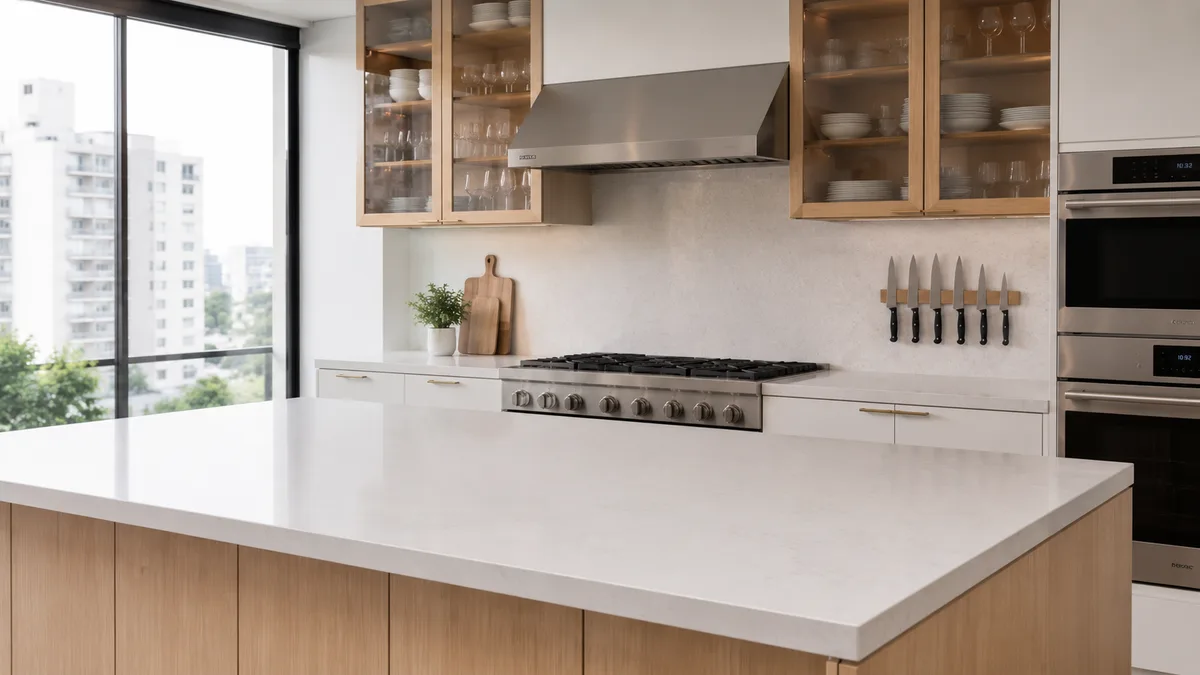
The center island is, at the same time, the most valuable asset and the biggest risk of disorganization in a gourmet kitchen. When it works as it should, it is the prep station that frees up the traffic flow around it. When it accumulates clutter, it blocks the space and shrinks the working perimeter.
What stays on the island: the daily-use rule
Nothing stays permanently on the island except what gets used at least once a day. The list almost never runs past four or five items: an active cutting board, the oil you use daily, a salt cellar, a pepper mill and, if it applies, one everyday appliance like a coffee maker. Decorative dishware, bulky fruit bowls and utensils that "just look nice" take up work surface for visual reasons, not functional ones. When guests are over, a clear counter is already the look that works.
The island drawers: the most contested territory
The drawers in the center island tend to be the most chaotic point in a gourmet kitchen. Sitting in the middle of the space, they attract everything without a defined home: batteries, pens, medication, jewelry, receipts. The island drawer is a prep-utensil drawer, or it is not a kitchen drawer at all. The rule has to be applied once and held.
The internal organization of the drawers follows the same logic: modular organizers that divide the space into fixed compartments, one item per compartment. No generic "miscellaneous" box. Every piece has an address.
Side counters: the second line of work
Gourmet kitchens with perimeter counters beyond the island have a second line of work that needs a defined function. The counter near the stove is the cooking counter. The counter near the sink is for washing and draining. The furthest counter can be the pastry counter, if that is a regular activity. Without that assignment, the counters turn into rotating dumping surfaces.
How do you organize appliances and large equipment in a gourmet kitchen?
Gourmet kitchen appliances are organized by frequency of use. Size does not determine the spot. What you use every week stays accessible. What you use once a month goes into a cabinet. What you use only on special occasions can leave the kitchen entirely with no cost to your routine.
Sorting by frequency: the three zones
- Counter zone (weekly use or more): at most two to three appliances. The criteria is actual use, not intention. If you use the coffee maker every day and the juicer four times a week, both stay on the counter. The stand mixer you use "every weekend," but which in practice came out six times last month, goes into a cabinet.
- Low-cabinet zone (monthly use): equipment accessible without a step stool. Food processor, air fryer if not used daily, electric pressure cooker. The cabinet has enough clearance to pull it out and put it back without shoving other items.
- Tall-cabinet or out-of-kitchen zone (occasional use): ice cream maker, fondue set, electric grill, pasta machine. These stay in labeled boxes with the equipment name. They can leave the kitchen entirely if space is limited.
Storage rules for high-value equipment
Premium equipment needs protection in storage, not just space. A stand mixer is stored with its attachments inside a protective bag: the pieces don't knock against the cabinet walls. Chef's knives and mandolines always with a blade guard. Equipment with nonstick surfaces is never stacked without separation between pieces.
Cords are the second critical point. A cord wound tightly creates a kink and damages the connector over time. The correct system is a cord-tie velcro strap: it keeps the slack without cinching it into a spiral. For countertop appliances, the cord is routed through a discreet clip so it doesn't take up visual space.
- List every appliance with its real frequency of use over the last 3 months
- Sort into: weekly use / monthly use / occasional use / never used
- Weekly use: maximum 3 on the counter
- Monthly use: low cabinet with enough clearance
- Occasional use: tall cabinet or out of the kitchen, in a labeled box
- Never used: donate or sell
- Cords secured with velcro, never wound into a spiral
Professional cookware and specialty utensils
The cookware in a gourmet kitchen is not ordinary cookware and it does not get organized the same way. A copper set, a 30 cm cast iron fryer, two Le Creuset dutch ovens and three nonstick pans of different sizes each have different storage requirements. Treating them as one generic block of "pots and pans" is the first mistake.
Access criteria: this week's pots on the right shelf
The first step is identifying which pots come out of the cabinet every week. In most gourmet kitchens, that is three or four: the main frying pan, the all-purpose pot, the pasta pot and, depending on the profile, a wok or the pressure cooker. These stay on the most accessible shelf, ideally on a wall rack or in a low cabinet with an internal hanging bar. The rest are organized by use, in a dedicated cabinet.
Protection by material: what nobody tells you
- Copper: never stacked directly. A felt disc between each piece preserves the finish and prevents scratches. Copper pans also should not touch stainless steel without protection: the metals react over time and with humidity.
- Cast iron: stored dry, with absorbent paper inside to catch any residual moisture. The lid stays cracked open, never fully closed, so air can circulate.
- Nonstick: a felt or silicone divider between one piece and the next. Stacking without separation scratches the coating and shortens its life.
- Enameled cast iron (Le Creuset and similar): never stack more than two pieces. The enamel chips on impact, even with felt padding. A generously tall shelf with one piece per position is ideal.
Specialty utensils: mapping a fixed home for each one
A precision scale, a Japanese mandoline, a spiralizer, a culinary torch, a pastry brush, a sous-vide immersion circulator: specialty utensils with no fixed address end up in the generic drawer and disappear. The system is simple: each specialty utensil gets a designated position, with protection if the piece is fragile or sharp, and frequency of use determines accessibility. What comes out of the drawer every week stays in the active rotation. What comes out once a month goes into the backup drawer.
A session in Cidade Jardim, in a 280 m² apartment, made this point clear. The client had a French culinary torch bought on a trip to Paris, a full set of pastry cutters in twelve shapes, and a set of baking molds for parties. She used the torch every week, the cutters once a month, and the molds only on special occasions. Everything sat in one tall cabinet, with no separation. Opening that cabinet for any recipe turned into a rearranging process.
We reorganized: the torch on a tray in a quick-access drawer, with the gas canister next to it. Cutters in a box labeled by shape, in the mid-level cabinet. Party molds in the tall cabinet, in a labeled box. The torch started coming out and going back in thirty seconds. Her reaction to seeing it work had a lot of relief in it: equipment she loved was finally accessible the right way.
The takeaway: a specialty utensil needs a home proportional to how often it gets used. What is used regularly deserves the best position, regardless of size or price.
How do you build a system for knives, boards and professional kitchen utensils?
Organizing knives and professional utensils starts with editing: most gourmet kitchens have twice as much as they actually use. A magnetic wall strip solves access to everyday knives without taking up drawer space. The rest stay in a dedicated case or box, never mixed into the generic drawer with spatulas and spoons. Every category gets a fixed home.
Knives: the system that preserves the equipment and protects whoever uses it
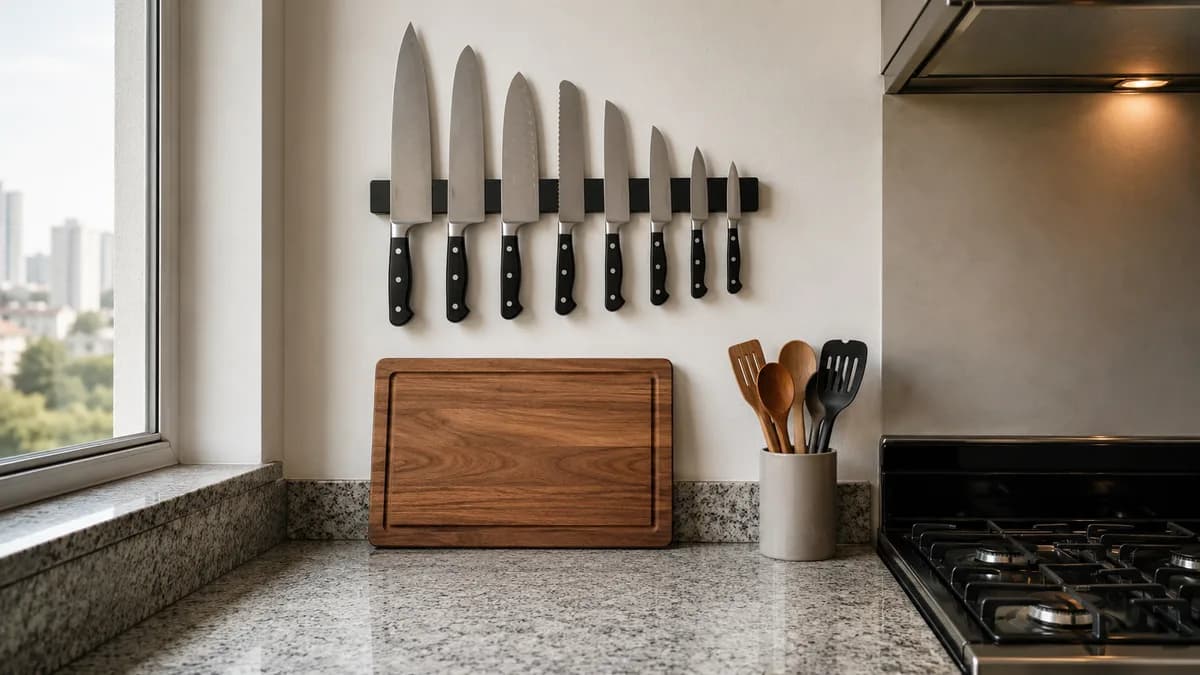
Quality knives do not belong in a drawer. The blade knocks against other utensils, loses its edge, and creates a cut risk when a hand reaches in without visibility. A magnetic wall strip is the standard solution for everyday knives: the chef's knife, bread knife and paring knife stay exposed, accessible and with the blade preserved.
Specialty knives (Japanese, sushi, collector pieces) stay in a case with an individual blade guard or in a wooden block with a proper slot for each piece. Never stacked, never in an open drawer without protection.
Cutting boards: the right quantity
Gourmet kitchens accumulate cutting boards. The right question is: how many do you use at the same time in a real preparation? The answer is almost always two: one for protein, one for vegetables. Maybe three if the person does a lot of pastry work. Boards beyond that are unnecessary storage in the prep space.
Boards stay upright, never stacked flat. Stacked, the one used most often tends to end up at the bottom, under all the others. A vertical steel divider or rack next to the stove solves this at low cost and guarantees immediate access.
Utensils: the 12-to-15-active-items criteria
A specialty utensil that is out of sight becomes forgotten. And forgotten becomes bought again. In a session in Pinheiros, a couple who cooked for groups of eight to twelve people every other week had 40 utensils in one drawer. When we did the sorting, the ones they actually used in their preparations came to 14.
The husband held onto three silicone spoons: "each one is for something different." None of them were different enough to justify the space of three. Two stayed. Six months passed with nobody going looking for the third. Two months after the organization project, he came home with two new "specialty" utensils. They went into the backup box. If nobody went looking for them in four months, they would be donated.
The takeaway: define the 12 to 15 utensils in your kitchen's active rotation. Everything else goes into a backup box. If nobody goes looking for it in six months, donate it.
China, crystal and family heirlooms
China in a gourmet kitchen is rarely a single collection. What shows up in sessions in high-end São Paulo apartments is always an overlap of layers: the dinnerware bought for everyday use, the formal set for dinner parties, pieces inherited from family that carry more sentimental than functional value, and loose pieces from trips or gifts that don't belong to any set.
Three collections, three storage criteria
- Everyday china: a direct-access cabinet, unwrapped, in stacks of no more than six to eight pieces so the bottom one isn't hard to pull out. The most accessible spot goes to the most used plates and cups. Water and juice glasses in the same cabinet or the one next to the fridge.
- Formal china: its own china cabinet or cupboard, with padded fabric or dividers between pieces, arranged by size (charger plate, dinner plate, dessert plate). When there are two sizes of wine glass, red wine glasses stay separate from white wine ones: at the mise en place stage of a dinner party, that distinction saves time and avoids confusion.
- Family pieces or items with sentimental value: their own protected spot, outside the frequent-use rotation. They do not need to be in the kitchen at all. A china cabinet in the dining room, locked if needed, serves the dual purpose of keeping and displaying them better. The criteria here is protection and visibility, not quick access.
Crystal: the care that extends its life
Fine crystal does not get stacked. Each glass takes up its own vertical space, either hanging stem-down in an inverted glass rack or in an individual padded compartment. Glasses hung by the stem from a ceiling rack look great and work well, but only in kitchens with generous ceiling height and no constant vibration from a nearby oven or blender.
The third risk, rarely mentioned: mixing crystal of different values in the same cabinet. When an everyday-priced glass and an irreplaceable family piece share the same space with no separation, the odds of accidentally breaking the more valuable one go up. Separate cabinets, or at least clearly separated zones within the same cabinet, prevent that problem.
Butler pantry: when it exists and how to integrate it
High-end apartments and houses in São Paulo often build a butler pantry adjacent to the kitchen to decentralize service: it holds the formal china and crystal, the silverware, the cloth napkins and the serving pieces. When the pantry exists but is not organized, it absorbs everything that "doesn't fit in the kitchen" and turns into a second dumping ground.
The butler pantry as a functional extension of the kitchen
A well-organized butler pantry has three clear functions: storing the entertaining collection (china, crystal, silverware), assembling the mise en place for a dinner party without taking over the working kitchen, and serving as the distribution point for drinks and desserts. Each function defines what goes there.
What does not go in the butler pantry: unused appliances, boxes of pantry staples, leftover construction materials, cleaning supplies. The butler pantry in a gourmet kitchen is an extension of function, not an alternative dumping ground.
Integration with the wine cellar
When the climate-controlled wine cellar sits in or next to the butler pantry, the logic is clear: the pantry becomes the drinks-and-service territory, from the glass to the label. Organizing the wine stock connects directly to the layout of glasses and serving accessories. The bottle headed to the table leaves the cellar and passes through the butler pantry before reaching the dining room. When that flow is mapped in the space, a dinner for ten has a backstage that runs without a scramble.
Your gourmet kitchen has quality equipment. What is missing is a system that puts every piece in the right place and keeps the prep space clear.
See home organization services →Gourmet pantry and home wine cellar
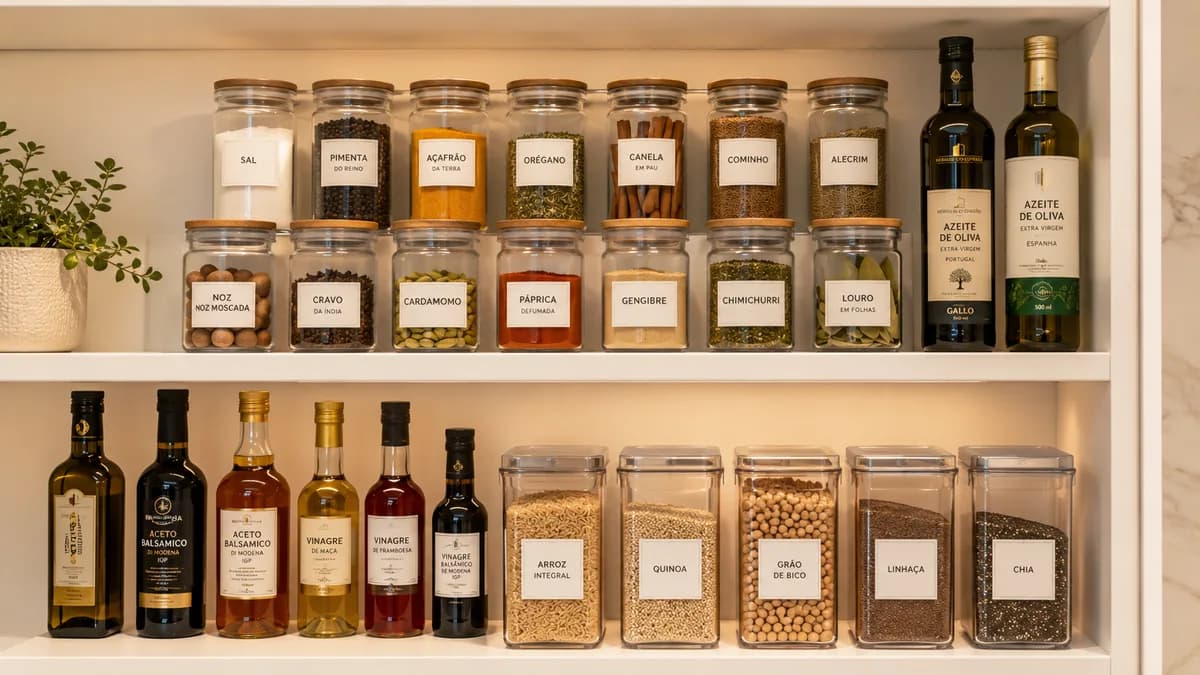
A gourmet kitchen's pantry usually holds three times as many items as a regular pantry: spices from different cuisines, infused oils, specialty flours, pastry ingredients, products brought back from trips. Without visibility and a system by category, waste is inevitable. According to CNN Brasil, Brazil loses billions in food every year, and according to the UN Food Waste Index, 60% of that waste happens inside people's homes.
The specific cost of a disorganized gourmet pantry
An expired premium ingredient is money lost twice over: you paid more for it and never got to use it. Cold-pressed extra virgin olive oil gone rancid. Za'atar from a trip never opened. Almond flour that dried out before it got used. Chocolate at 70% with a fat bloom from improper storage. These are the cases that come up repeatedly in gourmet kitchen pantries across São Paulo.
A system organized by cuisine category
Organizing by cuisine category makes more sense than organizing by product type for people who genuinely cook. Instead of "spices" as a single category, dividing by cuisine works better: Mediterranean, Asian, Mexican/Latin, pastry. When making a recipe, you grab the right basket or zone and every ingredient you need is right there.
In a 90 m² kitchen in Moema, the client considered herself "well organized" because everything was in labeled containers. The problem was somewhere else: three bottles of olive oil open at the same time, because she didn't know which one had been opened first. Two were rancid. Almond flour bought at four different times, two expired packages pushed to the back by the newer ones. The habit of putting new items in front had buried the older ones.
We reorganized by cuisine category: Mediterranean, Asian, pastry and everyday staples. Each group in a labeled basket. We added opening dates written in masking tape on the oil and sauce labels. We installed a lazy Susan for the spice jars: 360-degree visibility without pulling anything off the shelf. Over the following three months, zero ingredient waste.
Four months later, she came home from a trip with twelve new jars. The system needed a 30-minute reload to absorb everything. The structure was already there: it just got adjusted, not rebuilt.
The takeaway: an invisible ingredient is a nonexistent ingredient. What disappears from view gets bought again, forgotten again, thrown out again. Visibility solves more than the number of containers you own.
Rules for high-turnover and specialty ingredients
- Everyday ingredients: at eye level, without a lid that needs two hands to open, accessible in one motion. Active olive oil, salt, black pepper, garlic, dried onion.
- Weekly ingredients: a secondary shelf, visible but not necessarily up front. Sauces, vinegars, concentrated stocks, frequently used spices.
- Specialty or occasional-use ingredients: grouped by cuisine in baskets, with the opening date marked. Visible whenever the basket is accessed.
- The one-open-item rule: only open the second package once the first one is finished. For oils, sauces and specialty flours: one at a time, with the opening date marked on the label.
Home wine cellar: organized by turnover and cellaring
The home wine cellar integrated into a gourmet kitchen follows its own logic, different from the pantry. Wine is not organized by varietal or country of origin, except in very large collections. The practical criteria is turnover:
- Frequently consumed wines: the most accessible position, with easy label visibility. These are the ones that leave the cellar every week and need regular restocking.
- Cellaring wines: the deepest or lowest position. Taken out less often and with more care: the purchase date and ideal drinking window are noted on a discreet neck tag or in a cellar log.
- Occasion bottles (gifts, special wines): an identified position, separate from the two groups above, with context noted: "gift from X on date Y" or "to celebrate event Z." Without context, the special bottle just becomes one more in the row.
Temperature control is a prerequisite, not optional. Climate-controlled wine coolers, even countertop ones, need to run without interruption and away from heat sources like the stove, oven and windows with direct sun exposure. Frequent temperature swings degrade wine ahead of schedule, regardless of the label's price.
How do you get a gourmet kitchen ready for guests without reorganizing from scratch?
A well-organized gourmet kitchen has a hosting mode that takes 20 minutes. The difference lies in keeping work zones and display zones separate day to day: what stays on the counter for looks and what stays accessible because it gets used. When the two functions blur together with no criteria, any event forces a full reorganization before guests arrive.
Work zone and display zone
The work zone is where prep happens: cutting board, active knives, everyday spices, counter utensils. This zone needs to be functional. It can have the spoon with a bit of residue, the olive oil bottle with a stained cap, the board with real cut marks. Looks are not the criteria here.
The display zone is what guests see when they walk into the kitchen: the center island, the decorative shelf, the knife strip on the wall. This zone follows a presentation standard. The items here are also chosen for their looks: the olive oil in a nice bottle, the spices in matching jars, the knife strip with the blades lined up.
With both zones defined day to day, the pre-event checklist becomes doable in 20 minutes:
- Clear the center island surface and display counters
- Put away the day’s work utensils
- Check that the knives on the strip are lined up
- Reposition the cutting boards on the rack in the desired visual order
- Check the pantry: is anything open that shouldn’t be visible?
- Wipe down cabinet and drawer fronts (fingerprints)
- Check the position of countertop appliances
- Pull the serving items needed for dinner out of the butler pantry
The 20-minute reset works because the permanent system is already in order. If you need two hours every time you have guests, the day-to-day system needs a rework before the next event.
Gourmet kitchen organization has one practical goal: maintaining a baseline state that holds up day to day with no extra work when the pace changes. The kitchen that works when you're in a rush works when you have guests. It's the same kitchen.
Coordinating with the cook or household staff
Organizing a gourmet kitchen with a full-time cook or a housekeeper who cooks requires one extra step that many projects skip: staff orientation. A system organized by someone outside the kitchen's daily routine only works if the person using it understands the logic and can put items back in the right place without relying on memory.
What household staff needs to know about the new system
At the close of a gourmet kitchen organization project, an orientation session with the cook or housekeeper responsible for the kitchen is part of the process. It is not a five-minute conversation: it runs 30 to 40 minutes, walking through where every item was relocated, the logic behind each zone, what goes in the low cabinet and what goes up high, and where the less frequently used items are stored.
Beyond the verbal walkthrough, two physical tools help the team maintain the system:
- Labels on every cabinet and drawer: not just the utensil drawers, but the china, cookware and appliance cabinets too. The label removes the guesswork and reduces the odds of items going back in the wrong place.
- A laminated kitchen map: an A5 sheet with a map of the cabinets and what goes in each one, taped to the inside of the main cabinet door. For items that live outside the kitchen (occasional-use appliances), the map notes where they are stored.
When the cook already has her own system
Kitchens with a long-standing full-time cook come with a specific challenge: the cook's own system, built up over time, can conflict with the new one. The right approach is not to impose a new system, but to present the logic, understand the cook's habits, and merge the two views wherever possible.
A session in Itaim Bibi, in a 220 m² apartment with a gourmet kitchen open to the living room, brought exactly this scenario. The homeowner wanted the kitchen organized, but Dorinha, the family's cook for twelve years, had her own well-established system: pots arranged in her own order of use, spices where she could see them best, utensils in whatever position matched her workflow. The homeowner felt the kitchen was disorganized. Dorinha felt it was working perfectly.
They were both right. The problem was that Dorinha's system was not legible to anyone else. During one week she was away, the household couldn't find the right pot to make rice.
The three of us worked through it together: the homeowner pointed out what needed to work without Dorinha there. Dorinha pointed out what could not change without hurting her own workflow. The result was a labeled system that Dorinha approved of, positions adjusted to fit her flow, and a map taped to the main cabinet door. Dorinha's reaction at the end was not one of having been overruled: it was the sense that her work had finally been documented in a way other people could understand.
The takeaway: when there is a cook with her own system, the organization project is about integration, not imposition. The system that lasts is the one the team understands and can actually keep up.
Maintaining the system over time
A gourmet kitchen in heavy use runs through cycles: everyday cooking stretches, weekend prep for guests, pastry seasons, family dinners around holidays. Every cycle pulls items out of place and brings in new ingredients and equipment. Maintenance is not about returning to a zero point: it's about managing those cycles without letting the clutter creep back in.
Three maintenance rhythms
- Daily reset (10 minutes): at the end of each use, every item goes back to its place. Clear counter, boards on the rack, knives on the strip, utensils in the drawer. This habit keeps the system from unraveling day to day.
- Monthly review (30 minutes): check the pantry (expiration dates, one-open-item rule, what's running low), confirm occasional-use equipment made it back to its spot, check utensil drawers for anything out of place. The monthly review catches drift before it builds up.
- Biannual review (2 to 3 hours): a full sort of utensils (anything unused in six months leaves the active rotation), assessing equipment that has changed in frequency of use, restocking organizers that need replacing. The biannual review is when the system updates itself for the current routine, not the routine it was built for.
What to do when a big haul or a trip full of ingredients arrives
Bulk imported purchases, ingredients brought back from trips, and gourmet product gifts are one-off influxes that challenge any pantry system. The rule is not to absorb them without review: before putting new items away, check what already exists in that category. New spices don't go in before checking what's already open. New olive oil doesn't open before the current one runs out.
For more on home organization systems in São Paulo, including projects that involve the kitchen, pantry and connected spaces, see the guide to high-end home organization and the functional kitchen series.
Frequently asked questions about gourmet kitchen organization in São Paulo
Do I need to replace all my utensils to organize a gourmet kitchen?
No. The first step is sorting through what already exists. Gourmet kitchens tend to accumulate utensils over time: duplicate pieces, gifts that were never used, specialized items bought for a preparation that never happened. The process starts by identifying what actually gets used, what can be donated, and what can leave the kitchen entirely. Buying organizers before sorting is the most common mistake in this type of project.
How do you organize a gourmet kitchen with a center island?
The center island is the highest traffic zone in a gourmet kitchen. It should work exclusively as a prep counter: nothing stays on it permanently except what gets used at least once a day. An active cutting board, the oil you use daily, salt, and at most one everyday appliance. Everything else goes into the cabinets. With a clear island, prep is faster and the space works better when guests are around.
What's the difference between organizing a gourmet kitchen and a regular kitchen?
A gourmet kitchen has specific challenges: more large equipment, a wider variety of specialty ingredients, professional utensils that need proper storage to preserve the material, and a social function that a regular kitchen usually does not have. The organization system needs to account for frequency of use, care for valuable equipment, and a presentation that holds up when people are watching. The underlying logic is the same as any kitchen: a fixed spot for every item. The complexity is just higher.
How do you keep a gourmet kitchen organized after the project ends?
Maintaining a gourmet kitchen runs on two rhythms: a 10-minute daily reset at the end of each use (every item goes back to its place, counters clear, boards put away) and a 30-minute monthly review to check the pantry, expiration dates, misplaced utensils, and equipment that needs attention. Kitchens that host guests often benefit from a 20-minute pre-event checklist, which is separate from the day-to-day structural maintenance.
How do you organize professional cookware and specialty utensils in a gourmet kitchen?
Professional cookware needs storage that preserves the material: copper pans never stacked without a protector between them, cast iron stored with absorbent paper inside to prevent rust, and nonstick pans separated by a felt divider between each one. The access rule stays the same: the most used pieces on the accessible shelf, occasional-use pieces in the high cabinet. For specialty tools like mandolines, thermometers and precision scales, each one gets its own fixed spot with proper protection.
How do you organize gourmet kitchen china and crystal: everyday versus formal entertaining?
The rule is to physically separate the everyday collection from the formal entertaining collection. Everyday china stays in an easy-access cabinet, unwrapped, ready to use. Formal china stays protected with fabric between pieces, in a separate cabinet or china cabinet, arranged by size. Family pieces with sentimental or historical value get their own protected spot, outside the frequent-use rotation. Mixing the everyday with the special creates a risk of breakage and makes it harder to find the right set when guests are on their way.
How do you organize a home wine cellar integrated into a gourmet kitchen?
A home wine cellar works best when organized by turnover: frequently consumed wines in the most accessible position, cellaring labels on the lower shelves or in positions that require more care when reaching for them. Temperature control is a prerequisite: even small countertop wine coolers need to run without interruption and away from heat sources. Noting the purchase date, origin, and ideal drinking window on a discreet neck tag removes the guesswork when it is time to choose a bottle.
How do you organize a gourmet kitchen so the cook or household staff can find everything?
The system needs to be legible to people who did not create it. That means labels on every cabinet and drawer, fixed positions documented on a laminated sheet taped to the inside of the main cabinet door, and a 30 to 40 minute walkthrough with the cook on the day the organization project wraps up. The less the system depends on memory, the more it holds up over time. Visual consistency matters too: when everything has an obvious place, anyone on the team can put things back correctly without asking.

About the author
Silvana Santanna →Personal Organizer in São Paulo, specialized in residential move organization and functional organizing projects for homes, closets, kitchens, trousseaux and home offices. Creator of the Casa Pronta™ Method, with more than 100 projects completed across São Paulo and the greater metro area.
Related posts
How to Organize a Kitchen by Zones: A System That Works in Any Size
11 min · Read article →
How to Organize a Home Wine Cellar: System and Care
11 min · Read article →

High-End Home Organization in São Paulo: What Changes in Practice
9 min · Read article →
How to Organize a Pantry: The Zone System That Ends Food Waste
11 min · Read article →
Ready to have your home organized
without lifting a finger?
Project assessment visit.