How to Organize a Home Wine Cellar: System and Care
How to organize a home wine cellar: the right temperature, a system by type and vintage, bottle position, and the care that preserves quality. Personal organizer guide. São Paulo.
Neste guia você verá:
Why the home wine cellar turns into a mess
In an apartment in Pinheiros, I was hired to organize a living room. During the initial walkthrough, the client proudly showed me the wine cellar: a black iron rack, 48 slots, nearly full. I asked when he had last opened a bottle. He took a while to answer.
We took everything off the rack and did the inventory on the living room table. Five red wines he had been saving "for a special occasion" were past their drinking window. Two Argentine labels that should have been drunk between 2023 and 2024. By 2026, the wine had faded. He went to find the receipts in his email: a fair amount per bottle. The special occasion never came, and the wine was gone before it did.
The cellar had no inventory. It did not separate immediate consumption from aging bottles. It looked nice. It did not work.
Four causes explain why this happens in home wine cellars:
- No separation by drinking moment: wines for immediate consumption get mixed in with aging wines. You open whatever is most accessible, not what you should be drinking now.
- No up-to-date inventory: you do not know what you have. You buy more of the same style while a rare wine ages past its peak for lack of tracking.
- Wrong bottle position: corked bottles stored upright dry out the cork, let air in, and compromise the wine within weeks.
- Poor location: a cellar near the kitchen, with constant temperature swings, or in a spot with vibration accelerates aging and throws the wine off balance.
What are the ideal conditions for storing wine at home?
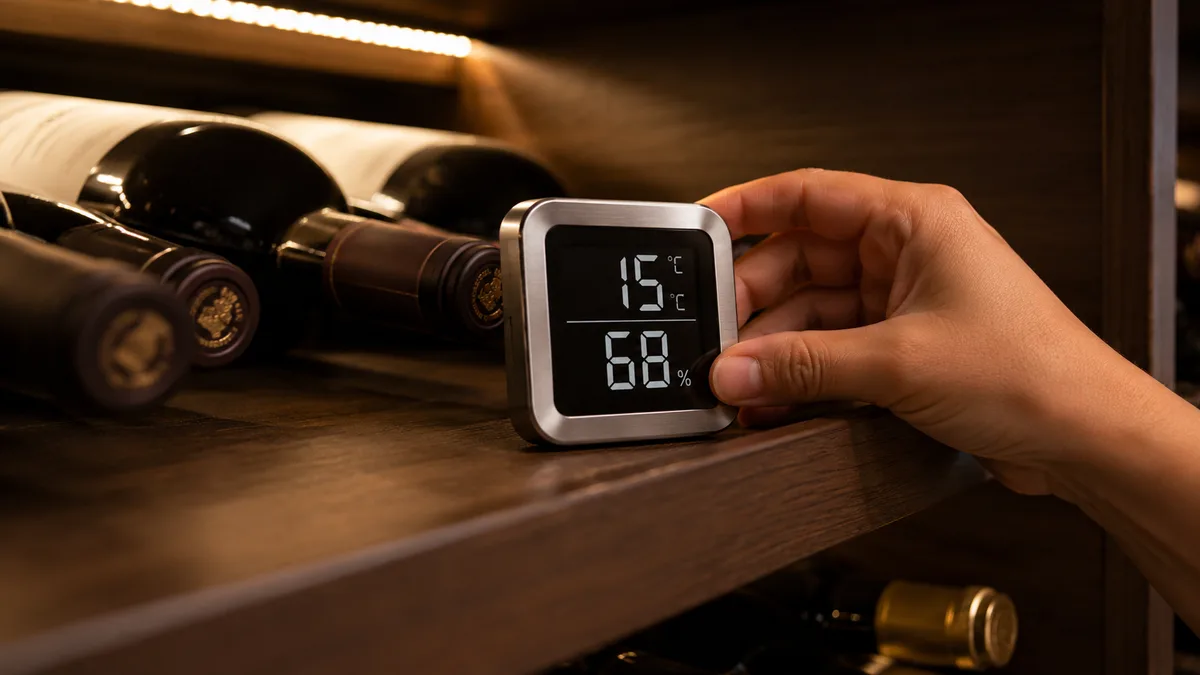
Constant temperature between 12°C and 18°C, relative humidity between 60% and 80%, no ultraviolet light, and minimal vibration. These four factors determine whether a wine evolves well or deteriorates before its time. Of all of them, temperature is the most critical, and the easiest to monitor with a cheap digital hygrometer.
What happens when a spot looks perfect but is not
A client called me after noticing her wines "did not smell right." The cellar sat in a nook under the stairs: dark, out of the way, no window. An apparently ideal spot. The problem was in the wall next to it: the laundry area, with a washing machine running daily.
I installed a hygrometer with min/max memory. Within 48 hours, it recorded a 12°C swing in the same space: 18°C overnight, 30°C in the early afternoon when the sun hit the outside of the wall. The machine's vibration traveled through the structure every time it spun. Wine cannot take that month after month.
We reorganized into an interior hallway of the apartment, with a stable 22°C and no vibration. It was not the prettiest spot. It was the only suitable one in that apartment.
Temperature: what kills wine and what preserves it
The 12°C to 18°C range is the industry's technical standard. Within that range, wine ages in a controlled way, aromas develop, and structure holds up. A temperature 2°C above the ideal range does not ruin wine. Swinging from 14°C at night to 26°C in the afternoon expands and contracts the cork repeatedly until the seal fails and air gets in. The swing is what destroys wine; a stable temperature, even slightly high, preserves it.
In São Paulo, air-conditioned apartments tend to hold a stable temperature between 20°C and 24°C, tolerable for wines meant to be drunk soon (within three months). For aging wines, a dedicated climate-controlled cellar is necessary.
Humidity: protects the cork, not the wine itself
Humidity between 60% and 80% keeps the cork hydrated and flexible. Below 50%, the cork dries out, shrinks, and loses its ability to seal. Above 85%, there is a risk of mold on labels and on the outside of the cork. Digital hygrometers cost little and monitor temperature and humidity in real time.
Light and vibration: the silent enemies
Ultraviolet light breaks down phenolic compounds in wine. Dark glass bottles offer some protection, but not enough for direct sun exposure or prolonged time under fluorescent lights. Use LED lighting: it emits no UV and does not heat the space. Frequent vibration from refrigerators, washing machines, or stairs stirs up sediment and interferes with aging.
Your wine cellar can be part of a more functional, more thoughtful home organization project.
Explore home organization →How to organize your wine: a system by type, vintage and drinking window
The most functional system for home cellars splits bottles into three groups: immediate consumption (within 30 days), near-term consumption (1 to 6 months), and aging (over 6 months). This split determines the bottle's position in the cellar, how closely temperature needs to be watched, and how often each bottle needs to be checked.
Organizing by wine type
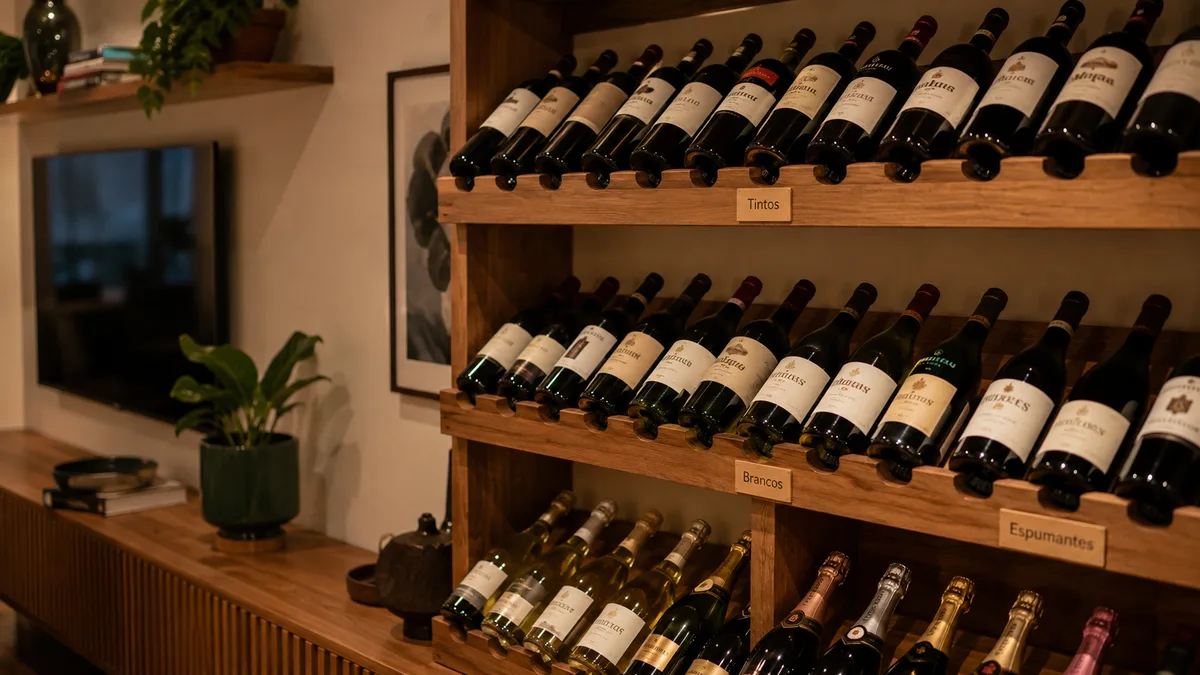
In cellars without dual temperature zones, reds go on the upper shelves, and whites, rosés, and sparkling wines go on the lower shelves. The top of a cellar is naturally warmer, ideal for reds that benefit from slightly higher temperatures. The bottom is cooler, suited to whites and sparkling wines that need lower temperatures to preserve acidity and freshness.
Sparkling wines deserve special attention: the state of Rio Grande do Sul alone sold 30.3 million liters of sparkling wine on the domestic market in 2024, split into 17.4 million liters of natural sparkling wine and 12.9 million of Moscatel sparkling wine, the latter up 32.1% in a single year, according to Embrapa's Brazilian Viticulture Overview. With more sparkling wine coming into homes, it is common to see bottles poorly positioned or at the wrong temperature. Sparkling wine with a cork closure should lie down; with a screw cap, it can stand upright.
Organizing by vintage and producer
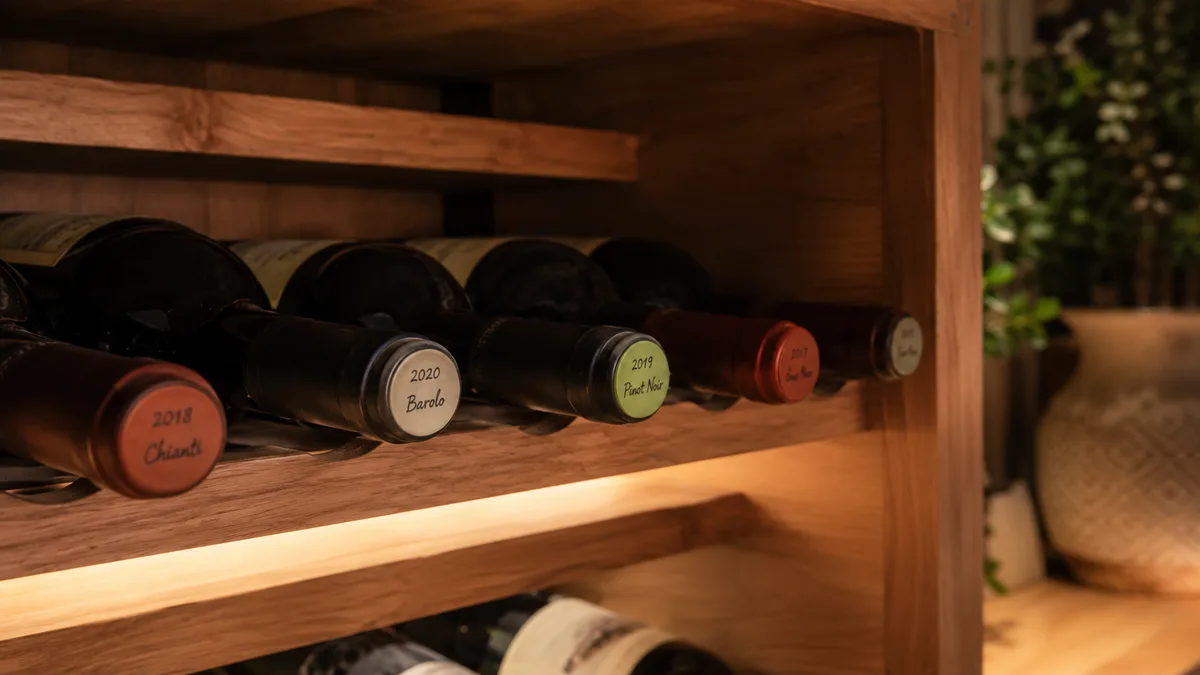
For collections above 30 bottles, organizing by vintage within each wine type makes it easier to find what you want without digging through everything. Shelf labels or removable stickers on the bottle neck (visible without removing any bottle from its spot) are the most practical solution. Apps like Vivino let you keep a digital inventory with a photo of the label, vintage, purchase date, and ideal drinking window.
The inventory as a control tool
Regardless of collection size, an up-to-date inventory avoids two costly mistakes: buying a duplicate of something you already have in stock, and forgetting an aging bottle past its ideal point. A simple spreadsheet with the wine's name, vintage, purchase date, and drinking window already solves it. Update it whenever you drink or buy a bottle.
- Separate bottles by group: immediate consumption, near-term, and aging
- Reds on the upper shelves; whites and sparkling wines on the lower shelves
- All corked bottles lying down
- Shelf labels or stickers identifying type and vintage
- Up-to-date inventory (spreadsheet or app) with purchase date and drinking window
- Sparkling wines with a screw cap can stand upright
What day-to-day care preserves your cellar's quality?
Maintaining a home wine cellar does not take much time. It takes consistency in three areas: monitored temperature, carefully handled bottles, and a clean space free of scented products.
Monitoring temperature and humidity
A digital hygrometer with min/max memory shows whether the temperature has drifted outside the range since you last checked it. Check it once a week. If it registers a peak above 24°C or a drop below 10°C repeatedly, reconsider the cellar's location or adjust the equipment.
Handling: move bottles as little as possible
Constant vibration harms wine. When taking out a bottle, do it carefully so you do not disturb the others. Aging bottles with sediment do not need to be moved. When you are about to drink one, stand the bottle upright for 24 hours before opening so the sediment can settle.
Cleaning the cellar
Clean the shelves monthly with a lightly damp cloth, without strongly scented products. Wine absorbs odors through the gap between the cork and the capsule, especially in small, enclosed cellars. No scented cleaning products, untreated aromatic woods, or food stored in the same space.
Cellars and aging collections: high-end wine cellar organization
There is a real difference between storing wine and collecting wine. Storing is a matter of logistics: the right spot, stable temperature, bottles in the right position. Collecting involves curation, an aging window of years (sometimes decades), provenance documentation, and, in larger collections, management that starts to resemble a portfolio.
When I work on properties in Jardins, Itaim, or Vila Nova Conceição, it is common to find cellars with 200, 400, sometimes more than 600 bottles. The challenge is not just physical: it is building a system that preserves each bottle's potential and lets the owner navigate the collection without relying on memory.
Dedicated climate-controlled cellar versus compact wine cooler
Compact countertop or built-in wine coolers handle collections of up to 80 to 120 bottles efficiently. The limitation is temperature control: residential models typically run between 5°C and 18°C, with an internal variation of up to 2°C to 3°C depending on placement and room temperature. For wines meant to age 2 to 5 years, that is adequate.
A dedicated climate-controlled cellar, built with proper thermal insulation, precision refrigeration, and independent humidity control, offers a stability no compact cooler can match. A temperature held between 12°C and 14°C with variation under 0.5°C is the right environment for long-aging wines, 10 years or more. The decision to invest in a dedicated cellar depends on the intended aging horizon and the size of the collection, not on a generic formula.
When the property allows it, integrating the cellar with the pantry or dining room also solves the aesthetic question: a cellar with tempered glass and internal LED lighting becomes part of the architecture, not a hidden appliance. In that context, the internal organization needs to be as visually coherent as it is functionally efficient. See how this kind of integration works in high-end residential organization projects in São Paulo.
Collection zoning: by wine region, vintage, and aging window
In collections above 150 bottles, zoning by consumption category (immediate, medium term, long term) becomes insufficient. The system I use most in these cases combines three dimensions:
- Wine region: Burgundy, Bordeaux, Tuscany, Rioja, Douro, Napa Valley, and so on. Each region has distinct aging characteristics, and grouping by origin makes curation and service easier. Brazilian labels (Serra Gaúcha, Campanha Gaúcha) form their own group.
- Vintage within the region: within each region, bottles ordered chronologically from oldest to newest, from the innermost position to the most accessible. Older vintages, which may be at or near their drinking window, sit at the immediate access point; young, long-aging vintages sit toward the back.
- Aging window: visual identification (color label or position marker) signals the estimated drinking period of each batch. Green for consumption in the next 3 years, amber for 3 to 10 years, red for aging beyond 10 years. This system allows a quick read of the cellar without consulting the inventory for every decision.
Collection curation: investment wines, en primeur, and verticals
High-end collections usually include three categories that need distinct treatment in the organization:
Investment wines and Grand Cru: bottles of Burgundy Premier Cru, Grand Cru, Bordeaux from classified châteaux, and equivalents from other regions. These wines have market value that fluctuates over the years and need careful provenance documentation. Their position in the cellar should see minimal movement: once placed, they only leave when it is time to drink or, eventually, resell them.
En primeur wines: wines bought as futures, before bottling. When they physically arrive (usually 2 to 3 years after purchase), they go straight into the long-aging zone with all the documentation from the négociant or château. The inventory needs to record the en primeur purchase date, physical arrival date, château, vintage, and number of bottles or magnums.
Verticals: several vintages of the same producer kept together. A vertical of 8 vintages of a Barolo or a Pomerol is both a tasting experience and a historical record of a terroir's evolution. Physically, verticals sit in a contiguous position, arranged chronologically. In the inventory, they are grouped as a series, with a note on which vintages have already been consumed.
Professional inventory for valuable collections
Vivino works well for collections meant for regular consumption. For collections with bottles of significant unit value, verticals, or wines bought as investments, the inventory needs more layers:
- Provenance: importer, château, négociant, receipt or proof of purchase
- Updated market value: quote from a specialized importer or reference auction
- Optimal drinking window: an estimate per label, not a generic category
- Condition: photos of the label, the cork, and the liquid level upon receipt
- Temperature history: if available, a record of transport and storage conditions
- Purpose: personal consumption, gifting, eventual resale (affects the documentation needed)
Apps like CellarTracker let you record all of this information per bottle, generate reports on the collection's total value, and export a complete inventory for insurance purposes. Updating market values annually is part of maintaining a serious collection, since aging wines change in valuation over time.
Handling logistics in large collections
In cellars with 300 or more bottles, day-to-day access needs to be planned so that taking out one bottle does not require moving dozens of others. Some practices I use:
- Long-aging bottles left untouched: once placed in the long-aging zone, these bottles should not be moved until it is time to drink them. Recurring vibration disturbs the sediment and the aging process. The digital inventory is enough to know what is there.
- Front-to-back access order: bottles closer to their drinking window always sit in the most accessible positions. When a spot opens up, it gets filled by a near-term bottle moving forward in line, never by a long-aging bottle that would then be moved to the back.
- Magnums and special formats in a fixed position: 1.5L, 3L, or Jeroboam bottles have a weight and size that make frequent handling difficult. They sit in easily accessible, safely handled positions, separate from the standard 750ml stock.
Integration with a high-end pantry and dining room
With the cellar sorted, the next point is service. In homes with a structured pantry or a dining room designed for entertaining, organizing wine service is part of the project. That means:
- Glasses by type in a set position: Burgundy, Bordeaux, white wine, and sparkling glasses in distinct positions, accessible without moving other items. Not mixed in with everyday glassware.
- Decanters with a fixed location: a frequently used decanter within reach; collector's pieces or gifted ones in a display cabinet or separate shelf. Each decanter with enough room to dry mouth-down without touching anything.
- Wine thermometer and aerator: occasional-use items in a designated drawer or space, not scattered among bottles or cutlery.
Organizing a high-end pantry in São Paulo has its own specifics worth a closer look. See what I observe in these projects in the post on organizing a gourmet kitchen in São Paulo.
Small cellar or no climate control: how to organize with what you have
A climate-controlled cellar is not a prerequisite for storing wine well. For those who drink regularly and do not hold bottles for more than six months, a cabinet or shelf in the right spot works. The secret is in choosing the space, not the equipment.
The most common mistake: on top of the fridge
A couple who had just started buying wine regularly called me after a bad experience. Fifteen bottles, no cellar, no rack. Their makeshift solution had been on top of the fridge, where there was room to spare. Four months later, they opened a white wine they had been saving for a special dinner. It had turned sour.
The top of a fridge reaches high temperatures when the compressor is running. The motor's vibration travels into any bottle resting there. Of the fifteen bottles, three were compromised. The fix cost very little: a 12-slot floor rack, installed in an interior hallway of the apartment, at a stable 21°C, with no vibration. The rest of the bottles held up well for more than six months.
Where to place bottles without a climate-controlled cellar
Look for the coolest, most stable spot in the apartment: an interior hallway, the lower part of a closet in an air-conditioned bedroom, or a windowless pantry. Avoid: the kitchen (constant temperature swings), a living room with afternoon sun, on top of the fridge (vibration and heat), and the laundry area (excess humidity and vibration).
Solutions for small volumes (up to 30 bottles)
- Countertop or floor rack: holds up to 12 bottles lying down, takes up little space, and positions them correctly. Costs vary depending on the material.
- Modular wall shelf: for walls in a climate-controlled room, away from windows. Holds 6 to 20 bottles depending on the model.
- Dedicated closet compartment: remove the shelves from a rarely used closet, install wine racking rails in MDF, and you have room for 20 to 40 bottles without any construction work.
When it is worth investing in a climate-controlled cellar
If you hold bottles for more than six months, own wines that cost a significant amount per unit, or are building an aging collection, it is worth investing. A compact wine cooler starts at a modest price for 8-bottle models. Losing one expensive bottle to poor storage already covers that cost.
Cellars I have organized
Every collection has a different story. What shows up in all of them, sooner or later, is that the environment is rarely the problem: the absence of a system is.
The collector who did not know what he had
A 52-year-old retiree in Perdizes, with 70 bottles in a six-year-old climate-controlled cellar. He called me because he wanted to "reorganize." When we did the inventory on the living room table, what turned up was different from what he expected: 11 bottles past their drinking window, some by as much as three years. Two French labels that should have been drunk between 2022 and 2023. They went to find the receipts in his email. A significant amount in wine had faded away waiting for the right occasion.
He went quiet for a moment, looking at those bottles on the table. It felt like he had poorly cared for something he admired.
The cellar was climate-controlled, at the right temperature, with no vibration. The mistake was the absence of an inventory with drinking windows. Aging bottles and immediate-consumption bottles sat mixed together. He reached for whichever was most accessible, never the ones that needed to be drunk.
We set up the inventory in the Vivino app, with purchase date and drinking window for each label. We reorganized the cellar by zone: consumption within 3 months up front, aging 1 to 3 years in the middle, long-aging at the back. He now revisits the inventory monthly.
The lesson: a well-climate-controlled cellar without an inventory still loses bottles. Where you store wine does not solve anything if you do not know what you have.
The gift bottles nobody drank
Sometimes the cellar starts like this: no planning, just bottles piling up as gifts.
A couple in Santana, married two years, with 18 bottles received as gifts. None bought by them. They sat on the living room table because there was no proper place to store them. Wines of completely different styles, some for aging, others for immediate consumption, without the couple being able to tell one from the other.
They told me they were afraid of opening bottles "at the wrong time." So they opened none of them. The bottles meant for immediate consumption had already passed their peak, but since nobody knew that, they stayed on the table waiting for the right occasion.
We mapped everything with Vivino: we identified each label, its drinking window, and its ideal temperature. We organized them on a floor rack, in the apartment's interior hallway, away from the kitchen. Wines for immediate consumption were separated from aging ones, with a label on each bottle. A month later they sent me a photo of a dinner with two of the bottles opened.
The lesson: wine stored without a consumption plan becomes a decorative object. A drinking window in the inventory turns a bottle back into a drink.
The cellar that grew without any criteria
This pattern shows up in people who travel often. One bottle here, another there, and suddenly there are 30 scattered across different places.
A 44-year-old executive in Moema, with 34 bottles accumulated over three years. She bought them on trips, at fairs, at restaurants that sold a label she had enjoyed. She stored them wherever there was room: a kitchen cabinet, the living room table, a rack in the bedroom. Temperature varying across three locations, no inventory, bottles standing upright mixed with bottles lying down.
When we did the survey, 7 corked bottles had been standing upright for more than 6 months. The cork on three of them already showed signs of drying out. She looked at those bottles with the expression of someone who did not expect this to happen to her.
We centralized everything into a single wall rack in the interior hallway, at a stable 21°C. All corked bottles, lying down. We installed a hygrometer and did a full inventory with drinking windows. She started buying with more discipline: when the rack is full, no new bottle comes in.
The lesson: a cellar that grows without criteria ends up with bottles in the wrong places and dried-out corks.
The collection in Jardins that needed a shared language
Some collections do not have a carelessness problem: they have a lack of a system shared between the people who use the cellar.
A 58-year-old businesswoman, apartment in Jardins, climate-controlled cellar built along with the property's renovation. About 280 bottles, spread across aging reds (Burgundy and Tuscany), French sparkling wines, and a vertical of five vintages from a producer from Rio Grande do Sul she has followed since 2016. Her husband also buys wine for the cellar. Neither of them knew exactly what the other had put in there.
She called me after discovering there were two duplicate bottles of the same Barolo bought a few months apart, and that three sparkling wines she had planned to serve at a dinner had been consumed without her knowing. The cellar was beautiful, well climate-controlled, visually organized. But there was no shared inventory. She said she felt like "the owner of a library where someone rearranges the books at night."
The work was part technical, part usage protocol. On the technical side: a full inventory in CellarTracker, with a photo of the label, vintage, importer, and drinking window. I reorganized the cellar by region (Burgundy, Tuscany, sparkling, Brazilian) and within each region by vintage, from oldest to newest. Position labels identifying each zone. The vertical from the producer from Rio Grande do Sul in a fixed, contiguous position, with a note on which two vintages had already been consumed.
On the protocol side: a simple rule, agreed on by both of them together, any bottle that enters or leaves needs to be logged in the app before it is moved. The app has shared access. In under two weeks the cellar had a language they both could read.
The lesson: a cellar without a shared inventory becomes a territory of assumptions. When more than one person uses the space, the system needs to be jointly accessible and updated in real time.
The investment collection in Itaim that arrived without documentation
Sometimes the biggest risk to a collection is not temperature: it is the absence of paperwork.
A 51-year-old financial executive, apartment in Itaim, a collection of 190 bottles focused on investment wines: Bordeaux from classified châteaux, two Barolo Riserva, and a series of en primeur wines bought in 2021 and 2023 that had physically arrived less than a year earlier. The cellar was a high-end compact unit, with dual temperature control (red wine zone at 14°C, white and sparkling zone at 10°C). Storage conditions were impeccable.
The problem became clear in the very first conversation: he could not locate the purchase receipts for roughly 40 bottles, all bought through an importer over five years. For insurance purposes, the property had recently been appraised including the cellar as an asset, but the insurer had requested an inventory with documented provenance for every bottle above a certain value. He looked at the cellar with the expression of someone who understands the value of what is there, but does not know how to prove it on paper.
We spent two days of work rebuilding the inventory. For bottles with an available receipt, direct documentation. For the rest: quotes from reference importers in Brazil and on international platforms like Wine-Searcher, photos of the label and capsule, and a record of condition. The en primeur wines had documentation from the négociant, which helped. The rest required bottle-by-bottle research. In the end, 183 of the 190 bottles were documented with an estimated market value and traceable provenance. The remaining seven were logged as "provenance undocumented" with a conservative value.
The lesson: provenance documentation is part of organizing a valuable collection, not an afterthought. Physically organizing an investment cellar starts with the paperwork, not the shelves.
Frequently asked questions about organizing a wine cellar
What is the ideal temperature for storing wine at home?
The ideal range for long-term storage is between 12°C and 18°C, with a maximum daily variation of 1°C. Sudden temperature swings are what damage wine quality the most: they expand and contract the cork repeatedly, letting air in and causing premature oxidation. For wines meant to be drunk soon (within a month), up to 22°C is tolerable. Above that, the aromas start to degrade and the wine ages faster than it should.
Do you need a climate-controlled cellar to store wine at home?
No. A climate-controlled cellar is necessary for aging collections, wines you plan to store for more than six months, or high-value bottles. For regular consumption, a cabinet or shelf in a cool, dark spot away from vibration and the kitchen works fine. What ruins wine is not the absence of climate control, it is unstable temperature, direct sunlight, constant heat above 22°C, or frequent vibration. If your apartment in São Paulo has air conditioning and you drink the bottles within three months, you do not need a climate-controlled cellar.
Why should a wine bottle be stored lying down?
Bottles with a cork closure should lie down to keep the cork in contact with the wine. A moist cork does not dry out, does not shrink, and does not let air in. A dried-out cork allows gradual oxidation and compromises both the aroma and the flavor. Bottles with a screw cap or glass stopper can stand upright without issue, since they do not rely on moisture to seal. Sparkling wines with a cork closure should also lie down.
How often should I maintain my wine cellar?
There are two rhythms. Monthly maintenance takes less than 20 minutes: checking temperature and humidity with a hygrometer, checking for poorly positioned bottles, cleaning shelves with a lightly damp cloth, and updating the inventory with the bottles consumed. The semiannual review takes one to two hours: a full inventory, an assessment of which wines are at their drinking peak, reorganizing by vintage if needed, deep cleaning the equipment, and checking the condition of the corks on aging bottles. With monthly maintenance kept up, the semiannual review becomes much faster.
How do you organize a collection of aging wines?
Aging collections require zoning by drinking window: long-aging wines (over 10 years) go at the back of the cellar, in the least-disturbed positions. Medium-aging wines (3 to 10 years) go in an intermediate zone. Internal organization follows wine region and then vintage within each region. The inventory needs to record provenance (importer, receipt), estimated market value, and optimal drinking window. For collections meant for insurance purposes or eventual resale, provenance documentation is part of the organization, not an afterthought.
Is it worth installing a dedicated climate-controlled cellar for collecting wine?
For collections above 100 bottles with long-aging wines, a dedicated climate-controlled cellar (with temperature control between 12°C and 14°C, humidity between 65% and 75%, and vibration isolation) is the only solution that preserves the aging potential of the wines over years. Compact wine coolers work for smaller collections, but have limited capacity and tend to have greater temperature variation. The decision depends on the size of the collection, the intended aging horizon, and the space available in the property. Each situation deserves a specific assessment.
How do you track a wine cellar for insurance purposes?
An inventory for insurance purposes goes beyond consumption tracking. Each bottle needs: producer name, vintage, volume, updated market value (quote from an importer or auction), documented provenance (receipt or proof of import), and recorded condition. Photos of the label and of the cellar conditions round out the documentation. Specialized apps such as CellarTracker let you record this information per bottle and export reports for insurers. Value should be updated annually, since aging wines change in valuation over time.

About the author
Silvana Santanna →Personal Organizer in São Paulo, specialized in residential move organization and functional organizing projects for homes, closets, kitchens, trousseaux and home offices. Creator of the Casa Pronta™ Method, with more than 100 projects completed across São Paulo and the greater metro area.
Ready to have your home organized
without lifting a finger?
Project assessment visit.