How to Store Silver Jewelry Without Tarnishing: Complete Guide
Silver does not tarnish on its own. The wrong place, the wrong wrapping, and the habit of storing it without cleaning do that work. Here is how to fix each one.
Neste guia você verá:
Silver does not tarnish on its own. You help it along. The bathroom where you keep it, the perfume you put on before the jewelry, the habit of tossing everything together in the wooden box: each of these details contributes to the tarnishing you blame on "the silver itself." With a few simple storage adjustments, 925 silver pieces stay bright for months without any special product.
Why silver tarnishes (and what speeds it up in daily life)
Silver tarnishes through sulfidation: the metal reacts with sulfur compounds present in the air, on the skin and in everyday products. It is not rust. It is a dark layer of silver sulfide that forms on the surface. Humidity speeds up this reaction. In São Paulo, where relative humidity stays above 70% for most of the year, silver tends to tarnish faster than in drier cities.
The biggest accelerators of tarnishing in daily life:
- Bathroom steam: concentrated humidity in direct contact with the pieces several times a day;
- Perfume and deodorant: compounds that sit on the skin in contact with the metal;
- Accumulated sweat: especially around the neck, wrist and ear areas;
- Pool chlorine and seawater: immediate chemical reaction with the silver;
- Open air with no wrapping: continuous exposure to the sulfur compounds in the environment.
Where to store silver jewelry (and where never to)
The storage location is the factor that most affects how fast tarnishing happens. A jewelry box in the bathroom, even a beautiful and well-organized one, exposes the pieces to shower steam several times a day. The result is inevitable.
Where to store it: a closet drawer, a dresser in the bedroom, a nightstand away from the window. Any dry place, with limited air circulation and away from steam. Stable temperature, with no sharp swings between night and day.
Where never to store it: the bathroom cabinet, near a window with direct sun, close to cleaning products, since chemical compounds in the air reach the pieces. And inside closed plastic bags with no humidity control: the plastic traps vapor and creates exactly the environment you want to avoid.
The bathroom seems like the logical spot. It is close to the mirror, the perfume, the getting-ready routine. For a client in Moema with a silver collection inherited from her mother, that was exactly where the pieces lived: in a closed metal box, in the cabinet next to the shower.
Within three months, the necklaces had gone black. Some earrings with sentimental value showed stains she tried to polish away with no result. When we asked to see the storage spot, the cause became clear.
We moved the pieces to a jewelry box with compartments in the closet drawer, with a silica sachet inside. Six months later, none of the newer pieces had tarnished. The inherited ones, after cleaning with a cloth and gentle polishing, recovered much of their original shine.
She resisted at first: "I will forget to wear it if it is not in the bathroom." We solved it with one everyday piece kept on the dresser jewelry tray, visible and accessible, but away from the steam. The rest stayed in the drawer.
The takeaway: where you store it matters more than any cleaning product.
How to wrap each piece to protect it from air and humidity
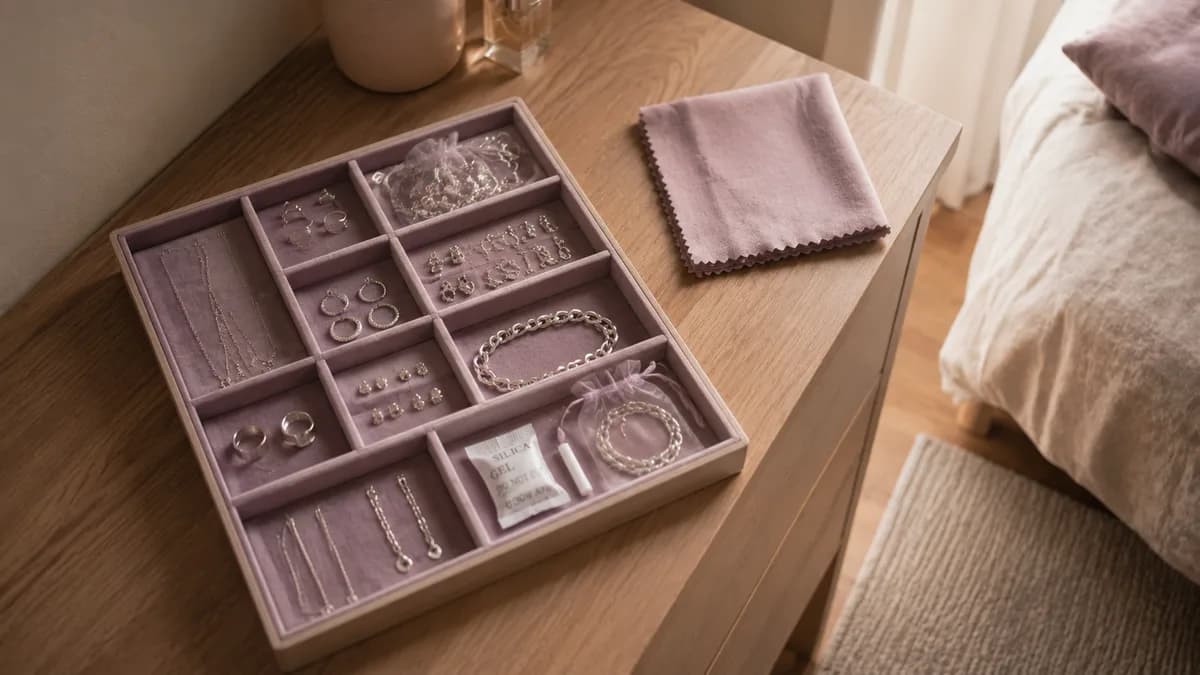
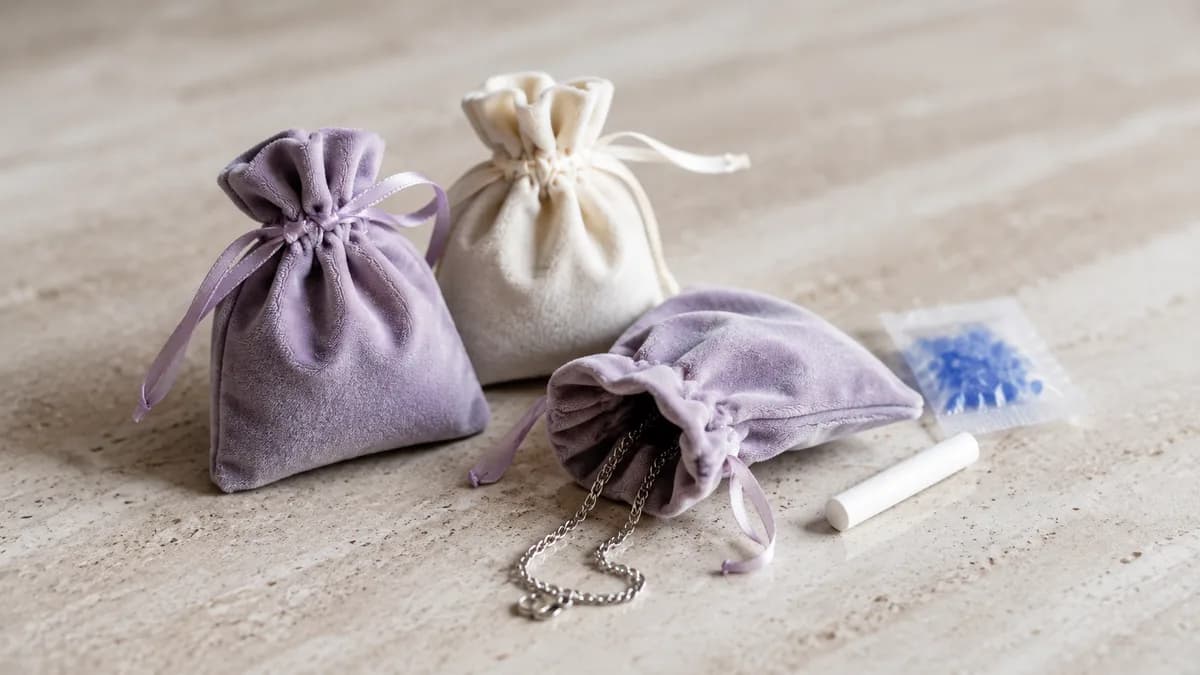
Storing each piece individually is what reduces contact with air the most and prevents sulfidation. It does not need to be expensive packaging. An organza or velvet pouch per piece, or a small ziplock bag with the air pressed out before sealing, already makes a real difference. What does not work is tossing everything together in an open box.
Humidity control inside the jewelry box
Place a piece of white school chalk or a silica gel sachet inside the jewelry box. According to Hagerty, a reference in metal conservation, chalk absorbs moisture from the micro-environment for weeks, slowing the sulfidation reaction. The silica sachet has greater absorption capacity and lasts longer. Replace it once it becomes saturated: most sachets change color as an indicator.
Wrapping by piece type
- Necklaces and chains: an individual pouch per piece, each one kept separate to avoid tangling. Longer necklaces are better off hung on a wall stand;
- Earrings: a pouch per pair, or a fabric card with small holes to hold the posts;
- Bracelets: rolled in tissue paper or an individual pouch. Thin bracelets should never sit together with rigid pieces;
- Rings: a velvet roll or a foam compartment that holds the piece without pressing the metal.
Well-preserved jewelry and accessories are part of a closet that works as a whole. Every piece in its place, with no searching and no damage.
See residential organization →What to do before storing: a quick post-use clean
Storing silver while it is dirty speeds up tarnishing. Sweat, perfume residue and makeup stay in contact with the metal inside the pouch, creating the conditions for sulfidation. One simple step before storing prevents that buildup.
Most people do something that seems fine but actually speeds up tarnishing: they put on perfume and immediately put on the jewelry. Perfume does not dry completely in seconds. The alcohol and aromatic compounds stay in direct contact with the metal for hours.
For a client in Pinheiros with five well-stored 925 silver pieces, that was exactly the problem. She used organza pouches, kept them in the right place. But the pieces always tarnished at the same spot: the back of the necklace, the inner side of the bracelet.
The pattern revealed the habit. Twenty years of putting on perfume before the jewelry. The residue built up exactly where the metal sat closest to sweaty skin. The fix was simple: reverse the order, perfume first, wait five minutes, then the jewelry. Plus a microfiber cloth kept next to the jewelry box to wipe the piece before storing.
The 20-year habit did not change overnight. She still forgot sometimes. But keeping the cloth next to the perfume worked as a visual reminder. The pieces reach the jewelry box cleaner now and stay bright for much longer.
The takeaway: the care before and after wearing a piece matters as much as storage.
Post-use routine (30 seconds)
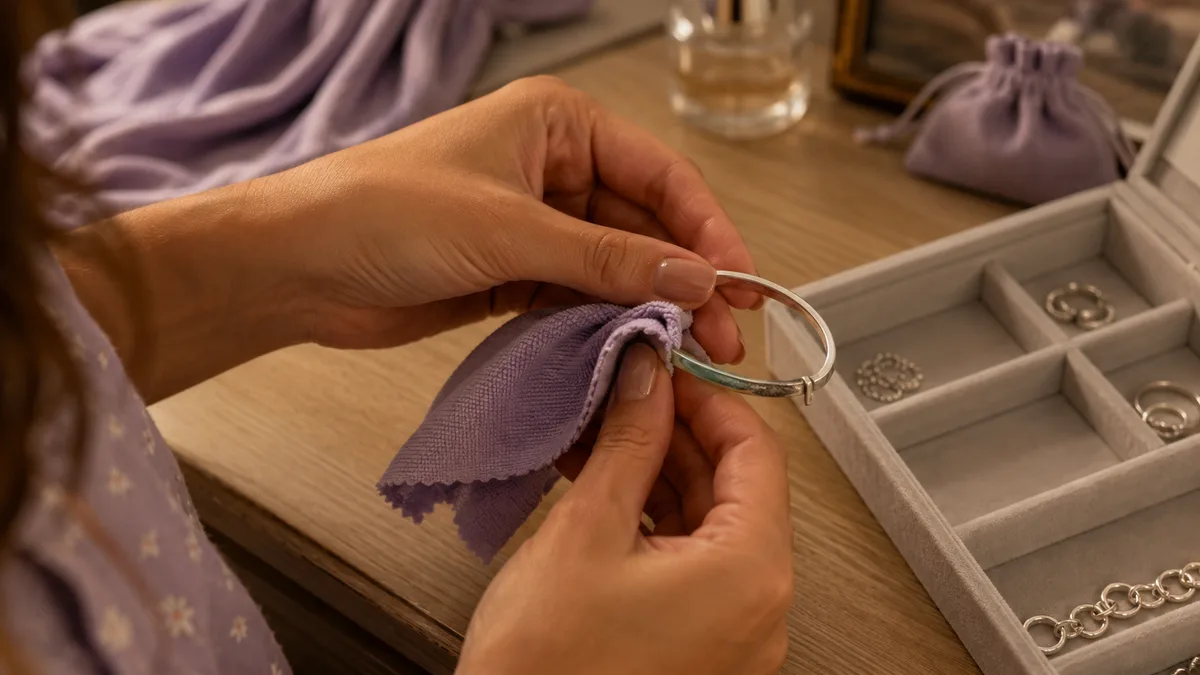
- Run a dry microfiber cloth over the whole piece;
- Pay attention to spots that touched perfume or sweaty skin;
- Dry it completely before storing, since water speeds up sulfidation;
- Store each piece in its individual pouch.
How to organize by type: necklaces, earrings, bracelets and rings
Organizing by type solves two problems at once: it keeps pieces from scratching each other and makes the collection visible for everyday use. A piece stored mixed in with others is a piece that disappears from your routine.
That one minute every morning spent untangling a necklace before giving up and wearing another one? For a client in Vila Mariana with ten years of 925 silver pieces, that was the scene every single morning.
Dozens of pieces in a wooden box on the nightstand. Necklaces tangled with bracelets, earrings without a match at the bottom, rings rolling loose. Three necklaces had broken from being yanked out of a knot. She had bought an organizer twice, but placed the pieces mixed together inside the compartments. Within a week it looked the same as before.
We separated everything by type first: necklaces apart from bracelets, earrings grouped in pairs, rings in their own section. The longer necklaces got a wall stand outside the box. Earrings went into an acrylic organizer with compartments by pair. Thin bracelets went into a velvet roll.
The following week she wore jewelry four days in a row, pieces that had been sitting in that box for two years. She also stopped buying "new" earrings, because the old ones finally showed up again.
The takeaway: an organizer only works once the pieces arrive already sorted by type. Putting everything together in nicer compartments is just a pricier version of the same old box.
What works for organizing silver
- Modular acrylic organizer: you see everything without opening anything, it is easy to clean, and it reconfigures as the collection grows;
- Wall-mounted necklace stand: hung necklaces do not tangle and stay visible in the closet;
- Velvet roll for bracelets: keeps the shape and protects thin pieces from friction;
- Labeled pouches for keepsake pieces: jewelry you rarely wear stays outside the main jewelry box, in a labeled pouch.
What does not work
- Decorative boxes with tiny lids: too little space, hard to keep separated;
- Too many necklaces on the same hook: they tangle the moment you take one out;
- Storing everything together "temporarily": temporary becomes permanent.
Family silverware and valuable pieces: high-standard conservation
A 120-piece flatware set, hollowware inherited across three generations, candelabras that come out of the cabinet once a year. This kind of silverware has conservation needs completely different from everyday jewelry. The most common mistake is treating the two the same way.
Everyday jewelry silver is almost always 925 sterling silver (92.5% pure silver). Inherited family silverware is often coin silver (800 to 900 parts per thousand) or imported sterling silver, with much greater weight, thickness and value. Some pieces carry hallmarks and punches from 19th-century European houses, which puts them in a different category: not just silverware, but family heritage with collector value.
Specific materials for valuable silverware
Ordinary flannel is not enough for long-term storage. For family silverware, the professional standard starts with silver cloth: flannel impregnated with silver particles that absorb sulfur compounds before they reach the piece. Every utensil, tray or decorative piece should be wrapped individually in this material before going into any drawer or case.
- Silver cloth (anti-tarnish flannel): available in rolls, cut to the right size for each piece. Replace it when it shows widespread tarnishing, a sign that its absorption capacity is spent;
- Anti-tarnish strips (tarnish strips / Intercept): placed inside cases and drawers, they create an active chemical barrier that neutralizes sulfur compounds in the air around the piece. Especially useful in closed cabinets with little air circulation;
- Acid-free, sulfur-free paper: for wrapping large pieces between layers of silver cloth in transport boxes or long-term storage;
- White cotton gloves: required for handling polished pieces. The natural acidity of skin leaves fingerprint marks that attack the finish and are visible on highly polished silver.
What speeds up tarnishing in family silverware (and almost no one knows)
Rubber, wool and untreated felt slowly release sulfur compounds. Storing a silver flatware set inside a drawer lined with regular felt, or resting on rubber, accelerates tarnishing from the inside out. Dedicated flatware cases use treated flannel or anti-tarnish velvet for exactly this reason.
The same goes for the surrounding environment: latex-based wall paint, some wallpapers and even certain types of wood (oak in particular) release acids and sulfur that reach silver stored nearby. Valuable silverware in homes with a lot of natural wood needs extra isolation.
Silver flatware: organizing by type and rotating use
A complete silver flatware set has between 60 and 180 pieces, depending on the service. Stored with no organization, it is common for dessert knives and forks to be forgotten at the bottom of a drawer for years while the larger pieces stay in circulation. The result: the bottom pieces show up for any occasion with deep stains that require heavy polishing.
- Dedicated case by type: knives, large forks, salad forks, soup spoons, teaspoons, dessert spoons, serving spoons, ladle. Each category in its own compartment, never mixed;
- Use rotation: in homes where the full set is not used often, rotating which pieces go to the table each time (not always the same ones) ensures the whole collection gets attention and air regularly;
- Original case or equivalent: a case lined with anti-tarnish velvet is the best long-term environment for flatware. If the original case is gone, there are replacement cases made specifically for this purpose;
- Temperature and humidity: flatware stored in a pantry cabinet or dining room in homes with central air conditioning fares better than in a climate-uncontrolled storage room.
Hollowware, trays and serving pieces
Candelabras, tureens, serving trays and samovars are pieces that literally disappear: wrapped up after the last party and stored with no label, they end up in drawers or cabinets no one opens anymore. When they resurface, the tarnishing represents months or years built up.
The correct protocol for large pieces: wrap each one individually in silver cloth, with no contact between pieces, in an environment with relative humidity below 50% whenever possible. Pieces with gilded parts (vermeil), colored enamel or set stones need extra care: never apply an abrasive or alkaline paste to those areas, since gold plating and enamel are removed easily. Polishing on those pieces should be limited to soft silver cloth on the pure silver sections, avoiding the special finish.
Inventory and insurance for inherited silverware
Before any organization of valuable silverware, there is a step almost no one takes but everyone should: the photo inventory. For each piece, record a photo under good light, a description of the type (utensil, tray, candelabra), any visible hallmark or punch, estimated weight and known provenance. This inventory serves two purposes.
The first is practical: in a two-story home with four adult children, the inventory is what prevents arguments about what exists and where it is. The second is financial: most homeowner insurance policies cover jewelry and valuables up to a standard limit, which can be insufficient for a complete coin silver flatware set or hollowware of European provenance. An independent appraisal by a jeweler or a silverware specialist determines the correct replacement value for a rider on the policy.
Family silverware integrated into the dining room: organization that preserves the heritage and makes everyday hosting easier.
See gourmet kitchen organization →Inherited family silverware carries more than weight in grams. Carrying 80 years of history in 120 utensils also means carrying the responsibility of not letting what survived generations fall apart.
A client in Higienópolis inherited her grandmother's complete flatware set: 120 pieces in English sterling silver, with a Birmingham Assay Office hallmark from the early 20th century. The set had sat stored for 15 years in her grandmother's apartment, inside an old leather suitcase, wrapped in an ordinary kitchen towel. When it was taken out for the estate inventory, nearly the entire set showed heavy tarnishing: some utensils had stains that had gone deeper than the surface layer.
She felt lost. She knew the pieces had value, but did not know whether they had been ruined for good. Her doubt was: throwing it away was not an option, but polishing everything herself seemed impossible. The set sat untouched for another six months while she decided what to do.
The organization work started with the inventory: we photographed each piece against a neutral background, noted the hallmark on every utensil, the estimated weight per lot and the condition. The inventory revealed that 108 of the 120 pieces had only surface tarnishing, fully recoverable. Twelve pieces with deeper stains were sent to a specialized silversmith for professional cleaning.
After cleaning, the complete set was organized into a replacement case lined with anti-tarnish velvet, with dividers by utensil type. Anti-tarnish strips were placed inside the case. The photo inventory served as the basis for a specific rider on the client's homeowner insurance.
Six months after the organization, the pieces still showed no sign of new tarnishing. She used the complete flatware set for the first time at the family's Christmas dinner: 18 people at the table, eating with her great-grandmother's utensils.
The takeaway: inherited silverware in apparently poor condition is almost always recoverable. The inventory comes before any decision about discarding or restoring.
Not all family silverware is stored out of sight. Sometimes it sits on the living room sideboard, on display, and that is exactly what is destroying the finish.
A client in Jardins had a complete set of 19th-century Portuguese coin silver hollowware: trays, a sauce boat, tureens and a samovar that were centerpieces of the dining room decor. The pieces stayed on display on a solid wood sideboard, with no wrapping, part of the room's permanent decor. Beautiful at first glance, but the sideboard was made of oak, and the wood releases tannic acid that, in prolonged contact with silver, forms stains that are hard to remove. The room also had its windows open in the afternoons.
The stains on the trays and at the base of the samovar looked different from ordinary sulfidation tarnish: more yellowish, at points of direct contact with the wood. She had polished them three times in two years and the problem kept coming back in the same spot.
The fix was not to remove the pieces from the room: they were part of the space's identity and she did not want that. We replaced the direct contact with the wood using silver cloth bases cut to fit under each piece. The windows started being closed during the hours of heaviest outdoor air circulation. The pieces that faced the window, the most affected ones, were repositioned. For the samovar, which had not moved in years, we introduced a quarterly review with silver cloth and a discreet anti-tarnish strip on the inner base.
Eight months later, the yellowish stains had not returned. The trays showed normal light tarnishing, manageable with silver cloth during the quarterly reviews.
The takeaway: silverware displayed as decor needs protection at the point of contact, not only when stored. The surface a piece rests on matters as much as the cabinet where it sleeps.
See also: how to organize a complete closet in São PauloMaintenance: when to clean and when silver needs extra attention
With correct storage, heavy cleaning becomes rare. The post-use wipe and the humidity sachet handle most of the conservation work. But when tarnishing does happen, two home approaches work before reaching for any specific product.
Light cleaning (recent tarnishing)
A polishing cloth made for silver or a microfiber cloth, with a gentle circular motion. For pieces with texture or detail, a soft toothbrush with a baking soda and water paste: apply for 1 to 2 minutes, rinse with warm water, dry completely. According to Dali Joias' guide, this technique removes the surface sulfide layer without harming the metal.
When a piece needs professional attention
Pieces with stones, colored enamel, rhodium plating or a matte finish need different care. Abrasive paste can scratch the finish or strip the plating. In those cases, use a soft polishing cloth with no product, and if the tarnishing persists, take it to a jeweler for professional cleaning. 925 silver with deep stains that will not come out with home cleaning also needs a specialist's assessment.
- Jewelry stored outside the bathroom, in a dry place
- Each piece in an individual pouch (velvet, organza or ziplock)
- Silica sachet or chalk inside the jewelry box
- Necklaces kept separate from bracelets and earrings, organized by type
- Microfiber cloth available for post-use cleaning
- Perfume applied first, with a 5-minute wait before putting on jewelry
- Review every 3 months: preventive polishing for pieces starting to tarnish
- Family silverware: silver cloth per piece, anti-tarnish case, cotton gloves
- Photo inventory of valuable silverware for insurance purposes
Well-stored silver does not need weekly attention. It needs a system that works without relying on daily discipline: the right place, the right wrapping, a sachet you swap every three months. Frequent heavy cleaning is a sign that storage needs reviewing, not that silver is hard to maintain.
Frequently asked questions about storing silver jewelry
How do I store silver jewelry so it does not tarnish?
Store each piece in an individual velvet pouch or a ziplock bag with the air pressed out, in a dry place, never in the bathroom, with a silica gel sachet or a piece of white chalk inside the jewelry box. In São Paulo, where average humidity stays above 70%, this care matters even more. Before storing, wipe the piece with a dry cloth to remove sweat and perfume residue, which speed up tarnishing.
Why does my silver tarnish so fast?
Silver tarnishes through sulfidation: the metal reacts with sulfur compounds present in the air, on the skin and in products like perfume, deodorant and makeup. Humidity, sweat, pool chlorine and seawater speed up this process. Storing silver in the bathroom, where shower steam touches the pieces several times a day, is one of the most common mistakes and the one that accelerates tarnishing the most.
Does white chalk work to preserve silver?
Yes. A piece of ordinary white school chalk inside the jewelry box absorbs moisture from the air, creating a drier micro-environment that delays sulfidation for weeks or months. Hagerty, an international reference in metal conservation, recommends chalk as a low-cost solution for home use. Replace it every 2 to 3 months or whenever it feels damp. A silica gel sachet works the same way, with greater absorption capacity.
How do I clean tarnished silver at home?
For light tarnishing, polishing with a microfiber cloth solves it. For heavier stains, make a paste with baking soda and water, apply it with a soft toothbrush, leave it on for 2 minutes and rinse with warm water. Dry completely before storing. For pieces with stones, enamel or rhodium plating, use only a soft polishing cloth with no product, since abrasive paste can damage the finish.
How do I preserve inherited family silverware?
Inherited family silverware, such as hollowware, flatware and serving pieces, needs different care than everyday jewelry. Each piece should be wrapped separately in silver cloth (flannel impregnated with anti-tarnish agents) or sulfur-free acid-free paper. Store it in cases lined with treated flannel, in an environment with controlled humidity, away from rubber, wool or untreated felt, since those materials release sulfur and speed up tarnishing. Use cotton gloves to handle polished pieces: the natural acidity of skin leaves visible marks on the metal. Create a photo inventory with a description of each piece for insurance purposes.
How do I store silver flatware and hollowware?
Silver flatware should be stored in a dedicated case with dividers by utensil type: knives, forks, spoons and teaspoons kept separate. The case lined with anti-tarnish flannel isolates each utensil from the air and prevents friction between pieces. Large hollowware and serving trays should be wrapped individually in silver cloth before going into any box or cabinet. Pieces used rarely benefit from anti-tarnish strips placed inside the case. Rotating use helps: pieces that sit completely still tend to tarnish in less visible spots.
Do I need insurance for inherited silverware?
For collections with significant value, yes. Most homeowner insurance policies cover jewelry and valuables up to a standard limit that can be insufficient for hollowware, complete flatware sets and collector pieces. An independent appraisal by a jeweler or a silverware specialist determines the replacement value and provides the basis for a specific rider on the policy. The photo inventory with a description of each piece (hallmark, weight, provenance, condition) is the document that supports any claim.

About the author
Silvana Santanna →Personal Organizer in São Paulo, specialized in residential move organization and functional organizing projects for homes, closets, kitchens, trousseaux and home offices. Creator of the Casa Pronta™ Method, with more than 100 projects completed across São Paulo and the greater metro area.

Ready to have your home organized
without lifting a finger?
Project assessment visit.