Organization and Productivity: What Science Says
What studies from Princeton, UCLA and Psychological Science show about organization, focus, productivity and the quality of your decisions.
Neste guia você verá:
You sit down to work with a clear list in your head, but within minutes you are already fiddling with something else, not quite sure how you got there. It is rarely just about you. Science has been showing that your surroundings compete for your attention constantly, and that organizing the space where you work changes how much you can genuinely get done.
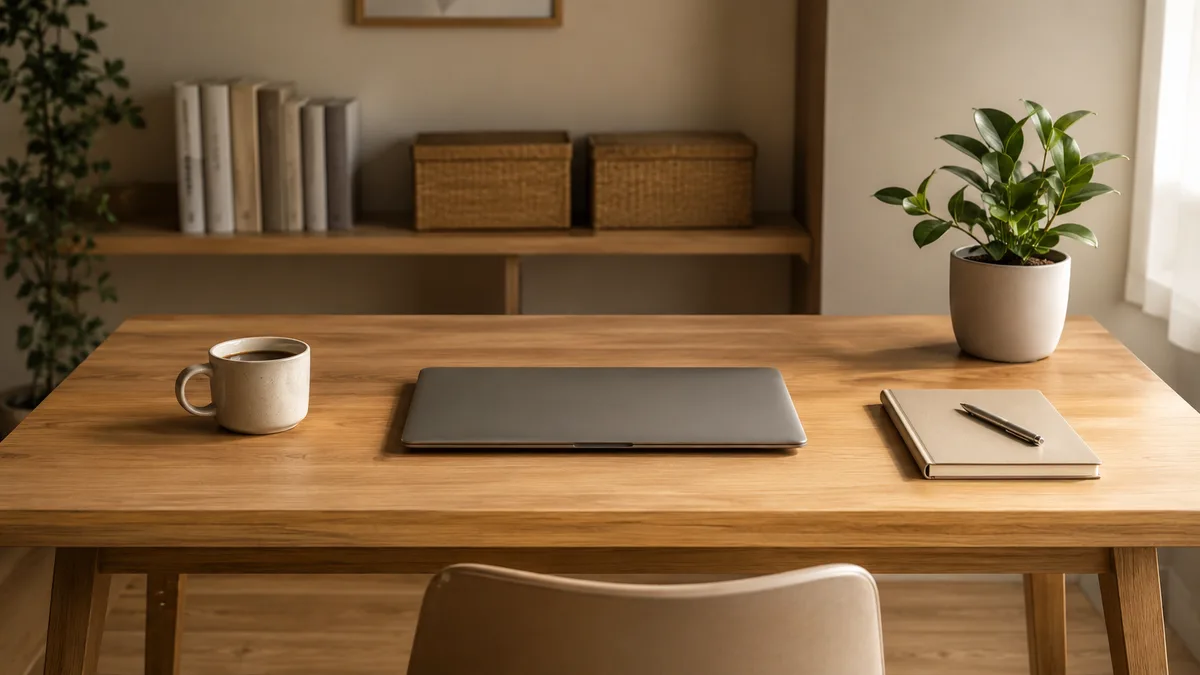
Does an organized environment boost productivity?
The evidence points to yes. Attention neuroscience research done at Princeton University shows that multiple objects in your visual field compete for the same brain resources. The more disorganized stimuli around you, the more energy your brain spends filtering out what does not matter, leaving less to sustain focus on the task you actually need to finish.
The study by Stephanie McMains and Sabine Kastner, available on PubMed, describes this competition in concrete terms: there is a pull toward what you want to see and a pull from the objects competing for your attention. On a cluttered desk, that pull happens constantly, even when you do not notice it. Organizing your work surface is not a nicety. It is reducing the number of things fighting for your head while you try to produce.
A client swore she had lost her focus. She had lost her desk.
In Vila Madalena, I worked with a freelance designer juggling three clients at once from her own apartment. Her desk had turned into a map of chaos: printed material from all three projects mixed together, two notebooks, sticky-note reminders, cables, and mugs she kept forgetting to carry to the sink. She told me she would start on one job, catch sight of a paper from another client, and within seconds find herself on the wrong task. We created a simple rule of one active zone at a time: only the material for the day's project stays visible, everything else goes into labeled vertical folders, out of her field of view. It was not magic, and she resisted at first, worried she would lose track of things. The following week she messaged me saying she had closed out an entire deliverable without getting up once. Her concentration was never the problem. It was the volume of work from her other two clients competing on the same desk.
Why does clutter feel tiring before you start?
Because a disorganized environment demands a background effort that begins before the first task. A UCLA study of dual-income couples linked describing your own home as cluttered and unfinished to a cortisol pattern associated with stress. Anyone working surrounded by disorder arrives at the main task with part of their mental energy already spent before they even begin.
Cortisol is the stress hormone, and the key point in the study by Saxbe and Repetti, published in Personality and Social Psychology Bulletin and indexed on PubMed, is that the effect showed up even after controlling for other factors. The space itself functioned as its own trigger. For anyone working from home, this is direct: every morning that starts with deciding where to sit, hunting for the charger and stepping around a pile of laundry next to the laptop eats into productivity that has not even arrived yet.
She thought it was a lack of discipline. It was a desk shared with the dishes.
In Santana, I worked with an analyst who works from home and shared her kitchen table between her laptop and the rest of domestic life. Every morning she pushed the previous night's dishes to one corner, opened her computer in whatever space was left, and started her day already in a small act of damage control. She told me she thought she was lazy, that she could not get going before ten in the morning. We set up a fixed workstation, even a small one, on a console table that had been underused, with only the essentials within reach and no kitchen items nearby. Her home did not become perfect, and that was never the goal. But the start of her day stopped being a negotiation with clutter. She later told me she was back to being productive early, not because of newfound discipline, but because she stopped spending the first half hour clearing space to exist.
Working from home pays off more when your workspace has its own system, separate from the household routine.
See the service →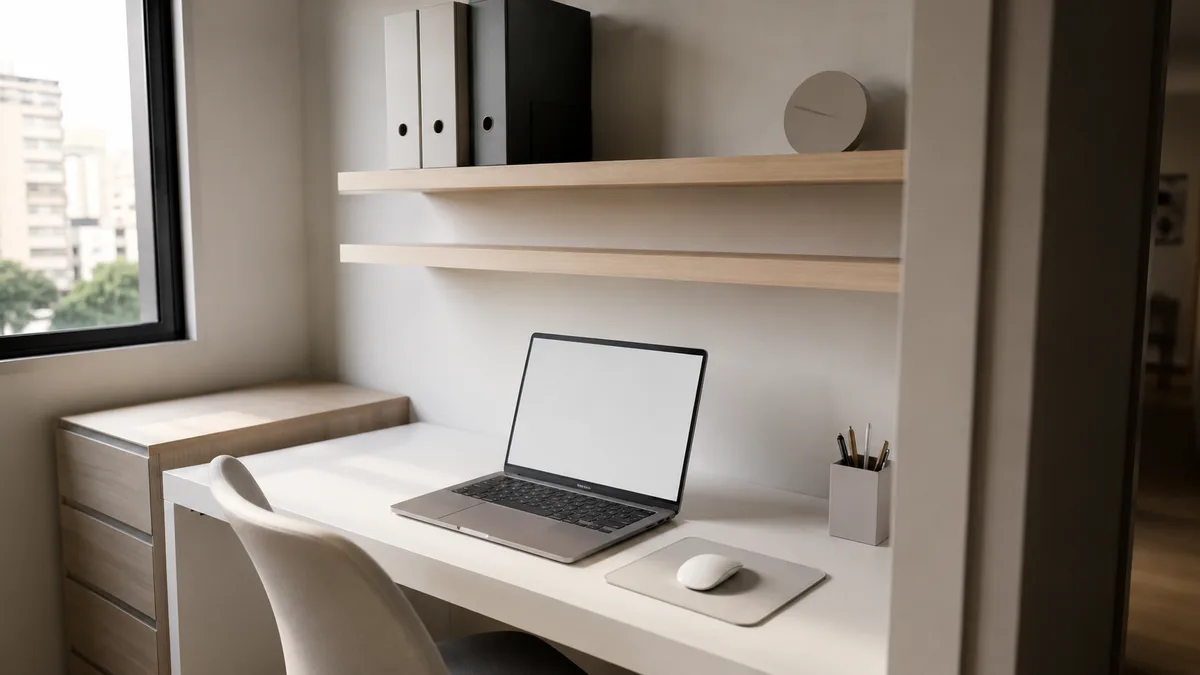
Does organization change decision quality?
It does, and this might be the least obvious finding. A study by Kathleen Vohs and colleagues, published in Psychological Science, compared the behavior of people in organized and messy rooms. Those in the orderly environment chose healthier snacks, donated more money and preferred conventional options. An orderly space seems to nudge people toward more sensible, disciplined choices.
The work by Vohs, Redden and Rahinel is indexed on PubMed and shows an effect that goes beyond getting more done: the environment influences the quality of the decisions you make inside it. In everyday life, this means an organized home and workspace help you eat better, spend more thoughtfully and stay on track with your plans, with less impulse. Productivity is also about deciding better what is worth doing, and the environment factors into that.
Does a messy desk help you create?
In part, and it is worth being honest about it. The same Vohs study found the other side of the coin: people in disordered rooms were more creative on a task that involved generating new ideas than those in organized rooms. Disorder seems to loosen the mind enough to break with convention. But that applies to the moment of creating, not to the entire routine.
The practical takeaway is to separate the phases. For execution, decisions and day-to-day operations, order pays off more, as the attention and behavior findings show. For the brainstorming phase, a bit of controlled clutter can actually help. Anyone who works in creative fields does not need to choose between the two. They need an organized workspace for most of the day and, if it applies, a specific zone reserved for the loose-idea phase, without letting that zone spill into the rest.
He said clutter was his creative process. She just wanted to sit down and work.
In an apartment in Vila Mariana, I worked with a couple who shared the same home office. He, an advertising creative, defended his desk covered in reference material as part of the creative process. She, who works in planning, spent time every single day clearing space just to open her laptop, and she was at her limit. The conflict was real, and both of them had a point. The solution was not to impose total order. We gave each of them a zone: his work surface organized for execution, plus a pinboard and a box just for loose material from the idea phase, which could stay as messy as he liked. He resisted, worried it would stifle his creativity. Weeks later he admitted separating the phases improved things for both of them, he created on the pinboard and executed at the clean desk. Not every friction in a home gets solved with organization, but this one, which came up daily, did.
What changes in real productivity
What changes is the invisible cost of your workday. Without the competition of a cluttered desk, without the effort of fixing up the space every morning, and with the phases of executing and creating kept separate, there is more attention left for what actually pays off. Science measures this in focus, cortisol and decision quality. You feel it as days when you got a lot done without quite knowing why.
It is worth holding on to the nuance, because that is what makes this honest. Organization is not a formula that multiplies output or promises endless focus. What it does is clear away the friction that eats energy before a task even begins, and reserve disorder for the one moment it actually helps, creating. If you work from home and constantly feel like you are running all day without finishing anything, your environment is probably charging you a price you had not noticed paying. Organizing your space will not fix everything, but it gives back the part of your day that was being spent on friction, and you feel that difference within the first week.
Project assessment
Want a workspace that pays off in your favor?
Tell me about your home office on WhatsApp: I will reply with a project assessment.
Request AssessmentFrequently asked questions about organization and productivity
Does an organized environment increase productivity?
The evidence points that way. Attention neuroscience research conducted at Princeton shows that multiple objects in your visual field compete for the same brain resources, so the more disorganized stimuli around you, the more energy your brain spends filtering out what does not matter. That constant filtering reduces your capacity to sustain focus on a task. An organized work environment lowers that competition and gives attention back to what you actually need to do, which translates into productivity throughout the day.
Why does clutter feel tiring before you even start working?
Because a disorganized environment demands a background effort that begins before the first task. A UCLA study of dual-income couples linked describing your own home as cluttered and unfinished to a cortisol pattern associated with stress. Cortisol is the stress hormone, and the finding shows that the space itself acts as a continuous trigger. Anyone working amid disorder spends energy deciding where to sit, hunting for materials and mentally clocking visible pending tasks, arriving at the main task with part of the mental load already spent.
Does an organized environment change the quality of your decisions?
Yes, according to a study published in Psychological Science. In experiments by Vohs, Redden and Rahinel, people in an organized room chose healthier snacks, donated more money and leaned toward conventional options, while people in a messy room took more risks. An orderly environment seems to nudge people toward more sensible, disciplined choices. Applied to work and home life, this suggests that organizing your space helps you not only get more done, but decide better throughout the day, with less impulse and less wear.
Does a messy desk help you be more creative?
In part. The same Vohs study in Psychological Science found that people in disordered environments were more creative on a task that involved generating new ideas than those in organized rooms. Disorder seems to favor breaking with convention. But that applies to the moment of creating, not to your entire routine. For tasks that require focus, execution and decisions, order pays off more. The practical balance is having an organized workspace and, if you create for a living, setting aside a specific zone for the loose-idea phase.

About the author
Silvana Santanna →Personal Organizer in São Paulo, specialized in residential move organization and functional organizing projects for homes, closets, kitchens, trousseaux and home offices. Creator of the Casa Pronta™ Method, with more than 100 projects completed across São Paulo and the greater metro area.
Ready to have your home organized
without lifting a finger?
Project assessment visit.